Vision Transformers (ViT)
Slice the image into patches, treat each patch as a word, and run a standard transformer on the sequence. No convolutions required.
Learning Objectives
- Implement patch embedding, learned positional embedding, class token, and transformer encoder blocks from scratch to build a minimal ViT
- Explain why ViT was thought to need massive pretraining data until DeiT and MAE proved otherwise
- Compare ViT, Swin, and ConvNeXt on their architectural priors (none, local window attention, conv backbone)
- Fine-tune a pretrained ViT on a small dataset using `timm` and the standard linear-probe / fine-tune recipe
The Problem
For a decade, convolution was computer vision. CNNs came with strong inductive biases built in, locality and translation equivariance, and nobody thought you could do without them. Then Dosovitskiy et al. (2020) showed that a plain transformer applied to flattened image patches, with no convolutional machinery at all, could match or beat the best CNNs at scale.
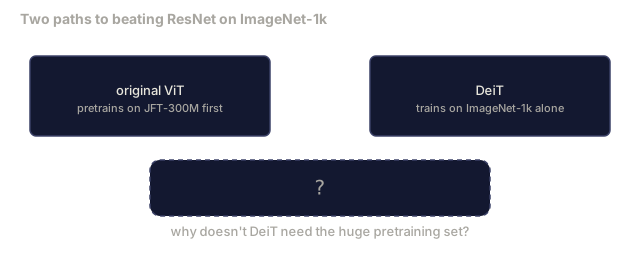
The catch was "at scale." ViT trained on ImageNet-1k alone lost to ResNet. Pretrain it on ImageNet-21k or JFT-300M first, then fine-tune on ImageNet-1k, and it won. The read at the time: transformers lack useful visual priors, but they can learn them given enough data. Subsequent work (DeiT, MAE, DINO) proved that wrong. With the right training recipe (strong augmentation, self-supervised pretraining, distillation), ViTs train fine on small data too.
By 2026, pure CNNs still hold the edge-device niche (ConvNeXt is the strongest), but transformers dominate everything else: segmentation (Mask2Former, SegFormer), detection (DETR, RT-DETR), multimodal (CLIP, SigLIP), video (VideoMAE, VJEPA). The ViT block structure — patch embed, class token, positional embedding, pre-LN transformer block — is the one worth knowing cold.

The Concept
The pipeline

Seven steps. Patches -> tokens -> attention -> classifier. Every variant (DeiT, Swin, ConvNeXt, MAE pretraining) changes one or two of the seven and leaves the rest alone.
Patch embedding
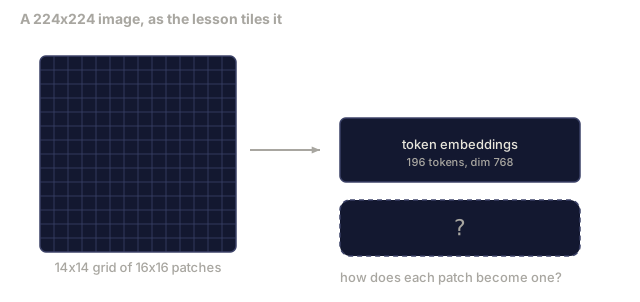
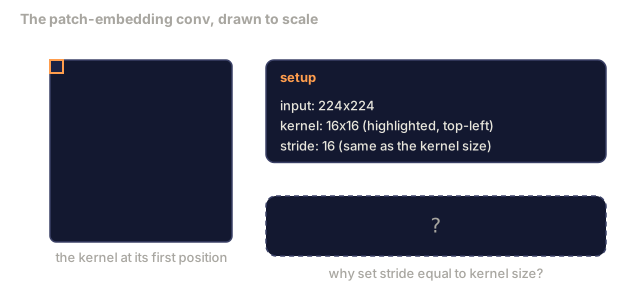
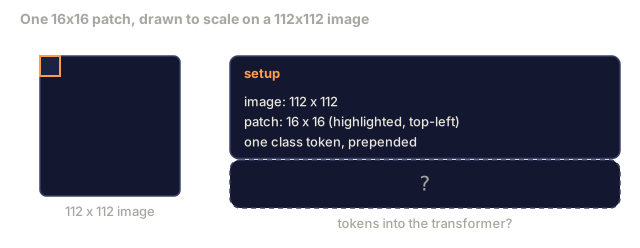
The first conv is the secret. Kernel size 16, stride 16, so a 224x224 image becomes a 14x14 grid of 16x16 patches, each projected to a 768-dim embedding. That single conv both patchifies and linearly projects.
Input:  (3, 224, 224)
Conv (3 -> 768, k=16, s=16, no padding):
Output: (768, 14, 14)
Flatten spatial: (196, 768)
196 patches = 196 tokens. Each token's feature dimension is 768 (ViT-B), 1024 (ViT-L), or 1280 (ViT-H).
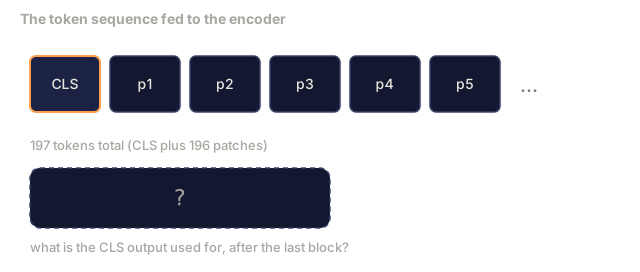
Class token
A single learned vector prepended to the sequence:
tokens = [CLS; patch_1; patch_2; ...; patch_196] shape (197, 768)
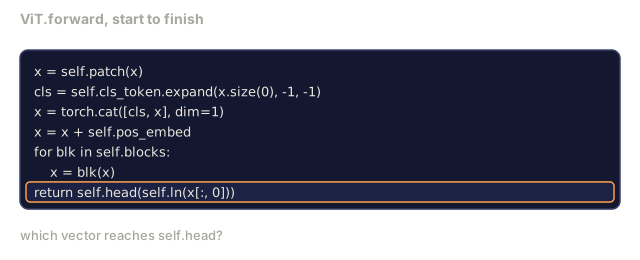
After N transformer blocks, the [CLS] output is the global image representation. Classification head reads only this one vector.
Positional embedding
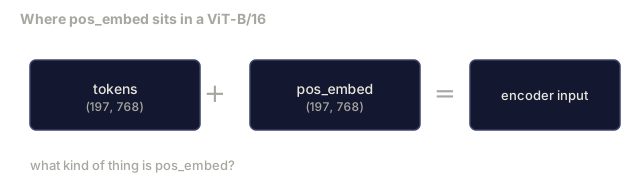
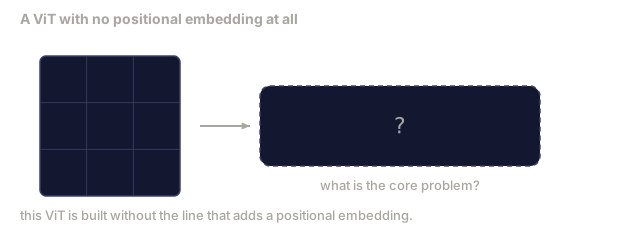
Transformers have no built-in notion of spatial position. Add a learned vector to every token:
tokens = tokens + learned_pos_embedding (also shape (197, 768))
The embedding is a parameter of the model; gradient-based training adapts it to 2D image structure. Sinusoidal 2D alternatives exist but are rarely used in practice.
Transformer encoder block
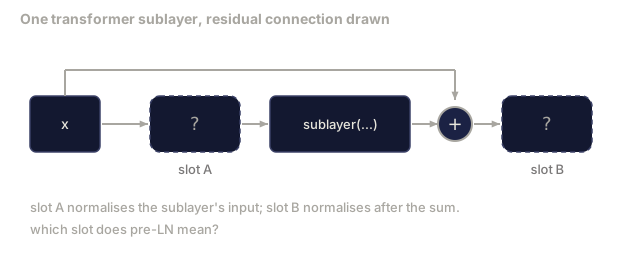
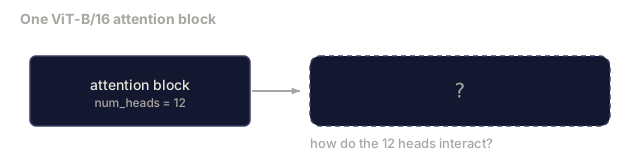
Standard. Multi-head self-attention, MLP, residual connections, pre-LayerNorm.
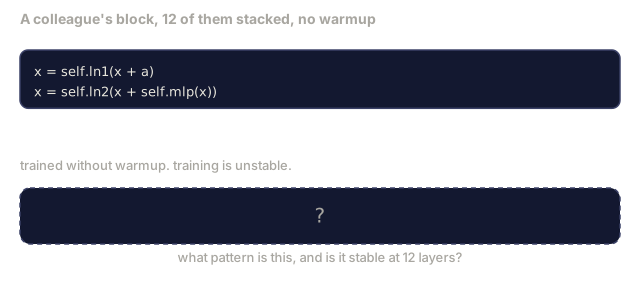
x = x + MSA(LN(x))
x = x + MLP(LN(x))

MLP is two-layer with GELU: Linear(d -> 4d) -> GELU -> Linear(4d -> d)
ViT-B/16 stacks 12 of these blocks, each with 12 attention heads, totalling 86M parameters.
Why pre-LN
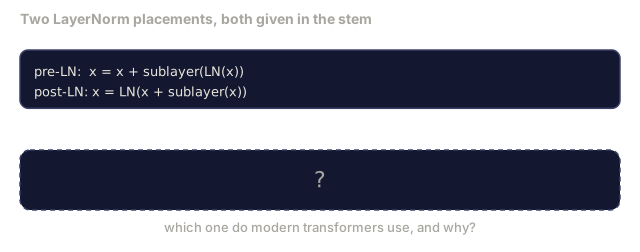
Early transformers used post-LN (x = LN(x + sublayer(x))) and struggled to train past 6-8 layers without warmup. Pre-LN (x = x + sublayer(LN(x))) trains deeper networks stably without warmup. Every ViT and every modern LLM uses pre-LN.
Patch size trade-off
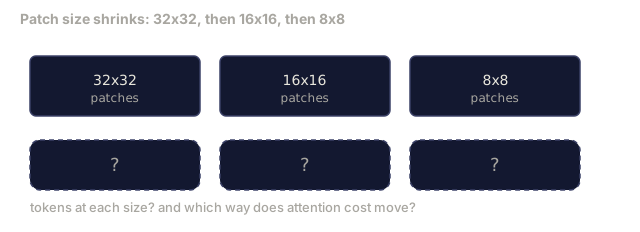
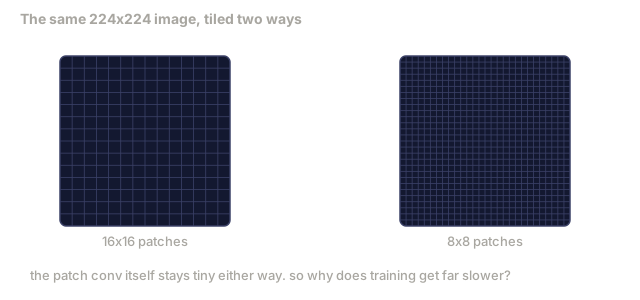
- 16x16 patches -> 196 tokens, standard.
- 32x32 patches -> 49 tokens, faster but lower resolution.
- 8x8 patches -> 784 tokens, finer but O(n^2) attention cost scales badly.
Bigger patches = fewer tokens = faster but less spatial detail. SwinV2 uses 4x4 patches in hierarchical windows.
DeiT's recipe for training ViT on ImageNet-1k
The original ViT needed JFT-300M to beat CNNs. DeiT (Touvron et al., 2020) trained ViT-B to 81.8% top-1 on ImageNet-1k alone with four changes:
- Heavy augmentation: RandAugment, Mixup, CutMix, Random Erasing.
- Stochastic depth (drop entire blocks at random during training).
- Repeated augmentation (same image sampled 3 times per batch).
- Distillation from a CNN teacher (optional, lifts accuracy further).
Every modern ViT training recipe descends from DeiT.
Swin vs ConvNeXt
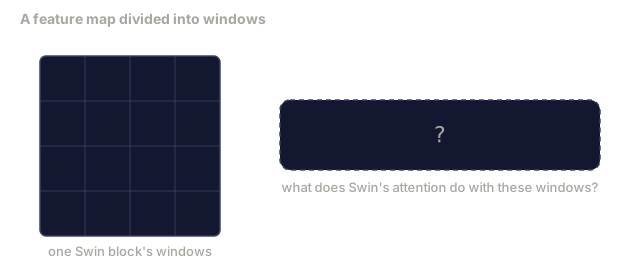
- Swin (Liu et al., 2021): window-based attention. Each block attends within a local window; alternating blocks shift the window to mix information across windows, bringing back a CNN-like locality prior without giving up the attention operator.
- ConvNeXt (Liu et al., 2022): a redesigned CNN matching Swin's architecture choices, borrowing depthwise convolutions and inverted bottlenecks from the MobileNet/EfficientNet lineage plus LayerNorm and GELU from transformers. It showed the gap was never "attention vs convolution": it was modern training recipe plus architecture.
In 2026, ConvNeXt-V2 and Swin-V2 are both production-grade; the right choice depends on your inference stack (ConvNeXt compiles better for edge) and pretraining corpus.
MAE pretraining
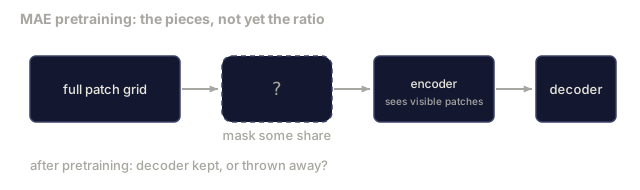
Masked Autoencoder (He et al., 2022): mask 75% of patches at random, train the encoder to process only the visible 25%, train a small decoder to reconstruct the masked patches from the encoder's output. After pretraining, discard the decoder and fine-tune the encoder.
MAE makes ViT trainable on ImageNet-1k alone, hits SOTA, and is the current default self-supervised recipe.






Build It
Step 1: Patch embedding
import torch
import torch.nn as nn

class PatchEmbedding(nn.Module):
    def __init__(self, in_channels=3, patch_size=16, dim=192, image_size=64):
        super().__init__()
        assert image_size % patch_size == 0
        self.proj = nn.Conv2d(in_channels, dim, kernel_size=patch_size, stride=patch_size)
        num_patches = (image_size // patch_size) ** 2
        self.num_patches = num_patches

    def forward(self, x):
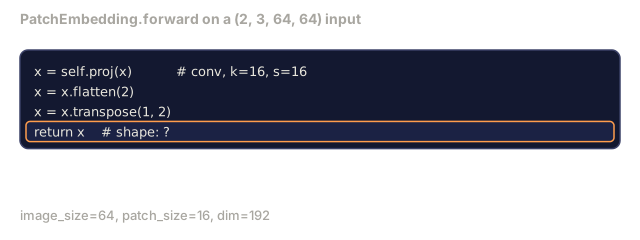
        x = self.proj(x)
        return x.flatten(2).transpose(1, 2)
One conv, one flatten, one transpose. That is the entire image-to-tokens step.
Step 2: Transformer block
Pre-LN, multi-head self-attention, MLP with GELU, residual connections.
class Block(nn.Module):
    def __init__(self, dim, num_heads, mlp_ratio=4, dropout=0.0):
        super().__init__()
        self.ln1 = nn.LayerNorm(dim)
        self.attn = nn.MultiheadAttention(dim, num_heads, dropout=dropout, batch_first=True)
        self.ln2 = nn.LayerNorm(dim)
        self.mlp = nn.Sequential(
            nn.Linear(dim, dim * mlp_ratio),
            nn.GELU(),
            nn.Dropout(dropout),
            nn.Linear(dim * mlp_ratio, dim),
            nn.Dropout(dropout),
        )

    def forward(self, x):
        a, _ = self.attn(self.ln1(x), self.ln1(x), self.ln1(x), need_weights=False)
        x = x + a
        x = x + self.mlp(self.ln2(x))
        return x
nn.MultiheadAttention handles the splitting into heads, the scaled dot-product, and the output projection. batch_first=True so shapes are (N, seq, dim).
Step 3: The ViT
class ViT(nn.Module):
    def __init__(self, image_size=64, patch_size=16, in_channels=3,
                 num_classes=10, dim=192, depth=6, num_heads=3, mlp_ratio=4):
        super().__init__()
        self.patch = PatchEmbedding(in_channels, patch_size, dim, image_size)
        num_patches = self.patch.num_patches
        self.cls_token = nn.Parameter(torch.zeros(1, 1, dim))
        self.pos_embed = nn.Parameter(torch.zeros(1, num_patches + 1, dim))
        self.blocks = nn.ModuleList([
            Block(dim, num_heads, mlp_ratio) for _ in range(depth)
        ])
        self.ln = nn.LayerNorm(dim)
        self.head = nn.Linear(dim, num_classes)
        nn.init.trunc_normal_(self.pos_embed, std=0.02)
        nn.init.trunc_normal_(self.cls_token, std=0.02)

    def forward(self, x):
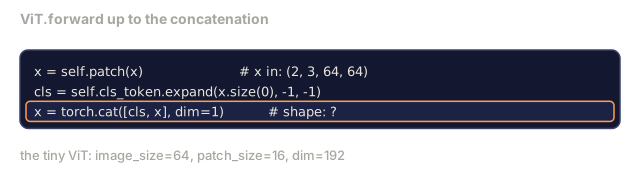
        x = self.patch(x)
        cls = self.cls_token.expand(x.size(0), -1, -1)
        x = torch.cat([cls, x], dim=1)
        x = x + self.pos_embed
        for blk in self.blocks:
            x = blk(x)
        x = self.ln(x[:, 0])
        return self.head(x)

vit = ViT(image_size=64, patch_size=16, num_classes=10, dim=192, depth=6, num_heads=3)
x = torch.randn(2, 3, 64, 64)
print(f"output: {vit(x).shape}")
print(f"params: {sum(p.numel() for p in vit.parameters()):,}")
About 2.8M parameters: a tiny ViT, tractable on CPU. Real ViT-B is 86M, same class definition, just dim=768, depth=12, num_heads=12.
Step 4: Sanity check on a single image
logits = vit(torch.randn(1, 3, 64, 64))
print(f"logits: {logits}")
print(f"probs:  {logits.softmax(-1)}")
Should run without error. Probabilities sum to 1.
Use It
timm ships every ViT variant with pretrained ImageNet weights, one line:
import timm

model = timm.create_model("vit_base_patch16_224", pretrained=True, num_classes=10)
timm is the production default for vision transformers in 2026: ViT, DeiT, Swin, Swin-V2, ConvNeXt, ConvNeXt-V2, MaxViT, MViT, EfficientFormer, and dozens more, all under the same API.
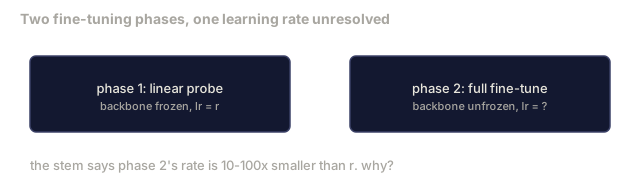
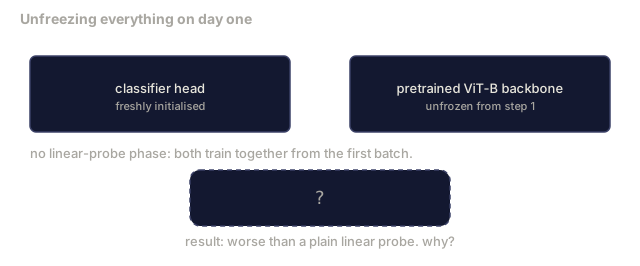
The standard recipe for a small dataset is two phases, in order. First, freeze the pretrained backbone and train only the new head (a linear probe) for a few epochs, so the classifier calibrates to your classes without disturbing the pretrained features. Second, unfreeze the whole network and fine-tune end to end at a learning rate 10-100x smaller than the probe phase used, letting the backbone adjust slightly to your data. Skip straight to full fine-tuning with a freshly initialized head, and the large, random early gradients from that head flow back through the whole network and degrade the pretrained weights before it has calibrated.
For multimodal work (image plus text), transformers ships CLIP, SigLIP, BLIP-2, LLaVA, and the image encoder in every one of them is a ViT variant.
Ship It
This lesson produces:
outputs/prompt-vit-vs-cnn-picker.md- a prompt that picks between a ViT, a ConvNeXt, or a Swin based on dataset size, compute, and inference stack.outputs/skill-vit-patch-and-pos-embed-inspector.md- a skill that verifies a ViT's patch embedding and positional embedding shapes match the model's expected sequence length, catching the most common porting bugs.
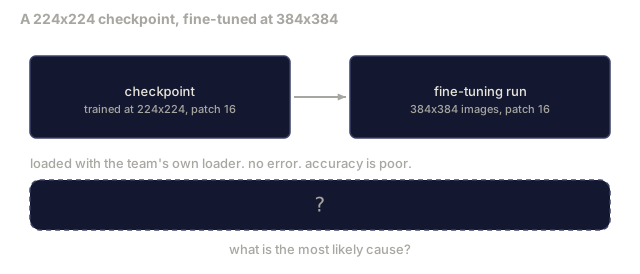
The bug I've hit more than any other with ViTs is a shape mismatch on the positional embedding. Pretrained weights are usually trained at 224x224 with a 16x16 patch, which locks in 196 patch tokens plus the class token, 197 total. Fine-tune at a different resolution and that count changes, but the checkpoint's positional embedding tensor doesn't know that. It still ships shaped for the original grid.
Load it naively and you get one of two outcomes: a shape error that at least fails loudly, or worse, a model that loads fine and just quietly underperforms because half its position information is garbage. The standard fix is to bicubically interpolate the positional embedding grid to the new patch count before loading the rest of the checkpoint. timm does this for you automatically. Roll your own loader, or port weights between frameworks by hand, and this is exactly where it bites. Check the shape first.
Exercises
- (Easy) Print the shapes of every intermediate tensor for a forward pass through the tiny ViT above. Confirm: input
(N, 3, 64, 64)-> patches(N, 16, 192)-> with CLS(N, 17, 192)-> classifier input(N, 192)-> output(N, num_classes). - (Medium) Fine-tune a pretrained
timmViT-S/16 on the synthetic-CIFAR dataset from Lesson 4. Compare against ResNet-18 fine-tuning on the same data. Report training time and final accuracy. - (Hard) Implement MAE pretraining for the tiny ViT: mask 75% of patches, train the encoder + a small decoder to reconstruct the masked patches. Evaluate linear-probe accuracy on the synthetic data before and after pretraining.
Key Terms
| Term | What people say | What it actually means |
|---|---|---|
| Patch embedding | "The first conv" | A conv with kernel size = stride = patch size; turns the image into a grid of token embeddings |
| Class token | "[CLS]" | A learned vector prepended to the token sequence; its final output is the global image representation |
| Positional embedding | "Learned pos" | A learned vector added to every token so the transformer knows where each patch came from |
| Pre-LN | "LayerNorm before sublayer" | The stable transformer variant: x + sublayer(LN(x)) instead of LN(x + sublayer(x)) |
| Multi-head attention | "Parallel attention" | Standard transformer attention split into num_heads independent subspaces, concatenated afterwards |
| ViT-B/16 | "Base, patch 16" | The canonical size: dim=768, depth=12, heads=12, patch_size=16, image=224; ~86M params |
| DeiT | "Data-efficient ViT" | ViT trained on ImageNet-1k alone with strong augmentation; proved large pretraining datasets are not strictly required |
| MAE | "Masked autoencoder" | Self-supervised pretraining: mask 75% of patches, reconstruct; the dominant ViT pretraining recipe |
Further Reading
- An Image is Worth 16x16 Words (Dosovitskiy et al., 2020) - the ViT paper
- DeiT: Data-efficient Image Transformers (Touvron et al., 2020) - how to train ViT on ImageNet-1k alone
- Masked Autoencoders are Scalable Vision Learners (He et al., 2022) - MAE pretraining
- timm documentation - the reference for every vision transformer you will use in production
Code
- main.py (python, 86 lines)