Vision-Language Models — The ViT-MLP-LLM Pattern
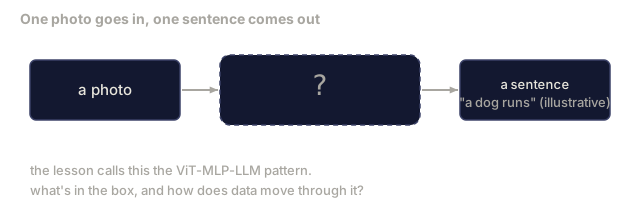
A vision encoder turns an image into tokens. A small MLP projector maps those tokens into the LLM's embedding space. The language model does the rest. ViT, MLP, LLM: that's the pattern behind every production VLM in 2026.
Learning Objectives
- State the ViT-MLP-LLM architecture and explain what each of the three components contributes
- Compare Qwen3-VL, InternVL3.5, LLaVA-Next, and GLM-4.6V on parameter count, context length, and benchmark performance
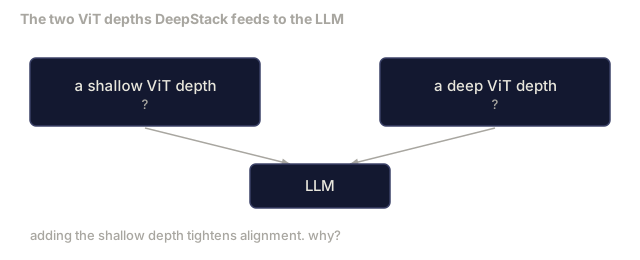
- Explain DeepStack: why multi-level ViT features tighten vision-language alignment better than a single last-layer feature
- Measure VLM hallucination in production with Cross-Modal Error Rate (CMER) and act on the signal
The Problem
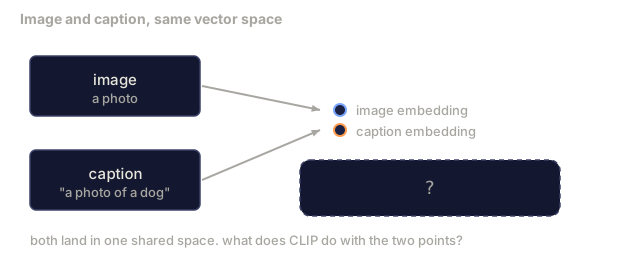
CLIP (Phase 4 Lesson 18) gives you a shared embedding space for images and text, which is enough for zero-shot classification and retrieval. It still can't answer "how many red cars are in this image?" — CLIP doesn't generate text, it only scores similarities.
A vision-language model (VLM) fixes that by bolting a CLIP-family image encoder onto a full language model. Qwen3-VL, InternVL3.5, LLaVA-Next, and GLM-4.6V all follow this pattern: the model sees an image plus a question and generates an answer. By 2026, open-source VLMs rival or beat GPT-5 and Gemini-2.5-Pro on multimodal benchmarks (MMMU, MMBench, DocVQA, ChartQA, MathVista, OSWorld).
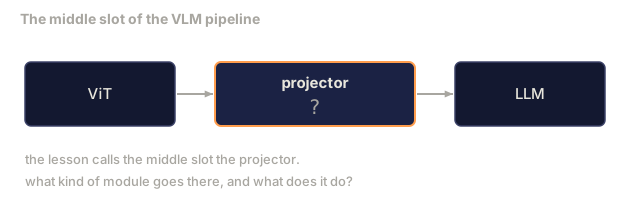
Every one of them is built from the same trio: ViT, projector, LLM. Models differ in which ViT, which projector, which LLM, what training data, and what alignment recipe they use. Learn the pattern once and swapping any component becomes mechanical.
The Concept
The ViT-MLP-LLM architecture

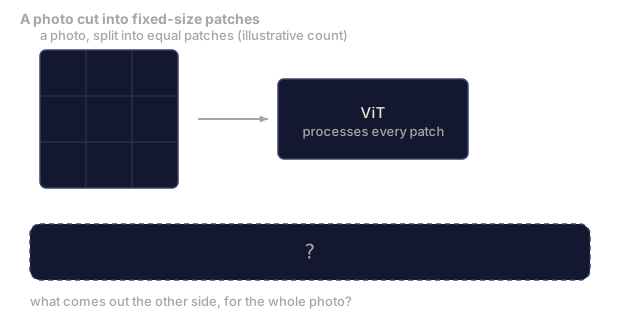
- Vision encoder: a pretrained ViT (CLIP-L/14, SigLIP, DINOv3, or a fine-tuned variant). Produces patch tokens.
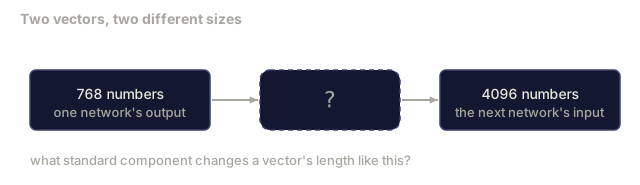
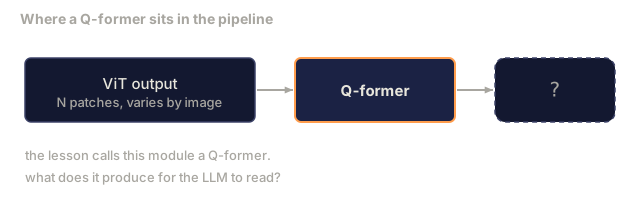
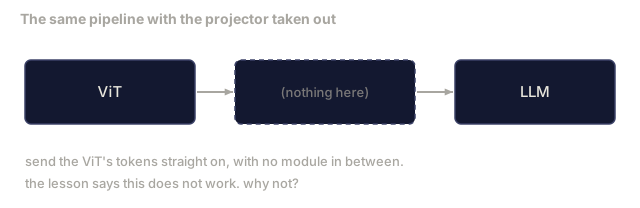
- Projector: a small module, usually a 2-4 layer MLP or a Q-former (a fixed-token-count alternative), that maps vision tokens into the LLM's embedding dimension. This is where most of the fine-tuning happens.
- LLM: a decoder-only language model (Qwen3, Llama, Mistral, GLM, InternLM). Reads the vision + text tokens in sequence, generates text.
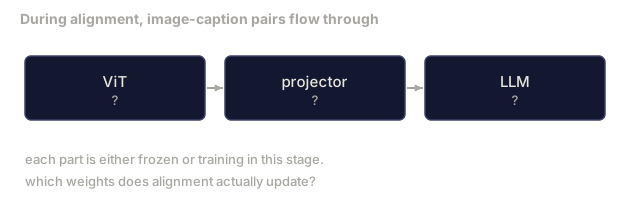
All three pieces are trainable in principle. In practice, the vision encoder and LLM stay mostly frozen while the projector trains. A few billion parameters end up carrying the whole cross-modal signal, which is cheap.
DeepStack
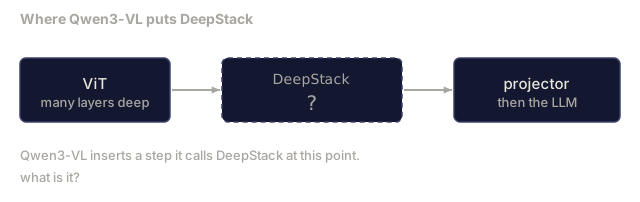
Vanilla projection keeps only the last ViT layer and throws the rest away. DeepStack (Qwen3-VL) doesn't: it samples features from multiple ViT depths and stacks them. Deeper layers carry high-level semantics; shallower layers carry fine-grained spatial and textural information. Feeding both into the LLM closes the gap between "what does the image contain" (semantics) and "where exactly" (spatial grounding).
Three training stages
Modern VLMs train in stages:
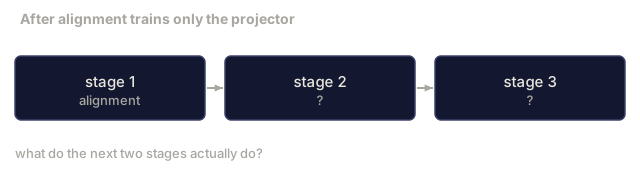
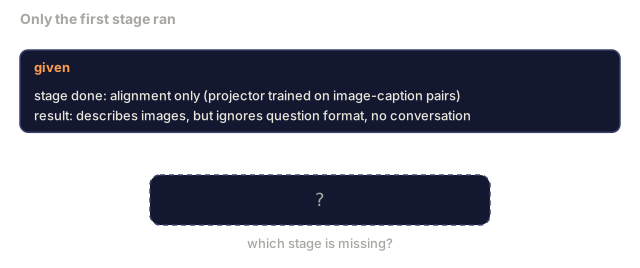
- Alignment: freeze ViT and LLM. Train only the projector on image-caption pairs. Teaches the projector to map vision space into language space.
- Pre-training: unfreeze everything. Train on large-scale interleaved image-text data (500M+ pairs). Builds the model's visual knowledge.
- Instruction tuning: fine-tune on curated (image, question, answer) triples. Teaches conversational behaviour and task formats. This is what turns a "vision-aware LM" into a usable assistant.
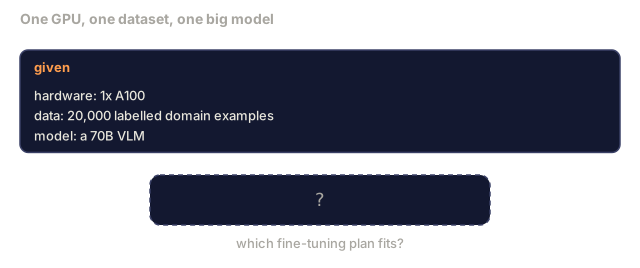
Most LoRA fine-tunes target stage 3 with a small labelled dataset.
Model family comparison (early 2026)
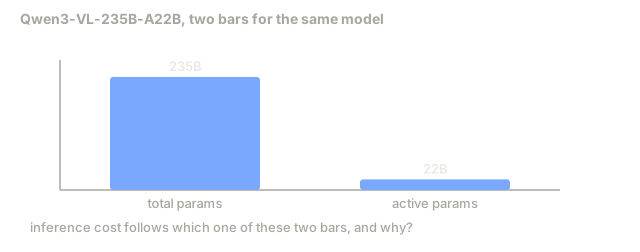
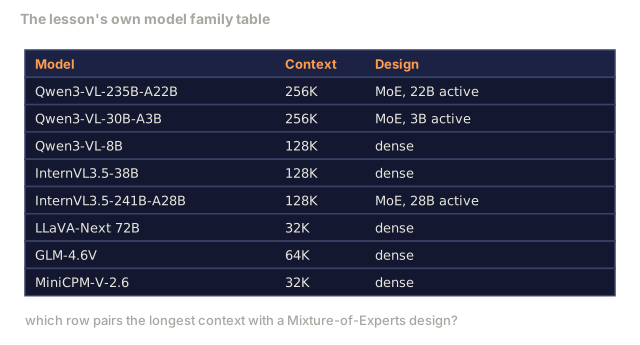
A few entries below are Mixture-of-Experts (MoE) models: only a fraction of their total parameters activate for any given token, so the "active" figure, not the total, is what actually drives inference cost.
| Model | Params | Vision encoder | LLM | Context | Strengths |
|---|---|---|---|---|---|
| Qwen3-VL-235B-A22B (MoE) | 235B (22B active) | custom ViT + DeepStack | Qwen3 | 256K | General SOTA, GUI agent |
| Qwen3-VL-30B-A3B (MoE) | 30B (3B active) | custom ViT + DeepStack | Qwen3 | 256K | Smaller MoE alternative |
| Qwen3-VL-8B (dense) | 8B | custom ViT | Qwen3 | 128K | Production dense default |
| InternVL3.5-38B | 38B | InternViT-6B | Qwen3 + GPT-OSS | 128K | Strong MMBench / MMVet |
| InternVL3.5-241B-A28B | 241B (28B active) | InternViT-6B | Qwen3 | 128K | Competitive with GPT-4o |
| LLaVA-Next 72B | 72B | SigLIP | Llama-3 | 32K | Open, easy to fine-tune |
| GLM-4.6V | ~70B | custom | GLM | 64K | Open-source, strong OCR |
| MiniCPM-V-2.6 | 8B | SigLIP | MiniCPM | 32K | Edge-friendly |
Visual agents
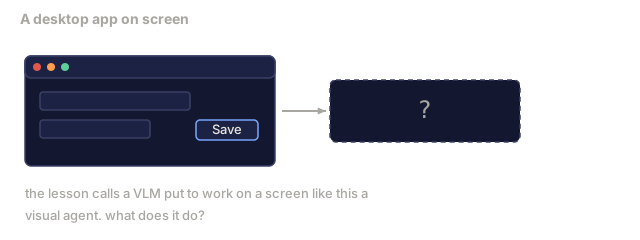
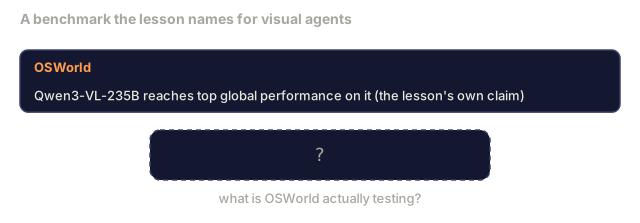
A visual agent is a VLM that operates GUIs directly: desktop, mobile, web. It reads a screenshot, understands the UI, and emits actions (click, type, scroll). Qwen3-VL-235B reaches top global performance on OSWorld, the benchmark built for exactly this. Combined with tools, it closes the loop on common desktop tasks, and it's what most 2026 "AI PC" demos run under the hood.
Agentic capabilities + RoPE variants
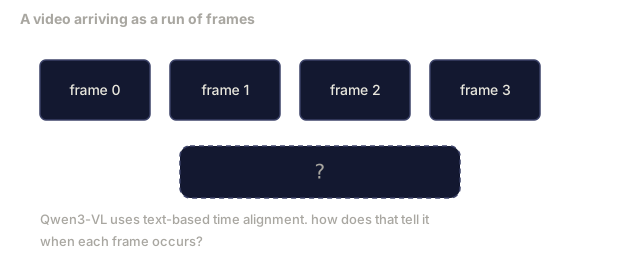
VLMs need to know when a frame is in a video. Qwen3-VL evolved from T-RoPE (temporal rotary position embeddings) to text-based time alignment: explicit timestamp text tokens interleaved with video frames. The model sees "<timestamp 00:32> frame, prompt" and can reason about temporal relationships.
The alignment problem
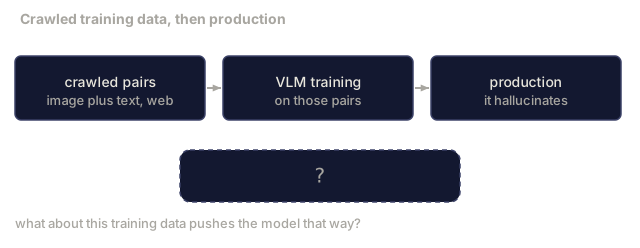
12% of image-text pairs in a crawled dataset contain descriptions not fully grounded in the image. A VLM trained on this silently learns to hallucinate: it fabricates objects, misreads numbers, and invents relationships. In production, this is the dominant failure mode.
Skywork.ai introduced the Cross-Modal Error Rate (CMER) to track it:
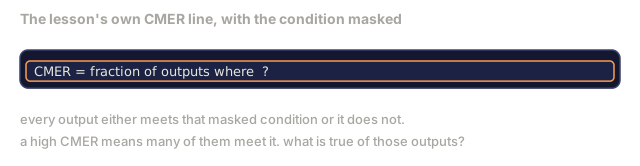
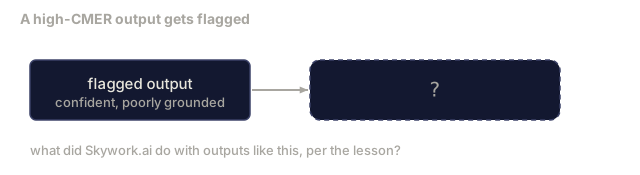
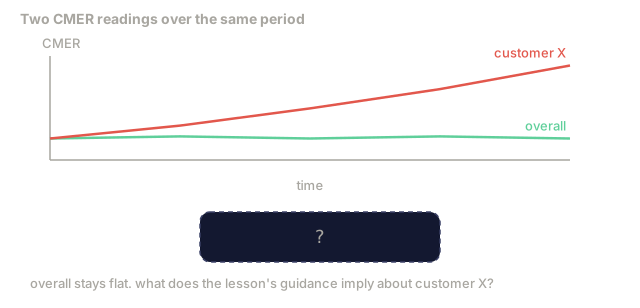
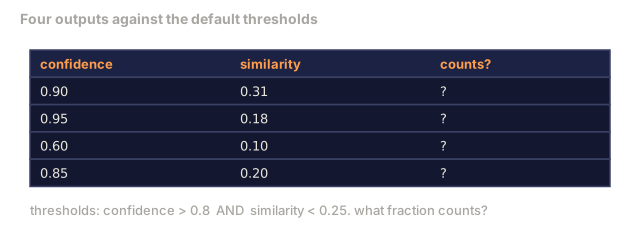
CMER = fraction of outputs where the text confidence is high but the image-text similarity (via a CLIP-family checker) is low
High CMER means the model is confidently saying things that aren't grounded in the image. Skywork.ai treated it as a production KPI and cut their hallucination rate by roughly 35%. The fix wasn't fixing the model: it was routing high-CMER outputs to human review.
Fine-tuning with LoRA / QLoRA
Full fine-tuning of a 70B VLM is out of reach for most teams. LoRA (rank 16-64) on attention and projector layers, or QLoRA with 4-bit base weights, fits on a single A100 or H100. Cost: 5,000-50,000 examples, $100-$5,000 in compute, 2-10 hours of training.
Spatial reasoning is still weak
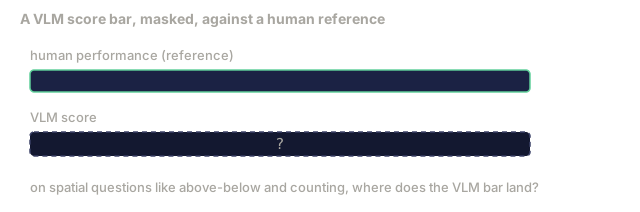
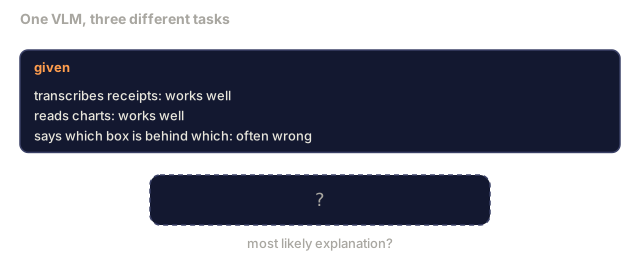
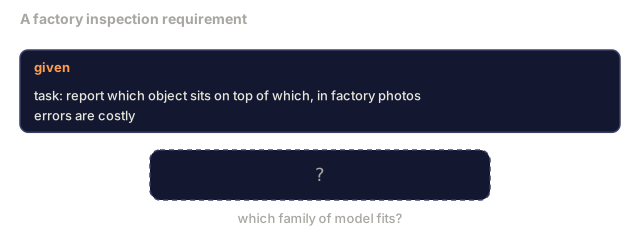
Current VLMs score 50-60% on spatial reasoning benchmarks (above-below, left-right, counting, distance), below human performance. If your use case depends on "which object is on top of which," validate heavily. Better alternatives for pure spatial tasks: a specialised keypoint / pose estimator, a depth model, or a detection model with box geometry post-processed.
Build It
Step 1: The projector
The part you will train most often. 2-4 layer MLP with GELU.
import torch
import torch.nn as nn


class Projector(nn.Module):
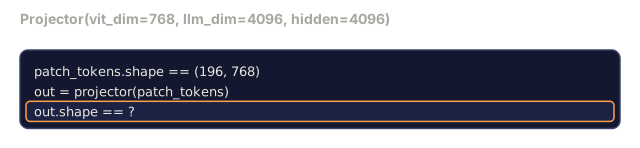
    def __init__(self, vit_dim=768, llm_dim=4096, hidden=4096):
        super().__init__()
        self.net = nn.Sequential(
            nn.Linear(vit_dim, hidden),
            nn.GELU(),
            nn.Linear(hidden, llm_dim),
        )

    def forward(self, x):
        return self.net(x)
Input is a (N_patches, d_vit) token tensor. Output is (N_patches, d_llm). The LLM treats every output row as just another token.
Step 2: Assemble ViT-MLP-LLM end-to-end
Skeleton of the forward pass for a minimal VLM. Real code uses transformers; this is the conceptual layout.
class MinimalVLM(nn.Module):
    def __init__(self, vit, projector, llm, image_token_id):
        super().__init__()
        self.vit = vit
        self.projector = projector
        self.llm = llm
        self.image_token_id = image_token_id  # placeholder token in text prompt

    def forward(self, image, input_ids, attention_mask):
        # 1. vision features
        vision_tokens = self.vit(image)                     # (B, N_patches, d_vit)
        vision_embeds = self.projector(vision_tokens)       # (B, N_patches, d_llm)

        # 2. text embeddings
        text_embeds = self.llm.get_input_embeddings()(input_ids)  # (B, M, d_llm)

        # 3. replace image placeholder tokens with vision embeds
        merged = self._merge(text_embeds, vision_embeds, input_ids)

        # 4. run LLM
        return self.llm(inputs_embeds=merged, attention_mask=attention_mask)

    def _merge(self, text_embeds, vision_embeds, input_ids):
        out = text_embeds.clone()
        expected = vision_embeds.size(1)
        for b in range(input_ids.size(0)):
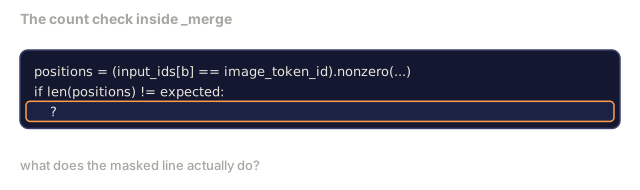
            positions = (input_ids[b] == self.image_token_id).nonzero(as_tuple=True)[0]
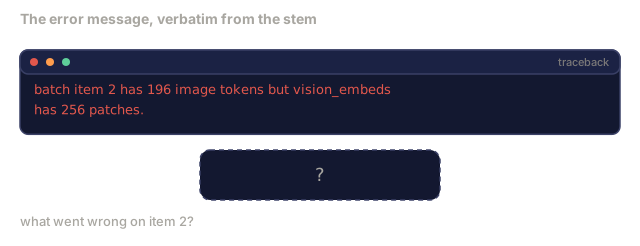
            if len(positions) != expected:
                raise ValueError(
                    f"batch item {b} has {len(positions)} image tokens but vision_embeds has {expected} patches."
                    " Every sample in the batch must be pre-padded to the same number of image placeholder tokens.")
            out[b, positions] = vision_embeds[b]
        return out
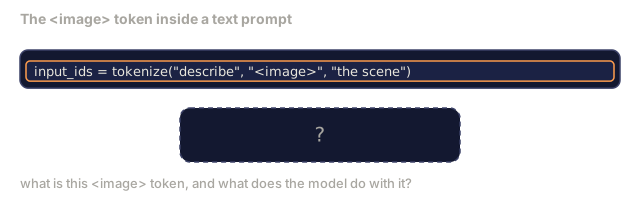
The <image> placeholder token in the text gets replaced with real image embeddings. LLaVA, Qwen-VL, and InternVL all use this same pattern.
Step 3: CMER computation
A lightweight runtime check.
import torch.nn.functional as F


def cross_modal_error_rate(image_emb, text_emb, text_confidence, sim_threshold=0.25, conf_threshold=0.8):
    """
    image_emb, text_emb: embeddings of image and generated text (normalised internally)
    text_confidence:     mean per-token probability in [0, 1]
    Returns:             fraction of high-confidence outputs with low image-text alignment
    """
    image_emb = F.normalize(image_emb, dim=-1)
    text_emb = F.normalize(text_emb, dim=-1)
    sim = (image_emb * text_emb).sum(dim=-1)        # cosine similarity
    high_conf_low_sim = (text_confidence > conf_threshold) & (sim < sim_threshold)
    return high_conf_low_sim.float().mean().item()
Treat CMER as a production KPI. Monitor it per endpoint, per prompt type, per customer. Rising CMER indicates the model is starting to hallucinate on some input distribution.
Step 4: Toy VLM classifier (runnable)
This demonstrates that the projector actually trains: fake "ViT features" go in, and a tiny LLM-style token predicts a class.
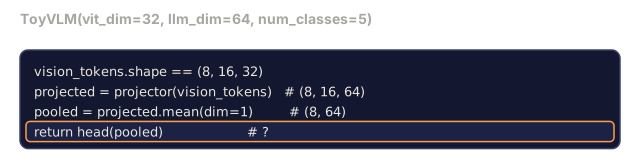
class ToyVLM(nn.Module):
    def __init__(self, vit_dim=32, llm_dim=64, num_classes=5):
        super().__init__()
        self.projector = Projector(vit_dim, llm_dim, hidden=64)
        self.head = nn.Linear(llm_dim, num_classes)

    def forward(self, vision_tokens):
        projected = self.projector(vision_tokens)
        pooled = projected.mean(dim=1)
        return self.head(pooled)
Fit it on synthetic (feature, class) pairs and it converges in under 200 steps, enough to show the projector pattern works.
Use It
Three ways production teams use VLMs in 2026:
- Hosted API: OpenAI Vision, Anthropic Claude Vision, Google Gemini Vision. Zero infra, vendor risk.
- Open-source self-host: Qwen3-VL or InternVL3.5 via
transformersandvllm. Full control, higher up-front effort. - Fine-tune on domain: load Qwen2.5-VL-7B or LLaVA-1.6-7B, LoRA on 5k-50k custom examples, serve with
vllmorTGI.
from transformers import AutoProcessor, AutoModelForVision2Seq
import torch
from PIL import Image

model_id = "Qwen/Qwen3-VL-8B-Instruct"
processor = AutoProcessor.from_pretrained(model_id)
model = AutoModelForVision2Seq.from_pretrained(model_id, torch_dtype=torch.bfloat16, device_map="auto")

messages = [{
    "role": "user",
    "content": [
        {"type": "image", "image": Image.open("plot.png")},
        {"type": "text", "text": "What does this chart show?"},
    ],
}]
inputs = processor.apply_chat_template(messages, add_generation_prompt=True, tokenize=True, return_dict=True, return_tensors="pt").to("cuda")
generated = model.generate(**inputs, max_new_tokens=256)
answer = processor.decode(generated[0][inputs["input_ids"].shape[1]:], skip_special_tokens=True)
apply_chat_template hides the <image> placeholder tokenisation; the model handles the merge internally.
Ship It
This lesson produces:
outputs/prompt-vlm-selector.md: picks Qwen3-VL / InternVL3.5 / LLaVA-Next / API given accuracy, latency, context length, and budget.outputs/skill-cmer-monitor.md: emits the code to instrument a production VLM endpoint with cross-modal error rate, per-endpoint dashboards, and alerting thresholds.
The failure mode that actually bites people in production isn't picking the wrong VLM. It's assuming the VLM you picked can do things it fundamentally can't. Spatial reasoning is the one that gets me every time — a model that reads a chart, transcribes a receipt, and describes a scene in fluent prose feels like it should also be able to tell you which box is behind which. It usually can't, not reliably, and its confidence in the wrong answer looks identical to its confidence in a right one.
That's the whole reason CMER exists. Not to make the model smarter, but to catch the gap between what it says and what's actually in the frame before a customer does. If you're shipping a VLM feature, budget the CMER-style check before you budget the fine-tune.
Exercises
- (Easy) Run three prompts ("what is this?", "count the objects", "describe the scene") through any open VLM on five images. Score each answer as correct / partially correct / hallucinated by hand. Compute a first-pass CMER-like rate.
- (Medium) Fine-tune Qwen2.5-VL-3B or LLaVA-1.6-7B with LoRA (rank 16) on 500 images of a target domain with captions. Compare zero-shot vs fine-tuned MMBench-style accuracy.
- (Hard) Replace the VLM's image encoder with DINOv3 instead of its default SigLIP/CLIP. Re-train only the projector (frozen LLM + frozen DINOv3). Measure whether dense-prediction tasks (counting, spatial reasoning) improve.
Key Terms
| Term | What people say | What it actually means |
|---|---|---|
| ViT-MLP-LLM | "The VLM pattern" | Vision encoder + projector + language model; every 2026 VLM |
| Projector | "The bridge" | 2-4 layer MLP (or Q-former) that maps vision tokens into LLM embedding space |
| DeepStack | "Qwen3-VL feature trick" | Multi-level ViT features stacked rather than last-layer only |
| Image token | " placeholder" | Special token in the text stream replaced by projected vision embeddings |
| CMER | "Hallucination KPI" | Cross-Modal Error Rate; high when text confidence is high but image-text similarity is low |
| Visual agent | "VLM that clicks" | VLM operating GUIs (OSWorld, mobile, web) with tool calls |
| Q-former | "Fixed-count token bridge" | BLIP-2 style projector producing a fixed number of visual query tokens |
| Alignment / pre-training / instruction tuning | "Three stages" | Standard VLM training pipeline |
Code
- main.py (python, 103 lines)