Any-Resolution Vision: Patch-n'-Pack and NaFlex
Real images are not 224x224 squares. A receipt is 9:16, a chart is 16:9, a medical scan might be 4096x4096, a mobile screenshot is 9:19.5. The pre-2024 VLM answer was to resize everything to a fixed square, which threw away the signal that makes OCR, document understanding, and high-resolution scene parsing work. NaViT (Google, 2023) showed you could pack variable-resolution patches into a single transformer batch with block-diagonal masking. Qwen2-VL's M-RoPE (2024) dropped absolute positional tables entirely. LLaVA-NeXT's AnyRes tiled high-resolution images into a base plus sub-images. SigLIP 2's NaFlex variant (2025) is now the default encoder for open VLMs that want a single checkpoint to serve every aspect ratio. This lesson implements patch-n'-pack end to end.
Learning Objectives
- Pack patches from a batch of variable-resolution images into one sequence and build the block-diagonal attention mask.
- Pick between AnyRes tiling (LLaVA-NeXT), NaFlex (SigLIP 2), and M-RoPE (Qwen2-VL) for a given task.
- Compute token budgets for OCR, charts, and photography without resizing.
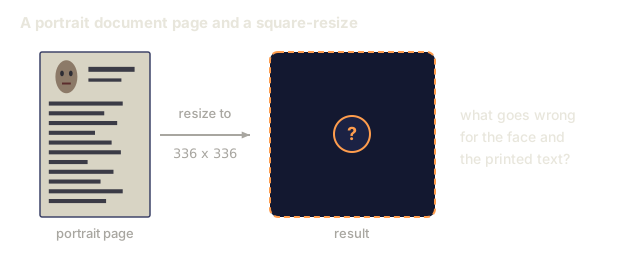
- Name the three failure modes of square-resize: squished text, cropped content, wasted tokens on padding.
The Problem
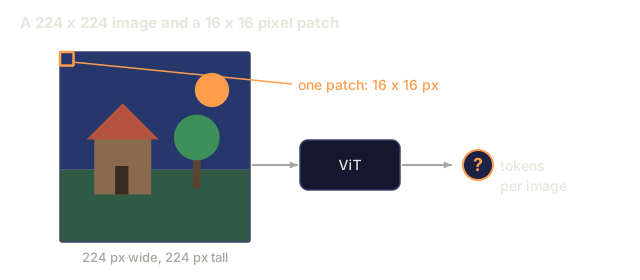
Transformers expect a sequence. A batch is a stack of sequences the same length. If your images are 224x224, you get 196 patch tokens every time, no padding needed. Train on 224, infer on 224, and resolution stops being your problem.
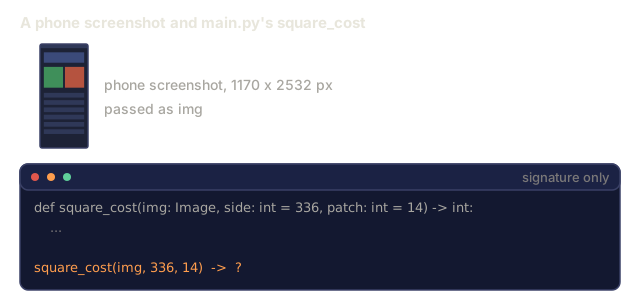
The world does not cooperate with this. Documents are portrait (8.5x11 inches, 2:3-ish). Chart screenshots are landscape (16:9). Receipts are tall and thin (1:3). Medical imaging ships at 2048x2048 or larger. Mobile device screenshots are 1170x2532 (0.46:1).
Three pre-2024 options, and why each one fails:
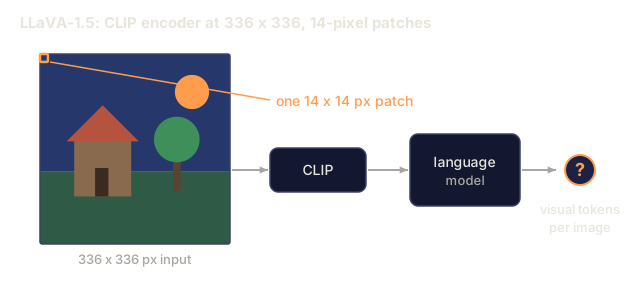
- Resize to a fixed square (224x224 or 336x336). The squish distorts text and faces, and the downscale wipes out chart labels and OCR content. This was standard practice until LLaVA-1.5.
- Crop to a fixed aspect ratio. You throw away most of the image, and choosing where to crop is its own vision problem.
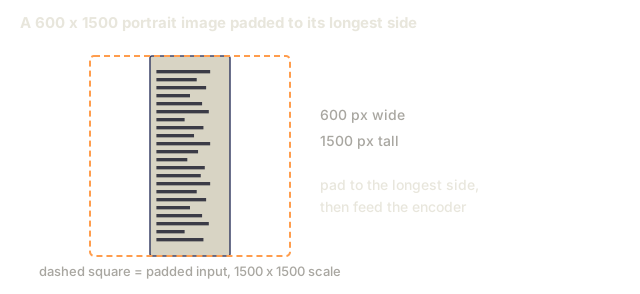
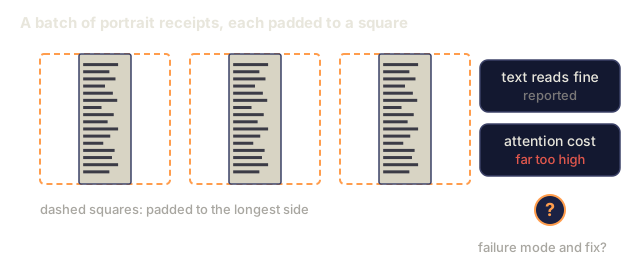
- Pad to the longest side. This fixes the distortion but can spend 50% or more of the tokens on padding for portrait images, and attention cost grows quadratically in all those pad tokens.
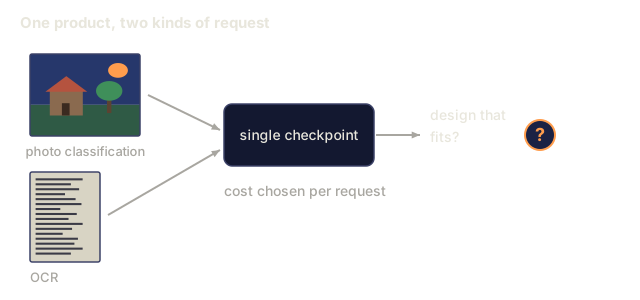
The 2024-2025 answer is to let the transformer take patches at the image's native resolution, then pack a mixed batch into one sequence without spending compute on padding.
The Concept
NaViT and patch-n'-pack
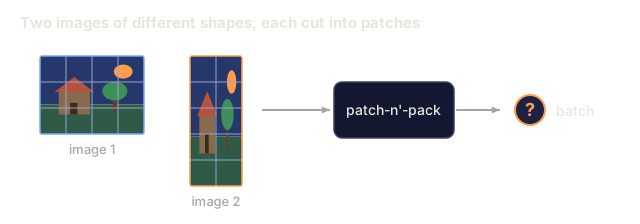
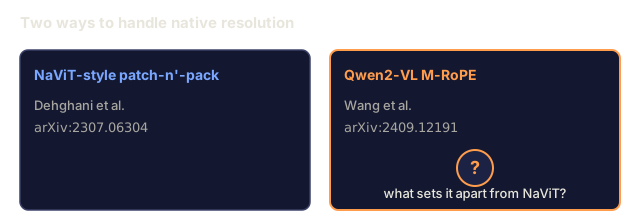
NaViT (Dehghani et al., 2023) showed this works at scale. The idea is mechanical:
- For each image in the batch, compute its native patch grid at a chosen patch size (say 14).
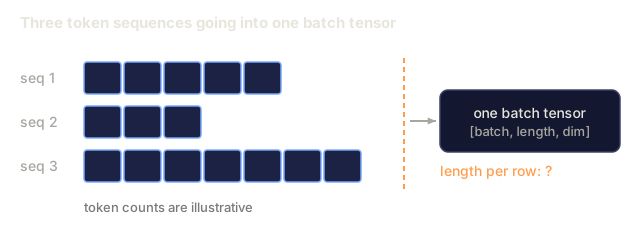
- Flatten each image's patches into its own variable-length sequence.
- Concatenate all images' patches into one long sequence for the batch.
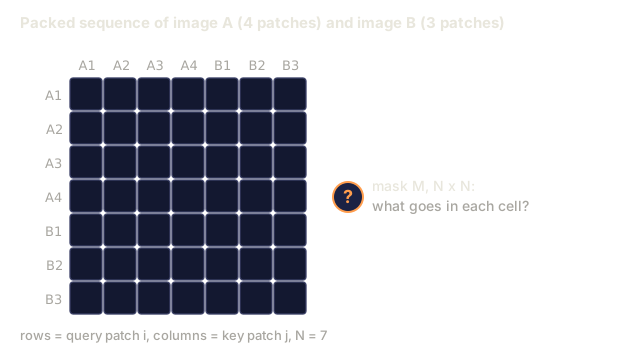
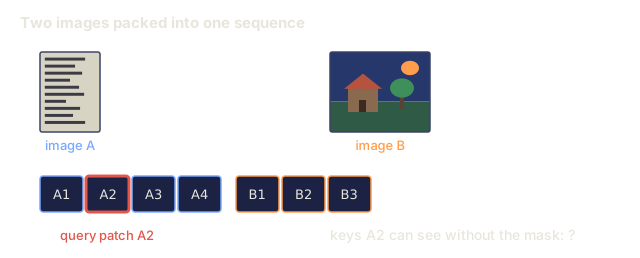
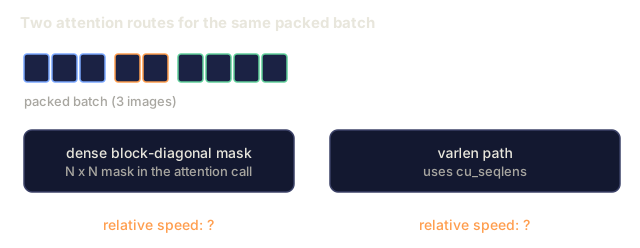
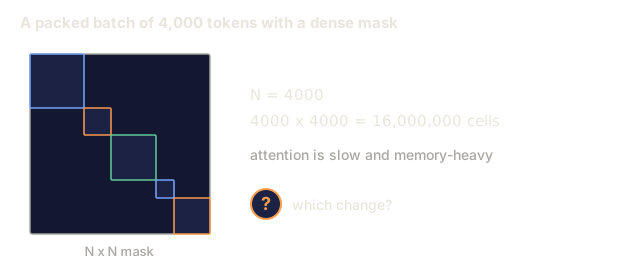
- Build a block-diagonal attention mask so image A's patches only attend within image A.
- Carry per-patch position information (2D RoPE or fractional position embeddings).
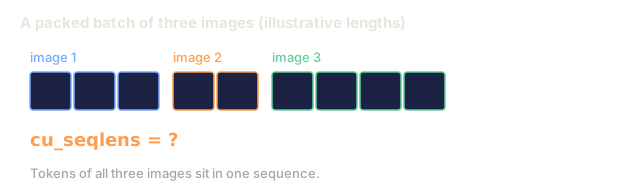
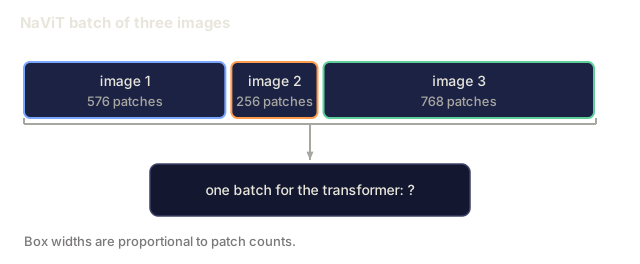
A batch of three images at 336x336 (576 tokens), 224x224 (256 tokens), and 448x336 (768 tokens) becomes one 1600-token sequence with a 1600x1600 block-diagonal mask. There is no padding, and the transformer handles arbitrary aspect ratios.
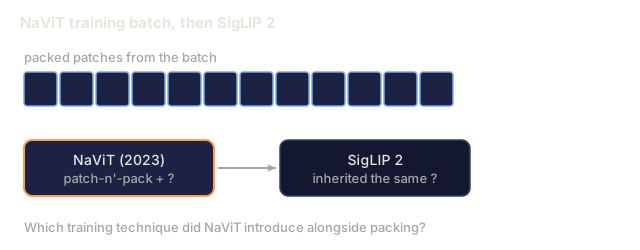
NaViT also introduced fractional patch dropping during training: drop 50% of patches at random across the batch, which regularizes and speeds up training. SigLIP 2 inherited this.
AnyRes (LLaVA-NeXT)
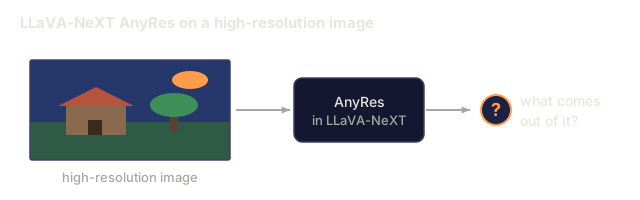
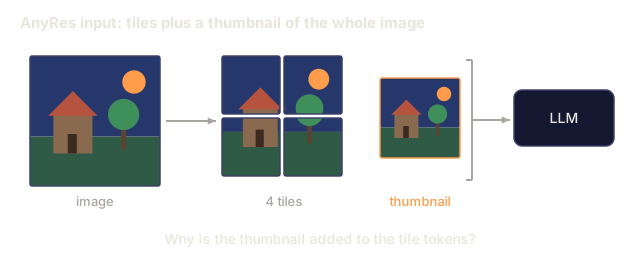
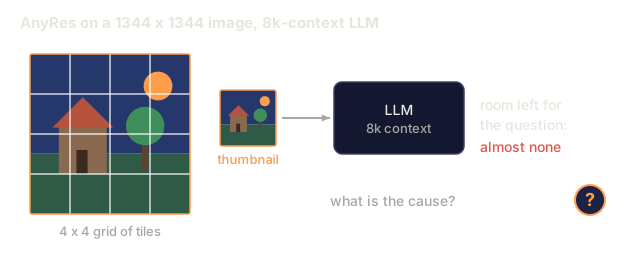
LLaVA-NeXT's AnyRes is the pragmatic alternative. Given a high-resolution image and a fixed encoder (CLIP or SigLIP at 336), tile the image:
- Pick a grid layout from a predefined set, such as (1x1), (1x2), (2x1), (1x3), (3x1), or (2x2), that best fits the image's aspect ratio.
- Tile the full image into the grid; each tile becomes a 336x336 crop.
- Also produce a thumbnail: the whole image resized to 336x336 as a global-context token.
- Encode every tile through the frozen 336-encoder. Concatenate the tile tokens + thumbnail tokens.
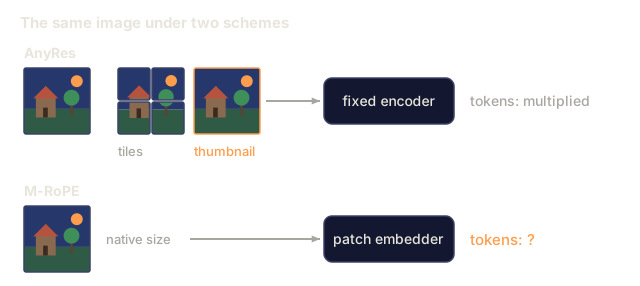
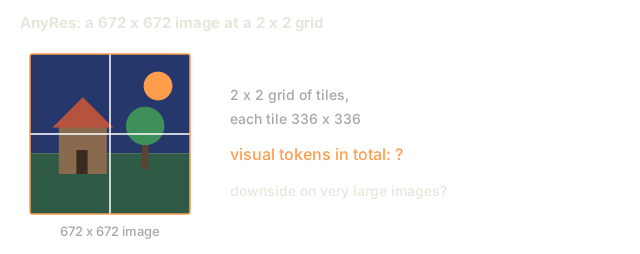
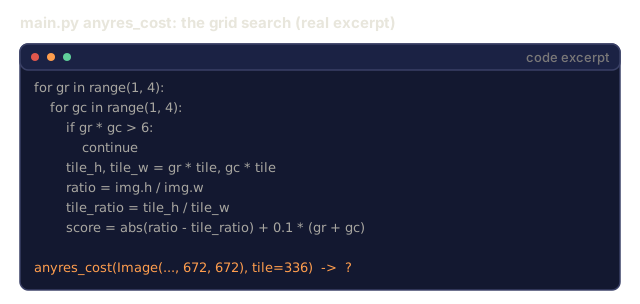
For a 672x672 image at 2x2 grid plus thumbnail: 4 * 576 + 576 = 2880 visual tokens. Expensive, but the LLM sees both local detail and global context. (The picker in main.py scores only aspect ratio, so it would give this square image a 1x1 grid and 1,152 tokens. LLaVA-NeXT's own selection also weighs resolution, which is what produces the 2x2 layout.)
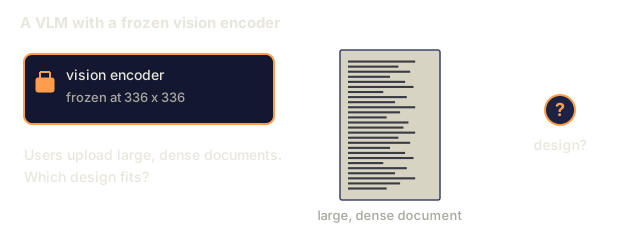
Reach for AnyRes when your encoder is frozen and only supports one resolution. The cost is token count on large images: a 1344x1344 image at 4x4 grid is 9216 + 576 ≈ 9800 tokens, which fills most of an 8k LLM context.
M-RoPE (Qwen2-VL)
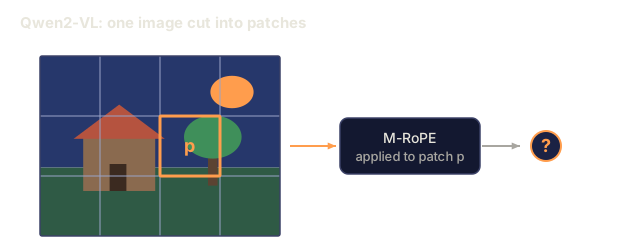
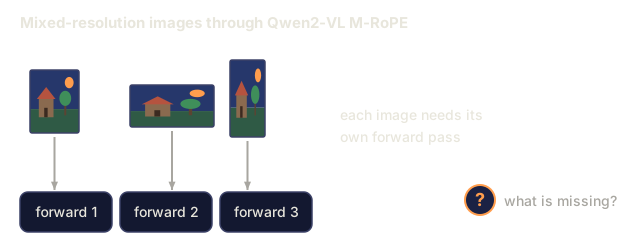
Qwen2-VL introduced Multimodal Rotary Position Embedding. Instead of NaViT's fractional positions or AnyRes's tile-and-thumbnail, each patch carries a 3D position (temporal, height, width). The query/key rotations handle arbitrary H, W, and temporal length.
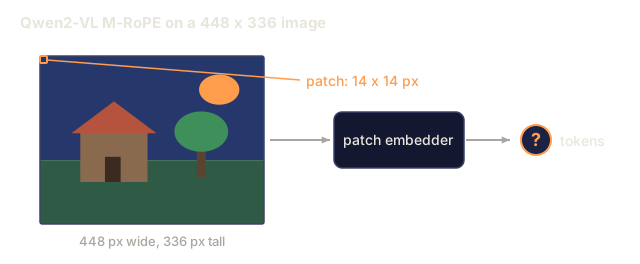
M-RoPE ships native dynamic resolution without retraining. At inference you feed any HxW image and the patch embedder produces H/14 x W/14 tokens. Each token gets its (t=0, r=row, c=col) position, and RoPE rotates attention with the right frequencies. Qwen2.5-VL and Qwen3-VL continue this. InternVL3's V2PE is the same idea with variable encoding per modality.
Unlike AnyRes, M-RoPE costs O(H x W / P^2) tokens at native resolution, with no multiplicative tile overhead. Unlike NaViT, it still expects a single image per forward. Batching across resolutions still needs patch-n'-pack on top.
NaFlex (SigLIP 2)
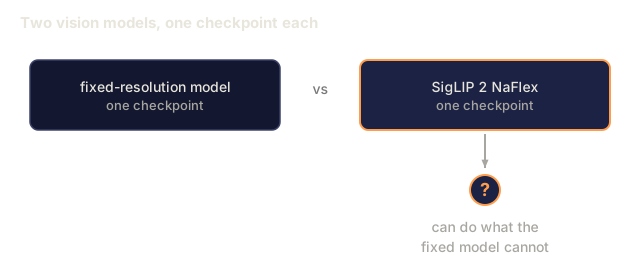
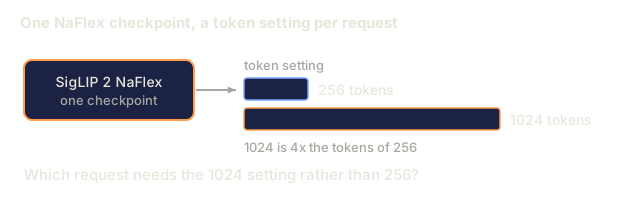
NaFlex is the SigLIP 2 checkpoint's native-flex mode. A single model serves multiple sequence lengths (256, 729, 1024 tokens) at inference. Internally it uses NaViT-style patch-n'-pack during training and absolute fractional positions per patch. The selling point is one checkpoint where you pick the token budget at inference based on the task.
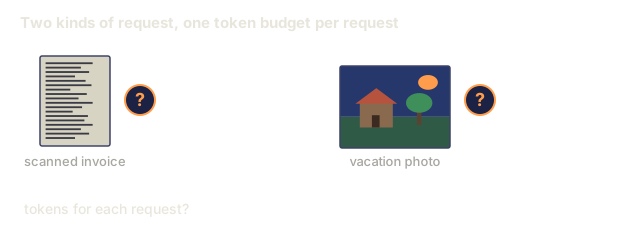
For a semantic task (classification, retrieval), 256 tokens. For OCR or chart understanding, 1024 tokens. No retraining.
The packing mask
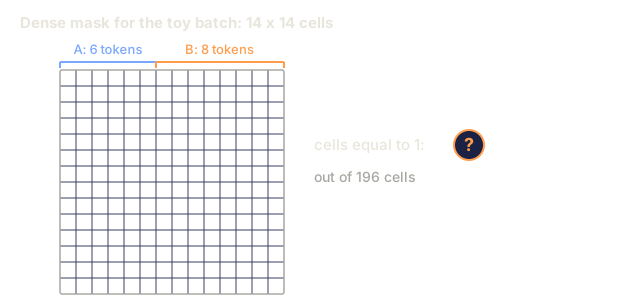
The block-diagonal mask is where implementations tend to stumble. For a packed sequence of length N_total covering images i=0..B-1 with lengths n_i, the mask M of shape (N_total, N_total) is 1 if both indices fall in the same image's block, else 0. You can build it from a cumulative length list:
offsets = [0, n_0, n_0+n_1, ..., N_total]
M[i, j] = 1 iff there exists b where offsets[b] <= i < offsets[b+1] and offsets[b] <= j < offsets[b+1]
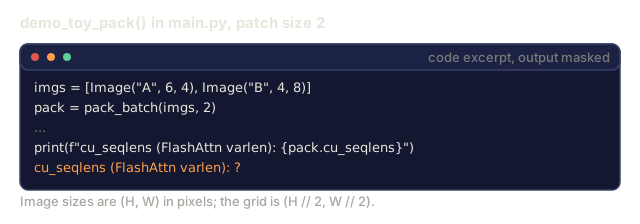
This is one line in PyTorch with torch.block_diag or an explicit gather. FlashAttention's variable-length path (cu_seqlens) skips the mask entirely and attends within sequences using the cumulative-length tensor directly, which is ~10x faster than a dense mask for typical batches.
Token budgets
Pick your strategy by task:
- OCR / documents: 1024-4096 tokens. SigLIP 2 NaFlex at 1024, or AnyRes 3x3 + thumbnail.
- Charts and UI: 729-1024 tokens at 384-448 native. Qwen2.5-VL dynamic resolution with max pixels cap.
- Natural photos: 256-576 tokens is usually enough for the downstream LLM. Spend tokens where content density is high.
- Video: 64-128 tokens per frame after spatial pooling, 2-8 FPS. Lesson 12.17 covers this.
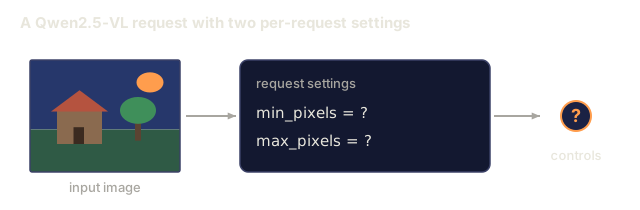
The 2026 production rule: pick a per-task max-pixels cap, encode at native aspect ratio up to that cap, pack the batch, and skip padding. Qwen2.5-VL exposes min_pixels and max_pixels for exactly this knob.
Use It
main.py implements patch-n'-pack for a heterogeneous batch of images, working from (H, W) sizes and integer patch counts. It:
- Takes a list of (H, W) image sizes.
- Computes each image's patch sequence length at patch size 14.
- Packs them into one sequence of total length
sum(n_i). - Builds the block-diagonal attention mask (dense, for clarity).
- Compares the packed cost vs square-resize and AnyRes tiling.
- Prints a token budget table for a mixed batch (receipt, chart, screenshot, photo).
Run it. The numbers that drop out are the reason every 2026 open VLM uses patch-n'-pack.
Ship It
This lesson produces outputs/skill-resolution-budget-planner.md. Given a mixed-aspect-ratio workload (OCR, charts, photos, video frames) and a total-token budget, it picks the right strategy (NaFlex, AnyRes, M-RoPE, or fixed-square) and emits a per-request configuration. Use this skill when you are sizing a VLM for a product, since it helps you catch a silent 10x token blowup before it eats your latency budget.
I'd run main.py first and read the toy batch before the budget table. Two tiny images, a 6x4 and a 4x8 at patch 2, make the packed length and the block-diagonal mask small enough to see in the terminal, and the cu_seqlens list printed next to it is the same offsets list the mask is built from.
The budget table is where I'd slow down. The native, square, and AnyRes columns are plain arithmetic on patch counts, and square-resize is a flat 576 tokens for every image no matter what it holds. My bet is that the gap between that flat 576 and the native column is the part worth staring at, because it shows where the token spend goes when the content is dense.
Keep the scope in mind, though. The code counts tokens. It does not encode patches, attach 2D or M-RoPE positions, or run attention, and the mask is a dense N x N list of lists, which is only sensible at toy size. For a real batch I'd use the cu_seqlens path, and I'd check the AnyRes grid picker before trusting its choices. It scores grids with a hand-written ratio-plus-penalty rule over 1 to 3 rows and columns (capped at 6 tiles), so it is a rough stand-in for LLaVA-NeXT's real layout selection.
Exercises
-
A receipt is 600x1500 (1:2.5). At patch size 14, how many native-resolution tokens? How many after square-resize to 336? Which loses more OCR accuracy in practice?
-
Build the block-diagonal mask for a batch of four images with lengths 256, 576, 729, 1024. Verify the attention matrix is 2585x2585 and has exactly
256^2 + 576^2 + 729^2 + 1024^2non-zero entries. -
For a 1792x896 image at patch 14, compare: (a) square-resize to 336 then encode, (b) AnyRes 2x1 + thumbnail, (c) M-RoPE at native. Which uses fewest tokens? Which preserves most detail?
-
Implement fractional patch dropping: given a packed sequence, drop 50% of tokens uniformly at random, and update the block-diagonal mask accordingly. Measure the mask's sparsity change.
-
Read Section 3.2 of the Qwen2-VL paper (arXiv:2409.12191). Describe in two sentences what
min_pixelsandmax_pixelscontrol and why both bounds matter.
Key Terms
| Term | What people say | What it actually means |
|---|---|---|
| Patch-n'-pack | "NaViT-style packing" | Concatenate variable-length patch sequences from different images into one batch dimension |
| Block-diagonal mask | "Packing mask" | Attention mask that confines each image's patches to attend only to themselves, not neighbors in the pack |
| AnyRes | "LLaVA-NeXT tiling" | Split a high-res image into a grid of fixed-size tiles plus a global thumbnail; encode every tile with a fixed encoder |
| NaFlex | "SigLIP 2 native-flex" | Single SigLIP 2 checkpoint that serves 256/729/1024-token budgets at inference without retraining |
| M-RoPE | "Multimodal RoPE" | 3D rotary position encoding (time, row, column) that handles arbitrary H, W, T without position tables |
| cu_seqlens | "FlashAttention packing" | Cumulative-length tensor the FlashAttention varlen path uses instead of a dense block-diagonal mask |
| min_pixels / max_pixels | "Resolution bounds" | Qwen2.5-VL per-request knobs capping token count on very small or very large inputs |
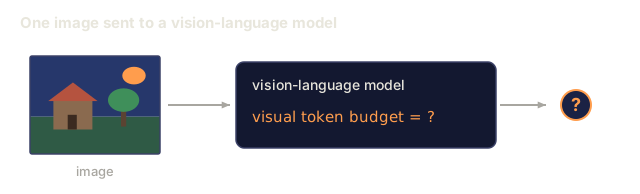
| Visual token budget | "How many tokens per image" | Rough count of patch tokens emitted per image; sets the LLM's prompt budget and attention cost |
Further Reading
Code
- main.py (python, 183 lines)