MCP Auth in Production — Enrollment, JWKS Refresh, Audience-Pinned Tokens
Lesson 16 stood up the OAuth 2.1 state machine in memory. By 2026, every MCP server you ship to a real org sits behind production auth: client enrollment that scales to an unbounded client population (Client ID Metadata Documents first, dynamic client registration as a backwards-compatible fallback), authorization-server metadata discovery (RFC 8414 *or* OpenID Connect Discovery), JWKS cache refresh that does not break a 3 a.m. token validation, and audience-pinned tokens that refuse cross-resource replay. This lesson models the full surface with three roles (an authorization server, a resource server that is the MCP server, and a client) so you can trace each hop from discovery to a validated tool call. **Spec note (2025-11-25):** the November 2025 MCP authorization spec demoted Dynamic Client Registration from `SHOULD` to `MAY` and made **Client ID Metadata Documents (CIMD)** the recommended default enrollment mechanism. This lesson teaches both, in the spec's priority order, and the code keeps DCR for the walk-through because it is fully self-contained in one process.
Learning Objectives
- Discover an authorization server through RFC 8414 metadata, and refuse to deploy when the IdP cannot satisfy MCP's auth profile.
- Enroll MCP clients with CIMD first and RFC 7591 dynamic client registration as the fallback, without admin intervention.
- Cache and refresh JWKS keys on a schedule so signature verification survives key roll-over.
- Pin tokens to a single MCP resource using RFC 8707 resource indicators and refuse confused-deputy reuse.
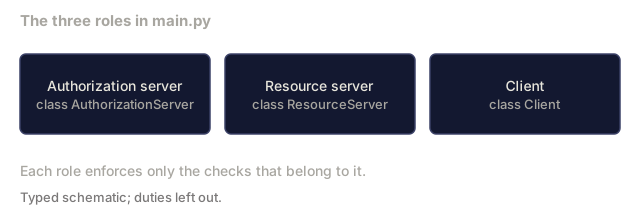
- Separate the three roles cleanly (authorization server, resource server, client) so each enforces only the checks that belong to it.
The Problem
The Lesson 16 simulator runs OAuth 2.1 in memory. Production has three operational gaps that a memory-only simulator does not see.
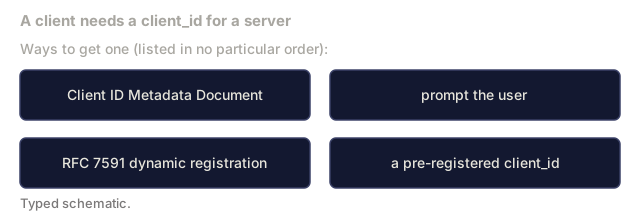
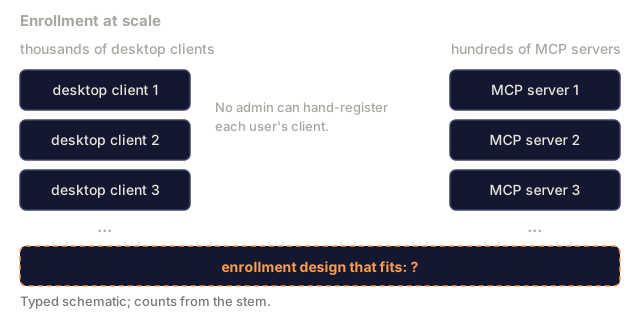
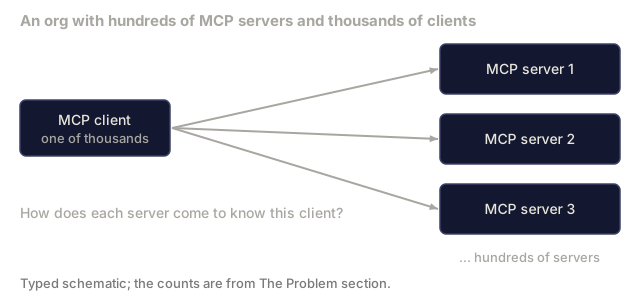
The first gap is enrollment. A real org runs hundreds of MCP servers and thousands of MCP clients. Operators do not hand-register every Cursor user as an OAuth client. The 2025-11-25 spec gives clients a priority order for solving this: use a pre-registered client_id if you have one, else use a Client ID Metadata Document (the client identifies itself with an HTTPS URL it controls and the authorization server pulls the metadata), else fall back to RFC 7591 dynamic client registration (the client pushes a POST /register and receives a client_id on the spot), else prompt the user. CIMD is the recommended default because it removes per-server registration entirely while keeping a DNS-rooted trust model; DCR is retained for backwards compatibility. Both discover their entry points from the authorization server's metadata: client_id_metadata_document_supported for CIMD, registration_endpoint for DCR.
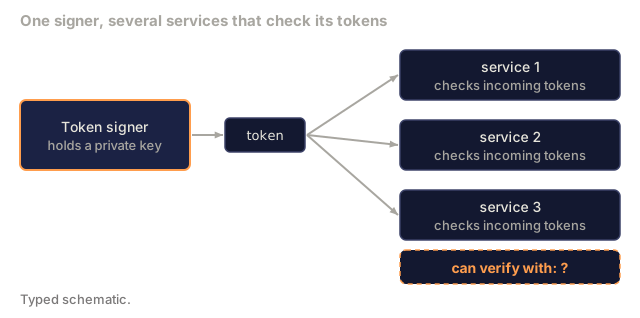
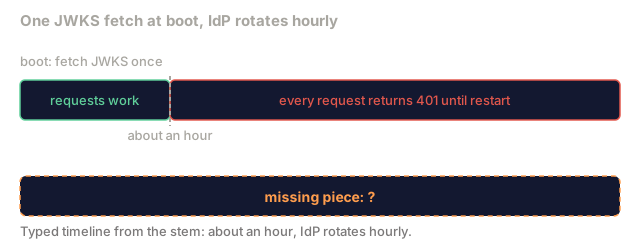
The second gap is key rotation. JWT validation depends on the authorization server's signing keys, published as a JSON Web Key Set (JWKS). The authorization server rotates these on a schedule (often hourly, sometimes faster under incident response). An MCP server that fetches JWKS once at boot validates fine until the rotation window, then every request fails until restart. Production wires JWKS as a cached value with a refresh job that overwrites the cache before the previous keys expire, plus a fall-back fetch on cache miss for the case where a token signed by a key newer than the cache arrives.
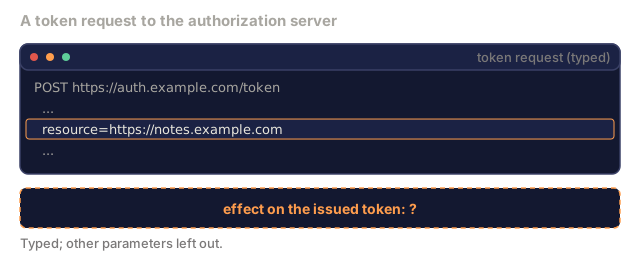
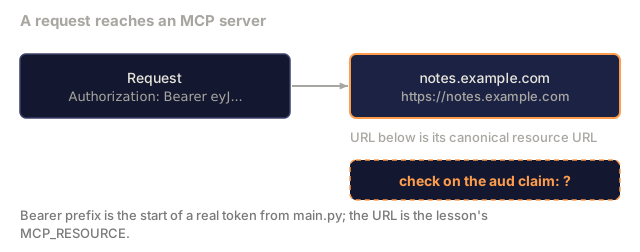
The third gap is audience binding. Lesson 16 introduced RFC 8707 resource indicators. In production, that indicator becomes a hard claim check on every request. The MCP server compares token.aud against its own canonical resource URL and rejects mismatches with HTTP 401. This is the only defense against an upstream MCP server (or a malicious client holding a token meant for one server) replaying that token against another server in the same trust mesh.
This lesson maps each gap onto a concrete piece of the surface. The metadata document is an HTTP endpoint. JWKS cache refresh is a scheduled job plus a key-value cache. JWT validation is a routine the resource server runs before dispatching any tool. Keep the three roles separate and each one enforces only the checks it owns: the authorization server issues and rotates keys, the resource server caches and validates, the client discovers and enrolls.
The Concept
RFC 8414: OAuth Authorization Server Metadata
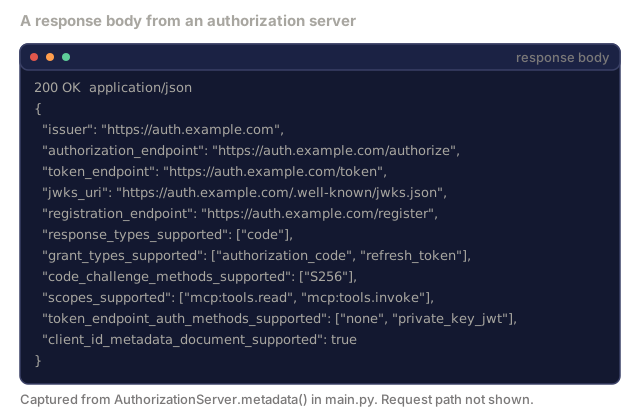
A document at /.well-known/oauth-authorization-server describes everything a client needs:
{
  "issuer": "https://auth.example.com",
  "authorization_endpoint": "https://auth.example.com/authorize",
  "token_endpoint": "https://auth.example.com/token",
  "jwks_uri": "https://auth.example.com/.well-known/jwks.json",
  "registration_endpoint": "https://auth.example.com/register",
  "response_types_supported": ["code"],
  "grant_types_supported": ["authorization_code", "refresh_token"],
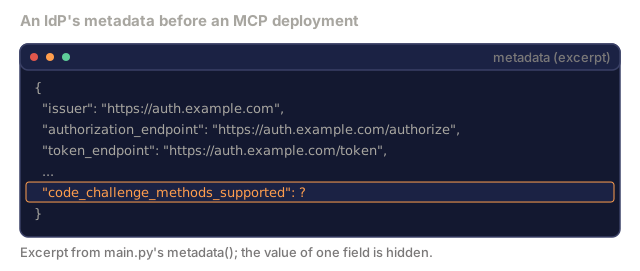
  "code_challenge_methods_supported": ["S256"],
  "scopes_supported": ["mcp:tools.read", "mcp:tools.invoke"],
  "token_endpoint_auth_methods_supported": ["none", "private_key_jwt"]
}
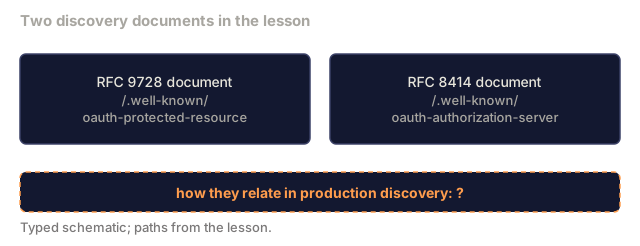
A client given an MCP resource URL chains discovery: oauth-protected-resource from RFC 9728 (the resource server's document) names the issuer, then oauth-authorization-server (this RFC) names every endpoint. The client never hard-codes an authorization URL.
The contract you verify before trusting an IdP for MCP:
code_challenge_methods_supportedincludesS256(PKCE per RFC 7636). The spec is explicit: if this field is absent, the authorization server does not support PKCE and the client MUST refuse to proceed.grant_types_supportedincludesauthorization_codeand rejectspasswordandimplicit.- At least one enrollment path is advertised:
client_id_metadata_document_supported: true(CIMD, preferred) orregistration_endpoint(RFC 7591 DCR, fallback). Either satisfies the contract; you no longer hard-require DCR. response_types_supportedis exactly["code"]for OAuth 2.1.
If S256 is missing, the MCP server refuses to deploy against this IdP. There is no degraded mode for PKCE. If neither enrollment path is advertised and you have no pre-registered client_id, you also cannot enroll; the deployment manifest is wrong, not the code.
RFC 9728 (recap): Protected Resource Metadata
Lesson 16 covered RFC 9728. The delta in production: this document is the only place a client looks to find the authorization servers trusted by this MCP server. A single MCP server may accept tokens from multiple IdPs (one for staff, one for partners). RFC 9728 declares that set; RFC 8414 documents what each IdP supports.
{
  "resource": "https://notes.example.com",
  "authorization_servers": ["https://auth.example.com", "https://partners.example.com"],
  "scopes_supported": ["mcp:tools.invoke"],
  "bearer_methods_supported": ["header"],
  "resource_documentation": "https://notes.example.com/docs"
}
Client ID Metadata Documents (the recommended default)
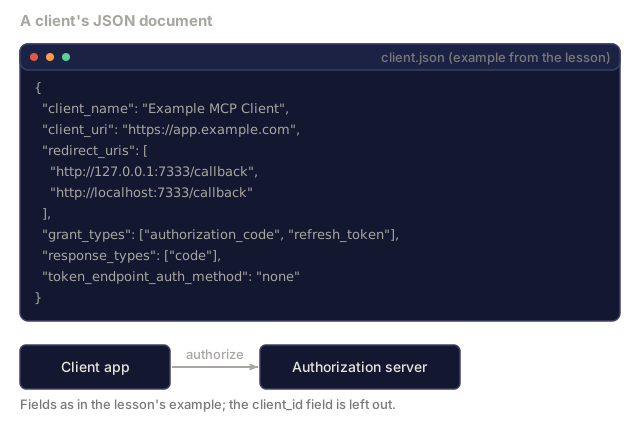
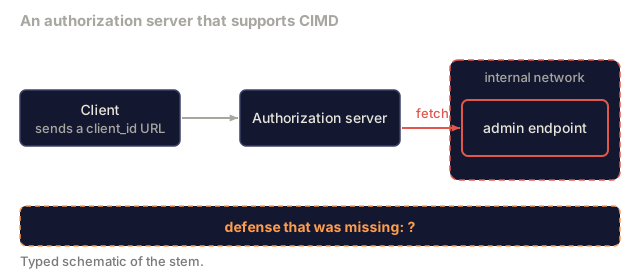
CIMD inverts registration from push to pull. Instead of asking the authorization server to mint a client_id, the client uses an HTTPS URL it controls as its client_id. The URL resolves to a JSON metadata document; the authorization server fetches it on demand during the OAuth flow. Trust is rooted in DNS: if the server operator trusts app.example.com, it trusts the client served from https://app.example.com/client.json. No registration round-trip, no client_id namespace to exhaust, no per-server state to keep in sync.
The metadata document the client hosts:
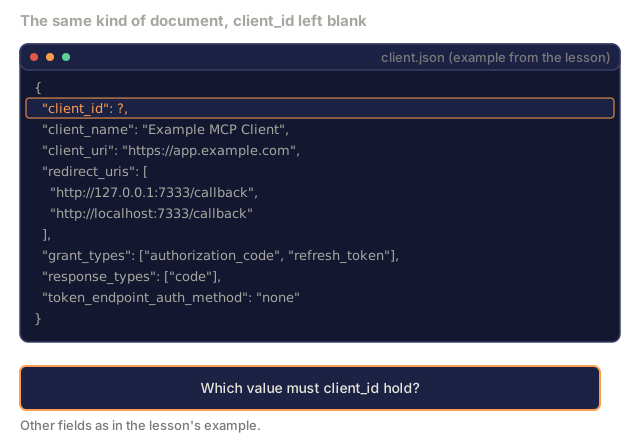
{
  "client_id": "https://app.example.com/oauth/client.json",
  "client_name": "Example MCP Client",
  "client_uri": "https://app.example.com",
  "redirect_uris": ["http://127.0.0.1:7333/callback", "http://localhost:7333/callback"],
  "grant_types": ["authorization_code", "refresh_token"],
  "response_types": ["code"],
  "token_endpoint_auth_method": "none"
}
The client_id value in the document MUST equal the URL it is served from (the authorization server verifies this; mismatches are rejected). The authorization server advertises support with client_id_metadata_document_supported: true in its RFC 8414 metadata.
Two security facts the spec is blunt about:
- SSRF. The authorization server fetches an attacker-supplied URL. It must defend against server-side request forgery (no fetches to internal/admin endpoints).
- localhost impersonation. CIMD alone cannot stop a local attacker from claiming a legitimate client's metadata URL and binding any
localhostredirect. The authorization server MUST clearly display the redirect URI hostname during consent and SHOULD warn onlocalhost-only redirects.
Because CIMD needs no server-side state, there is no registrar to stand up the way DCR requires. The client side is read-only: serve your metadata document from a static HTTPS endpoint and let the authorization server pull it.
RFC 7591: Dynamic Client Registration (fallback / backwards compatibility)
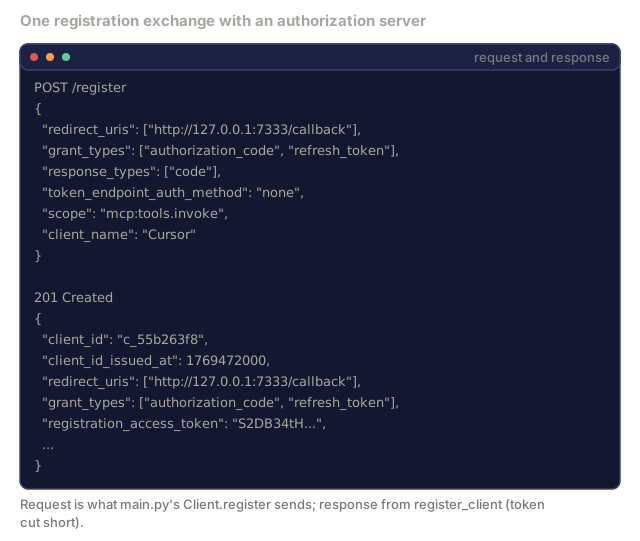
DCR is now a MAY, kept for backwards compatibility with pre-2025-11-25 deployments and IdPs that do not yet support CIMD. Without it (and without CIMD or pre-registration), every MCP client (Cursor, Claude Desktop, a custom agent) needs an out-of-band exchange with the IdP admin. With DCR, the client posts:
POST /register
Content-Type: application/json

{
  "redirect_uris": ["http://127.0.0.1:7333/callback"],
  "grant_types": ["authorization_code", "refresh_token"],
  "response_types": ["code"],
  "token_endpoint_auth_method": "none",
  "scope": "mcp:tools.invoke",
  "client_name": "Cursor",
  "software_id": "com.cursor.cursor",
  "software_version": "0.42.0"
}
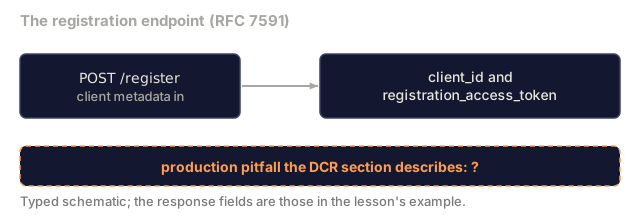
The server responds with client_id and a registration_access_token for later updates:
{
  "client_id": "c_3e7f1a",
  "client_id_issued_at": 1769472000,
  "redirect_uris": ["http://127.0.0.1:7333/callback"],
  "grant_types": ["authorization_code", "refresh_token"],
  "registration_access_token": "regt_b2...",
  "registration_client_uri": "https://auth.example.com/register/c_3e7f1a"
}
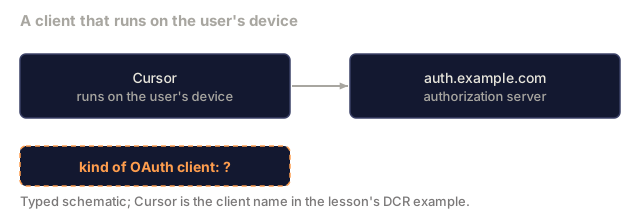
token_endpoint_auth_method: none is the right default for MCP clients that run on the user's device. They get a client_id only, with no client_secret to exfiltrate. PKCE provides the proof-of-possession that public clients need.
Three production pitfalls:
- The registration endpoint must rate-limit by source IP. Without that, a hostile actor scripts millions of fake registrations and exhausts the
client_idnamespace. Run a rate-limit check before the registrar handles the request. software_statement(a signed JWT vouching for the client) is required by some enterprise IdPs. The mock here skips it; production wires a verification step that rejects unsigned registrations from anything other than localhost redirect URIs.- The
registration_access_tokenmust be stored as a hash, not plaintext. Theft of this token means the attacker can rewrite the client's redirect URIs.
RFC 8707 (recap): Resource Indicators
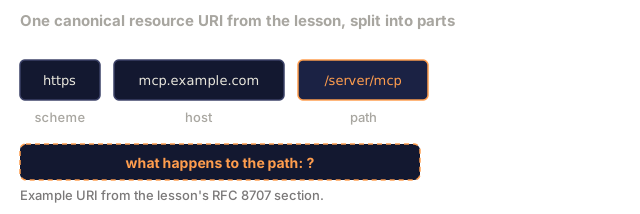
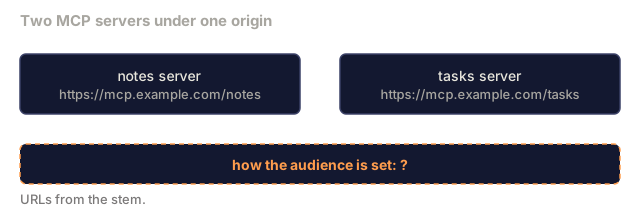
Lesson 16 established the shape. The production rule: every token request includes resource=<canonical-mcp-url>, and the MCP server verifies token.aud matches its own resource URL on every call. The canonical URI is the most specific identifier for the server: it uses lowercase scheme and host, no fragment, and conventionally no trailing slash. The path component is not stripped by rule. The spec keeps it when it is needed to identify an individual MCP server. https://mcp.example.com, https://mcp.example.com/mcp, https://mcp.example.com:8443, and https://mcp.example.com/server/mcp are all valid canonical URIs. Pick one per server and pin aud to exactly that. (This lesson's mock uses bare-host audiences like https://notes.example.com for brevity; a deployment that co-hosts several MCP servers under one origin distinguishes them by path.)
RFC 7636 (recap): PKCE
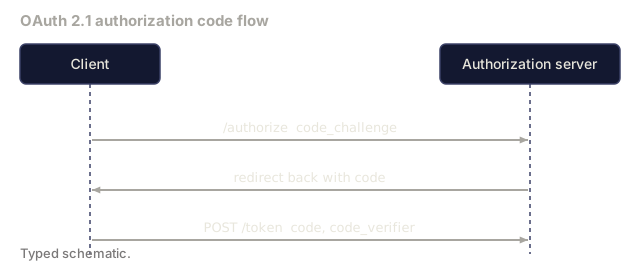
PKCE is mandatory in OAuth 2.1. The lesson's authorization-code flow always carries code_challenge and code_verifier. The server rejects any token request without a verifier or with a verifier that does not hash to the stored challenge.
MCP Spec 2025-11-25 Auth Profile
The MCP spec (2025-11-25) is precise about what an MCP server's authorization layer must do:
- Implement RFC 9728 protected-resource metadata, and provide its location either through the
WWW-Authenticate: Bearer resource_metadata="..."header on a 401 or the well-known URI/.well-known/oauth-protected-resource(SEP-985 made the header optional with a well-known fallback). The metadataauthorization_serversfield MUST name at least one server. - Accept tokens only via
Authorization: Bearer ...on every request, not in a query string and not validated only at session start. - Validate
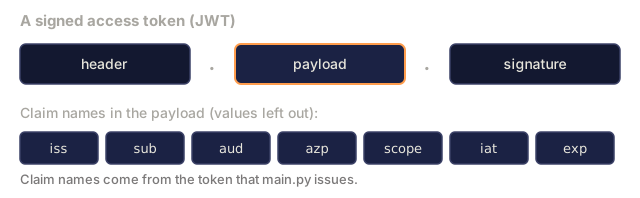
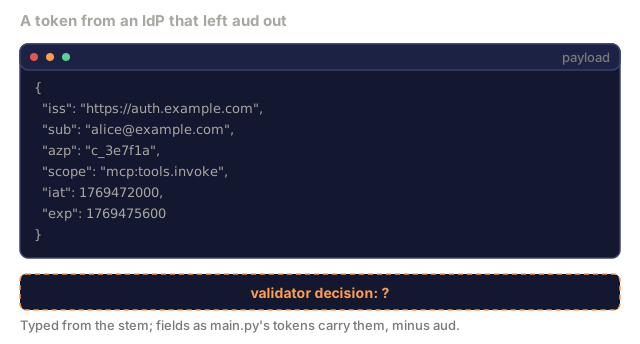
aud,iss,exp, and required scopes per request. The server MUST validate that the token was issued specifically for it (audience); a missing or mismatchedaudis rejected, never treated as wildcard. - On 401/403, return
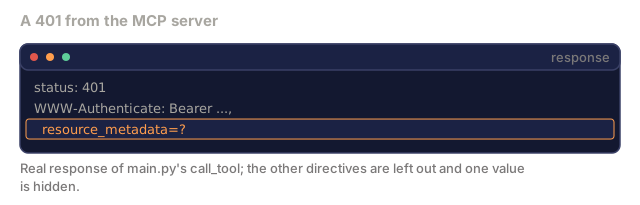
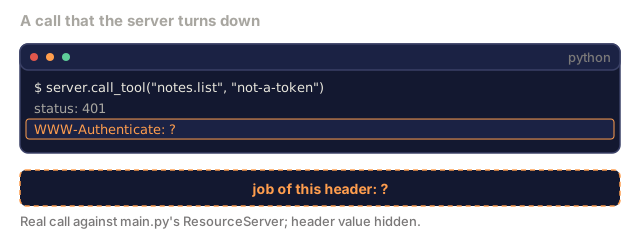
WWW-Authenticate: Bearercarryingerror=..., theresource_metadata="<PRM-URL>"parameter (the URL of the metadata document, not the bare resource), andscope="..."oninsufficient_scope(403). Note: the parameter isresource_metadata, a discovery pointer. There is noresourceparameter in the challenge. - Authorization-server discovery accepts either RFC 8414 OAuth metadata or OpenID Connect Discovery 1.0; clients must try both well-known suffixes in priority order.
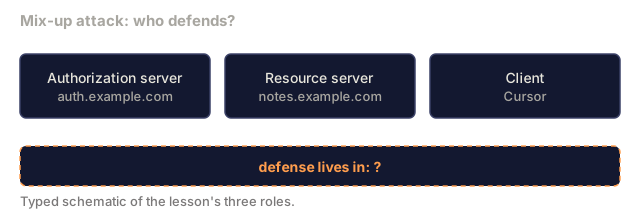
- The client (not the server) defends against mix-up attacks: it records the expected
issuerbefore redirecting and validates theissauthorization-response parameter (RFC 9207) before redeeming the code. PKCE alone does not stop mix-up, because the client hands itscode_verifierto whatever token endpoint it was steered to.
The OAuth 2.1 draft is the substrate; RFC 8414/7591/8707/9728/9207 + RFC 7636 + CIMD are the surface; the MCP spec is the profile.
IdP capability matrix
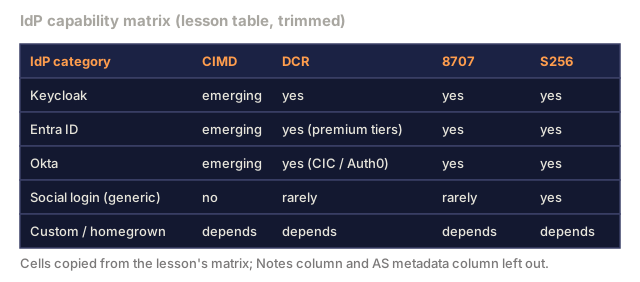
Not every IdP supports the full MCP profile. The matrix below documents factual capability statements as of the 2025-11-25 spec. It is a deployment gate, not a recommendation.
CIMD shipped in the 2025-11-25 spec and the underlying OAuth draft was adopted only in October 2025, so vendor support is still arriving. Treat "CIMD" below as "where it stands today, verify in your tenant," not a permanent statement.
| IdP category | AS metadata (8414/OIDC) | CIMD | RFC 7591 DCR | RFC 8707 resource | RFC 7636 S256 PKCE | Notes |
|---|---|---|---|---|---|---|
| Self-hosted (Keycloak) | yes | emerging | yes | yes (since 24.x) | yes | Reference IdP for the MCP profile in this lesson; full DCR path end-to-end, CIMD tracking the new spec. |
| Enterprise SSO (Microsoft Entra ID) | yes | emerging | yes (premium tiers) | yes | yes | DCR availability differs by tenant tier; verify in target tenant before deploying. |
| Enterprise SSO (Okta) | yes | emerging | yes (Okta CIC / Auth0) | yes | yes | DCR available on Auth0 (now Okta CIC); classic Okta orgs require admin pre-registration. |
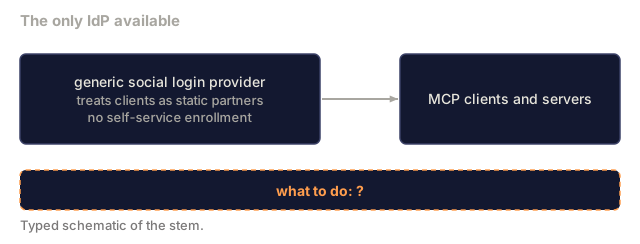
| Social login IdPs (generic) | varies | no | rarely | rarely | yes | Most social IdPs treat clients as static partners; no self-service enrollment. Use as identity source only, layer your own MCP-aware authorization server on top. |
| Custom / homegrown | depends | depends | depends | depends | depends | If you ship your own, ship the full profile and prefer CIMD. Skipping PKCE or audience binding breaks the MCP auth contract. |
Refusal rule for the deployment manifest: if the chosen IdP does not list S256 in code_challenge_methods_supported, the MCP server refuses to start, because PKCE has no degraded mode. Enrollment is a softer gate: you need one working path (a pre-registered client_id, client_id_metadata_document_supported: true, or a registration_endpoint). DCR's absence alone is no longer a refusal trigger, because CIMD or pre-registration can cover it.
JWKS refresh pattern (rotate at the AS, refresh at the resource server)
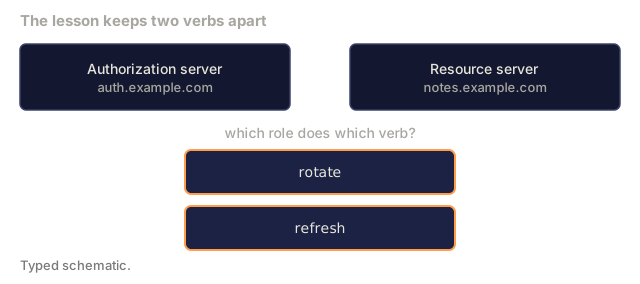
Keep two verbs separate, because conflating them is a real production bug:
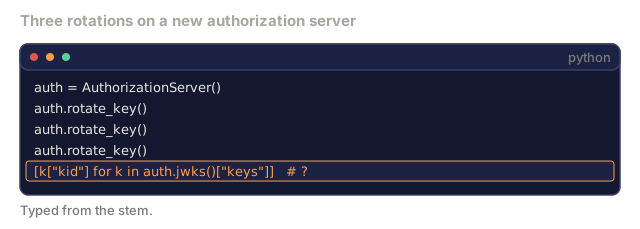
- Rotate is what the authorization server does: mint a new signing key, publish it in the JWKS, retire the old one later. The resource server has no part in this and cannot do it, since it does not hold the IdP's private keys.
- Refresh is what the resource server does: re-
GETthe published JWKS into its cache. That is the only JWKS action a resource server ever performs.
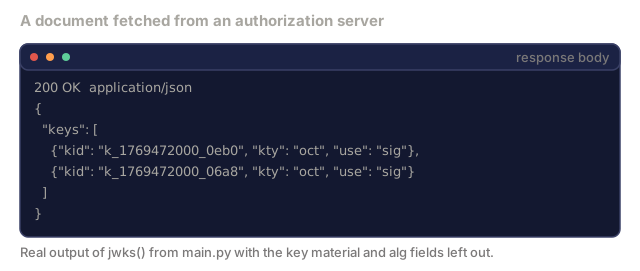
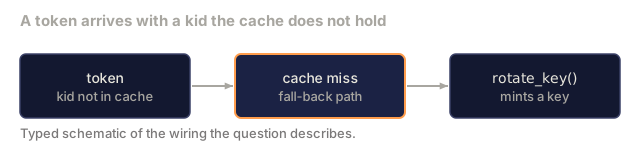
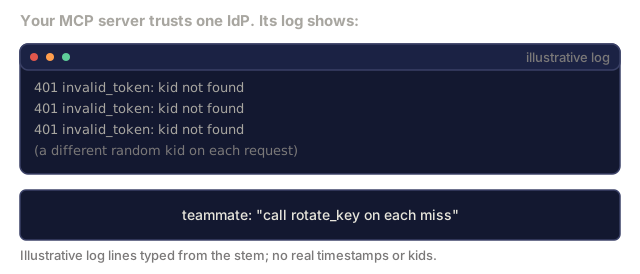
The production failure mode is a stale cache. Solve it with a scheduled refresh job plus a key-value cache. The resource server runs a job (cron, timer, whatever your runtime offers) that, on a fixed interval, fetches <issuer>/.well-known/jwks.json and overwrites cache[issuer] = {keys, fetched_at}. The validator reads from that cache. A token whose kid is missing from the cache triggers one synchronous refresh as a fall-back, then re-checks. This handles two cases at once: the scheduled refresh, and key-overlap windows where a token signed by a brand-new key arrives before the next scheduled refresh.
The fall-back must be a re-fetch, never a rotate. If you wire the cache-miss path to a rotate-and-mint, two things break: (1) minting a fresh key produces a kid that still does not match the token, so the lookup fails anyway; and (2) an attacker who sprays tokens with random kid values forces an unbounded series of key creations, a self-inflicted DoS. A re-fetch is idempotent, so a bogus kid costs at most one wasted fetch.
The cache shape:
{
  "https://auth.example.com": {
    "keys": [
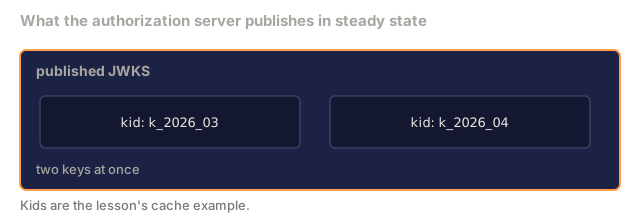
      {"kid": "k_2026_03", "kty": "RSA", "n": "...", "e": "AQAB", "alg": "RS256", "use": "sig"},
      {"kid": "k_2026_04", "kty": "RSA", "n": "...", "e": "AQAB", "alg": "RS256", "use": "sig"}
    ],
    "fetched_at": 1772668800
  }
}
Two keys at once is the steady state. Authorization servers rotate by introducing the next key (k_2026_04) before retiring the previous (k_2026_03), so tokens issued under the old key remain valid until they expire. The cache holds the union; the validator picks by kid.
The validation routine
The MCP server runs validation before dispatching any tool. The shape code/main.py uses:
result = server.validate(bearer_token, required_scope="mcp:tools.invoke")
if not result["valid"]:
    return {"status": result["status"], "WWW-Authenticate": result["www_authenticate"]}
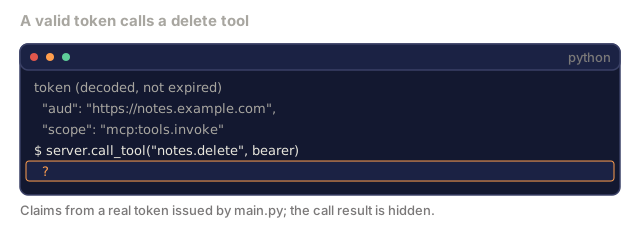
validate decodes the JWT, resolves the signing key from the JWKS cache (refreshing once on a miss), verifies the signature, then checks iss against the allow-list, aud against this server's canonical resource, exp, and the required scope, returning a WWW-Authenticate challenge on the first failure. Keeping it a single routine on the resource server means every entry point (every tool call, every transport) goes through the same checks; in this code no path reaches a tool without validating first.
Audience-replay walkthrough (access-token privilege restriction)
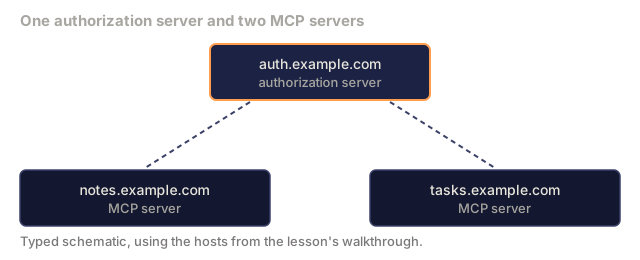
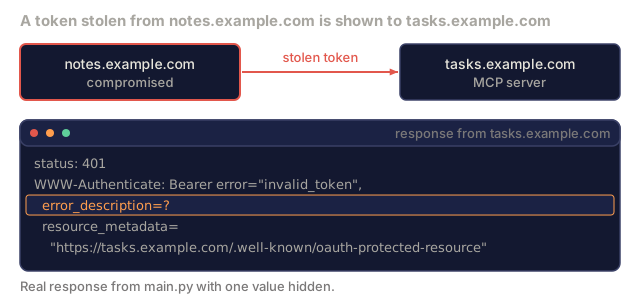
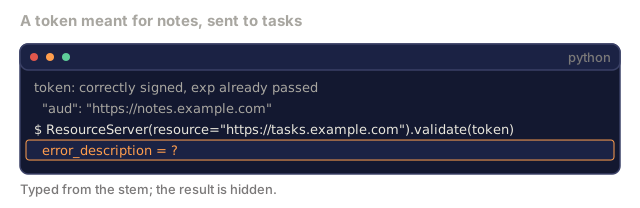
Server A (notes.example.com) and Server B (tasks.example.com) both register against the same authorization server. Server A is compromised. The attacker takes a user's notes token and replays it against Server B.
Server B's validator:
- Decode JWT, fetch JWKS by
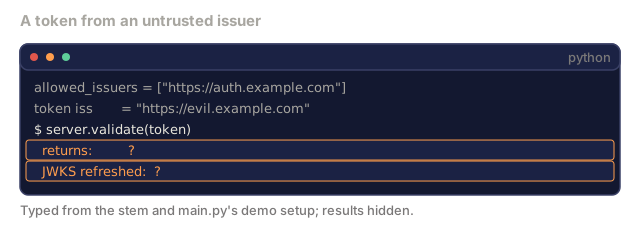
kid, verify signature. - Check
issagainst its protected-resource metadata'sauthorization_servers. (Pass, same IdP.) - Check
aud == "https://tasks.example.com". (Fail, the token'saudishttps://notes.example.com.) - Return 401 with
WWW-Authenticate: Bearer error="invalid_token", error_description="audience mismatch", resource_metadata="https://tasks.example.com/.well-known/oauth-protected-resource".
The audience claim is the only defense against this attack at the protocol layer. Skipping it for performance is the most common production mistake. The validator has to run on each request, not just at session start. The spec calls this access-token privilege restriction: an MCP server MUST reject any token that does not name it in the audience.
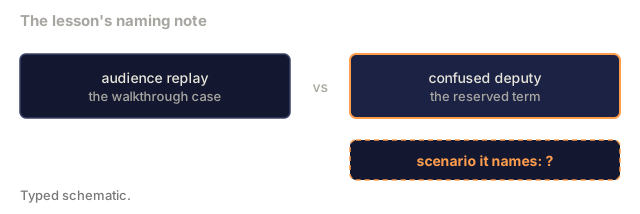
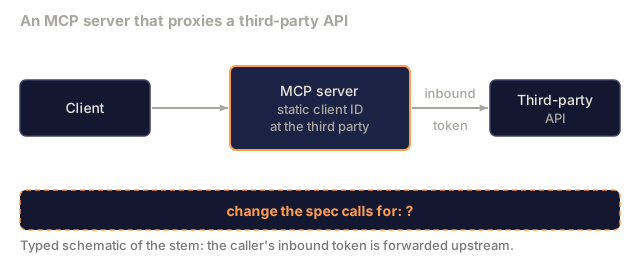
Naming note. The spec reserves the term confused deputy for a related-but-distinct problem: an MCP server acting as an OAuth proxy to a third-party API, using a static client ID, that forwards a token without obtaining per-client user consent. Audience binding fixes the replay above; the confused-deputy fix is per-client consent plus never passing the inbound token through to upstream APIs (the MCP server
MUSTget its own separate upstream token).
Mix-up attacks (a client-side defense the server cannot provide)
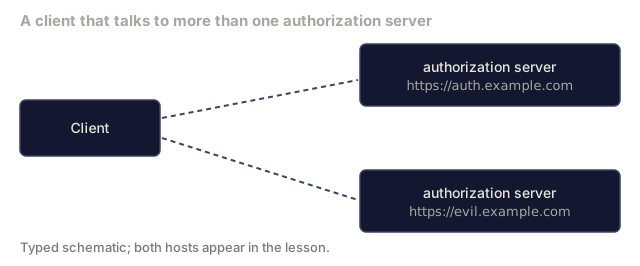
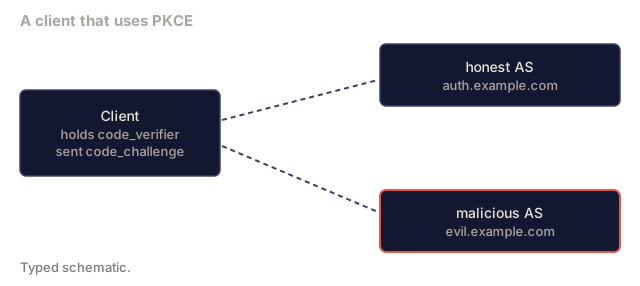
A client talks to many authorization servers over its life. A malicious AS can try to make the client redeem an honest AS's authorization code at the attacker's token endpoint. Audience binding does not help here because the attack happens before any token exists. The defense lives in the client (RFC 9207):
- Before redirecting, the client records the expected
issuerfrom the validated AS metadata. - On the authorization response, the client compares the returned
issparameter against that recorded issuer (simple string comparison, no normalization) before sending the code anywhere. - Mismatch (or
issabsent when the AS advertisedauthorization_response_iss_parameter_supported) → reject, and do not even display theerrorfields.
PKCE alone does not stop mix-up, because the client hands its code_verifier to whatever token endpoint it was steered to. This is why the spec records the issuer per-request alongside the PKCE verifier and state.
Failure modes
- Stale JWKS. The validator rejects valid tokens after the AS rotates a key. The fix is the cron-refresh + cache-miss-refetch pattern above. Don't cache JWKS without a refresh job.
- Rotate-as-fall-back. Wiring the cache-miss path to a rotate-and-mint instead of a re-fetch is a real bug: it never produces the missing
kid, and it turns attacker-controlledkidvalues into a key-creation DoS. The fall-back must be the idempotentrefresh-jwks. - Missing
audclaim. Some IdPs default to omittingaudunlessresourceis present in the token request. The validator must reject tokens with missingaud, not treat absence as wildcard. - Mix-up via missing
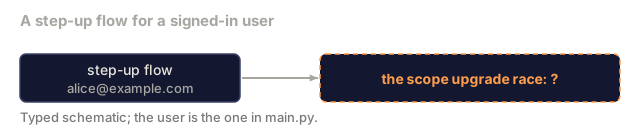
isscheck. A client that does not validate the RFC 9207issauthorization-response parameter against the issuer it recorded before redirecting can be steered into redeeming an honest AS's code at an attacker's token endpoint. This is a client-side failure; the resource server cannot compensate for it. - Scope upgrade race. Two concurrent step-up flows for the same user can both succeed and produce two access tokens with different scopes. The validator must use the token presented on the request, not look up "the user's current scope", which creates a TOCTOU window.
- Registration token theft. A leaked
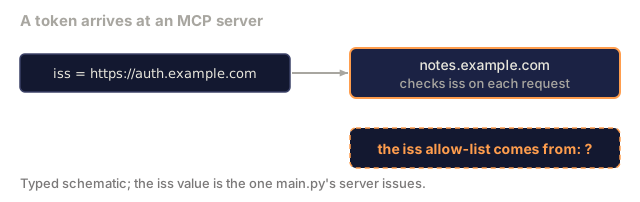
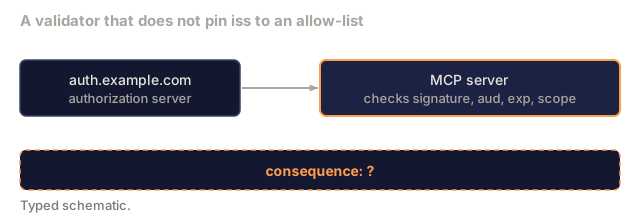
registration_access_tokenlets the attacker rewrite redirect URIs. Hash these at rest; require the client to present the cleartext on every update; rotate on suspicion. issnot pinned. A validator that accepts anyisslets an attacker stand up their own authorization server, register a client for the target audience, and issue tokens. The protected-resource metadata'sauthorization_serverslist is the allow-list; enforce it.
Use It
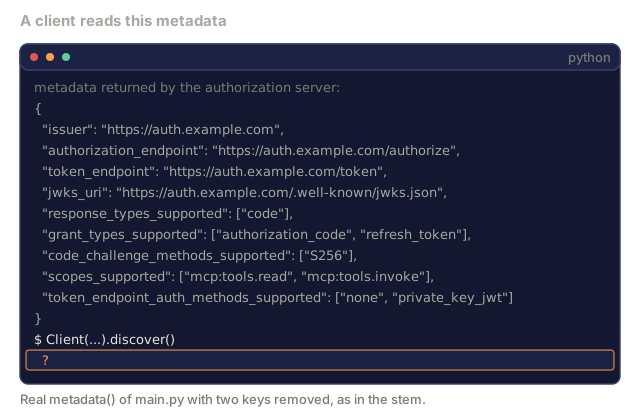
code/main.py walks the full production flow with stdlib Python and three roles: AuthorizationServer, ResourceServer, and Client. The flow:
- Authorization server publishes RFC 8414 metadata at
/.well-known/oauth-authorization-server. - MCP client calls the metadata endpoint and checks its enrollment options (
client_id_metadata_document_supportedfor CIMD,registration_endpointfor DCR) andS256PKCE support. - The walk-through takes the DCR fallback path: the client posts to
/register(RFC 7591) and receives aclient_id. (A CIMD client would instead present its own HTTPSclient_idURL and skip this step.) - MCP client runs PKCE-protected authorization code flow (RFC 7636) with
resourceindicator (RFC 8707). - MCP client calls a tool on the MCP server with
Authorization: Bearer .... - MCP server runs
validate, resolving the signing key from the JWKS cache. - The IdP rotates a key; the scheduled refresh re-pulls the JWKS into the cache.
- The next call validates against the refreshed keys without restart, and the previous token still validates during the overlap window.
- An audience-replay attempt against a different MCP resource gets 401 with
audience mismatchand aresource_metadatapointer.
The JWT here uses HS256 with a shared secret (so the code runs on stdlib only). Production uses RS256 or EdDSA with the JWKS pattern above; the validation logic is otherwise identical. Because the IdP and resource server live in one process, refresh_jwks reads the authorization server's key list directly; over the wire it is an HTTP GET to jwks_uri.
Ship It
This lesson produces outputs/skill-mcp-auth.md. Given an MCP server config and an IdP capability set, the skill emits the auth surface to stand up: the protected-resource metadata, the enrollment path to use (CIMD, pre-registration, or DCR fallback), the JWKS refresh schedule, the scope mapping, and the refusal rules to apply when the IdP does not support the full RFC profile.
I'd run main.py and read the output top to bottom before the prose. It asserts a 200 on the first call, again after the key rotation, and again on the fresh token, then asserts the 401 with audience mismatch when the same bearer hits the tasks server. If any of those flips, the printed step tells you which role broke.
The habit I'd take from it is keeping rotate_key and refresh_jwks far apart in your head. Rotation lives on AuthorizationServer, and the resource server only re-pulls what the IdP published. validate calls refresh_jwks on an unknown kid, so a junk kid costs one re-fetch and then a 401. The failure to avoid is wiring that path to a rotate.
The code is also a toy in a few specific ways. Tokens are HS256 with a shared secret so it runs on stdlib, and authorize computes a PKCE challenge it never checks. Enrollment goes through DCR because it fits in one process, and register_client skips rate limiting and software_statement. For a real deployment I'd start from CIMD, sign with RS256 or EdDSA, and treat those gaps as the work.
Exercises
-
Run
code/main.py. Trace the flow. Note how the IdP rotates a key in step 6, the scheduledrefresh_jwksre-pulls the published set, and both the old token (overlap window) and a fresh token validate without restart. -
Add a new IdP to the protected-resource metadata's
authorization_serverslist. Issue a token signed by the new IdP and confirm the validator accepts it. Issue a token signed by an unlisted IdP and confirm the validator rejects withWWW-Authenticate: Bearer error="invalid_token", error_description="iss not allowed". -
Add a rate-limit check to
register_clientthat runs before the registrar accepts a request. Use a token-bucket per source IP held in a small dict keyed by IP. -
Read RFC 7591 and identify two fields the
/registerhandler here does not validate. Add the validation. (Hint:software_statementandredirect_urisURI scheme.) -
Add a Client ID Metadata Document path. Serve a
client.jsonwhoseclient_idequals its own URL, and have the authorization server fetch and verify it (reject ifclient_id≠ URL). Confirm a CIMD client enrolls with noregister_clientcall. -
Prove the DoS fix. Send the validator a token with a random
kidand confirmrefresh_jwksruns at most once and the authorization server's key count does not grow. Then deliberately re-wire the fall-back to a rotate-and-mint and watch the key count climb per bogus token. Restore the re-fetch afterward. -
Implement the client-side RFC 9207
isscheck from the mix-up section: record the expected issuer before the authorization request, then reject an authorization response whoseissdoes not match.
Key Terms
| Term | What people say | What it actually means |
|---|---|---|
| ASM | "OAuth metadata document" | RFC 8414 /.well-known/oauth-authorization-server JSON |
| CIMD | "Client metadata URL" | Client ID Metadata Document, an HTTPS URL used as the client_id; the AS pulls the JSON. Recommended default since 2025-11-25 |
| DCR | "Self-service client registration" | RFC 7591 POST /register flow; demoted to a MAY fallback in 2025-11-25 |
| JWKS | "Public keys for JWT validation" | JSON Web Key Set, fetched from jwks_uri, indexed by kid |
| Rotate vs refresh | "Updating the keys" | Rotate = AS mints/retires signing keys; refresh = resource server re-fetches the published set. Resource servers only ever refresh |
| Resource indicator | "Audience parameter" | RFC 8707 resource parameter pinning the token to one server |
aud claim | "Audience" | JWT claim the validator compares against the canonical resource URL |
| Audience replay | "Token replay" | Token issued for Server A presented to Server B; defended by audience validation (spec: access-token privilege restriction) |
| Confused deputy | "Proxy token misuse" | An MCP proxy with a static client ID forwarding a token without per-client consent; distinct from audience replay |
| Mix-up attack | "Wrong token endpoint" | Client steered to redeem an honest AS's code at an attacker's endpoint; defended client-side via RFC 9207 iss |
iss allow-list | "Trusted authorization servers" | The set named in protected-resource metadata's authorization_servers |
resource_metadata | "Where to find the PRM doc" | WWW-Authenticate parameter naming the RFC 9728 metadata URL on a 401/403 |
| Public client | "Native or browser client" | OAuth client with no client_secret; PKCE compensates |
WWW-Authenticate | "401/403 response header" | Carries Bearer error=... directives that drive client recovery |
Further Reading
- MCP: Authorization spec (2025-11-25): the MCP auth profile this lesson implements
- MCP blog: One Year of MCP: November 2025 Spec Release: what changed in 2025-11-25 (CIMD, XAA, DCR demotion)
- Aaron Parecki: Client Registration in the November 2025 MCP Authorization Spec: the CIMD-over-DCR rationale
- OAuth Client ID Metadata Document (draft-ietf-oauth-client-id-metadata-document-00): CIMD
- RFC 8414: OAuth 2.0 Authorization Server Metadata: discovery contract
- RFC 7591: OAuth 2.0 Dynamic Client Registration Protocol: DCR (fallback path)
- RFC 7636: Proof Key for Code Exchange (PKCE): public-client proof-of-possession
- RFC 8707: Resource Indicators for OAuth 2.0: audience pinning
- RFC 9728: OAuth 2.0 Protected Resource Metadata: resource server discovery
- RFC 9207: OAuth 2.0 Authorization Server Issuer Identification: the
issparameter that defends against mix-up attacks - OAuth 2.1 draft: the consolidated OAuth substrate
Code
- main.py (python, 397 lines)