STaR, V-STaR, Quiet-STaR — Self-Taught Reasoning
The smallest possible self-improvement loop sits inside the rationale. A model generates a chain of thought, keeps the ones that land on correct answers, and fine-tunes on those. That is STaR. V-STaR adds a verifier so inference-time selection is better. Quiet-STaR pushes the rationale down to every token. All three improve benchmark scores, but none of them are magic: the loop preserves any shortcut that happened to reach the right answer.
Learning Objectives
- Describe the STaR loop, including rationalization, and say what it keeps and what it discards.
- Explain how V-STaR adds a DPO verifier for best-of-N selection and how Quiet-STaR moves rationales to every token position.
- Explain why an answer-conditioned gradient can reinforce shortcut rationales that generalize badly.
- Run the simulator and read the in-distribution versus OOD gap and the V-STaR best-of-N results.
- Name the process-supervised and OOD-evaluation checks you would add when auditing a self-training pipeline.
The Problem
The straightforward way to teach a model to reason is to collect human-written reasoning traces. That is expensive, slow, and bounded by how much high-quality chain-of-thought humans are willing to write.
STaR (Self-Taught Reasoner, Zelikman et al., 2022) asks: what if the model writes its own rationales and grades them against known answers? The loop is:
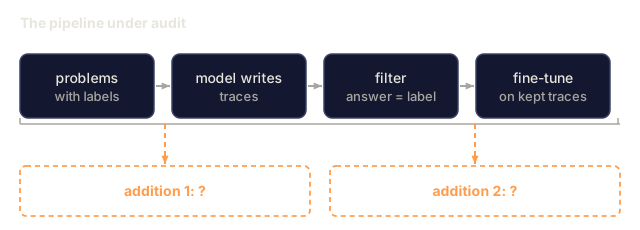
- Sample a reasoning trace plus answer.
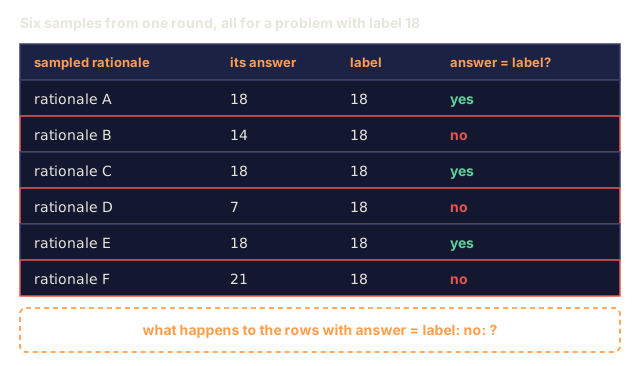
- If the final answer is correct, keep the trace.
- Fine-tune on the kept traces.
- Repeat.
It works. GSM8K and CommonsenseQA both improved without new human annotation. But the loop has a built-in bias: any rationale that produced the right answer is retained, regardless of whether the reasoning itself was sound. V-STaR (Hosseini et al., 2024) patches this with a learned verifier; Quiet-STaR (Zelikman et al., 2024) generalizes the idea to per-token internal rationales.
The Concept
STaR: bootstrap on what worked
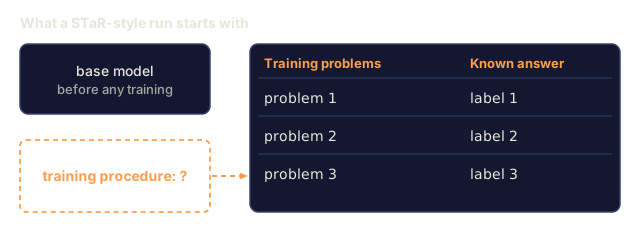
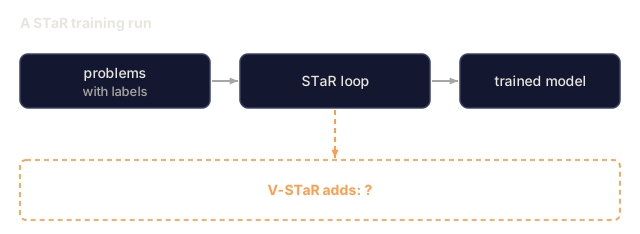
Start from a base model with some weak reasoning ability. On each training problem, sample a rationale plus answer. If the answer matches the label, keep the (problem, rationale, answer) triple. Fine-tune the model on the kept set. Repeat.
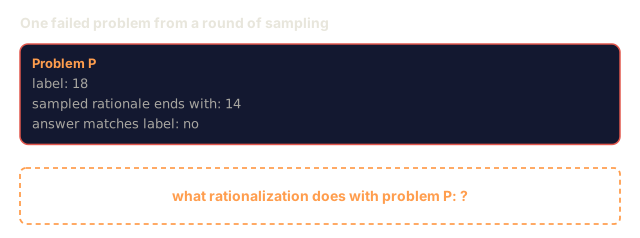
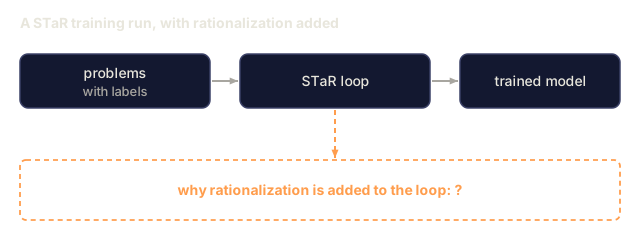
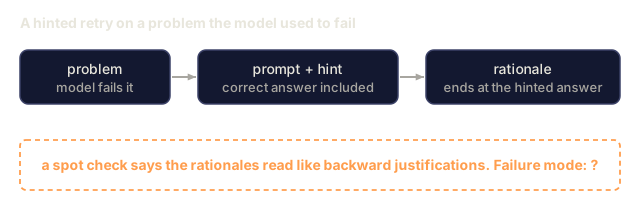
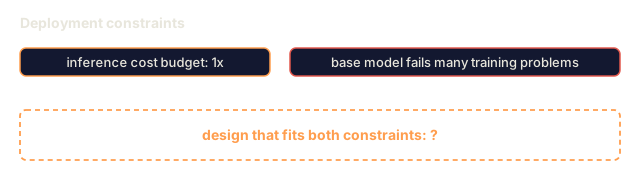
One twist matters. If the model can never get a problem right, the loop cannot learn on it. STaR adds rationalization: for problems the model fails, inject the correct answer as a hint and re-prompt the model to produce a rationale that leads to it. Rationalized rationales are added to the training set.
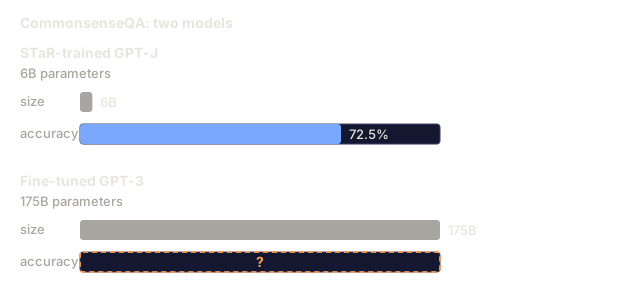
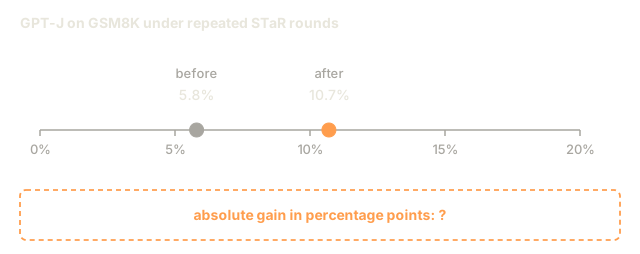
Result in the original paper (Zelikman et al., 2022): a GPT-J base model improved on GSM8K from 5.8% to 10.7% through repeated STaR rounds with rationalization, about 5 percentage points absolute. On CommonsenseQA, STaR-trained GPT-J 6B reached 72.5%, comparable to a fine-tuned GPT-3 175B (~73%), a roughly 30x larger model trained on hand-annotated rationales.
V-STaR: train a verifier with DPO
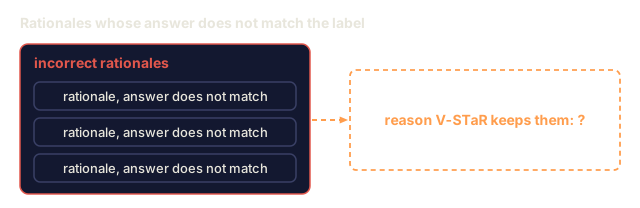
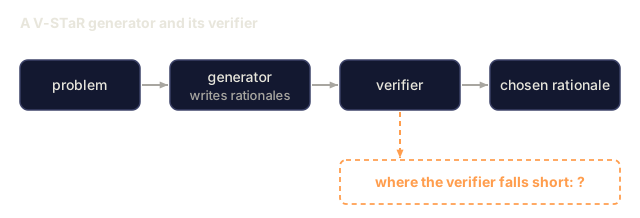
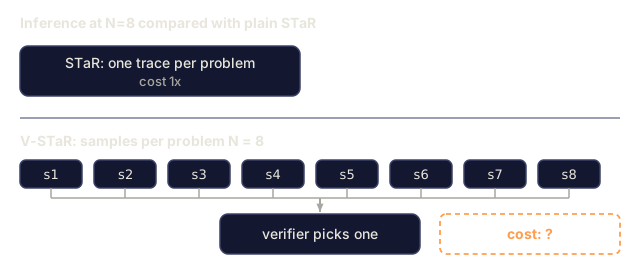
STaR throws away incorrect rationales. Hosseini et al. (2024) observed those are also data: every pair of (rationale, "is this correct") can train a verifier. They use Direct Preference Optimization over both correct and incorrect solutions to build a ranker. At inference time, sample N rationales and pick the verifier's top choice.
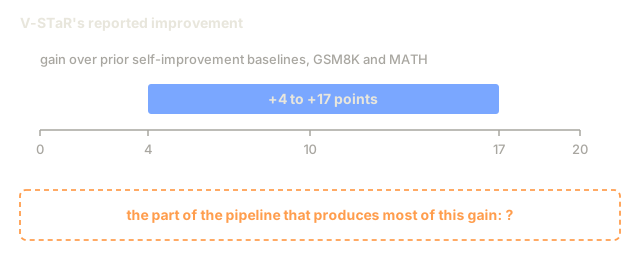
Reported delta: +4 to +17 percentage points over prior self-improvement baselines on GSM8K and MATH, with most of the gain coming from using the verifier for inference-time selection rather than for additional generator fine-tuning.
Quiet-STaR: per-token internal rationales
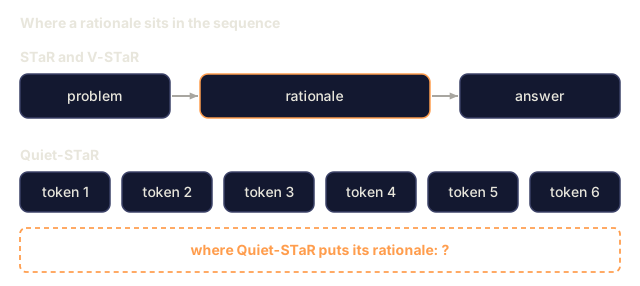
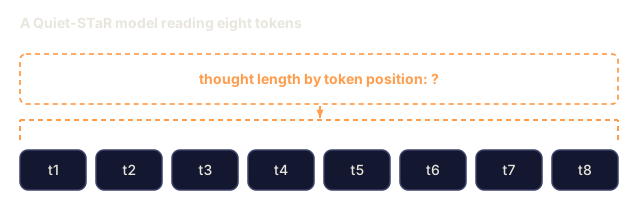
Zelikman et al. (2024) asked: what if the model learns to generate a short internal rationale at every token position, not just between problem and answer? Quiet-STaR trains a model to emit a hidden "thought" before each predicted token, then mixes the thought-aware prediction with the baseline prediction via a learned weight.
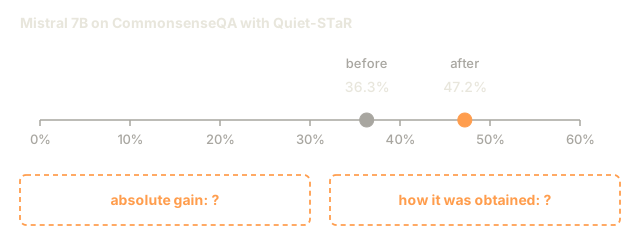
Result: Mistral 7B gained absolute zero-shot improvements on GSM8K from 5.9% to 10.9% and CommonsenseQA from 36.3% to 47.2% without task-specific fine-tuning. The model learned "when to think": hard tokens get longer internal rationales; easy ones get almost none.
Why all three share a safety concern
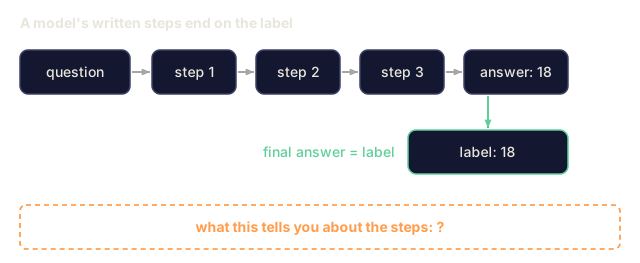
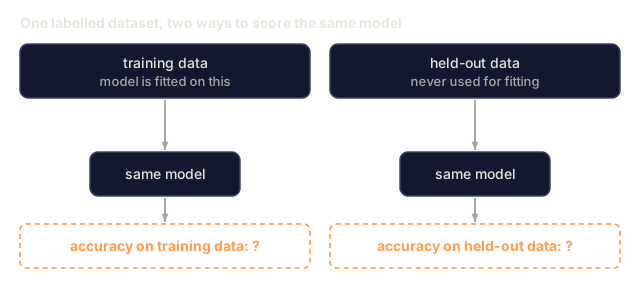
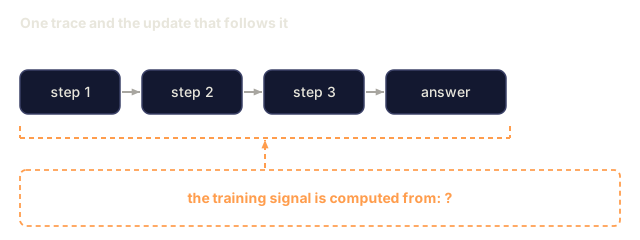
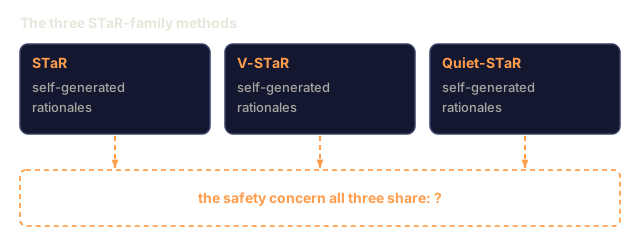
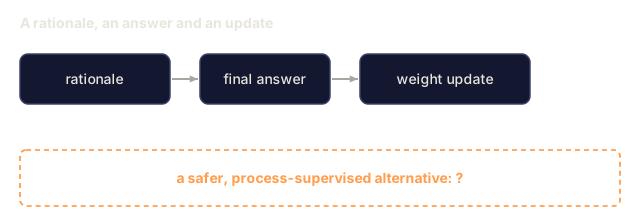
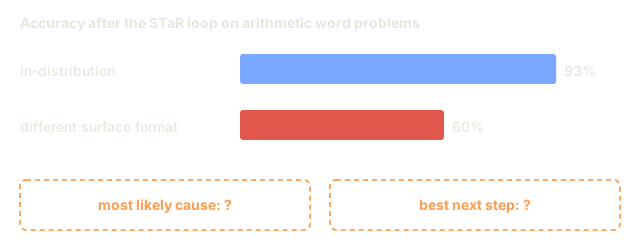
All three methods use the final answer as the gradient signal. A rationale that reaches the right answer via flawed reasoning (exploiting a shortcut, guessing, or using a non-generalizing pattern) gets positively reinforced. On in-distribution problems the shortcut works. On out-of-distribution problems it breaks silently.
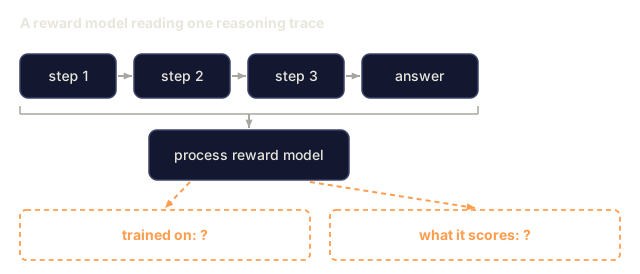
V-STaR's verifier mitigates by learning to rank rationales, but the verifier is trained on the same label set. It can learn to prefer well-formatted wrong reasoning over honest uncertainty. The safer design is to combine STaR-style data with (a) process-supervised reward models (rewarding intermediate steps, not just answers) and (b) held-out OOD evaluation that breaks simple shortcuts.
Comparison
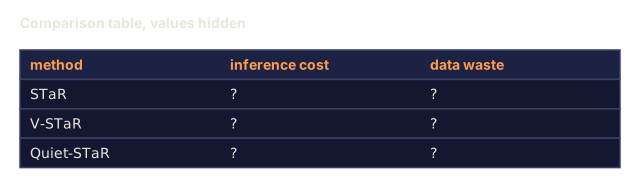
| Method | Training signal | Inference cost | Data waste | Known failure mode |
|---|---|---|---|---|
| STaR | keep (rationale, answer) if correct | 1x | discards all incorrect rationales | shortcut rationales |
| STaR + rationalization | above + correct-answer hinted retries | 1x | less | rationalized rationales may be implausible |
| V-STaR | STaR + DPO verifier from both classes | Nx (best-of-N) | minimal | verifier can reinforce confident wrongness |
| Quiet-STaR | per-token rationale + mixing weight | 1.5-3x | minimal | still answer-conditioned gradient |
Where this sits in the 2026 stack
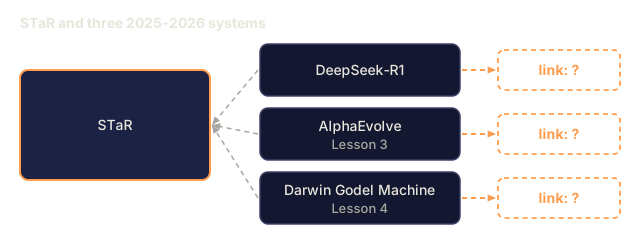
STaR is old. But the pattern reappears everywhere in 2025-2026. RL on verifiable math problems (DeepSeek-R1, Kimi-k1.5, o1) is STaR's answer-conditioned gradient signal, scaled up. Process reward models (Lightman et al., 2023; OpenAI's "Let's verify step by step") are the process-supervised alternative. AlphaEvolve (Lesson 3) is STaR for code, with a program evaluator instead of a label. Darwin Godel Machine (Lesson 4) is STaR for the agent scaffolding itself.
Understanding STaR makes all of these click. It is the minimum-viable self-improvement loop.
Use It
code/main.py runs a simulated STaR loop on a toy arithmetic task. You can watch:
- How accuracy climbs over bootstrap rounds.
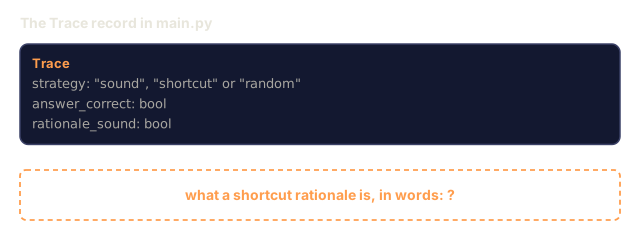
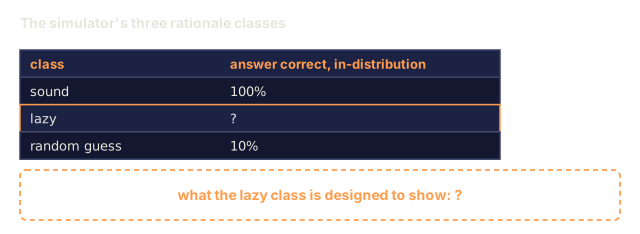
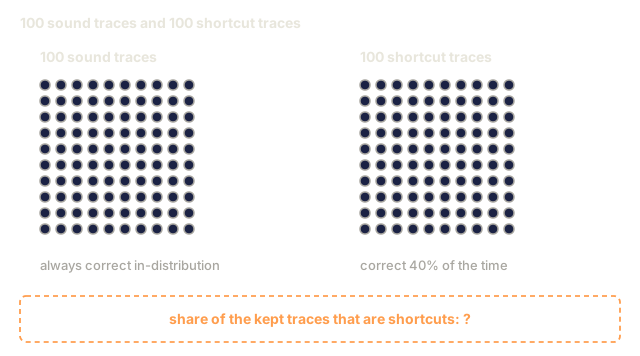
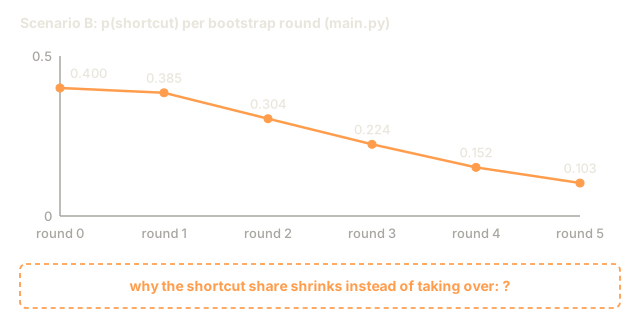
- How shortcuts sneak in: the simulator includes a "lazy" rationale class that gets the right answer 40% of the time but generalizes badly. Watch how large a share of the kept traces they make up from round to round.
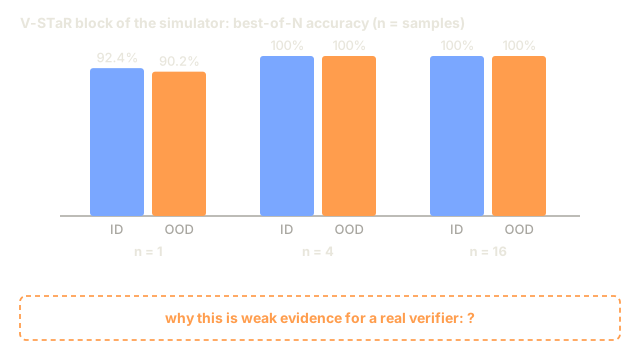
- How a verifier (V-STaR style) helps at inference but cannot fully prune shortcuts introduced during training.
Ship It
outputs/skill-star-loop-reviewer.md helps you audit a proposed self-taught-reasoning pipeline before you train on it.
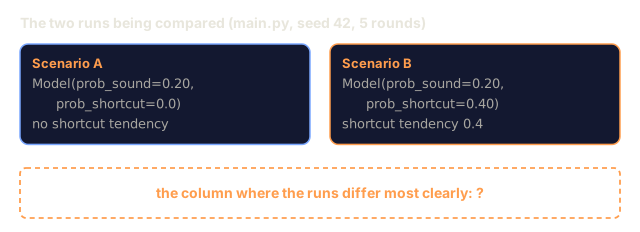
I'd run main.py and read the Scenario A and Scenario B tables side by side before anything else. A starts with no shortcut tendency, B starts with a shortcut probability of 0.4, and the OOD column is where they differ.
Before you go hunting for the failure, know that in this simulator the shortcut share shrinks over the rounds instead of growing. A sound trace is always correct and a shortcut trace is correct 40% of the time in-distribution, so the keep filter favors sound traces. What the shortcut buys is a head start on in-distribution accuracy and an OOD gap (its OOD hit rate is 5%) that narrows but is still there at round 5. That is weaker than the headline the script prints at the bottom. To see a shortcut win you would have to give sound traces a hit rate below the shortcut's, which means editing Model.sample.
I'd also not read much into the V-STaR block. In my run it reaches 100% at n=4 and n=16 on both sets, but the verifier reads the ground-truth rationale_sound flag, which its docstring calls an upper bound. A real verifier has to infer soundness from the trace itself, and that is the case the body worries about.
Exercises
-
Run the simulator. Set the shortcut frequency to zero, then to 0.4. How much does final accuracy diverge between the two runs, even though both hit >90% on the training distribution?
-
Add a held-out OOD test to the simulator. Draw problems from a different distribution and evaluate the bootstrapped model on both in-distribution and OOD sets. Quantify the gap.
-
Read the Quiet-STaR paper (arXiv:2403.09629) Section 3. Explain the "end-of-thought" token and the mixing-weight head in three sentences each.
-
Compare STaR's keep-if-correct filter to a process-supervised alternative that rewards each rationale step independently. Identify the labelling cost difference and the plausible quality difference.
-
Design one evaluation that would catch shortcut rationales in a deployed model. It does not have to be perfect, it has to break the simplest shortcuts a STaR loop would reinforce.
Key Terms
| Term | What people say | What it actually means |
|---|---|---|
| STaR | "Self-Taught Reasoner" | Fine-tune on model-generated rationales that land correct answers; repeat |
| Rationalization | "Hinted retry" | Inject the correct answer and re-prompt for a rationale on problems the base model fails |
| V-STaR | "Verifier STaR" | DPO-train a verifier on both correct and incorrect rationales, use it for inference-time selection |
| Quiet-STaR | "Per-token rationales" | Generate hidden thoughts at every token position; mix with baseline prediction |
| Answer-conditioned gradient | "Outcome-based signal" | The training loop rewards final answers, not reasoning steps |
| Process reward model | "Step-level verifier" | Reward model trained on per-step correctness, not outcome. Contrasts with STaR |
| Shortcut rationale | "Right answer, wrong reasoning" | A rationale that reaches the label via a non-generalizing pattern; STaR keeps these |
Further Reading
- Zelikman et al. (2022). STaR: Bootstrapping Reasoning With Reasoning: the original paper.
- Hosseini et al. (2024). V-STaR: Training Verifiers for Self-Taught Reasoners: adds a DPO verifier for inference-time selection.
- Zelikman et al. (2024). Quiet-STaR: Language Models Can Teach Themselves to Think Before Speaking: per-token internal rationales.
- Lightman et al. (2023). Let's Verify Step by Step: process reward models, the alternative gradient signal.
- DeepSeek-R1 paper (arXiv:2501.12948): RL on verifiable tasks, STaR scaled to frontier training.
Code
- main.py (python, 180 lines)