Agent Economies, Token Incentives, Reputation
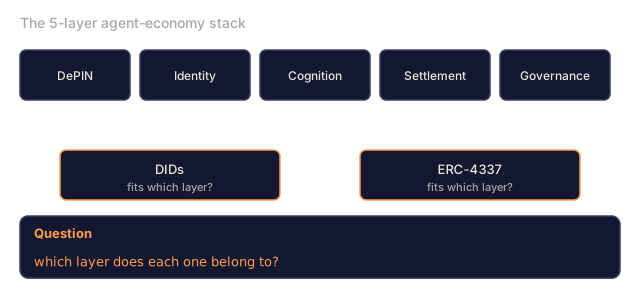
Long-horizon autonomous agents (METR's 1-hour to 8-hour work curve) need economic agency, and a 5-layer stack is emerging to give it to them: **DePIN** for physical compute, **Identity** (W3C DIDs plus reputation capital), **Cognition** (RAG and MCP), **Settlement** (account abstraction), and **Governance** (Agentic DAOs). Production networks already pay agents for work: **Bittensor** (TAO subnets reward task-specific models), **Fetch.ai / ASI Alliance** (ASI-1 Mini LLM and the FET token), and **Gonka** (transformer-based PoW that points compute at useful AI tasks). The academic side is just as concrete. AAMAS 2025's decentralized LaMAS uses **Shapley-value credit attribution** to reward contributing agents fairly, and Google Research's "Mechanism design for large language models" proposes **token auctions** with second-price payment under monotone aggregation. Here you build a minimal agent marketplace, attribute credit across a three-agent pipeline with Shapley values, and run a second-price auction, so the game theory has something to run on.
Learning Objectives
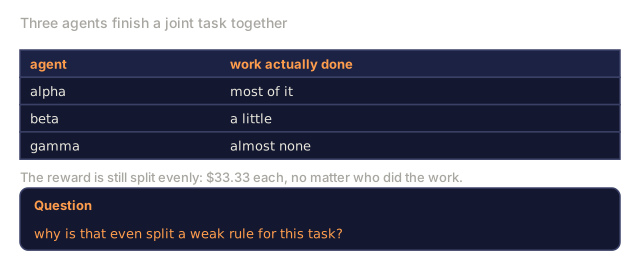
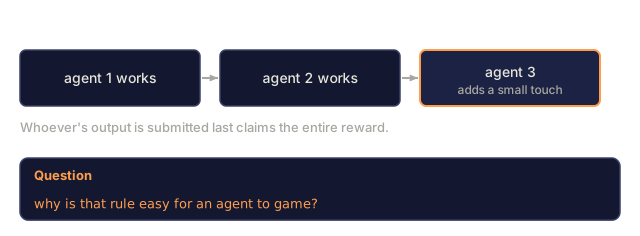
- Explain why equal splits and last-contributor-takes-all fail for joint work, and how Shapley values attribute credit fairly.
- Compute exact Shapley values for three agents and say when to switch to sampled orderings.
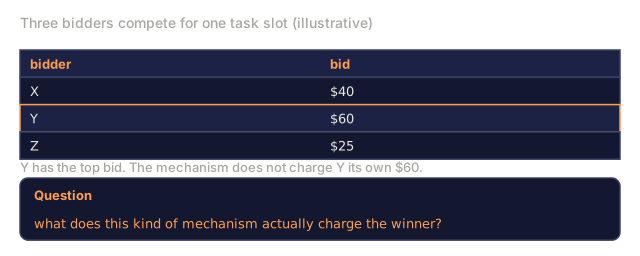
- Describe how a second-price auction pays the winner and why it is truthful under monotone aggregation.
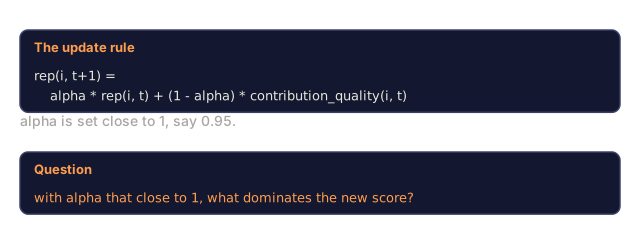
- Apply the reputation update rule rep(i, t+1) = alpha * rep(i, t) + (1 - alpha) * contribution_quality(i, t) and predict the effect of alpha.
- Run main.py and tie its Shapley, auction, and reputation-routing output to the 5-layer stack and the failure modes in the Concept section.
Problem
Multi-agent systems get awkward when agents produce value jointly but have to be rewarded individually. The classical fixes, an equal split or last-contributor-takes-all, are unfair or easy to game. Coalition-based rewarding with Shapley values is fair by construction but expensive to compute. The 2025-2026 literature leans on approximations: Shapley sampling, monotone aggregation auctions, and on-chain reputation that accrues from confirmed contributions.
The field has also moved on to agents that transact for real. Bittensor TAO rewards miners who fine-tune subnet-specific models, Fetch.ai/ASI pays out FET tokens for ASI-1 Mini LLM usage, and Gonka reallocates transformer proof-of-work toward productive AI tasks. Autonomous paying agents exist today, so the open question is how to align their incentives.
I treat agent economies here as three problems: credit attribution, mechanism design, and reputation. Each gets the smallest piece of math that makes it work.
Concept
The 5-layer agent-economy stack
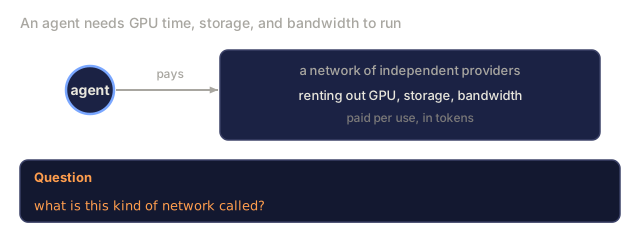
- DePIN (physical compute). Decentralized infrastructure that rents GPU, storage, and bandwidth: Bittensor subnets, Render Network, Akash. It isn't agent-specific, but agents use it.
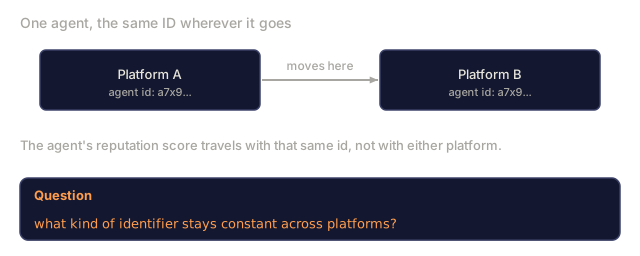
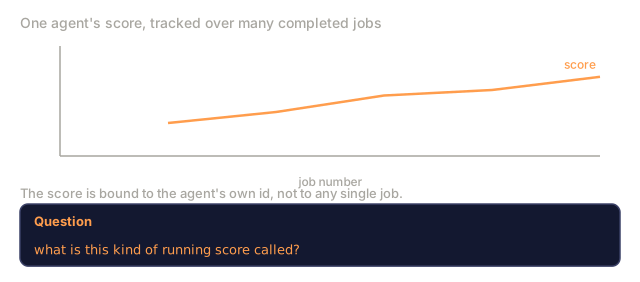
- Identity. W3C Decentralized Identifiers (DIDs) give each agent a durable ID independent of any platform, and reputation accrues to the DID. The Agent Network Protocol (ANP) uses DIDs as its discovery layer.
- Cognition. The agent's reasoning loop: LLM + RAG + MCP. The other phases build this layer.
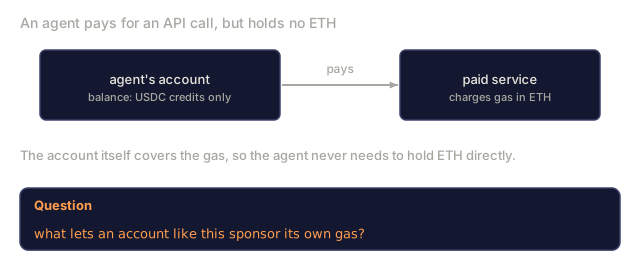
- Settlement. Account abstraction (ERC-4337) lets agents pay gas from their own balances without holding ETH, so they can pay for services, for each other, or for compute.
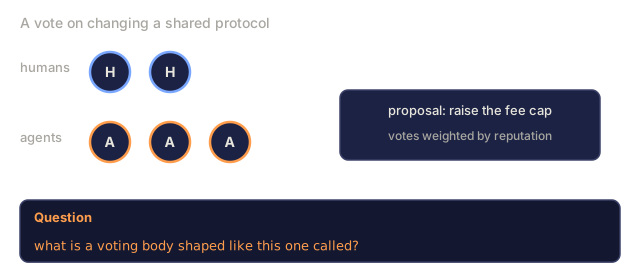
- Governance. Agentic DAOs, where humans and agents vote on protocol changes and voting power follows reputation.
Few production systems use all five. Bittensor uses layers 1 and 2, part of 3 and part of 4, and none of 5. OpenAI agents use only 3. Treat the stack as a reference map, not a checklist.
Bittensor, Fetch.ai, Gonka: what runs
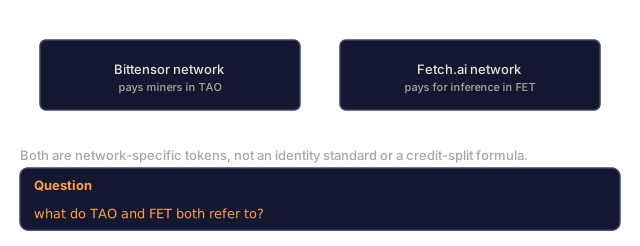
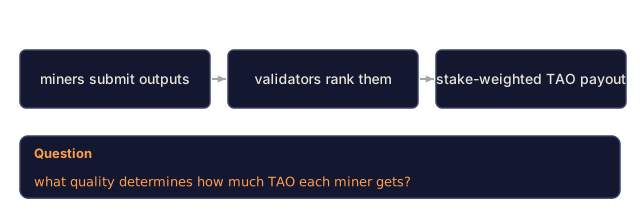
Bittensor (TAO). Subnets are specialized tasks such as language modeling, image generation, and forecasting. Miners submit model outputs, validators rank them, and stake-weighted scoring distributes the TAO rewards. Each subnet has its own evaluation. The economic lesson is to pay for task-specific output quality, not for compute used.
Fetch.ai / ASI Alliance. The ASI-1 Mini LLM runs on Fetch.ai's network, and users pay FET tokens for inference. The agents-as-peers story is stronger here: an agent on Fetch can call another agent for a task and pay in FET.
Gonka. Transformer proof-of-work, where the "work" is forward passes of a transformer. Miners earn by running inference tasks that have known correct outputs (taken from training data). It is resource-productive PoW in place of hash-based PoW.
All three were production-grade as of April 2026, but they pay out differently. Bittensor rewards quality relative to subnet validators, Fetch rewards utility as measured by paying users, and Gonka rewards verifiable inference work.
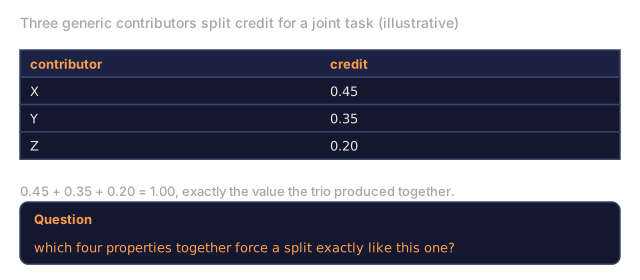
Shapley-value credit attribution
Three agents collaborate on a task and the output scores 0.8. Who contributed what?
The Shapley value is the unique credit allocation that satisfies four axioms: efficiency, symmetry, linearity, and null. For agent i:
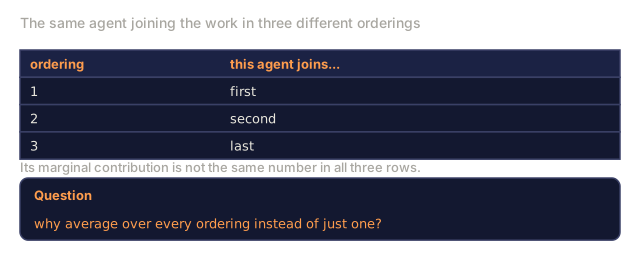
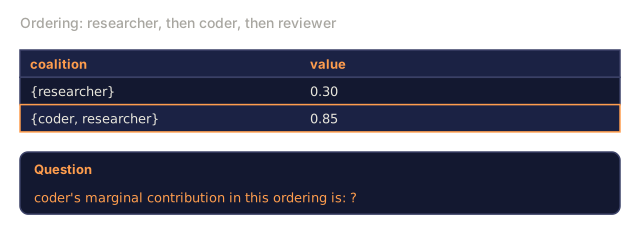
shapley(i) = (1/N!) * sum over all orderings O of (v(S_i_O ∪ {i}) - v(S_i_O))
where S_i_O is the set of agents before i in ordering O. In practice you enumerate all permutations, record each agent's marginal contribution in each one, and average.
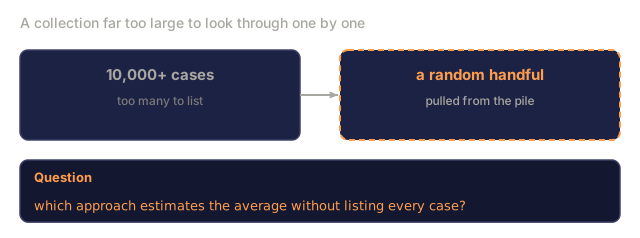
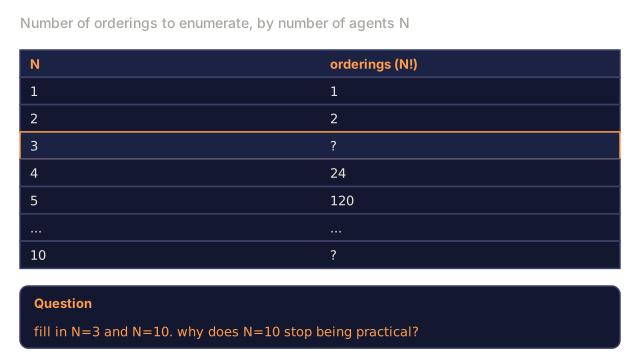
N=3 gives 6 permutations. N=10 gives 3.6M, so at that size you sample orderings instead of enumerating them.
Second-price auction for aggregation
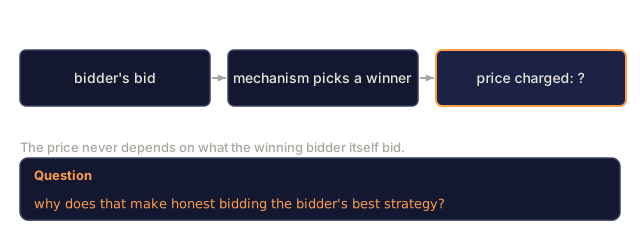
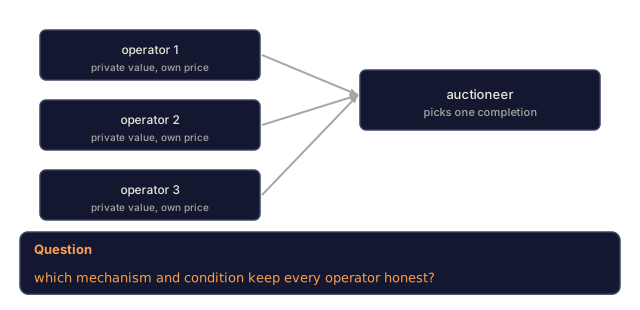
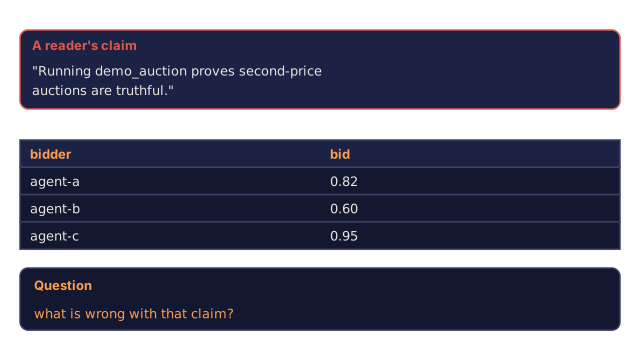
Google Research ("Mechanism design for large language models") proposes second-price token auctions for aggregating LLM outputs. Each of N agents proposes a completion and holds a private value for being selected. The auctioneer picks the highest-value proposal and pays the second-highest value. When aggregation is monotone (value depends on which proposal is chosen, not on how many were bid), the mechanism is truthful: agents bid their true value.
For LLM systems this means you can outsource completions to several agents with different pricing. The auction picks the best one, pays fairly, and gives nobody a reason to misreport.
Reputation capital
A DID-bound reputation score accumulates from confirmed contributions. A simple update rule:
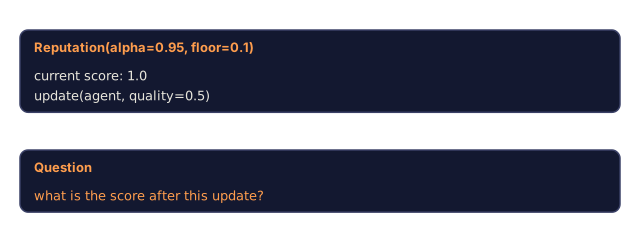
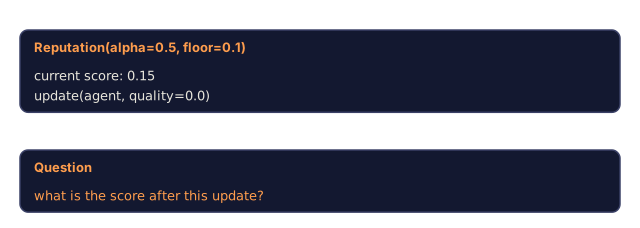
rep(i, t+1) = alpha * rep(i, t) + (1 - alpha) * contribution_quality(i, t)
Keep the decay factor alpha close to 1. Reputation has three useful properties:
- It's cheap to read for routing decisions ("send hard tasks to high-rep agents").
- It's expensive to forge, because it accumulates over time and is bound to a DID.
- It can be slashed: contributions that fail verification subtract from it.
AAMAS 2025 decentralized LaMAS
The LaMAS proposal (AAMAS 2025) combines DID identity, Shapley-value credit attribution, and a simple auction mechanism. Its key claim is that decentralizing the credit attribution step makes the system auditable and resistant to manipulation at a single point.
Where the economics falls apart
- Price oracle manipulation. If the credit function can be gamed, agents will game it. Every mechanism needs an adversarial test.
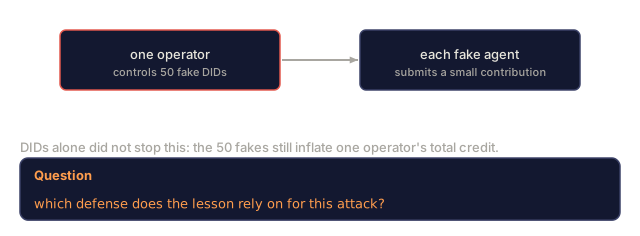
- Sybil attacks. One operator spins up N fake agents to inflate their own contribution. DIDs slow this down without stopping it, and the real mitigation is the cost of forging reputation.
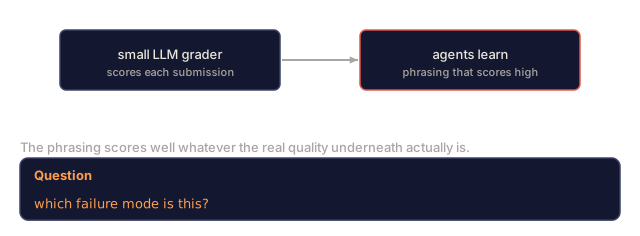
- Verification cost. Credit attribution is only as fair as its verifier. A cheap verifier (a small LLM) can be gamed, and an expensive one (a human panel) doesn't scale.
- Regulatory overhang. Agent economies run into financial regulation. As of 2026, Bittensor, Fetch, and Gonka all operate in legal gray areas in some jurisdictions.
When agent economies make sense
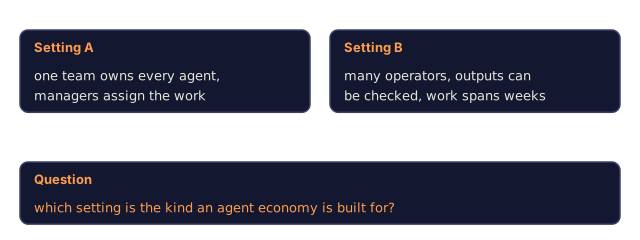
- Open networks with heterogeneous operators. No single team controls all the agents.
- Verifiable outputs. Without verification, credit attribution is a guess.
- Long-horizon workflows. One-shot tasks gain nothing from accumulated reputation.
- Legally viable tokenized payments in your jurisdiction.
Closed corporate systems fall back on simpler allocation: managers assign work and the metrics are internal. The economics literature mostly applies to open networks.
Build It
code/main.py implements:
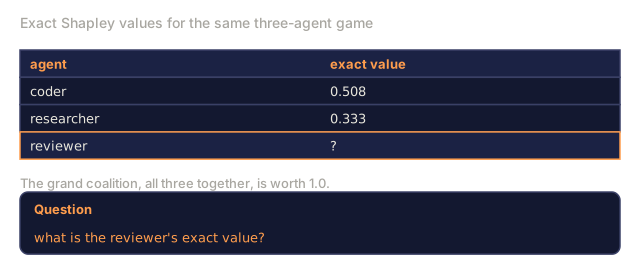
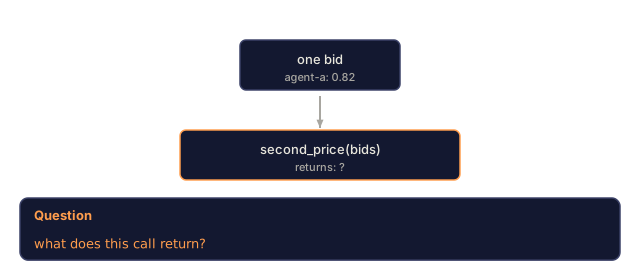
shapley_exact(value_fn, agents)computes exact Shapley values by enumerating permutations.shapley_sampled(value_fn, agents, samples, rng)averages marginal contributions over random orderings instead.second_price(bids)is the truthful mechanism: the winner pays the second-highest bid.Reputationkeeps a per-agent score with exponential decay and a floor.- Demo 1: three agents collaborate, and both exact and sampled Shapley attribute the credit.
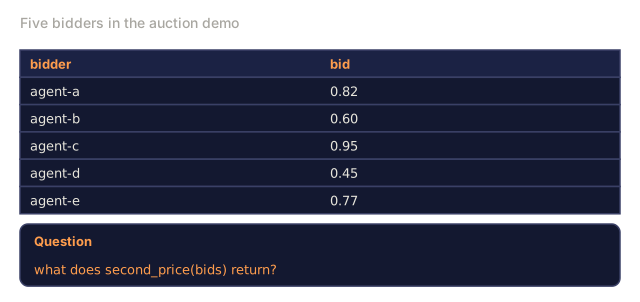
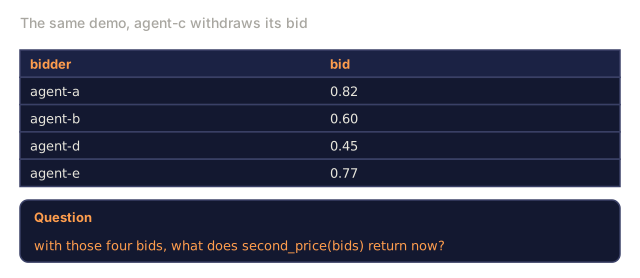
- Demo 2: five agents bid for a task slot, and the second-price auction picks the winner and the payment.
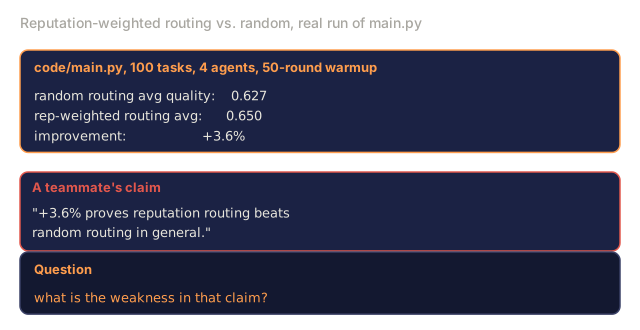
- Demo 3: 100 rounds of task assignment to agents with different true quality, comparing random routing against reputation-weighted routing after a 50-round warmup.
Run:
python3 code/main.py
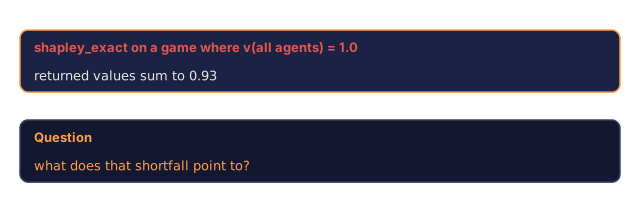
Expected output: Shapley values for each agent that sum to the grand-coalition value of 1.0; an auction where agent-c wins and pays 0.82; and reputation-weighted routing that edges out random routing by a few percent (+3.6% with the seed in the file).
Use It
outputs/skill-economy-designer.md designs a minimal agent economy. It picks the identity layer, the credit attribution mechanism, the payment mechanism, and the reputation rule.
Ship It
Running an agent economy in 2026:
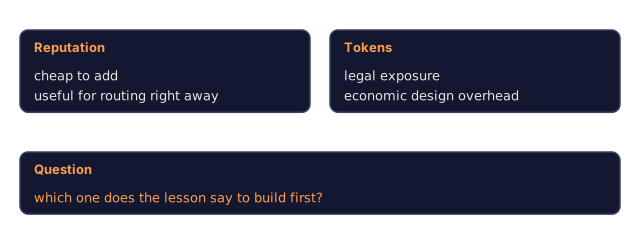
- Start with reputation, not tokens. Reputation is cheap to implement and useful on its own. Tokens add legal and economic complexity.
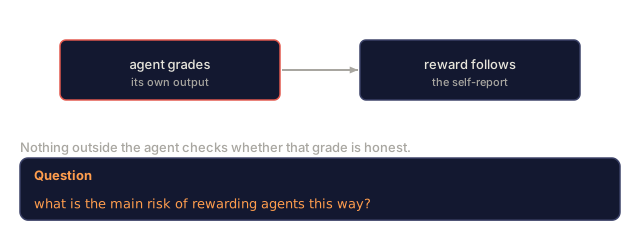
- Verify before you reward. Don't distribute credit without an independent verification step. Self-reported quality invites sybil games.
- Sample Shapley, don't enumerate it. Draw 100-1000 orderings, because exact enumeration doesn't scale.
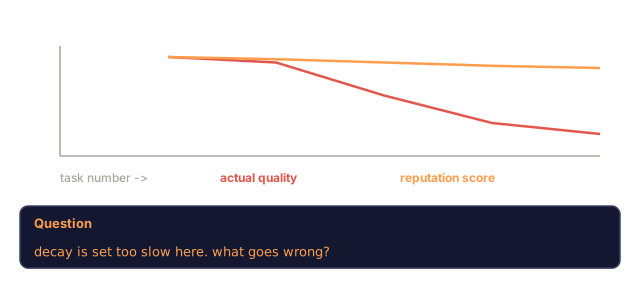
- Cap the decay factor and floor reputation. Unbounded decay wipes out legitimate contributors, while decay that is too slow keeps stale high-rep agents on top.
- Audit mechanisms adversarially. Red-team the design before you open the network. Every mechanism has a game theory, and you want to find the holes before an attacker does.
I'd run main.py first and look at the Shapley block before touching the auction. The value function in demo_shapley has superadditive pairs, and the exact values still sum to the grand-coalition value of 1.0, so you can see the efficiency axiom hold on real numbers. The sampled run with 200 orderings lands within about 0.005 of each exact value on this three-agent game, which is the argument for sampling once N gets big.
The reputation demo is the part I'd read most skeptically. The Reputation class has a decay factor and a floor, but no slashing, so the slashing described in the Concept section is something you would add yourself. The routing gain is also small, +3.6% over random with the seed in the file, and it comes from one run on four agents with four fixed true qualities. I'd treat it as a sanity check that the update rule routes toward better agents, not as a benchmark.
One more thing to keep in proportion: second_price just sorts the bids and charges the runner-up. It shows the payment rule, not truthfulness, since every bidder in the demo already bids a fixed number. Exercise 4 is where you find out what breaks the guarantee.
Exercises
- Run
code/main.py. Confirm Shapley values sum to total value (efficiency axiom). Change the value function; do Shapley allocations change in the expected direction? - Implement Shapley sampling (Monte Carlo over K orderings). How does K affect approximation accuracy? Compare to exact for N=4.
- Implement a coalition-forming step before the auction: agents can merge into teams and bid as a unit. Which coalitions form? Is the outcome Pareto-better than individual bidding?
- Read the Google Research mechanism-design post. Identify one assumption that, if violated, breaks truthfulness. What does that failure mode look like in an LLM setting?
- Read the AAMAS 2025 decentralized LaMAS paper. Implement their Shapley step over 10 agents on a synthetic task. How long does exact computation take? How close does sampling get with 100 draws?
Key Terms
| Term | What people say | What it actually means |
|---|---|---|
| DePIN | "Decentralized physical infrastructure" | Token-incentivized compute/storage/bandwidth. Bittensor, Akash, Render. |
| DID | "Decentralized identifier" | W3C spec for portable IDs. Agent reputation binds to DID, not to a platform. |
| ERC-4337 | "Account abstraction" | Contract accounts that can sponsor gas, enabling agent payments. |
| Shapley value | "Fair credit attribution" | Unique allocation satisfying efficiency, symmetry, linearity, null. |
| Second-price auction | "Vickrey auction" | Truthful mechanism: winner pays second-highest bid. Monotone aggregation compatible. |
| Reputation capital | "Accumulated quality score" | DID-bound score from confirmed contributions; decays over time. |
| Agentic DAO | "Agents + humans govern" | DAO with agent voters as first-class, voting power tied to reputation. |
| TAO / FET / GPU credits | "Token denominations" | Bittensor TAO, Fetch.ai FET, various DePIN tokens. |
Further Reading
- The Agent Economy: 2026 survey of the 5-layer agent-economy stack
- Google Research: Mechanism design for large language models: token auctions with monotone aggregation
- AAMAS 2025: decentralized LaMAS: Shapley-value credit attribution
- Bittensor TAO documentation: subnet structure and reward distribution
- Fetch.ai / ASI Alliance: ASI-1 Mini LLM and FET token
- W3C Decentralized Identifiers (DIDs) spec: identity foundation
Code
- main.py (python, 202 lines)