Video Understanding — Temporal Modeling
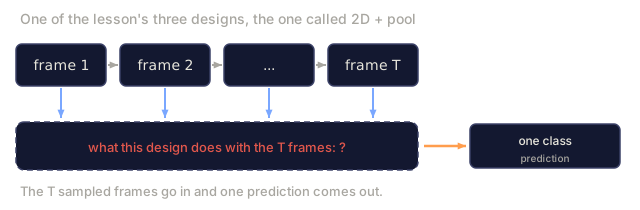
A video is a sequence of images plus the physics connecting them. Every model handles that connection one of three ways: time as an extra axis (3D conv), a sequence to attend over (transformer), or a feature extracted once per frame and pooled (2D+pool).
Learning Objectives
- Distinguish the three main video-modelling approaches (2D+pool, 3D conv, spatio-temporal transformer) and predict their cost and accuracy trade-offs
- Implement frame sampling, temporal pooling, and a 2D+pool baseline classifier in PyTorch
- Explain why I3D's "inflated" 3D kernels transfer well from ImageNet weights and what a factorised (2+1)D conv does differently
- Read the standard action-recognition datasets and metrics: Kinetics-400/600, UCF101, Something-Something V2; top-1 accuracy at the clip and video level
The Problem
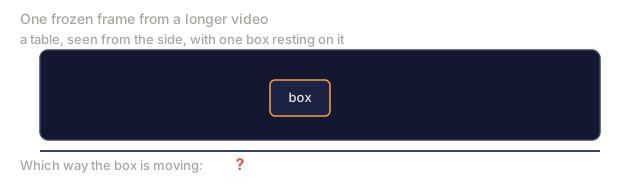
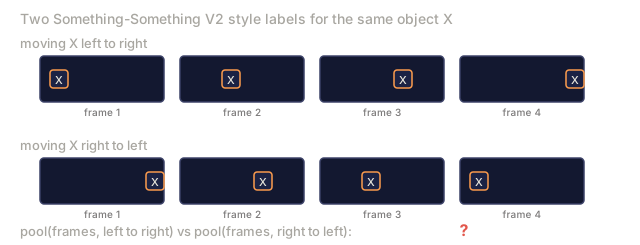
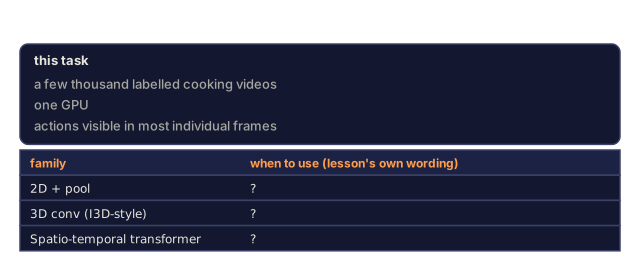
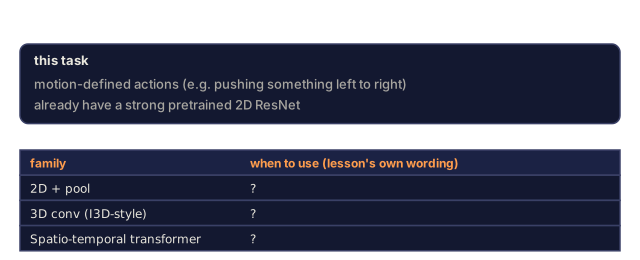
A 30-second video at 30 fps is 900 images. Naively, video classification is just image classification run 900 times, then some kind of aggregation on top. That works fine when the action is visible in almost every frame: sports, cooking, exercise videos. It fails badly when the action is defined by motion itself — freeze any single frame of "pushing something from left to right" and all you get is two still objects, no motion in sight.
The core question for every video architecture is when temporal structure gets modelled, and how. That answer drives everything downstream: compute cost, pretraining strategy, whether you can reuse ImageNet weights, what datasets the model can even learn from.
The 2D CNN backbones and ImageNet pretraining from earlier lessons carry over untouched. What's different here is entirely about time: how you sample it, how you model it, and how you pool it back down to a single prediction.
The Concept
The three architectural families

2D + pool
Take a 2D CNN (ResNet, EfficientNet, ViT) and run it independently on every sampled frame. Average (or max-pool, or attention-pool) the per-frame embeddings, then feed the pooled vector to a classifier.
Pros:
- ImageNet pretraining transfers directly.
- Simplest to implement.
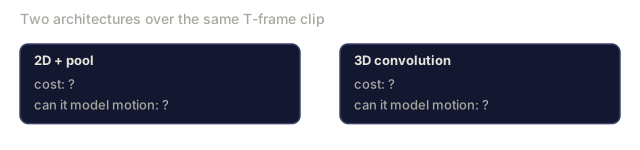
- Cheap: T frames times single-image inference cost.
Cons:
- Cannot model motion: an action is just an aggregate of appearances here.
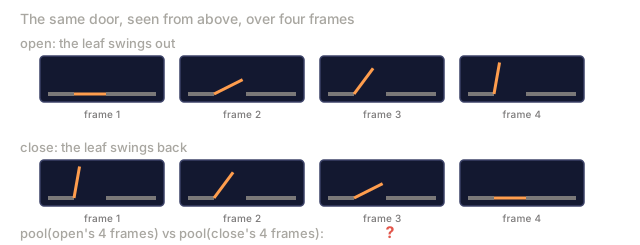
- Temporal pooling is order-invariant, so "open door" and "close door" look the same.
When to use: appearance-heavy tasks, transfer learning on small video datasets, initial baselines.
3D convolutions
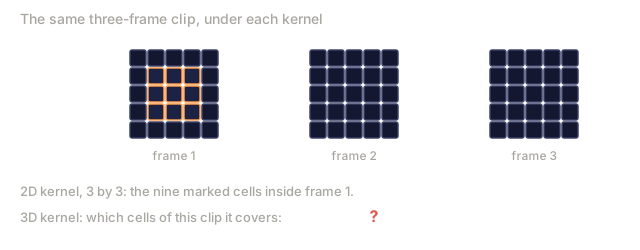
Replace 2D (H, W) kernels with 3D (T, H, W) kernels, so the network convolves over both space and time. Early family: C3D, I3D, SlowFast.
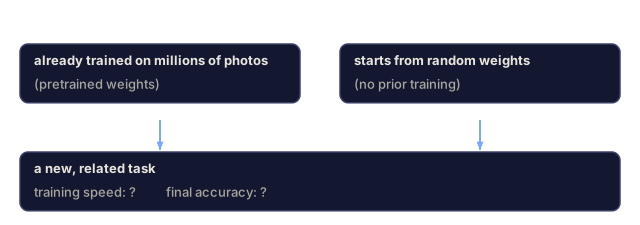
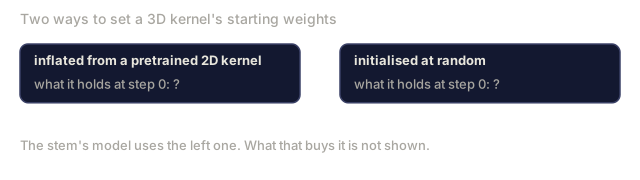
I3D's trick: take a pretrained 2D ImageNet model and "inflate" each 2D kernel by copying it along a new time axis, so a 3x3 2D conv becomes a 3x3x3 3D conv. That hands the 3D model strong pretrained weights instead of forcing it to train from scratch.
Pros:
- Directly models motion.
- I3D inflation gives free transfer learning.
Cons:
- T/8 more FLOPs than the 2D counterpart (for a temporal kernel of 3 stacked 3 times).
- Temporal kernels are small; long-range motion needs a pyramid or dual-stream approach.
When to use: action recognition where motion is the signal (Something-Something V2, Kinetics with motion-heavy classes).
Spatio-temporal transformers
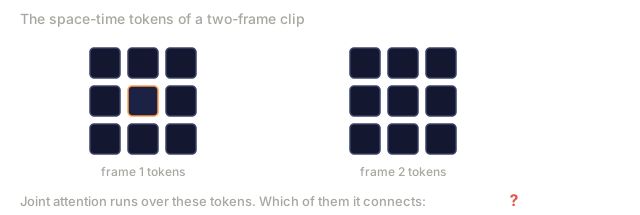
Tokenise the video into a grid of space-time patches and attend across all of them, meaning each patch weighs every other patch by learned similarity: TimeSformer, ViViT, Video Swin, and VideoMAE are all variations on this idea.
Attention patterns that matter:
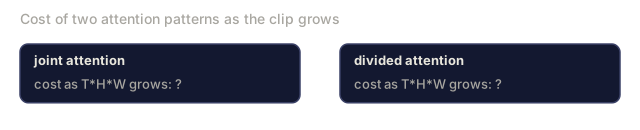
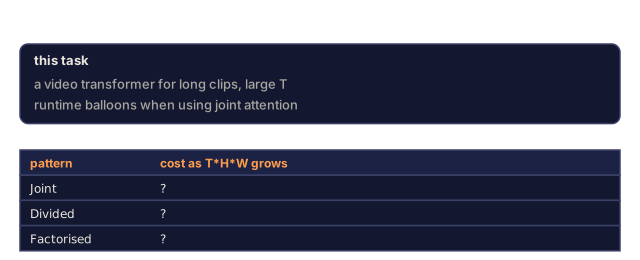
- Joint: one big attention over (t, h, w), quadratic in
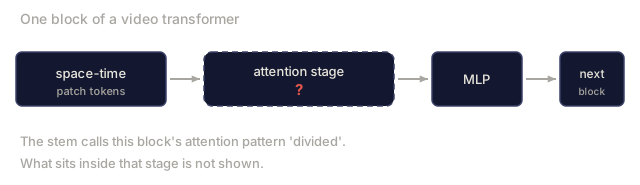
T*H*Wand expensive. - Divided: two attentions per block, one over time and one over space, which scales roughly linearly.
- Factorised: time attention alternates with space attention across blocks.
Pros:
- SOTA accuracy on every major benchmark.
- Transfers from image transformers (ViT) via patch inflation.
- Supports long-context video via sparse attention.
Cons:
- Compute-hungry.
- Requires careful attention pattern choice or the runtime balloons.
When to use: large datasets, high-fidelity video understanding, multi-modal video+text tasks.
Frame sampling
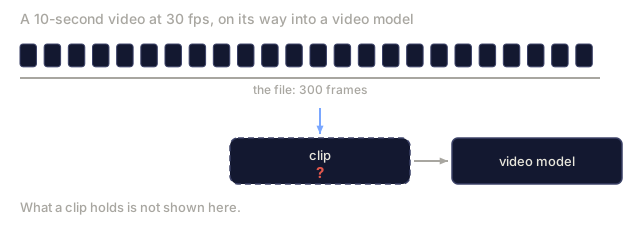
A 10-second clip at 30 fps is 300 frames; feeding all 300 to any model is wasteful. Standard strategies:
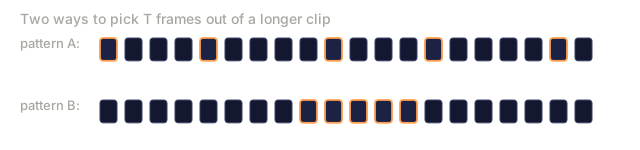
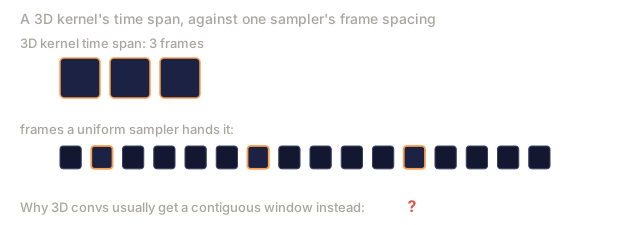
- Uniform sampling: pick T frames evenly across the clip. Default for 2D+pool.
- Dense sampling: a random contiguous T-frame window, common for 3D convs because motion needs neighbouring frames.
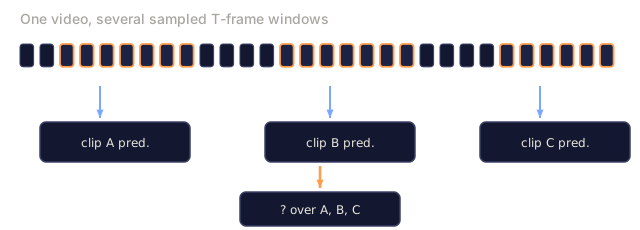
- Multi-clip: sample multiple T-frame windows from the same video, classify each, and average predictions at test time.
T is usually 8, 16, 32, or 64. Higher T means more temporal signal at more compute.
Evaluation
Two levels:
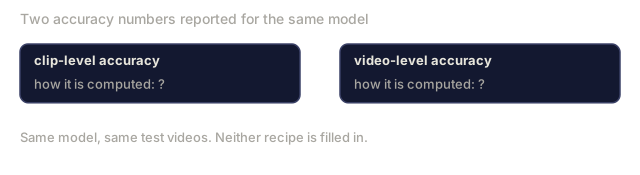
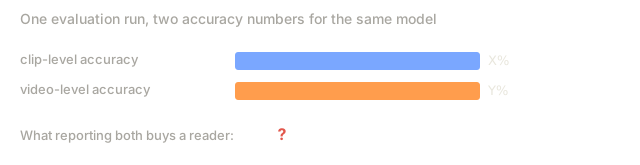
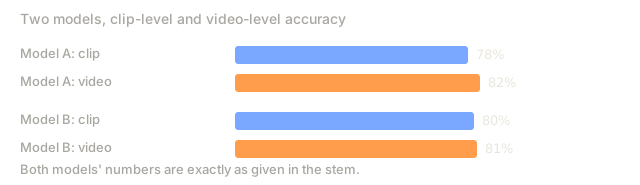
- Clip-level accuracy: the model sees one T-frame clip and reports top-1 (or top-k) accuracy.
- Video-level accuracy: average clip-level predictions across multiple clips per video, which runs higher and more stable.
Always report both. A model that scores 78% clip / 82% video is relying heavily on test-time averaging; one that scores 80% / 81% is more robust per clip.
Datasets you'll meet
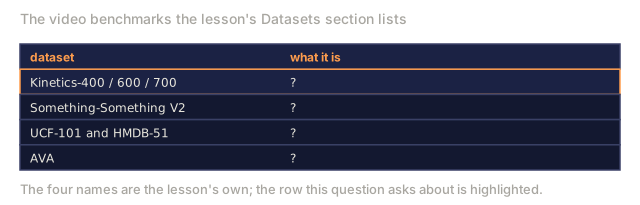
- Kinetics-400 / 600 / 700: the general-purpose action dataset, 400k clips, sourced from YouTube URLs (many now dead).
- Something-Something V2: motion-defined actions ("moving X from left to right"), unsolvable by 2D+pool.
- UCF-101 and HMDB-51: older, smaller, still commonly reported.
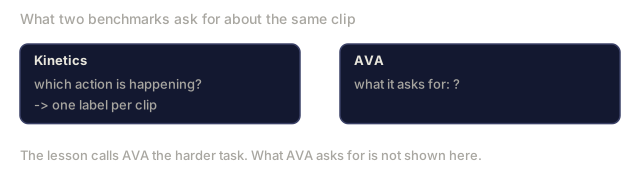
- AVA: action localisation in space and time, harder than plain classification.

Build It
Step 1: Frame sampler
Uniform and dense samplers that work on a list of frames (or a video tensor).
import numpy as np

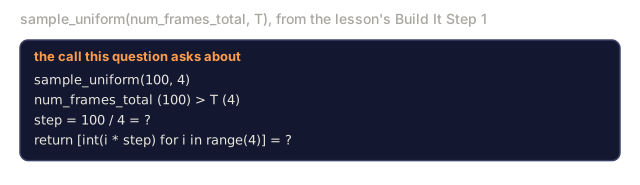
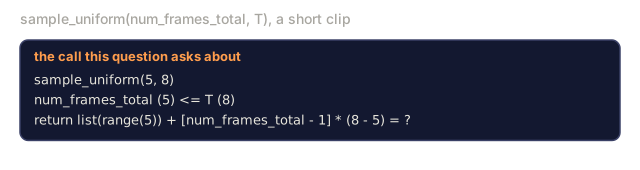
def sample_uniform(num_frames_total, T):
    if num_frames_total <= T:
        return list(range(num_frames_total)) + [num_frames_total - 1] * (T - num_frames_total)
    step = num_frames_total / T
    return [int(i * step) for i in range(T)]


def sample_dense(num_frames_total, T, rng=None):
    rng = rng or np.random.default_rng()
    if num_frames_total <= T:
        return list(range(num_frames_total)) + [num_frames_total - 1] * (T - num_frames_total)
    start = int(rng.integers(0, num_frames_total - T + 1))
    return list(range(start, start + T))
Both return T indices that you use to slice the video tensor.
Step 2: A 2D+pool baseline
Run a 2D ResNet-18 over every frame, average-pool features, classify.
import torch
import torch.nn as nn
from torchvision.models import resnet18, ResNet18_Weights

class FramePool(nn.Module):
    def __init__(self, num_classes=400, pretrained=True):
        super().__init__()
        weights = ResNet18_Weights.IMAGENET1K_V1 if pretrained else None
        backbone = resnet18(weights=weights)
        self.features = nn.Sequential(*(list(backbone.children())[:-1]))  # global avg pool kept
        self.head = nn.Linear(512, num_classes)

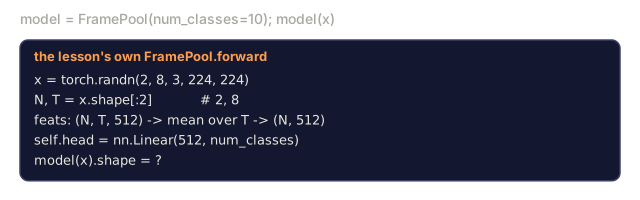
    def forward(self, x):
        # x: (N, T, 3, H, W)
        N, T = x.shape[:2]
        x = x.view(N * T, *x.shape[2:])
        feats = self.features(x).view(N, T, -1)
        pooled = feats.mean(dim=1)
        return self.head(pooled)

model = FramePool(num_classes=10)
x = torch.randn(2, 8, 3, 224, 224)
print(f"output: {model(x).shape}")
print(f"params: {sum(p.numel() for p in model.parameters()):,}")
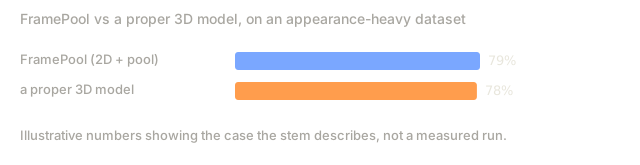
Eleven million parameters, ImageNet pretrained, runs per-frame, averages, classifies. This baseline often lands within 5-10 points of proper 3D models on appearance-heavy tasks, sometimes ahead of them, because it's riding a stronger ImageNet backbone.
Step 3: An I3D-style inflated 3D conv
Turn a single 2D conv into a 3D conv by repeating weights along a new time axis.
def inflate_2d_to_3d(conv2d, time_kernel=3):
    out_c, in_c, kh, kw = conv2d.weight.shape
    weight_3d = conv2d.weight.data.unsqueeze(2)  # (out, in, 1, kh, kw)
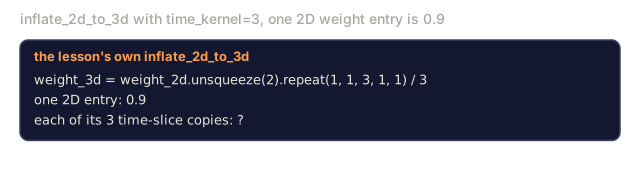
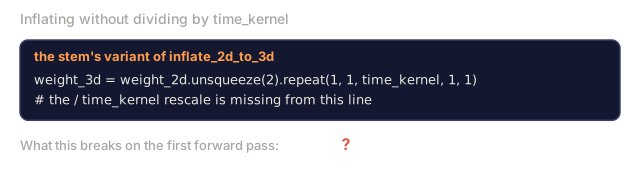
    weight_3d = weight_3d.repeat(1, 1, time_kernel, 1, 1) / time_kernel
    conv3d = nn.Conv3d(in_c, out_c, kernel_size=(time_kernel, kh, kw),
                        padding=(time_kernel // 2, conv2d.padding[0], conv2d.padding[1]),
                        stride=(1, conv2d.stride[0], conv2d.stride[1]),
                        bias=False)
    conv3d.weight.data = weight_3d
    return conv3d

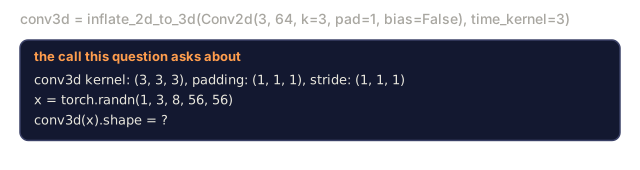
conv2d = nn.Conv2d(3, 64, kernel_size=3, padding=1, bias=False)
conv3d = inflate_2d_to_3d(conv2d, time_kernel=3)
print(f"2D weight shape:  {tuple(conv2d.weight.shape)}")
print(f"3D weight shape:  {tuple(conv3d.weight.shape)}")
x = torch.randn(1, 3, 8, 56, 56)
print(f"3D output shape:  {tuple(conv3d(x).shape)}")
The division by time_kernel keeps the activation magnitudes roughly constant — skip it and you'll break batch-norm statistics on the very first pass.
Step 4: Factorised (2+1)D conv
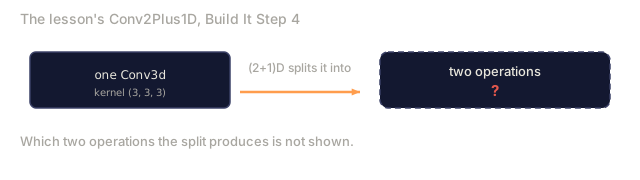
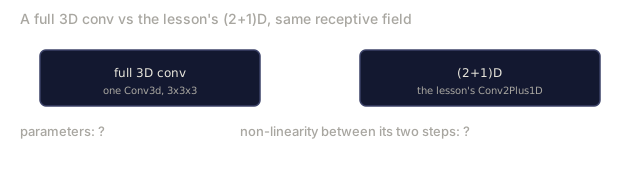
Split a 3D conv into a 2D (spatial) and a 1D (temporal) conv. Same receptive field, fewer parameters, better accuracy on some benchmarks.
class Conv2Plus1D(nn.Module):
    def __init__(self, in_c, out_c, kernel_size=3):
        super().__init__()
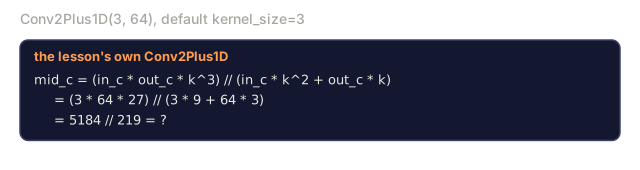
        mid_c = (in_c * out_c * kernel_size * kernel_size * kernel_size) \
                // (in_c * kernel_size * kernel_size + out_c * kernel_size)
        self.spatial = nn.Conv3d(in_c, mid_c, kernel_size=(1, kernel_size, kernel_size),
                                 padding=(0, kernel_size // 2, kernel_size // 2), bias=False)
        self.bn = nn.BatchNorm3d(mid_c)
        self.act = nn.ReLU(inplace=True)
        self.temporal = nn.Conv3d(mid_c, out_c, kernel_size=(kernel_size, 1, 1),
                                  padding=(kernel_size // 2, 0, 0), bias=False)

    def forward(self, x):
        return self.temporal(self.act(self.bn(self.spatial(x))))

c = Conv2Plus1D(3, 64)
x = torch.randn(1, 3, 8, 56, 56)
print(f"(2+1)D output: {tuple(c(x).shape)}")
A full R(2+1)D network is the same as a ResNet-18 with every 3x3 conv replaced by Conv2Plus1D.
Use It
Two libraries cover production video work:
torchvision.models.video: R(2+1)D, MViT, Swin3D with pretrained Kinetics weights, same API as the image models.pytorchvideo(Meta): model zoo, data loaders for Kinetics, SSv2, and AVA, plus standard transforms.
For Vision-Language video models (video captioning, video QA), use transformers (VideoMAE, VideoLLaMA, InternVideo).
Ship It
This lesson produces:
outputs/prompt-video-architecture-picker.md: a prompt that picks 2D+pool / I3D / (2+1)D / transformer based on appearance-vs-motion, dataset size, and compute budget.outputs/skill-frame-sampler-auditor.md: a skill that inspects a video pipeline's sampler and flags common bugs, like off-by-one indices, uneven sampling whennum_frames < T, or a missing aspect-preserving crop.
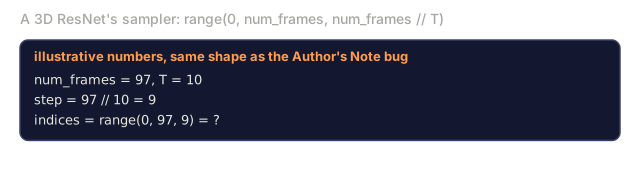
The first video classifier I built went straight to a 3D ResNet, because it felt like the serious architecture for the job. Two days of debugging later, the bug wasn't in the model — it was in the frame sampler. I was slicing frames with something like range(0, num_frames, num_frames // T), which silently drops the tail of the clip whenever num_frames isn't a clean multiple of T. The model looked broken. The data feeding it was broken, and the model was faithfully learning from garbage.
If you take one habit from this lesson into production, take this: build the 2D+pool baseline first, even when you're sure the task needs motion. It's cheap, it reuses ImageNet weights, and it doubles as a sanity check on your data pipeline before you spend a week debugging a 3D conv that never had a chance because the frames going in were already wrong. Reach for I3D or a transformer once the baseline works and you've confirmed, on your own data, that appearance alone isn't enough.
Exercises
- (Easy) Compute FLOPs (approximate) for FramePool with T=8 vs an I3D-style 3D ResNet with T=8. Justify why 2D+pool is 3-5x cheaper.
- (Medium) Generate a synthetic video dataset: random balls moving in random directions, labelled by direction of motion ("left-to-right", "right-to-left", "diagonal-up"). Train FramePool on it. Show that it achieves near-chance accuracy, proving appearance alone is insufficient for motion tasks.
- (Hard) Build an R(2+1)D-18 by replacing every Conv2d in a ResNet-18 with
Conv2Plus1D. Inflate the first conv's weights from an ImageNet-pretrained ResNet-18. Train on the motion dataset from exercise 2 and beat FramePool.
Key Terms
| Term | What people say | What it actually means |
|---|---|---|
| 2D + pool | "Per-frame classifier" | Run a 2D CNN on every sampled frame, average-pool features across time, classify |
| 3D convolution | "Spatio-temporal kernel" | Kernel that convolves over (T, H, W); can model motion natively |
| Inflation | "Lift 2D weights to 3D" | Initialise 3D conv weights by repeating a 2D conv's weights along the new time axis, then divide by kernel_T to preserve activation scale |
| (2+1)D | "Factorised conv" | Split 3D into 2D spatial + 1D temporal; fewer parameters, extra non-linearity between |
| Divided attention | "Time then space" | Transformer block with two attentions per layer: one over tokens at the same frame, one over tokens at the same position |
| Clip | "T-frame window" | A sampled subsequence of T frames; the unit a video model consumes |
| Clip vs video accuracy | "Two eval settings" | Clip = one sample per video, video = average across multiple sampled clips |
| Kinetics | "The ImageNet of video" | 400-700 action classes, 300k+ YouTube clips, the standard video pretraining corpus |
Further Reading
- I3D: Quo Vadis, Action Recognition (Carreira & Zisserman, 2017): introduces inflation and the Kinetics dataset
- R(2+1)D: A Closer Look at Spatiotemporal Convolutions (Tran et al., 2018): factorised conv, still a strong baseline
- TimeSformer: Is Space-Time Attention All You Need? (Bertasius et al., 2021): the first strong video transformer
- VideoMAE (Tong et al., 2022): masked autoencoder pretraining for video, the current dominant pretraining recipe
Code
- main.py (python, 114 lines)