Multi-Head Attention
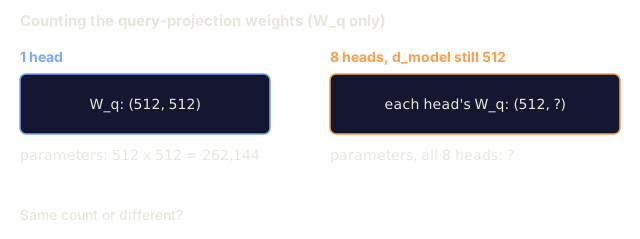
Split the embedding across several heads and the parameter count stays put, while each head gets its own attention pattern.
Learning Objectives
- Explain why a single attention head loses signal and how splitting d_model across heads keeps the parameter count fixed.
- Implement split_heads, per-head scaled dot-product attention, combine_heads, and the W_o output projection in plain Python.
- Compare MHA, MQA, GQA, and MLA by how many K/V heads each keeps and what that does to KV-cache memory.
- Choose d_head and n_heads for a given d_model using the rules of thumb from production models.
The Problem
Multi-head attention runs several attention functions in parallel, each with its own Q, K, V projections, and concatenates their outputs. Each head works in a smaller subspace of dimension d_model / n_heads, so total parameters stay the same while the layer can express more.
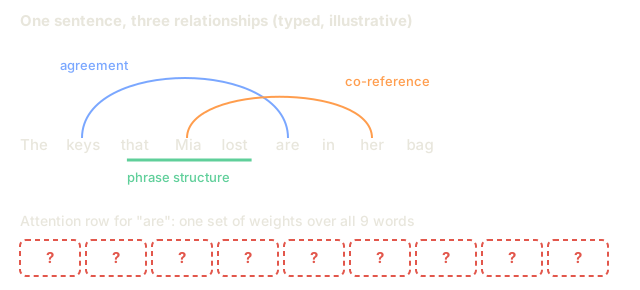
The motivation is what one head can't do. A single self-attention head computes one attention matrix, which captures one kind of relationship, typically the one that lowers loss on the training signal. If your data has subject-verb agreement, co-reference, long-range discourse, and syntactic chunking tangled together, a single head smears them into one softmax distribution and loses half the signal.
The 2017 Vaswani paper introduced the fix. In 2026 it is the default in transformers, and the live questions are how many heads to use and whether keys and values share projections (Grouped-Query Attention, Multi-Query Attention, Multi-head Latent Attention).
The Concept

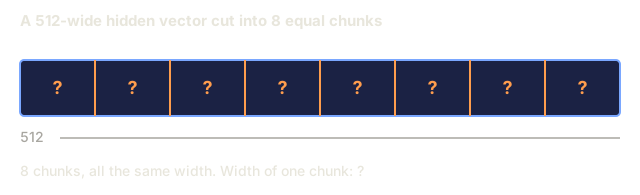
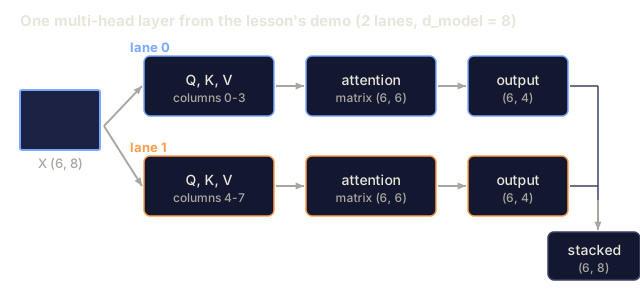
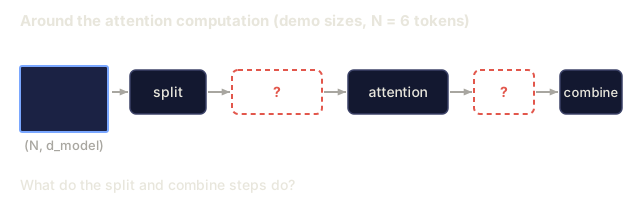
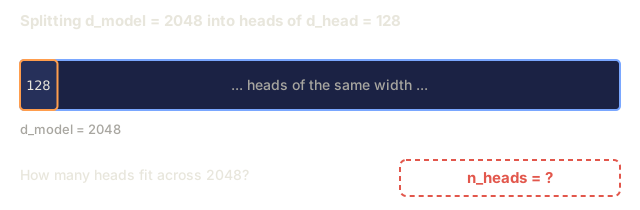
Split. Take X of shape (N, d_model). Project to Q, K, V, each of shape (N, d_model). Reshape to (N, n_heads, d_head) where d_head = d_model / n_heads, then transpose to (n_heads, N, d_head).
Attend in parallel. Run scaled dot-product attention inside each head. Each head produces (N, d_head). The heads work on different subspaces of the embedding and don't exchange information during the attention computation itself.
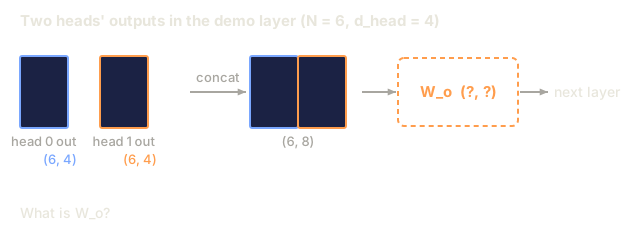
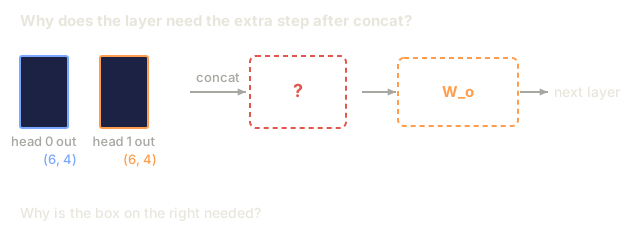
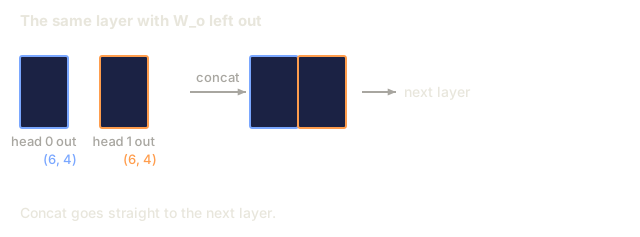
Concatenate and project. Stack the heads back to (N, d_model) and multiply by a learned output matrix W_o of shape (d_model, d_model). W_o is where the heads mix.
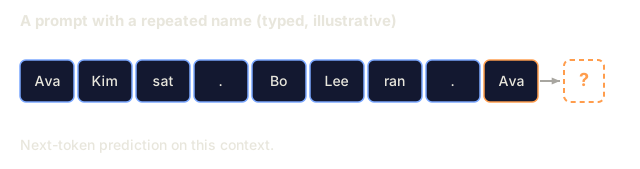
Why it works. Each head can specialize without competing with the others for representational budget. Probing studies from 2019–2024 found distinct head roles: positional heads, heads that attend to the previous token, copy heads, named-entity heads, and induction heads (which underlie in-context learning).
The 2026 lineage of variations:
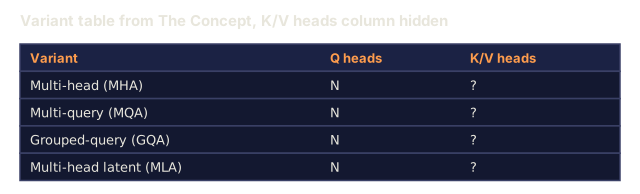
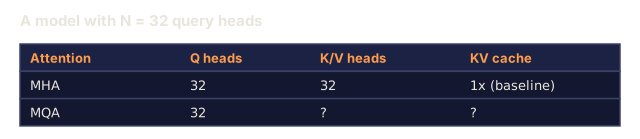
| Variant | Q heads | K/V heads | Used by |
|---|---|---|---|
| Multi-head (MHA) | N | N | GPT-2, BERT, T5 |
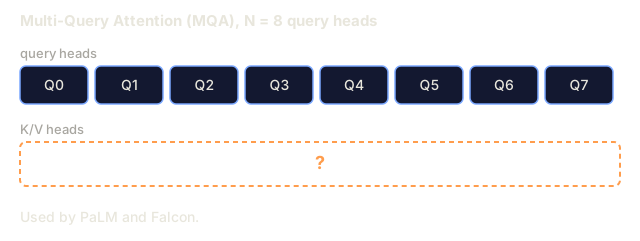
| Multi-query (MQA) | N | 1 | PaLM, Falcon |
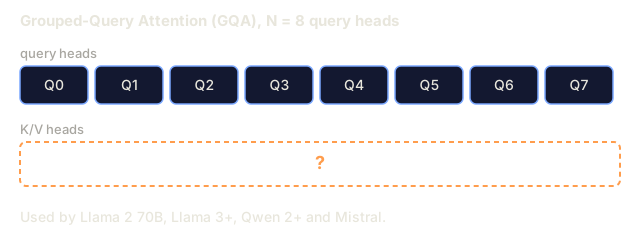
| Grouped-query (GQA) | N | G (e.g. N/8) | Llama 2 70B, Llama 3+, Qwen 2+, Mistral |
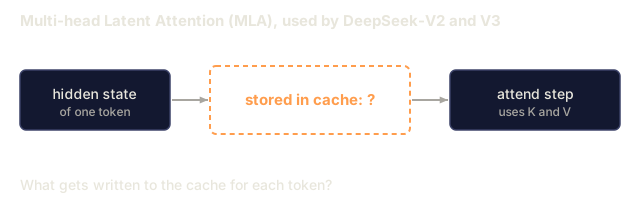
| Multi-head latent (MLA) | N | compressed to low-rank | DeepSeek-V2, V3 |
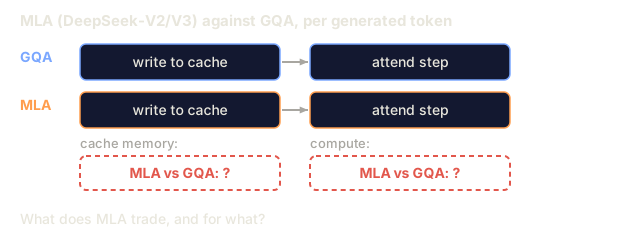
GQA is the modern default because it cuts KV-cache memory by a factor of N/G while keeping nearly full quality. MLA goes further: it compresses K/V into a latent space and projects back at compute time. That costs extra FLOPs and saves considerably more memory.
Build It
Step 1: split heads from the single-head attention we already have
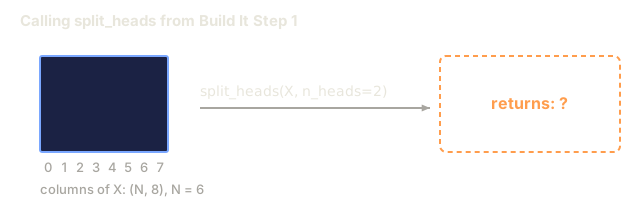
Start from the standalone scaled_dot_product_attention function from Lesson 02 and wrap it with a split/combine pair. code/main.py is pure stdlib: a small Matrix class (row-major floats) carries matmul, transpose, and softmax_rows, so there is no numpy. Splitting copies each head's contiguous block of columns into its own Matrix:
def split_heads(X: Matrix, n_heads: int) -> List[Matrix]:
    d_head = X.cols // n_heads
    heads = []
    for h in range(n_heads):
        H = Matrix(X.rows, d_head)
        for i in range(X.rows):
            for j in range(d_head):
                H.set(i, j, X.get(i, h * d_head + j))
        heads.append(H)
    return heads

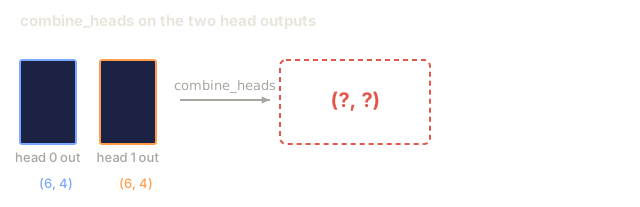
def combine_heads(heads: List[Matrix]) -> Matrix:
    n, d_head = heads[0].rows, heads[0].cols
    out = Matrix(n, d_head * len(heads))
    for h, H in enumerate(heads):
        for i in range(n):
            for j in range(d_head):
                out.set(i, h * d_head + j, H.get(i, j))
    return out
A head is a column slice of width d_head, and combining writes the slices back side by side. These are nested loops over a List[Matrix]. NumPy or PyTorch does the same split with one reshape and one transpose, which is the shape bookkeeping The Concept describes.
Step 2: run scaled-dot-product attention per head
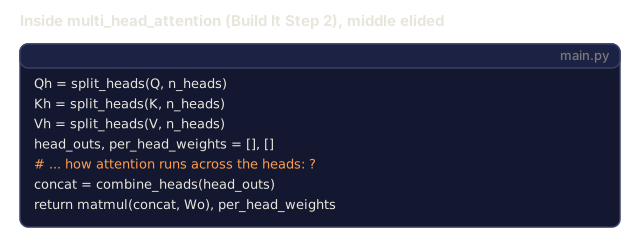
Each head gets its own slice of Q, K, V, so attention runs once per head in a plain Python loop:
def multi_head_attention(X, Wq, Wk, Wv, Wo, n_heads):
    Q = matmul(X, Wq)
    K = matmul(X, Wk)
    V = matmul(X, Wv)
    Qh = split_heads(Q, n_heads)
    Kh = split_heads(K, n_heads)
    Vh = split_heads(V, n_heads)
    head_outs, per_head_weights = [], []
    for q, k, v in zip(Qh, Kh, Vh):
        o, w = scaled_dot_product_attention(q, k, v)
        head_outs.append(o)
        per_head_weights.append(w)
    concat = combine_heads(head_outs)
    return matmul(concat, Wo), per_head_weights
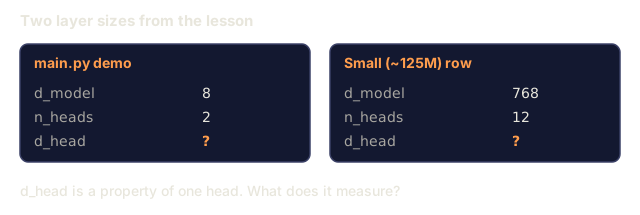
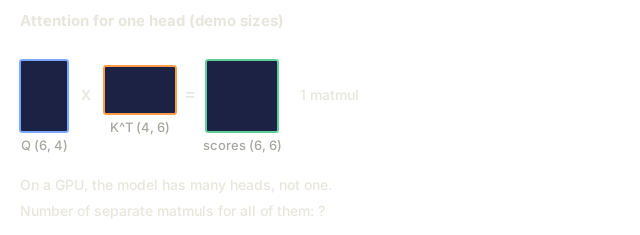
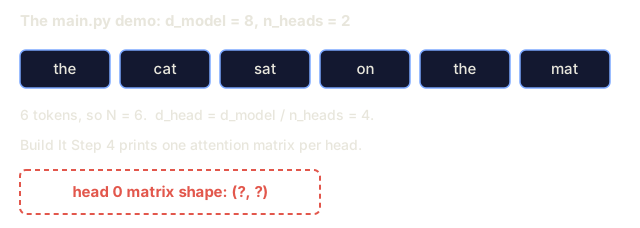
In main.py the heads run one after another. On real hardware the same computation is one batched matmul of shape (heads, N, d_head) × (heads, d_head, N) -> (heads, N, N), so adding heads doesn't add a matmul. The demo uses n_heads=2 and d_model=8, so d_head=4.
Step 3: Grouped-Query Attention variant
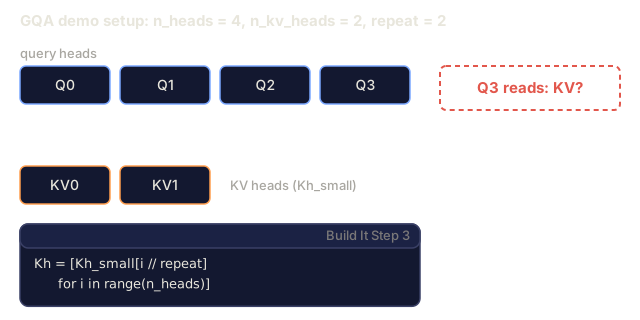
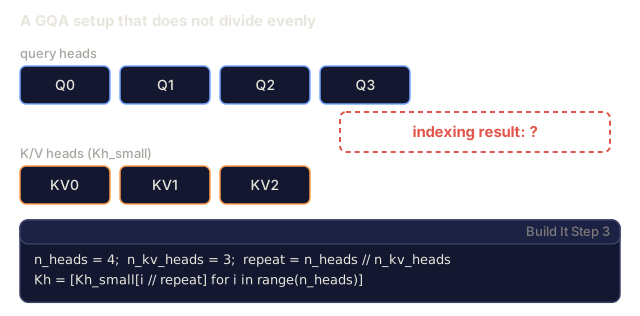
Only the key and value projections change. Q keeps n_heads groups. K and V get n_kv_heads < n_heads groups, which are repeated to match Q by indexing into the smaller list:
Qh = split_heads(Q, n_heads)
Kh_small = split_heads(K, n_kv_heads)
Vh_small = split_heads(V, n_kv_heads)
repeat = n_heads // n_kv_heads
Kh = [Kh_small[i // repeat] for i in range(n_heads)]
Vh = [Vh_small[i // repeat] for i in range(n_heads)]
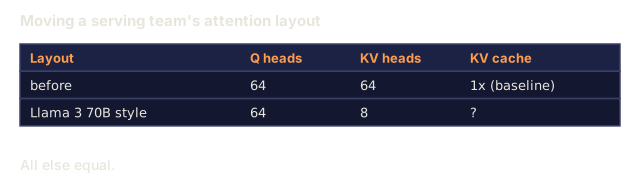
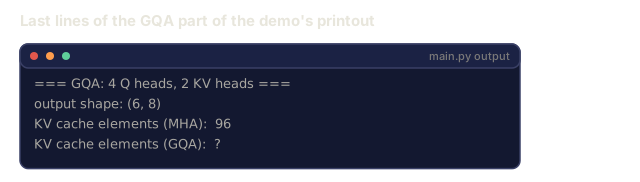
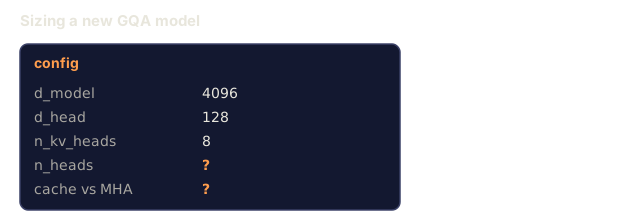
At inference this saves memory because only n_kv_heads copies live in the KV cache, not n_heads. Llama 3 70B uses 64 query heads with 8 KV heads, an 8× cache shrink. The GQA demo in main.py uses 4 query heads and 2 KV heads and prints the KV-cache element counts for both layouts, a 2× shrink.
Step 4: probe what each head learned
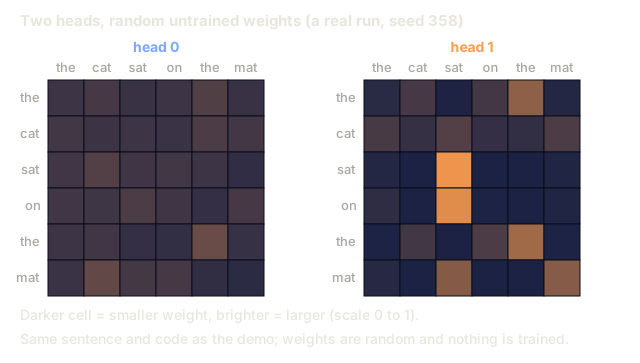
Run MHA on a short sentence and print the (N, N) attention matrix for each head. The main.py demo does this for the cat sat on the mat with 2 heads at d_model=8. The GQA demo prints no attention matrices, only the output shape and cache sizes. Different heads pick out different structure even with random initialization. Part of that is signal, and part is rotational symmetry in the subspaces.
Use It
In PyTorch, MHA is one line:
import torch.nn as nn

mha = nn.MultiheadAttention(embed_dim=512, num_heads=8, batch_first=True)
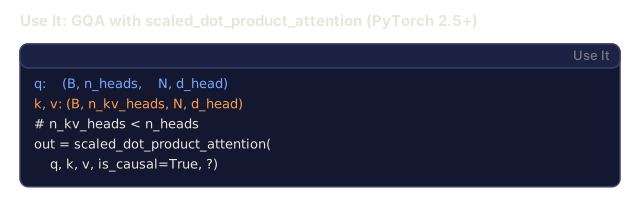
GQA as of PyTorch 2.5+:
from torch.nn.functional import scaled_dot_product_attention

# scaled_dot_product_attention auto-dispatches Flash Attention on CUDA.
# For GQA, pass Q of shape (B, n_heads, N, d_head) and K,V of shape
# (B, n_kv_heads, N, d_head). PyTorch handles the repeat.
out = scaled_dot_product_attention(q, k, v, is_causal=True, enable_gqa=True)
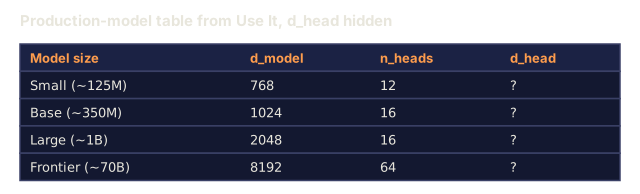
How many heads? Rules of thumb from production models in 2026:
| Model size | d_model | n_heads | d_head |
|---|---|---|---|
| Small (~125M) | 768 | 12 | 64 |
| Base (~350M) | 1024 | 16 | 64 |
| Large (~1B) | 2048 | 16 | 128 |
| Frontier (~70B) | 8192 | 64 | 128 |
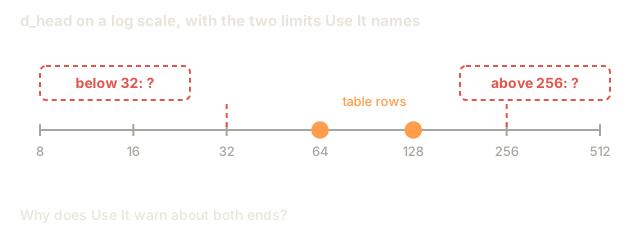
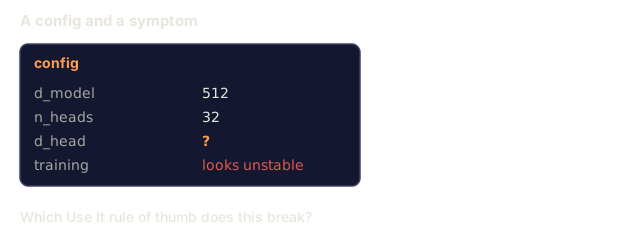
In the table, d_head lands at 64 or 128. It sets how much one head can "see." Drop below 32 and heads start fighting the scaling factor sqrt(d_head). Go above 256 and you lose the "many small specialists" benefit.
Ship It
outputs/skill-mha-configurator.md is a skill that recommends head count, kv-head count, and projection strategy for a new transformer. Give it your parameter budget, sequence length, and deployment target.
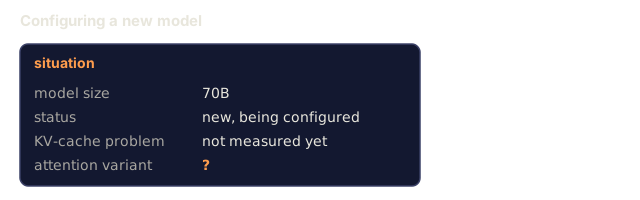
If I were configuring a new model today, I'd start from GQA and justify going anywhere else. The cache shrink is the reason: with 64 query heads and 8 KV heads you hold an eighth of the K/V in memory, and The Concept puts quality at nearly full. I'd reach for MLA only after the KV cache was the measured problem, since it trades extra FLOPs for the memory.
I'd keep d_head at 64 or 128 and let n_heads fall out of d_model from there. Every row in the Use It table lands on one of those two, and the warning about the sqrt(d_head) scaling factor below 32 is enough for me not to experiment in that direction without a reason.
I'd treat Step 4 as a shape check. main.py prints per-head attention matrices on random weights, so a head that looks like it found structure there only tells you that your split and per-head attention run, not what a trained head does. For that, read the induction-head paper in Further Reading.
Exercises
- Easy.
code/main.pyhas no training loop, so this one is an extension you write. Build a tiny one-layer model around the MHA inmain.py, train it on a synthetic copy task, and sweepn_headsfrom 1 to 16 withd_model=64fixed. Plot the loss. Do more heads help, plateau, or hurt? - Medium. Implement MQA (one KV head shared across all query heads). Measure how much parameter count drops vs full MHA. Compute how much the KV-cache size shrinks at inference for N=2048.
- Hard. Implement a tiny version of Multi-head Latent Attention: compress K,V to a rank-
rlatent, store the latent in the KV cache, decompress at attention time. At whatrdoes cache memory cross below 1/8 of full MHA while quality stays within 1 bit of validation ppl?
Key Terms
| Term | What people say | What it actually means |
|---|---|---|
| Head | "A single attention circuit" | One Q/K/V projection of dimension d_head = d_model / n_heads with its own attention matrix. |
| d_head | "Head dimension" | Per-head hidden width; 64 or 128 in the production models above. |
| Split / combine | "Reshape tricks" | Moves between (N, d_model) and (n_heads, N, d_head) around attention: column slices in main.py, reshape+transpose in numpy or PyTorch. |
| W_o | "Output projection" | (d_model, d_model) matrix applied after concatenating heads; where heads mix. |
| MQA | "One KV head" | Multi-Query Attention: single shared K/V projection. Smallest KV cache, some quality loss. |
| GQA | "The default since Llama 2" | Grouped-Query Attention with n_kv_heads < n_heads; repeats to match Q. |
| MLA | "DeepSeek's trick" | Multi-head Latent Attention: K,V compressed to low-rank latent, decompressed at attend time. |
| Induction head | "The circuit behind in-context learning" | A pair of heads that detect previous occurrences and copy what followed them. |
Further Reading
- Vaswani et al. (2017). Attention Is All You Need §3.2.2: the original multi-head spec.
- Shazeer (2019). Fast Transformer Decoding: One Write-Head is All You Need: the MQA paper.
- Ainslie et al. (2023). GQA: Training Generalized Multi-Query Transformer Models from Multi-Head Checkpoints: how to convert MHA to GQA after training.
- DeepSeek-AI (2024). DeepSeek-V2 Technical Report: MLA and why it beats MHA/GQA on cache memory.
- Olsson et al. (2022). In-context Learning and Induction Heads: mechanistic look at what heads actually do.