Tokenizers: BPE, WordPiece, SentencePiece
Your LLM does not read English, it reads integers. The tokenizer decides whether those integers carry meaning or waste it.
Learning Objectives
- Implement BPE, WordPiece, and Unigram tokenization algorithms from scratch and compare their merge strategies
- Explain how vocabulary size affects model efficiency: too small creates long sequences, too large wastes embedding parameters
- Analyze tokenization artifacts across languages and code, identifying where specific tokenizers break down
- Use the tiktoken and sentencepiece libraries to tokenize text and inspect the resulting token IDs
The Problem
Your LLM does not read English. It does not read any language. It reads numbers.
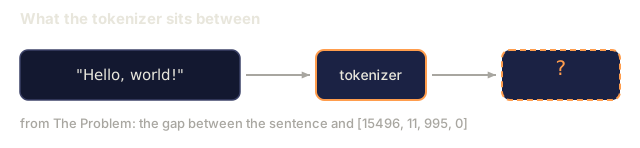
The gap between "Hello, world!" and [15496, 11, 995, 0] is the tokenizer. Every word, every space, and every punctuation mark gets converted into an integer before the model sees it. That conversion is not neutral, because it bakes assumptions into the model that you cannot undo later.
Get it wrong and the model spends capacity on common words that take several tokens each, and your context window holds less text than it should. Get it right and the same window holds more meaning. Much of the gap between "this model handles code well" and "this model chokes on Python" comes down to how the tokenizer was trained.
API calls to GPT-4 or Claude are priced per token, and every token a model generates costs compute. The fewer tokens it takes to represent an output, the faster inference finishes end to end. Tokenization is not preprocessing. It is architecture.
The Concept
Three Approaches That Failed (and One That Won)
There are three obvious ways to convert text to numbers. Two of them break down at scale.
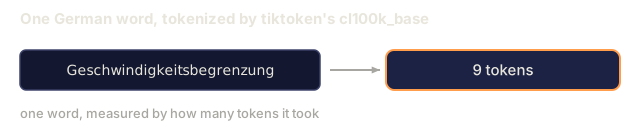
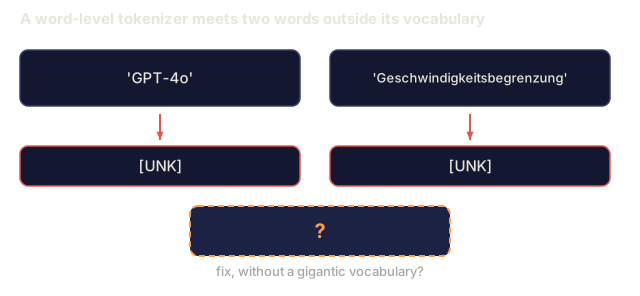
Word-level tokenization splits on spaces and punctuation. "The cat sat" becomes ["The", "cat", "sat"]. It is simple, but what about "tokenization"? Or "GPT-4o"? Or a German compound word like "Geschwindigkeitsbegrenzung"? Word-level needs a huge vocabulary to cover every word in every language. Miss a word and you get the [UNK] token, the model's way of saying "I have no idea what this is." Add code, URLs, scientific notation, and many other languages, and no fixed vocabulary keeps up.
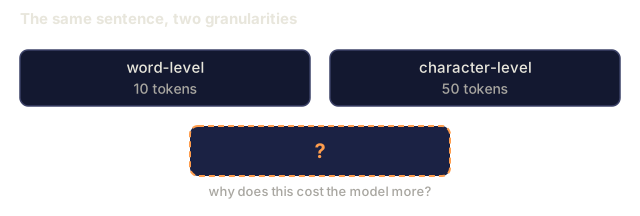
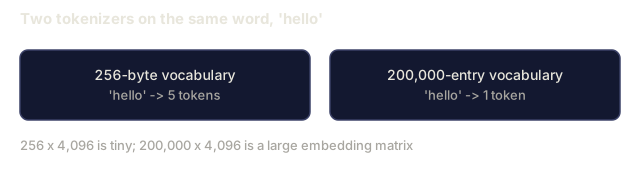
Character-level tokenization goes the other direction. "hello" becomes ["h", "e", "l", "l", "o"]. The vocabulary is tiny (a few hundred characters) and there are no unknown tokens. The cost is sequence length. A sentence that is 10 word-level tokens can run to 50 character-level tokens, and the model has to learn that "t", "h", "e" together mean "the", which spends attention on something a word-level model gets for free.
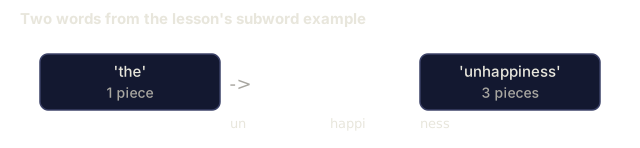
Subword tokenization sits between the two. Common words stay whole, so "the" is one token. Rare words break into pieces, so "unhappiness" becomes ["un", "happi", "ness"]. The vocabulary stays manageable (30K to 128K tokens), sequences stay short, and unknown tokens mostly go away because any word can be built from smaller pieces.
Nearly every modern LLM uses subword tokenization, including GPT-2, GPT-4, BERT, and Llama 3. The real question is which algorithm.

BPE: Byte Pair Encoding
BPE is a greedy compression algorithm repurposed for tokenization. The whole idea fits on an index card.
Start with individual characters. Count every adjacent pair in the training corpus. Merge the most frequent pair into a new token. Repeat until you reach your target vocabulary size.
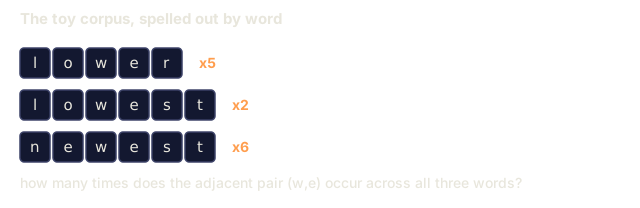
Here is BPE running on a tiny corpus with the words "lower", "lowest", and "newest":
Corpus (with word frequencies):
  "lower"  x5
  "lowest" x2
  "newest" x6

Step 0 -- Start with characters:
  l o w e r       (x5)
  l o w e s t     (x2)
  n e w e s t     (x6)

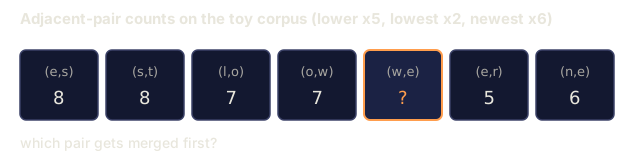
Step 1 -- Count adjacent pairs:
  (e,s): 8    (s,t): 8    (l,o): 7    (o,w): 7
  (w,e): 13   (e,r): 5    (n,e): 6    ...

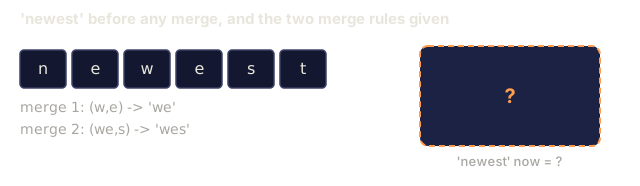
Step 2 -- Merge most frequent pair (w,e) -> "we":
  l o we r        (x5)
  l o we s t      (x2)
  n e we s t      (x6)

Step 3 -- Recount after the merge. The pairs that matter now:
  (l,o): 7   (o,we): 7   (we,r): 5   (we,s): 8
  (s,t): 8   (n,e): 6    (e,we): 6

Step 4 -- (we,s) and (s,t) tie at 8. Pick the first one seen, (we,s) -> "wes":
  l o we r        (x5)
  l o wes t       (x2)
  n e wes t       (x6)

Step 5 -- Merge (wes,t) -> "west":
  l o we r        (x5)
  l o west        (x2)
  n e west        (x6)

...continue until target vocab size reached.
The merge table is the tokenizer. To encode new text, apply the merges in the order they were learned. The training corpus decides which merges exist, and that choice shapes everything the model sees afterward.

Byte-Level BPE (GPT-2, GPT-3, GPT-4)
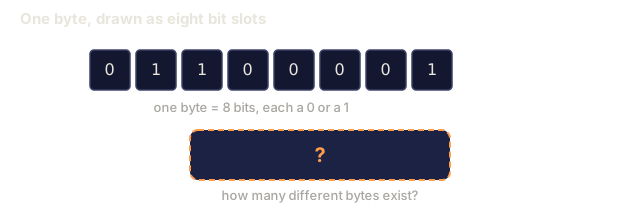
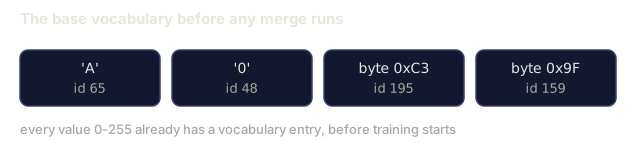
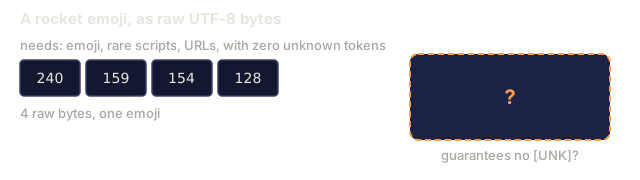
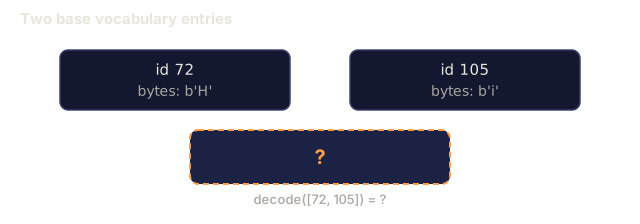
Standard BPE operates on Unicode characters. Byte-level BPE operates on raw bytes (0-255), which gives a base vocabulary of exactly 256 and handles any language or encoding without an unknown token.
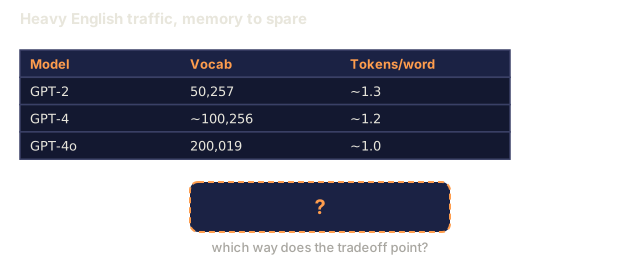
GPT-2 introduced this approach. The base vocabulary covers every possible byte, and BPE merges build on top of it. OpenAI's tiktoken library implements byte-level BPE with these vocabulary sizes:
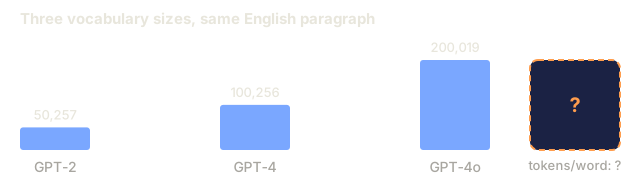
- GPT-2: 50,257 tokens
- GPT-3.5/GPT-4: ~100,256 tokens (cl100k_base encoding)
- GPT-4o: 200,019 tokens (o200k_base encoding)
WordPiece (BERT)
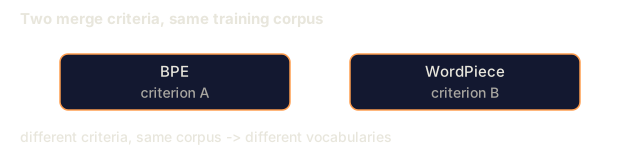
WordPiece looks like BPE but picks merges differently. Instead of raw frequency, it maximizes the likelihood of the training data:
BPE merge criterion:      count(A, B)
WordPiece merge criterion: count(AB) / (count(A) * count(B))
BPE asks which pair appears most often. WordPiece asks which pair appears together more often than chance would predict. The two questions produce different vocabularies, because WordPiece favors merges where co-occurrence is surprising and not just frequent.
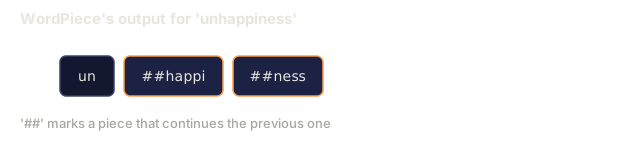
WordPiece also uses a "##" prefix for continuation subwords:
"unhappiness" -> ["un", "##happi", "##ness"]
"embedding"   -> ["em", "##bed", "##ding"]
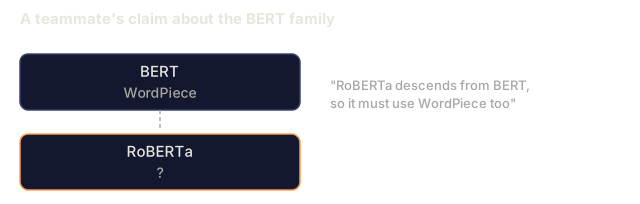
The "##" prefix marks a piece that continues the previous token. BERT uses WordPiece with a vocabulary of 30,522 tokens. Not every BERT descendant follows it: RoBERTa, despite the name, uses BPE.
SentencePiece (Llama, T5)
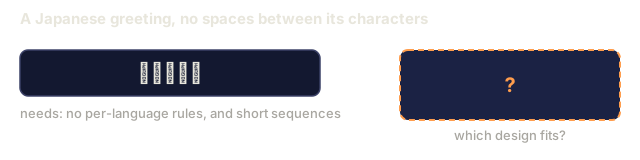
SentencePiece treats the input as a raw stream of Unicode characters, including whitespace. There is no pre-tokenization step and no language-specific rule about word boundaries, so it works on Chinese, Japanese, Thai, and other languages where spaces do not separate words.
SentencePiece supports two algorithms:
- BPE mode: same merge logic as standard BPE, applied to raw character sequences
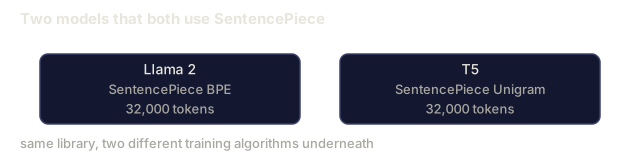
- Unigram mode: starts with a large vocabulary and repeatedly removes the tokens that least affect the overall likelihood. It is BPE run backwards: prune instead of merge.
Llama 2 uses SentencePiece BPE with a vocabulary of 32,000 tokens. T5 uses SentencePiece Unigram, also with 32,000 tokens. Llama 3 switched to a tiktoken-based byte-level BPE tokenizer with 128,256 tokens.
Vocabulary Size Tradeoffs
Vocabulary size is a real engineering decision with measurable consequences.

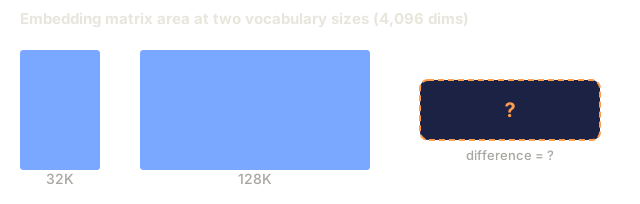
Take 4,096-dimensional embeddings. With a 128K vocabulary the embedding matrix alone is 128,000 x 4,096 = 524 million parameters. With a 32K vocabulary it is 131 million. The tokenizer choice by itself moves roughly 390 million parameters.
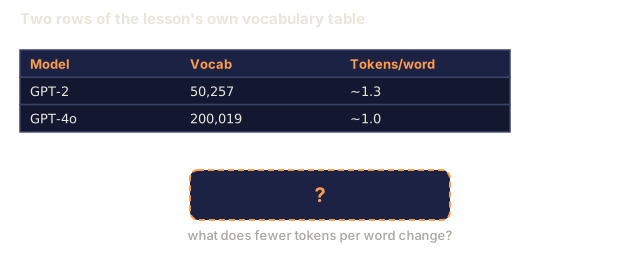
Larger vocabularies also compress text harder. The same English paragraph takes fewer tokens with a 128K vocabulary than with a 32K one, and fewer tokens means fewer forward passes during generation. For a model serving heavy traffic, that is a direct cut in compute cost.
Vocabulary sizes keep growing. GPT-2 used 50,257, GPT-4 uses ~100K, Llama 3 uses 128K, and GPT-4o uses 200K.
| Model | Vocab Size | Tokenizer Type | Avg Tokens per English Word |
|---|---|---|---|
| BERT | 30,522 | WordPiece | ~1.4 |
| GPT-2 | 50,257 | Byte-level BPE | ~1.3 |
| Llama 2 | 32,000 | SentencePiece BPE | ~1.4 |
| GPT-4 | ~100,256 | Byte-level BPE | ~1.2 |
| Llama 3 | 128,256 | Byte-level BPE (tiktoken) | ~1.1 |
| GPT-4o | 200,019 | Byte-level BPE | ~1.0 |
The Multilingual Tax
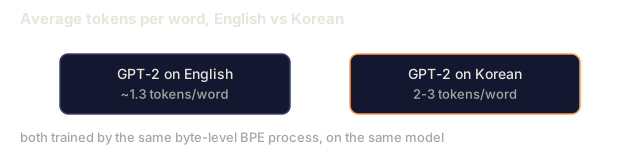
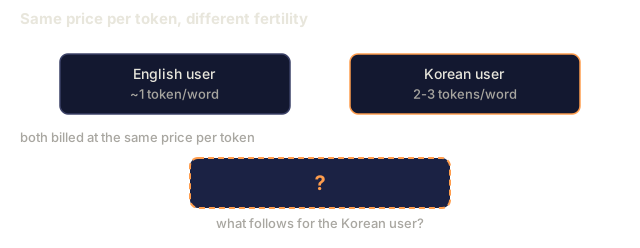
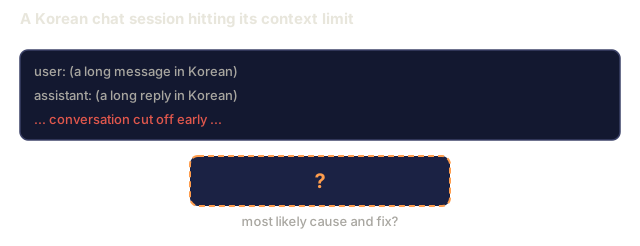
Tokenizers trained mostly on English treat other languages badly. Korean text in GPT-2's tokenizer can average 2-3 tokens per word, and Chinese can be worse. A Korean user then gets a context window that holds far less text than an English user's, at the same price per token.
That is one reason Llama 3 quadrupled its vocabulary from 32K to 128K. More tokens for non-English scripts means more even compression across languages.



Build It
Step 1: Character-Level Tokenizer
Start at the foundation. A character-level tokenizer maps each character to its Unicode code point. It needs no training and has no unknown tokens.
class CharTokenizer:
    def encode(self, text):
        return [ord(c) for c in text]

    def decode(self, tokens):
        return "".join(chr(t) for t in tokens)
"hello" becomes [104, 101, 108, 108, 111]. Every character is its own token, and that is the baseline we improve on.
Step 2: BPE Tokenizer from Scratch
Now the real thing. We train on raw bytes (like GPT-2), count pairs, merge the most frequent, and record every merge in order. The merge table is the tokenizer.
from collections import Counter

class BPETokenizer:
    def __init__(self):
        self.merges = {}
        self.vocab = {}

    def _get_pairs(self, tokens):
        pairs = Counter()
        for i in range(len(tokens) - 1):
            pairs[(tokens[i], tokens[i + 1])] += 1
        return pairs

    def _merge_pair(self, tokens, pair, new_token):
        merged = []
        i = 0
        while i < len(tokens):
            if i < len(tokens) - 1 and tokens[i] == pair[0] and tokens[i + 1] == pair[1]:
                merged.append(new_token)
                i += 2
            else:
                merged.append(tokens[i])
                i += 1
        return merged

    def train(self, text, num_merges):
        tokens = list(text.encode("utf-8"))
        self.vocab = {i: bytes([i]) for i in range(256)}

        for i in range(num_merges):
            pairs = self._get_pairs(tokens)
            if not pairs:
                break
            best_pair = max(pairs, key=pairs.get)
            new_token = 256 + i
            tokens = self._merge_pair(tokens, best_pair, new_token)
            self.merges[best_pair] = new_token
            self.vocab[new_token] = self.vocab[best_pair[0]] + self.vocab[best_pair[1]]

        return self

    def encode(self, text):
        tokens = list(text.encode("utf-8"))
        for pair, new_token in self.merges.items():
            tokens = self._merge_pair(tokens, pair, new_token)
        return tokens

    def decode(self, tokens):
        byte_sequence = b"".join(self.vocab[t] for t in tokens)
        return byte_sequence.decode("utf-8", errors="replace")
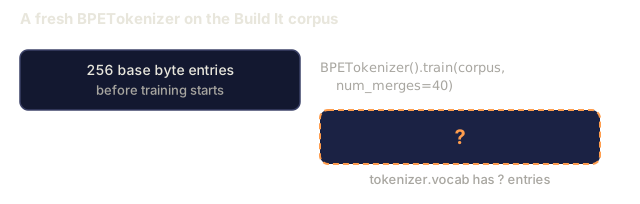
The training loop is the core of BPE: count pairs, merge the winner, repeat. Each merge shrinks the token list, and after num_merges rounds the vocabulary has grown from 256 base bytes to 256 + num_merges.
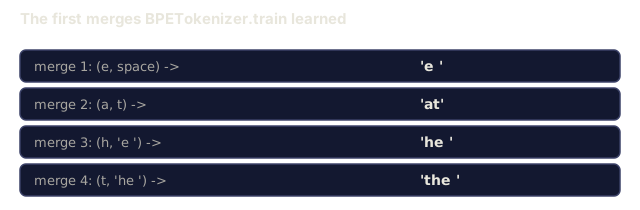
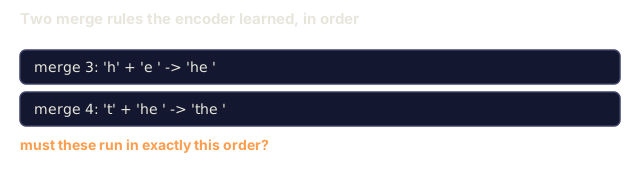
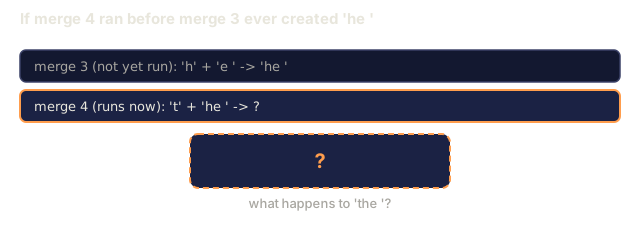
Encoding applies merges in the exact order they were learned, and the order matters. On the corpus above, the third merge builds "he " and the fourth builds "the " from "t" + "he ". Encoding has to apply the third merge first, or the fourth has nothing to build on.
Decoding runs the other way. Look up each token ID in the vocabulary, concatenate the bytes, and decode them as UTF-8.
Step 3: Encode and Decode Roundtrip
corpus = (
    "The cat sat on the mat. The cat ate the rat. "
    "The dog sat on the log. The dog ate the frog. "
    "Natural language processing is the study of how computers "
    "understand and generate human language. "
    "Tokenization is the first step in any NLP pipeline."
)

tokenizer = BPETokenizer()
tokenizer.train(corpus, num_merges=40)

test_sentences = [
    "The cat sat on the mat.",
    "Natural language processing",
    "tokenization pipeline",
    "unhappiness",
]

for sentence in test_sentences:
    encoded = tokenizer.encode(sentence)
    decoded = tokenizer.decode(encoded)
    raw_bytes = len(sentence.encode("utf-8"))
    ratio = len(encoded) / raw_bytes
    print(f"'{sentence}'")
    print(f"  Tokens: {len(encoded)} (from {raw_bytes} bytes) -- ratio: {ratio:.2f}")
    print(f"  Roundtrip: {'PASS' if decoded == sentence else 'FAIL'}")
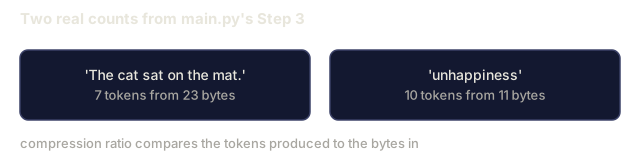
The compression ratio tells you how well the tokenizer is doing. A ratio of 0.50 means it produced half as many tokens as raw bytes, and lower is better. On the training corpus the ratio will look good. On text the corpus never saw, like "unhappiness", it will be worse, because unseen patterns fall back to raw bytes.
Step 4: Compare with tiktoken
import tiktoken

enc = tiktoken.get_encoding("cl100k_base")

texts = [
    "The cat sat on the mat.",
    "unhappiness",
    "Hello, world!",
    "def fibonacci(n): return n if n < 2 else fibonacci(n-1) + fibonacci(n-2)",
    "Geschwindigkeitsbegrenzung",
]

for text in texts:
    our_tokens = tokenizer.encode(text)
    tiktoken_tokens = enc.encode(text)
    tiktoken_pieces = [enc.decode([t]) for t in tiktoken_tokens]
    print(f"'{text}'")
    print(f"  Our BPE:   {len(our_tokens)} tokens")
    print(f"  tiktoken:  {len(tiktoken_tokens)} tokens -> {tiktoken_pieces}")
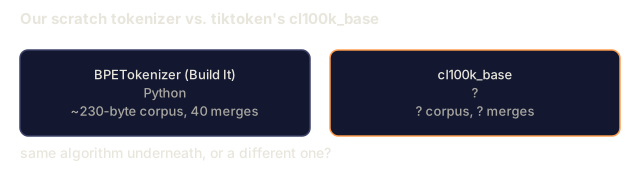
tiktoken uses the same core algorithm, trained on a vastly larger corpus with roughly 100K merges. The difference is the training data and the number of merges. A tokenizer trained on one paragraph with 40 merges will not keep up with that, but the mechanism is the same.
Step 5: Vocabulary Analysis
def analyze_vocabulary(tokenizer, test_texts):
    total_tokens = 0
    total_chars = 0
    token_usage = Counter()

    for text in test_texts:
        encoded = tokenizer.encode(text)
        total_tokens += len(encoded)
        total_chars += len(text)
        for t in encoded:
            token_usage[t] += 1

    print(f"Vocabulary size: {len(tokenizer.vocab)}")
    print(f"Total tokens across all texts: {total_tokens}")
    print(f"Total characters: {total_chars}")
    print(f"Avg tokens per character: {total_tokens / total_chars:.2f}")

    print(f"\nMost used tokens:")
    for token_id, count in token_usage.most_common(10):
        token_bytes = tokenizer.vocab[token_id]
        display = token_bytes.decode("utf-8", errors="replace")
        print(f"  Token {token_id:4d}: '{display}' (used {count} times)")

    unused = [t for t in tokenizer.vocab if t not in token_usage]
    print(f"\nUnused tokens: {len(unused)} out of {len(tokenizer.vocab)}")
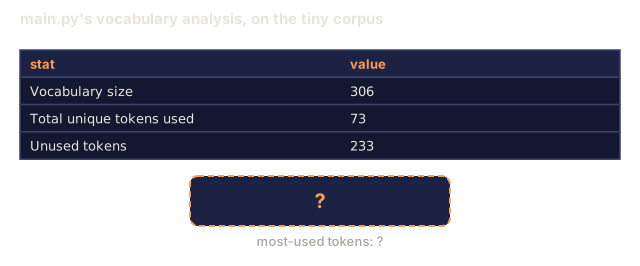
This shows the Zipf-style skew in your vocabulary. A few tokens dominate, starting with the space, and most tokens are rarely used. In this code, the earliest merges get the lowest new IDs, so the patterns learned first are the ones that were most frequent.


Use It
Your scratch BPE works. Here is what the production tools look like.
tiktoken (OpenAI)
import tiktoken

enc = tiktoken.get_encoding("cl100k_base")

text = "Tokenizers convert text to integers"
tokens = enc.encode(text)
print(f"Tokens: {tokens}")
print(f"Pieces: {[enc.decode([t]) for t in tokens]}")
print(f"Roundtrip: {enc.decode(tokens)}")
tiktoken is written in Rust with Python bindings. It runs the same BPE algorithm with an implementation built for speed.
Hugging Face tokenizers
from tokenizers import Tokenizer
from tokenizers.models import BPE
from tokenizers.trainers import BpeTrainer
from tokenizers.pre_tokenizers import ByteLevel

tokenizer = Tokenizer(BPE())
tokenizer.pre_tokenizer = ByteLevel()

trainer = BpeTrainer(vocab_size=1000, special_tokens=["<pad>", "<eos>", "<unk>"])
tokenizer.train(["corpus.txt"], trainer)

output = tokenizer.encode("The cat sat on the mat.")
print(f"Tokens: {output.tokens}")
print(f"IDs: {output.ids}")
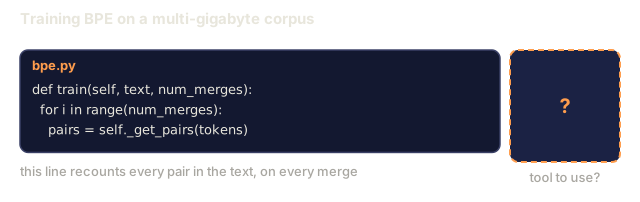
The Hugging Face tokenizers library is also Rust under the hood, and it is built to train BPE on large corpora quickly. Reach for it when you train your own model.
Loading Llama's Tokenizer
from transformers import AutoTokenizer

tokenizer = AutoTokenizer.from_pretrained("meta-llama/Llama-3.1-8B")

text = "Tokenizers are the unsung heroes of LLMs"
tokens = tokenizer.encode(text)
print(f"Token IDs: {tokens}")
print(f"Tokens: {tokenizer.convert_ids_to_tokens(tokens)}")
print(f"Vocab size: {tokenizer.vocab_size}")

multilingual = ["Hello world", "Hola mundo", "Bonjour le monde"]
for text in multilingual:
    ids = tokenizer.encode(text)
    print(f"'{text}' -> {len(ids)} tokens")
Llama 3's 128K vocabulary should compress non-English text better than GPT-2's 50K vocabulary. Check it yourself by encoding the same sentence in several languages and counting the tokens.
Ship It
This lesson produces outputs/prompt-tokenizer-analyzer.md, a reusable prompt that analyzes tokenization efficiency for a text and model combination. Feed it a text sample and it tells you which model's tokenizer handles it best.
I'd run main.py before reading the BPE code again. It prints a Roundtrip: PASS or FAIL line for every sentence, and "unhappiness" passes even though the corpus never contains it. That works because the base vocabulary is all 256 bytes, so nothing is ever out of vocabulary. It just compresses badly: in my run of main.py that word comes out as 10 tokens from 11 bytes, a ratio of 0.91.
My bet is that encode is the part worth staring at. It loops over self.merges in insertion order and replays each merge across the whole token list, so the dict's ordering is the tokenizer. On the Build It corpus, the fourth merge builds "the " from "t" + "he ", which only exists because the third merge built "he ". Training also recounts every pair from scratch on every merge, and encoding makes one full pass per merge. That is fine for a paragraph and wrong for real data.
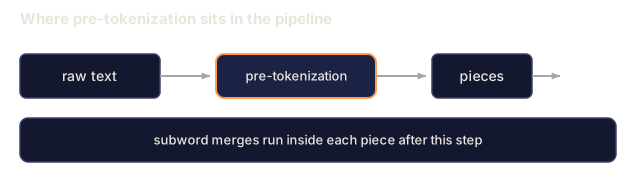
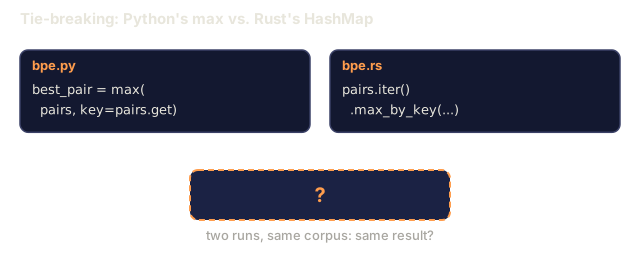
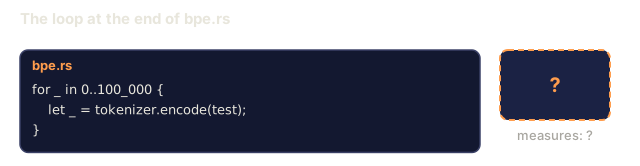
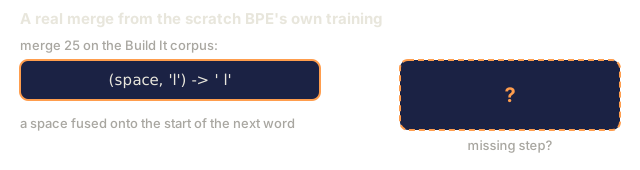
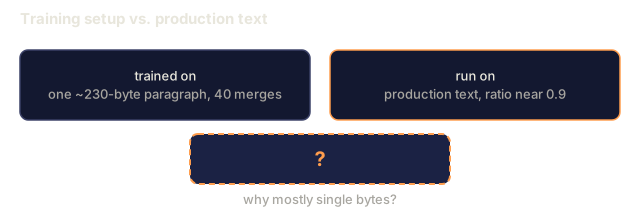
Two things are missing, and both matter more than they look. There is no pre-tokenization, so merges can cross word boundaries and a space can fuse onto the next word. Ties are also broken by max, which keeps the first pair it saw, so the merge order depends on where a pair first appears in the text. On this tiny corpus the merges are thin too: in the main.py vocabulary analysis, the ten most used tokens are all single bytes, led by the space. bpe.rs ports the same loop to Rust and adds a timing loop over 100K encodes. It breaks ties differently, though. It takes the last maximum from a HashMap with random iteration order, so merge order can change between runs. I'd treat it as a way to measure the cost, not a fix for it.
Exercises
-
Modify the BPE tokenizer to print the vocabulary at each merge step. Watch how "h" + "e " becomes "he ", then "t" + "he " becomes "the ". Track how common English words get assembled piece by piece.
-
Add special tokens (
<pad>,<eos>,<unk>) to the BPE tokenizer. Assign them IDs 0, 1, 2 and shift all other tokens accordingly. Implement a pre-tokenization step that splits on whitespace before running BPE. -
Implement the WordPiece merge criterion (likelihood ratio instead of frequency). Train both BPE and WordPiece on the same corpus with the same number of merges. Compare the resulting vocabularies. Which one produces more linguistically meaningful subwords?
-
Build a multilingual tokenizer efficiency benchmark. Take 10 sentences in English, Spanish, Chinese, Korean, and Arabic. Tokenize each with tiktoken (cl100k_base) and measure the average tokens per character. Quantify the "multilingual tax" for each language.
-
Train your BPE tokenizer on a larger corpus (download a Wikipedia article). Tune the number of merges to achieve a compression ratio within 10% of tiktoken on that same text. This forces you to understand the relationship between corpus size, merge count, and compression quality.
Key Terms
| Term | What people say | What it actually means |
|---|---|---|
| Token | "A word" | A unit in the model's vocabulary -- could be a character, subword, word, or multi-word chunk |
| BPE | "Some compression thing" | Byte Pair Encoding -- iteratively merge the most frequent adjacent pair of tokens until the target vocabulary size is reached |
| WordPiece | "BERT's tokenizer" | Like BPE but merges maximize the likelihood ratio count(AB)/(count(A)*count(B)) instead of raw frequency |
| SentencePiece | "A tokenizer library" | A language-agnostic tokenizer that operates on raw Unicode without pre-tokenization, supporting BPE and Unigram algorithms |
| Vocabulary size | "How many words it knows" | The total number of unique tokens: GPT-2 has 50,257, BERT has 30,522, Llama 3 has 128,256 |
| Fertility | "Not a tokenizer term" | Average number of tokens per word -- measures tokenizer efficiency across languages (1.0 is perfect, 3.0 means the model works three times harder) |
| Byte-level BPE | "GPT's tokenizer" | BPE operating on raw bytes (0-255) instead of Unicode characters, guaranteeing no unknown tokens for any input |
| Merge table | "The tokenizer file" | Ordered list of pair merges learned during training -- this IS the tokenizer, and order matters |
| Pre-tokenization | "Splitting on spaces" | Rules applied before subword tokenization: whitespace splitting, digit separation, punctuation handling |
| Compression ratio | "How efficient the tokenizer is" | Tokens produced divided by input bytes -- lower means better compression and faster inference |
Further Reading
- Sennrich et al., 2016, "Neural Machine Translation of Rare Words with Subword Units": the paper that introduced BPE for NLP, turning a 1994 compression algorithm into the foundation of modern tokenization
- Kudo & Richardson, 2018, "SentencePiece: A simple and language independent subword tokenizer": language-agnostic tokenization that made multilingual models practical
- OpenAI tiktoken repository: production BPE implementation in Rust with Python bindings, used by GPT-3.5/4/4o
- Hugging Face Tokenizers documentation: production-grade tokenizer training with Rust performance