RL for Games — AlphaZero, MuZero, and the LLM-Reasoning Era
1992: TD-Gammon beat human champions at backgammon with pure TD. 2016: AlphaGo beat Lee Sedol. 2017: AlphaZero mastered chess, shogi, and Go from scratch. 2024: DeepSeek-R1 showed the same recipe works on reasoning, with GRPO standing in for PPO. Every breakthrough in this phase got tested on a game first.
Learning Objectives
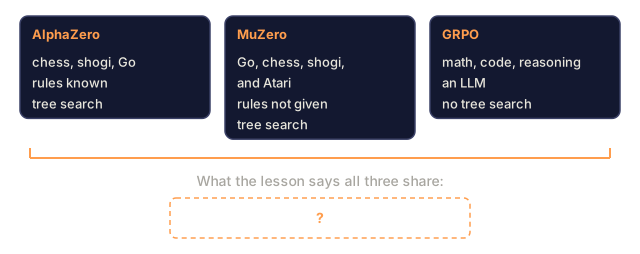
- Explain the self-play + search + policy-improvement loop that AlphaZero, MuZero, and GRPO all share, and state what changes across the three: known rules and MCTS, learned latent dynamics, and no search at all.
- Walk through AlphaZero's policy-value network, PUCT selection, and self-play loss, then explain how MuZero's learned dynamics model (h, g, f) removes the need for known rules.
- Derive GRPO's group-relative advantage from a batch of sampled completions, and give the three DeepSeekMath reasons it replaces PPO's critic for reasoning tasks.
- Trace DeepSeek-R1's four-stage pipeline from R1-Zero's raw GRPO run to the full cold-start-SFT-then-RL recipe, and explain why distilling a strong RL teacher beats training RL from scratch at a smaller model's scale.
The Problem
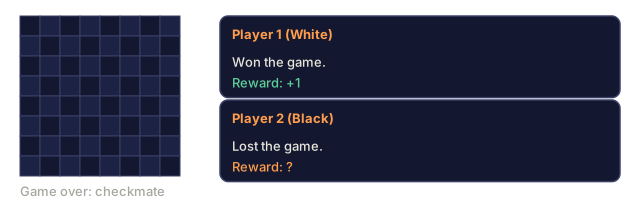
Games have everything RL wants. Clean reward (win or loss). Infinite episodes, since self-play just resets. Perfect simulation, because the game is the simulator. Discrete or small continuous action spaces. Multi-agent structure that forces adversarial robustness.
Games are also where every major RL breakthrough got tested first. TD-Gammon (backgammon, 1992). Atari-DQN (2013). AlphaGo (2016). AlphaZero (2017). OpenAI Five (Dota 2, 2019). AlphaStar (StarCraft II, 2019). MuZero (learned model, 2019). AlphaTensor (matrix multiplication, 2022). AlphaDev (sorting algorithms, 2023). DeepSeek-R1 (math reasoning, 2025), the newest proof that game-RL techniques carry over to text.
This capstone surveys three landmark architectures, AlphaZero, MuZero, and GRPO, through one lens: self-play + search + policy improvement. Each generalizes the one before it. GRPO in particular is AlphaZero's recipe applied to LLM reasoning, with tokens standing in for actions and mathematical verification standing in for the win signal.
The Concept

The unifying loop.
while True:
    trajectory = self_play(current_policy, search)     # play game against self
    policy_target = search.improved_policy(trajectory) # search improves raw policy
    policy_net.update(policy_target, value_target)     # supervised on search output
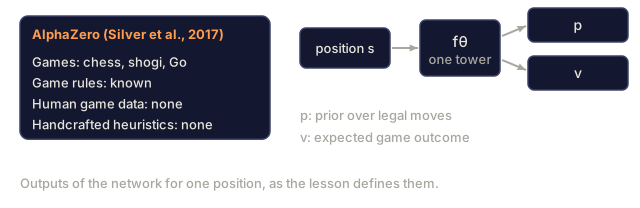
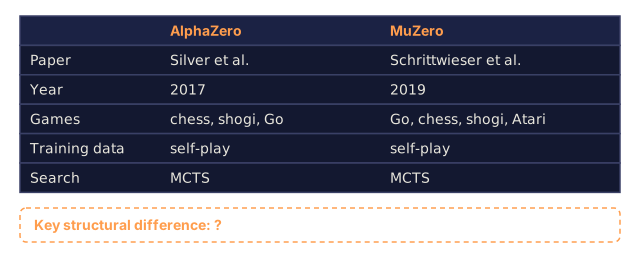
AlphaZero (2017). Silver et al. Given a game (chess, shogi, Go) with known rules:
- Policy-value network: one tower
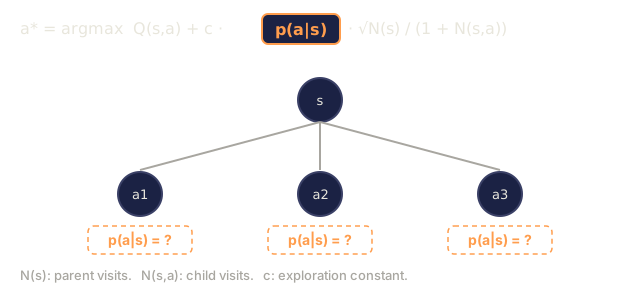
f_θ(s) → (p, v).pis a prior over legal moves.vis the expected game outcome. - Monte Carlo Tree Search (MCTS): at each move, expand a tree of possible continuations, using
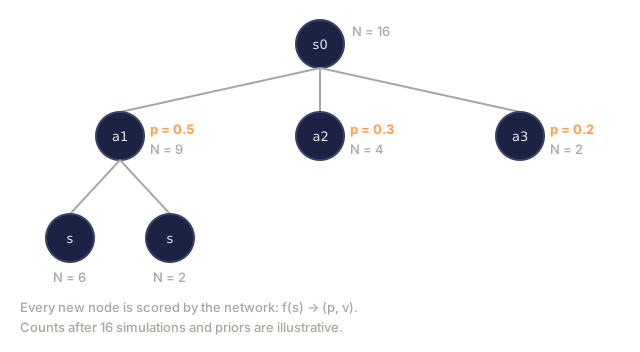
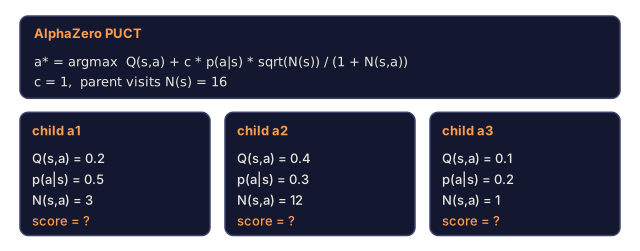
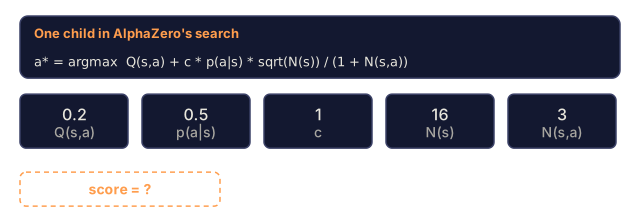
(p, v)as the prior and the bootstrap. Select nodes by UCB (PUCT):a* = argmax Q(s, a) + c · p(a|s) · √N(s) / (1 + N(s, a)). - Self-play: play games agent-vs-agent. At move
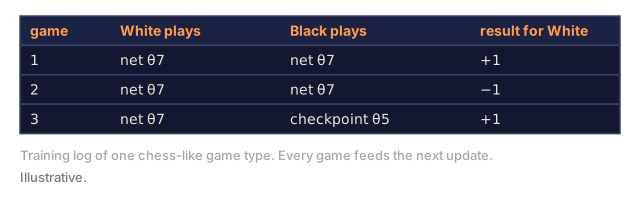
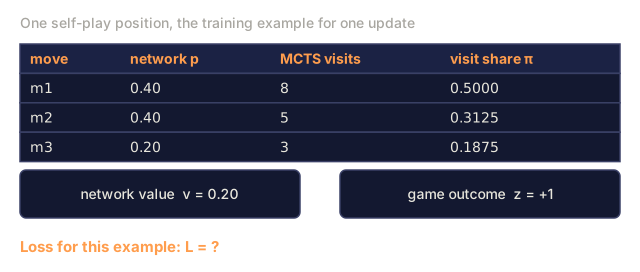
t, the MCTS visit distributionπ_tbecomes the policy training target. - Loss:
L = (v - z)² - π · log p + c · ||θ||².zis the game outcome (+1 / 0 / -1).
Zero human knowledge. Zero handcrafted heuristics. One recipe that mastered chess, shogi, and Go after a few tens of millions of self-play games each.
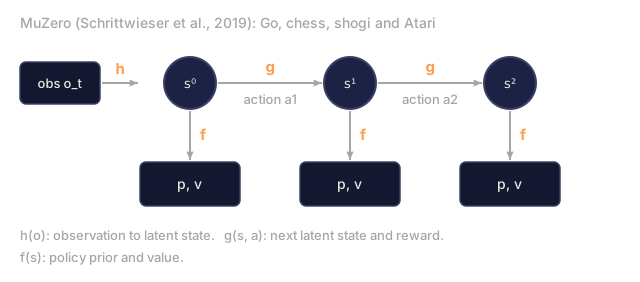
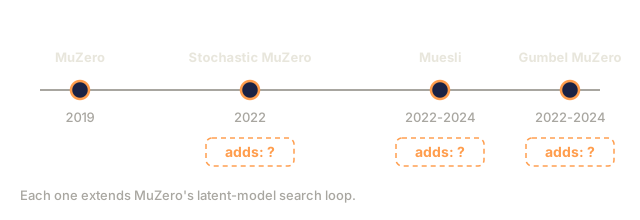
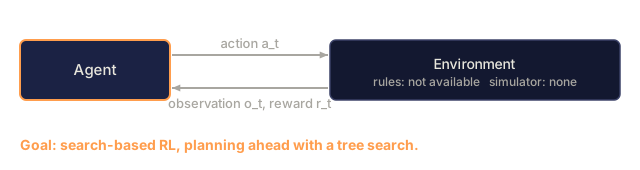
MuZero (2019). Schrittwieser et al. Drops the requirement that the rules are known.
- Instead of a fixed environment, learn a latent dynamics model
(h, g, f):h(s): encode observation to latent state.g(s_latent, a): predict next latent state + reward.f(s_latent): predict policy prior + value.
- MCTS runs in the learned latent space. Same search, same training loop.
- Works on Go, chess, shogi, and Atari too: one algorithm, no rule knowledge required.
Stochastic MuZero (2022). Adds stochastic dynamics and chance nodes, extending the recipe to backgammon-class games.
Muesli, Gumbel MuZero (2022-2024). Improve sample efficiency and deterministic search.
GRPO (2024-2025). The DeepSeek-R1 recipe. Same AlphaZero-shaped loop, applied to language-model reasoning:
-
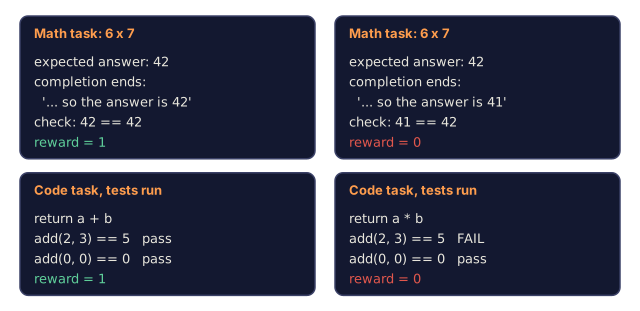
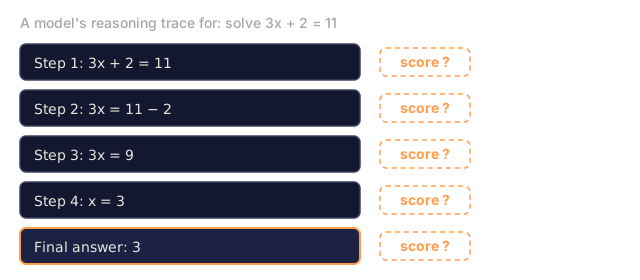
"Game": answer a math, coding, or reasoning problem. "Win" means the verifier (a test case passes, a numerical answer matches) returns 1.
-
Policy: the LLM. Actions: tokens. State: prompt plus response-so-far.
-
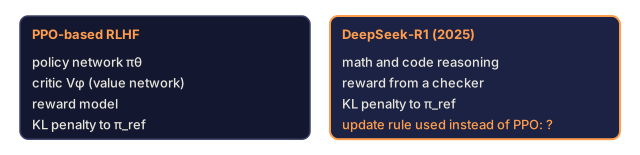
No critic (no PPO-style
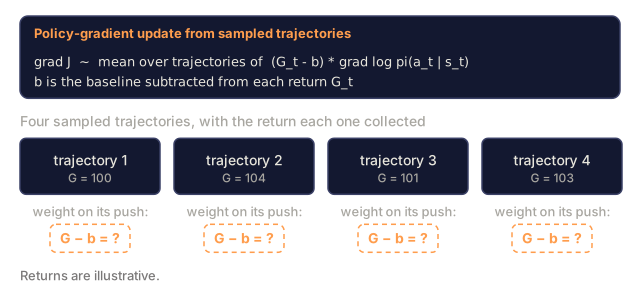
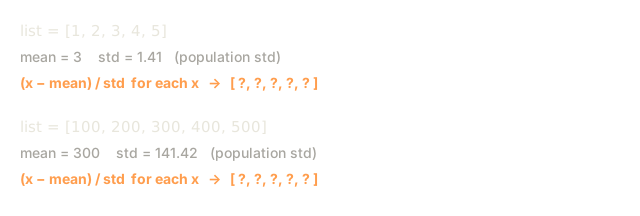
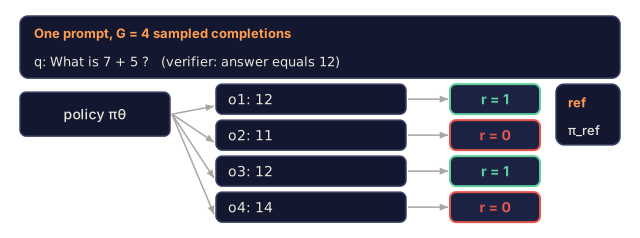
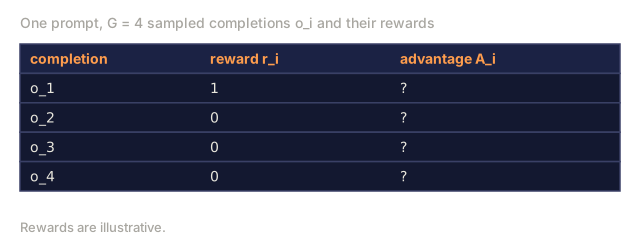
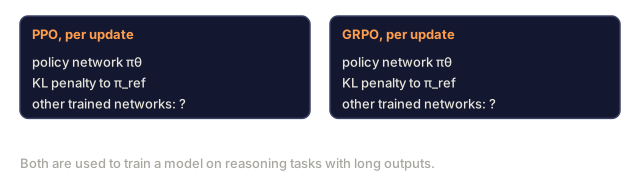
V_φ). Instead, for each prompt, sampleGcompletions from the policy and compute a reward for each. The group-relative advantageA_i = (r_i - mean_r) / std_ris the signal for a REINFORCE-style update. -
A KL penalty to the reference policy prevents drift, the same way RLHF does.
-
Full loss:
L_GRPO(θ) = -E_{q, {o_i}} [ (1/G) Σ_i A_i · log π_θ(o_i | q) ] + β · KL(π_θ || π_ref)
No reward model, no critic, no MCTS. A group-relative baseline replaces all three, and it matches or exceeds PPO-RLHF quality on reasoning benchmarks at a fraction of the compute.
The R1 recipe in full. DeepSeek-R1 (DeepSeek 2025) is really two models in one paper:
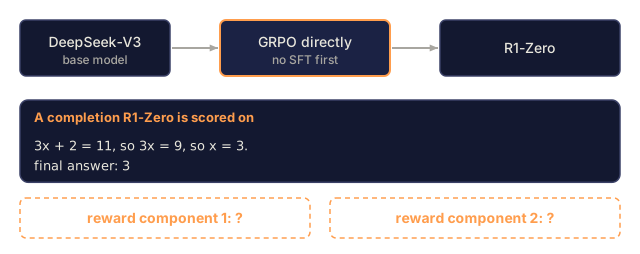
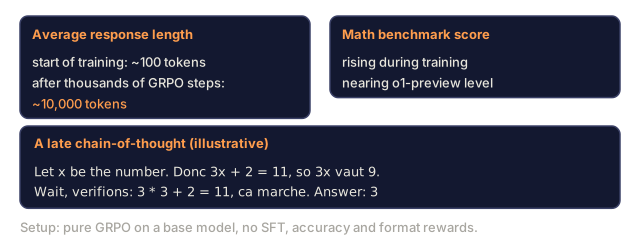
- R1-Zero. Start from the DeepSeek-V3 base model with no SFT. Apply GRPO directly with two reward components: an accuracy reward (rule-based: did the final answer parse to the correct number, did the code pass unit tests) and a format reward (did the completion wrap its chain-of-thought in
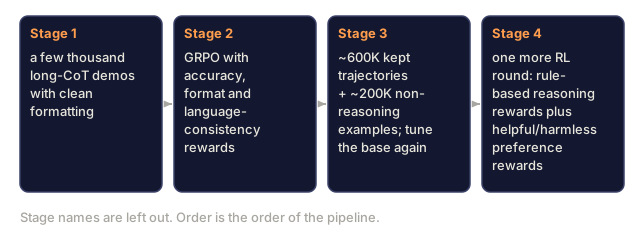
<think>…</think>tags). Over thousands of steps, average response length grows from roughly 100 to roughly 10,000 tokens while math benchmark scores climb to near-o1-preview levels. The model learns to reason from scratch. The catch: its chains of thought are often unreadable, mix languages, and have no stylistic polish. - R1. Fixes R1-Zero's readability problem with a four-stage pipeline:
- Cold-start SFT. Collect a few thousand long-CoT demonstrations with clean formatting and supervised-finetune the base model on them. This gives a readable starting point.
- Reasoning-oriented GRPO. Apply GRPO with the accuracy and format rewards, plus a language-consistency reward that stops the model from code-switching.
- Rejection sampling + SFT round 2. Sample around 600K reasoning trajectories from the RL checkpoint, keep only the ones with correct final answers and readable CoT, and combine those with about 200K non-reasoning SFT examples (writing, QA, self-cognition). Fine-tune the base again.
- Full-spectrum GRPO. One more RL round covering both reasoning (rule-based rewards) and general alignment (helpfulness and harmlessness preference-based rewards).
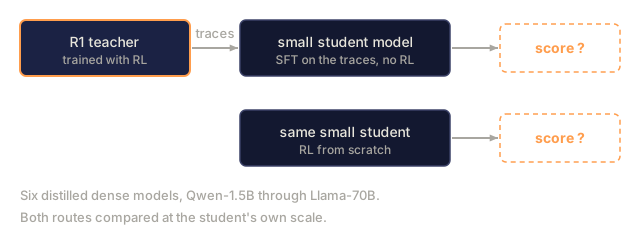
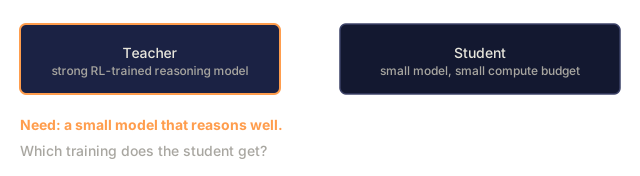
The result matches o1 on AIME and MATH-500 at open weights and is small enough to distill. The same paper also releases six distilled dense models (Qwen-1.5B through Llama-70B), trained by SFT on R1's reasoning traces with no RL at the student at all. Distillation from a strong RL teacher consistently beats RL from scratch at the student's scale.
Why GRPO instead of PPO for reasoning. The DeepSeekMath paper (Feb 2024) gives three reasons. First, there is no value network to train, which halves memory. Second, the group baseline naturally handles the sparse end-of-trajectory reward that reasoning tasks produce. Third, per-prompt normalization makes advantages comparable across problems of wildly different difficulty, something PPO's single critic can't do.
Search-free vs search-based. Games have split into two camps:
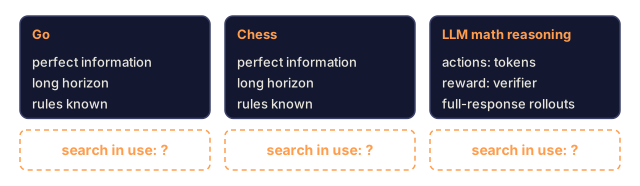
- Perfect-information games with long horizons (Go, chess) are still search-based. AlphaZero and MuZero dominate.
- LLM reasoning has no MCTS in production yet: GRPO runs on full rollouts, with best-of-N spending the inference compute instead. Process reward models (PRMs) hint that step-level search is on its way back.
Build It
The code in code/main.py implements GRPO in miniature: a bandit with multiple groups of samples. The algorithm is the same one used on an LLM, just with a simpler policy and environment. It teaches the loss and the group-relative advantage, which is the real 2025 innovation.
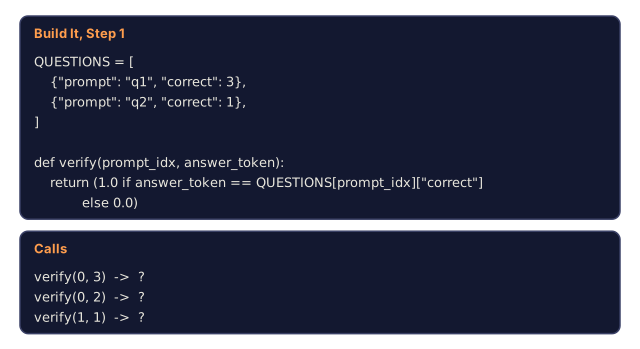
Step 1: a tiny verifier environment
QUESTIONS = [
    {"prompt": "q1", "correct": 3},
    {"prompt": "q2", "correct": 1},
]

def verify(prompt_idx, answer_token):
    return 1.0 if answer_token == QUESTIONS[prompt_idx]["correct"] else 0.0
In real GRPO the verifier runs unit tests or checks math equality.
Step 2: policy: softmax over K answer tokens per prompt
def policy_probs(theta, p_idx):
    return softmax(theta[p_idx])
Equivalent to the final-layer output of an LLM conditioned on a prompt.
Step 3: group sampling and group-relative advantage
def grpo_step(theta, p_idx, G=8, beta=0.01, lr=0.1, rng=None):
    probs = policy_probs(theta, p_idx)
    samples = [sample(probs, rng) for _ in range(G)]
    rewards = [verify(p_idx, s) for s in samples]
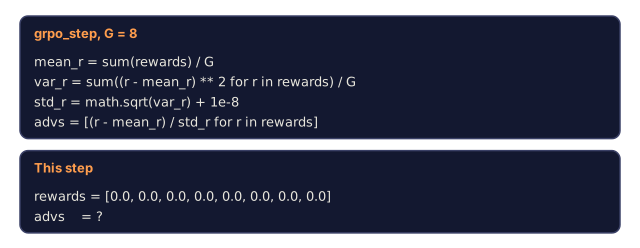
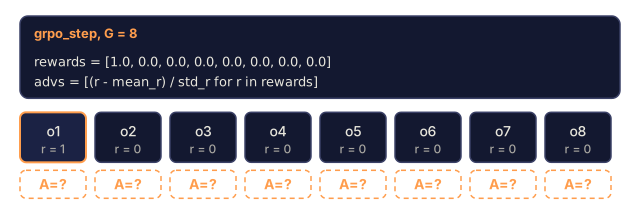
    mean_r = sum(rewards) / G
    std_r = stddev(rewards) + 1e-8
    advs = [(r - mean_r) / std_r for r in rewards]

    for a, A in zip(samples, advs):
        grad = onehot(a) - probs
        for i in range(len(probs)):
            theta[p_idx][i] += lr * A * grad[i]
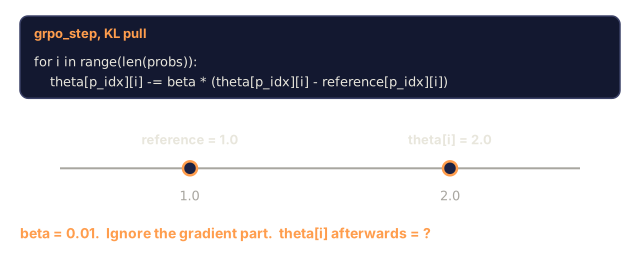
    # KL penalty: pull theta toward reference
    for i in range(len(probs)):
        theta[p_idx][i] -= beta * (theta[p_idx][i] - reference[p_idx][i])
The group-relative advantage is 2024's DeepSeek trick: no critic needed. The baseline is just the group mean, and normalization uses the group standard deviation.
Step 4: compare to REINFORCE baseline (value-free)
Same setup, same compute, but plain REINFORCE this time. GRPO converges faster and lands more stably.
Step 5: observe entropy and KL
Same diagnostics as RLHF: mean KL to reference, policy entropy, reward-over-time. Once these stabilize, training is done.
Pitfalls
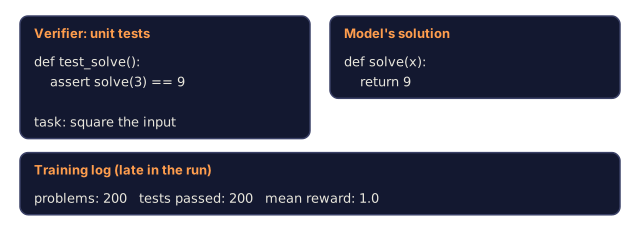
- Reward hacking via verifier gaming. GRPO inherits RLHF's risk. If the verifier is wrong or exploitable, the LLM finds the exploit, so robust verifiers (multiple test cases, formal proofs) matter.
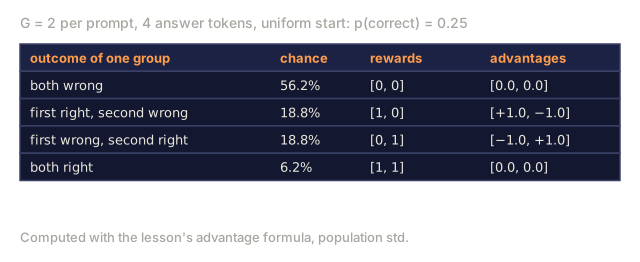
- Group size too small. Variance of the group baseline goes like
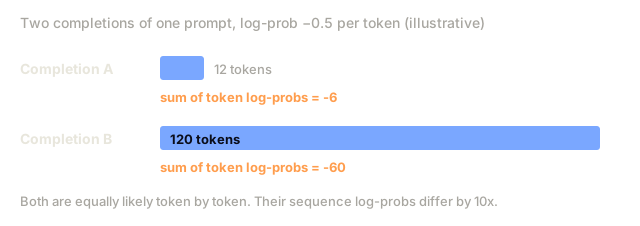
1/√G. BelowG = 4the advantage signal is noisy. The standard choice isG = 8to64. - Length bias. LLM completions of different lengths have different log-probabilities. Normalize by token count, use sequence-level log-prob, or truncate to a max length.
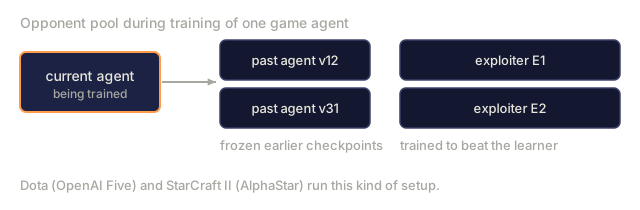
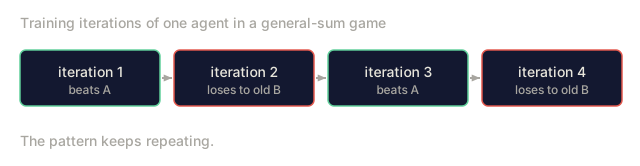
- Pure self-play cycles. AlphaZero-style training can get stuck in dominance loops on general-sum games. Diverse opponent pools (league play, Lesson 10) mitigate it.
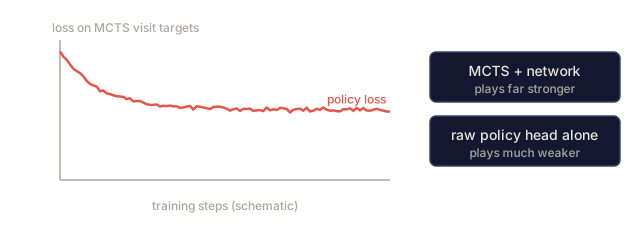
- Search-policy mismatch. AlphaZero trains the policy to mimic search output. If the policy net is too small to represent the search's distribution, training stalls.
- Compute floor. MuZero and AlphaZero need massive compute. A single ablation often runs hundreds of GPU-hours. Miniature demos exist (AlphaZero on Connect Four, for instance) for learning the shape of the algorithm.
- Verifier coverage. Unit tests that pass for a buggy solution reinforce the bug. Design verifiers that catch edge cases.
Use It
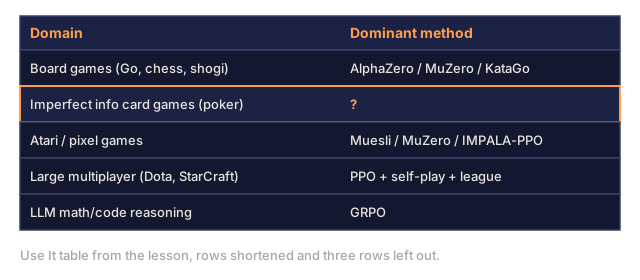
The 2026 game-RL landscape, by domain:
| Domain | Dominant method |
|---|---|
| Two-player zero-sum board games (Go, chess, shogi) | AlphaZero / MuZero / KataGo |
| Imperfect info card games (poker) | CFR + deep learning (DeepStack, Libratus, Pluribus) |
| Atari / pixel games | Muesli / MuZero / IMPALA-PPO |
| Large multiplayer strategy (Dota, StarCraft) | PPO + self-play + league (OpenAI Five, AlphaStar) |
| LLM math/code reasoning | GRPO (DeepSeek-R1, Qwen-RL, open replications) |
| LLM alignment | DPO / RLHF-PPO (not GRPO; verifier is preference not verifiable) |
| Robotics | PPO + DR (not game-RL, but uses same policy-gradient tools) |
| Combinatorial problems | AlphaZero variants (AlphaTensor, AlphaDev) |
The recipe (self-play, search-augmented improvement, policy distillation) spans text, pixels, and physical control. GRPO is the youngest instance. More are coming.
Ship It
Save as outputs/skill-game-rl-designer.md:
---
name: game-rl-designer
description: Design a game-RL or reasoning-RL training pipeline (AlphaZero / MuZero / GRPO) for a given domain.
version: 1.0.0
phase: 9
lesson: 12
tags: [rl, alphazero, muzero, grpo, self-play]
---

Given a target (perfect-info game / imperfect-info / Atari / LLM reasoning / combinatorial), output:

1. Environment fit. Known rules? Markov? Stochastic? Multi-agent? Informs AlphaZero vs MuZero vs GRPO.
2. Search strategy. MCTS (PUCT with learned prior), Gumbel-sampled, best-of-N, or none.
3. Self-play plan. Symmetric self-play / league / offline data / verifier-generated.
4. Target signal. Game outcome / verifier reward / preference / learned model. Include robustness plan.
5. Diagnostics. Win rate vs baseline, ELO curve, verifier pass rate, KL to reference.

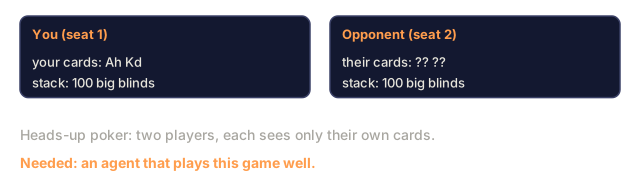
Refuse AlphaZero on imperfect-info games (route to CFR). Refuse GRPO without a trusted verifier. Refuse any game-RL pipeline without a fixed baseline opponent set (self-play ELO is uncalibrated otherwise).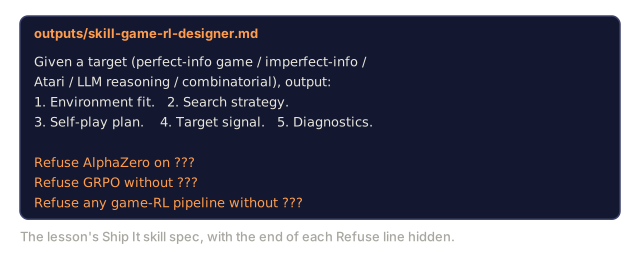
The first time I read the GRPO paper I assumed "no critic" was marketing gloss. REINFORCE with a group-mean baseline is textbook variance reduction, and DeepSeek never claimed otherwise. What actually convinced me was building the bandit in code/main.py and watching group size change the outcome directly: at G = 2 the policy thrashes, at G = 8 it locks onto the right answer within a few hundred steps. GRPO isn't a new idea wearing a new name. It's an old idea, drop the critic and normalize within a group, that happens to be cheap and stable enough to run at the scale a frontier lab needs for RL on reasoning. That's also why it took until 2024 and not 2017 to matter: nobody needed to skip the critic on Go, since AlphaZero already got a value network almost for free out of self-play. LLM rollouts don't offer that shortcut.
Exercises
- Easy. Implement the GRPO bandit in
code/main.py. Train on 2 prompts × 4 answer tokens each. Converge in < 1,000 updates withG=8. - Medium. Plug in PPO (clipped) and vanilla REINFORCE. Compare sample efficiency and reward variance to GRPO on the same bandit.
- Hard. Extend to a length-2 "reasoning chain": the agent emits two tokens and the verifier rewards the pair. Measure how GRPO handles the credit assignment across two-step sequences. (Hint: compute group advantage per full sequence, propagate to both token positions.)
Key Terms
| Term | What people say | What it actually means |
|---|---|---|
| MCTS | "Tree search with learned net" | Monte Carlo Tree Search; UCB1/PUCT selection with learned (p, v) priors. |
| AlphaZero | "Self-play + MCTS" | Policy-value net trained to match MCTS visits and game outcome. |
| MuZero | "Learned-model AlphaZero" | Same loop but in latent space via learned dynamics. |
| GRPO | "Critic-free PPO" | Group Relative Policy Optimization; REINFORCE with group-mean baseline + KL. |
| PUCT | "AlphaZero's UCB" | Q + c · p · √N / (1 + N_a): balances value estimate with prior. |
| Self-play | "Agent vs past self" | Standard for zero-sum; symmetric training signal. |
| League play | "Population-based self-play" | Past + current + exploiters sampled as opponents. |
| Verifier reward | "Verifiable RL" | Reward comes from a deterministic checker (tests pass, answer matches). |
| Process reward | "PRM" | Scores each reasoning step, not just the final answer. |
Further Reading
- Silver et al. (2017). Mastering the game of Go without human knowledge (AlphaGo Zero).
- Silver et al. (2018). A general reinforcement learning algorithm that masters chess, shogi, and Go through self-play (AlphaZero).
- Schrittwieser et al. (2020). Mastering Atari, Go, chess and shogi by planning with a learned model (MuZero).
- Vinyals et al. (2019). Grandmaster level in StarCraft II (AlphaStar).
- DeepSeek-AI (2024). DeepSeekMath: Pushing the Limits of Mathematical Reasoning in Open Language Models (GRPO): the paper that introduced GRPO and the group-relative baseline.
- DeepSeek-AI (2025). DeepSeek-R1: Incentivizing Reasoning Capability in LLMs via Reinforcement Learning: the full four-stage R1 recipe plus the R1-Zero ablation.
- Brown et al. (2019). Superhuman AI for multiplayer poker (Pluribus): CFR + deep-learning at scale.
- Tesauro (1995). Temporal Difference Learning and TD-Gammon: the paper that started it all.
- Hugging Face TRL: GRPOTrainer: the production reference for applying GRPO with custom reward functions.
- Qwen Team (2024). Qwen2.5-Math: GRPO replication: open replication of the R1 recipe at multiple scales.
- Sutton & Barto (2018). Ch. 17: Frontiers of Reinforcement Learning: the textbook framing for self-play, search, and "designed reward" that R1 instantiates at LLM scale.
Code
- main.py (python, 141 lines)