Reward Modeling & RLHF
Humans cannot write a reward function for "good assistant response," but they can compare two responses and pick the better one. Fit a reward model to those comparisons, then RL the language model against it. Christiano 2017. InstructGPT 2022. The recipe that turned GPT-3 into ChatGPT. In 2026 it's mostly being replaced by DPO, but the mental model stays.
Learning Objectives
- Explain why a hand-written reward function for 'good response' doesn't work, and how pairwise human preference comparisons fix that by training a reward model.
- Walk through the three-stage SFT then reward-model then PPO pipeline, including the Bradley-Terry pairwise loss that fits the reward model and the KL-penalized objective that optimizes the policy against it.
- Diagnose the core RLHF failure modes, reward hacking, length hacking, an undersized reward model, noisy preference labels, and explain why the KL-to-reference term is the primary safeguard against over-optimization.
- Place RLHF in the 2026 alignment landscape relative to DPO, GRPO, process reward models, and RLAIF/Constitutional AI, and state what each replaces or extends.
The Problem
You trained a language model on next-token prediction. It writes grammatical English. It also lies, rambles, and refuses to refuse. More pretraining won't fix that: web text is the problem, not the cure.
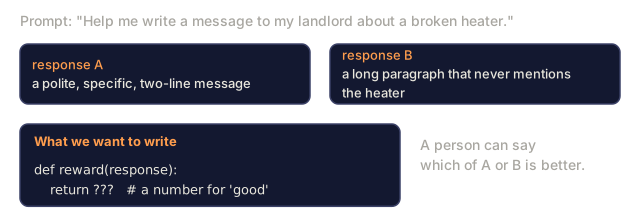
What you actually want is a scalar reward: a number that says "response A is better than response B for instruction X." Writing that function by hand is impossible, since "helpfulness" has no closed-form expression over tokens. But humans can compare two outputs and mark a preference, and that's cheap to collect at scale.
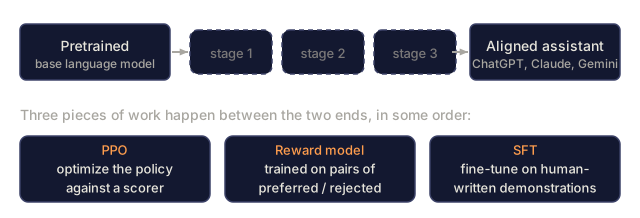
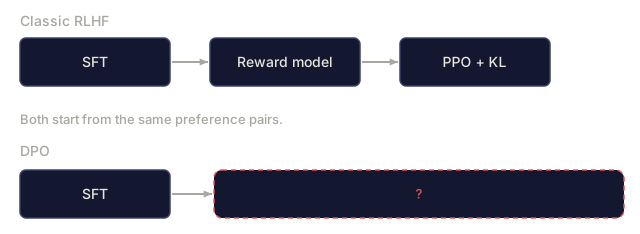
RLHF (Christiano et al. 2017; Ouyang et al. 2022) turns those preferences into a reward model, then optimizes the LM with PPO against it, in three steps: SFT → RM → PPO. It's the recipe that shipped ChatGPT, Claude, Gemini, and every other aligned LLM between 2023 and 2025.
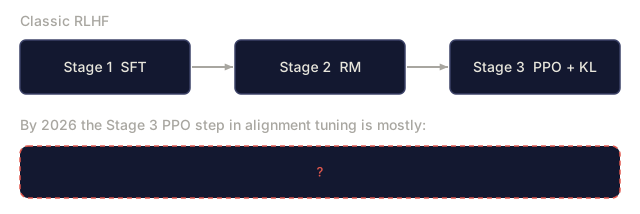
By 2026 the PPO step is mostly replaced by DPO (Phase 10 · 08), which is cheaper and nearly as good for alignment tuning. The reward model piece hasn't gone anywhere, though: it still underlies every Best-of-N sampler, every RL-from-verifiable-rewards pipeline, and every reasoning model built on a process reward model. Understand RLHF and you understand the whole alignment stack.
The Concept

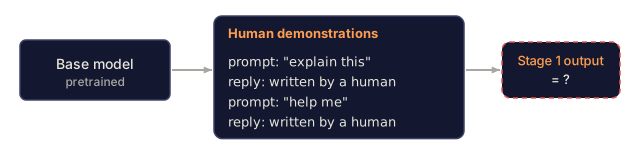
Stage 1: Supervised Fine-Tuning (SFT). Start from a pretrained base model and fine-tune it on human-written demonstrations of the target behavior: instruction-following responses, helpful replies, and so on. The result is a model π_SFT that's biased toward good behavior but still has an unbounded action space.
Stage 2: Reward Model training.
-
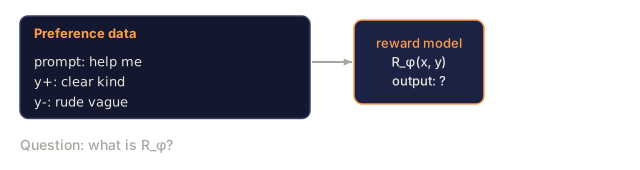
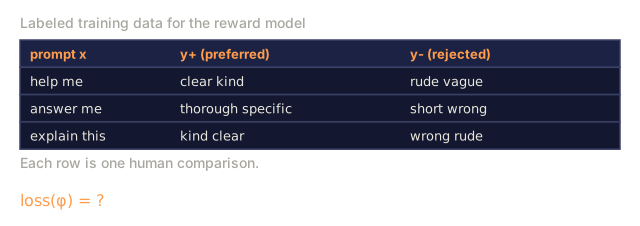
Collect pairs of responses
(y_+, y_-)to promptsx, labeled by humans as "y_+ is preferred over y_-." -
Train a reward model
R_φ(x, y)to assign higher scores toy_+. -
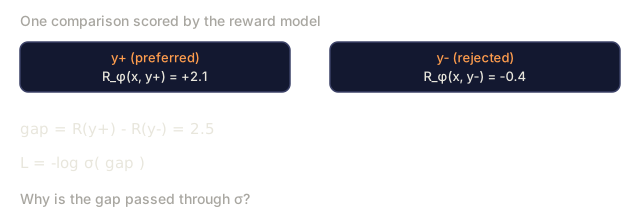
Loss: the Bradley-Terry pairwise logistic:
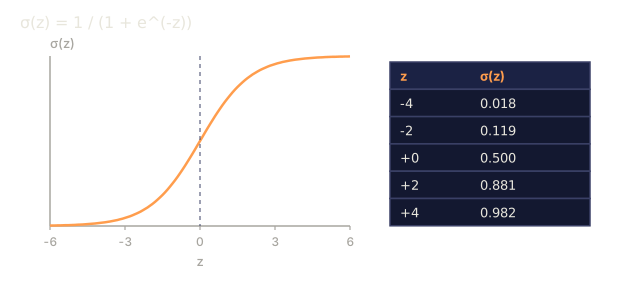
L(φ) = -E[ log σ(R_φ(x, y_+) - R_φ(x, y_-)) ]σ is the sigmoid, so the reward gap maps directly to a log-odds of preference. Bradley-Terry has been the standard since 1952 and is still the dominant choice in modern RLHF.
-
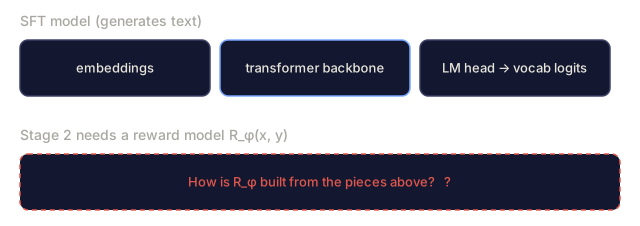
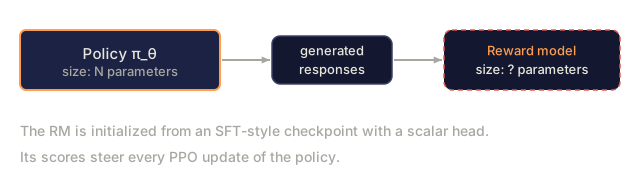
R_φis usually initialized from the SFT model with a scalar head bolted on: same transformer backbone, one linear layer producing the reward.
Stage 3: PPO against the RM with KL penalty.
-
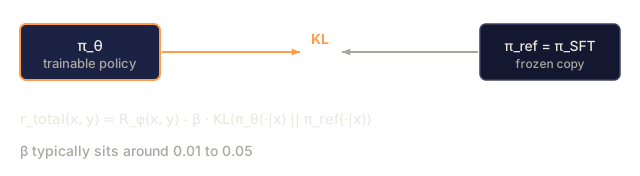
Initialize the trainable policy
π_θfromπ_SFT, and keep a frozen referenceπ_ref = π_SFT. -
Reward at the end of a response
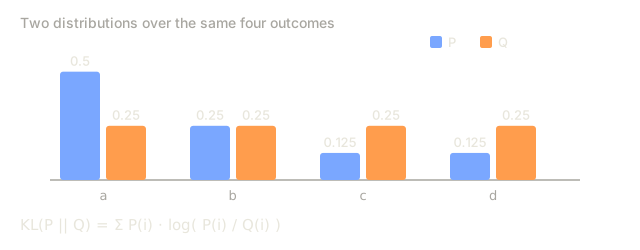
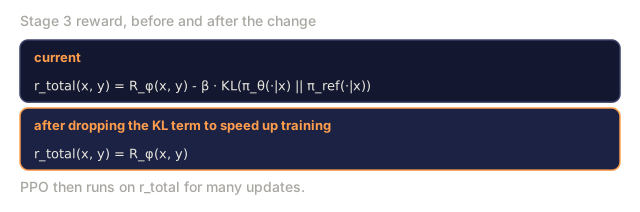
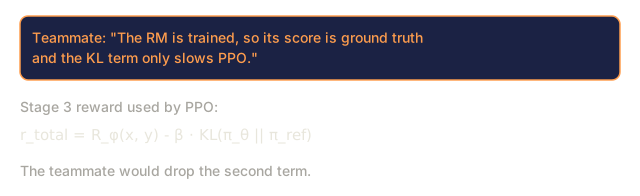
y:r_total(x, y) = R_φ(x, y) - β · KL(π_θ(·|x) || π_ref(·|x))The KL penalty stops
π_θfrom drifting arbitrarily far fromπ_SFT. It's a regularizer, not a hard trust region, andβtypically sits around0.01-0.05. -
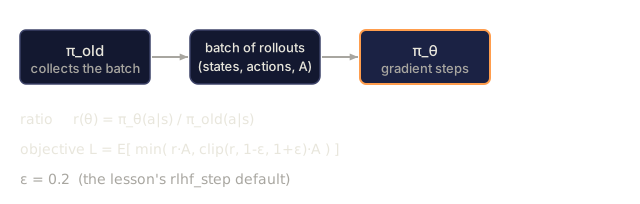
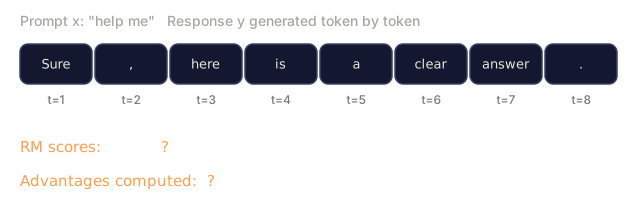
Run PPO (Lesson 08) with this reward. Advantages get computed on the token-level trajectory, but the RM only scores the full response.
Why the KL? Without it, PPO will happily find reward-hacking strategies, since the RM was only trained on in-distribution completions. An out-of-distribution response can score higher than anything a human ever wrote. The KL keeps π_θ near the manifold where the RM was actually trained: it's the single most important knob in RLHF.
2026 status. The three-stage pipeline above is the classic recipe, but most of it has since been streamlined or replaced:
- DPO (Rafailov 2023): closed-form algebra collapses Stage 2+3 into a single supervised loss over preference data. No RM, no PPO. Same quality on alignment benchmarks for a fraction of the compute. Covered in Phase 10 · 08.
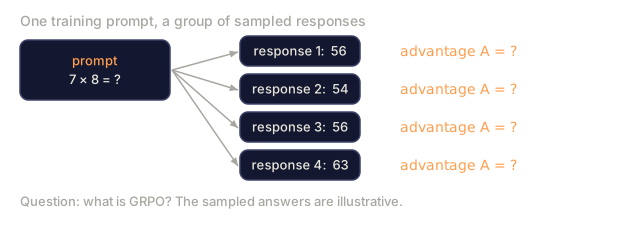
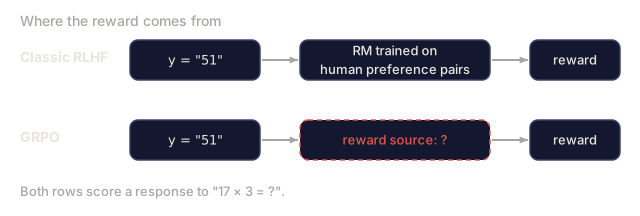
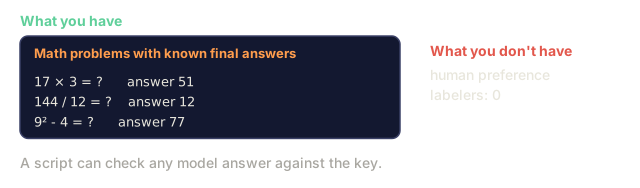
- GRPO (DeepSeek 2024–2025): PPO with a group-relative baseline instead of a critic, reward from a verifier (code runs / math answer matches) instead of a human-trained RM. Dominant for reasoning models. Covered in Phase 9 · 12.
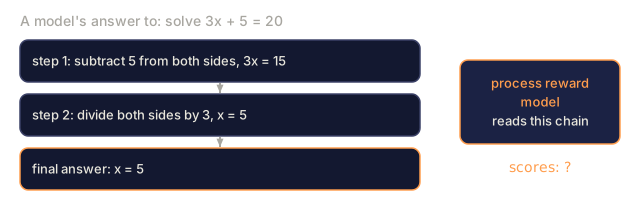
- Process reward models (PRMs): score partial solutions (each reasoning step), used in both RLHF and GRPO variants for reasoning.
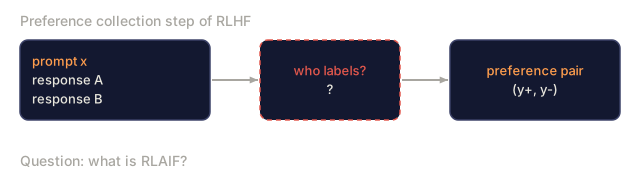
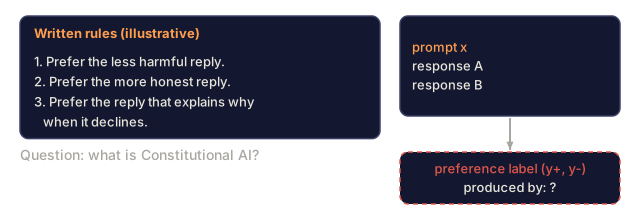
- Constitutional AI / RLAIF: use an aligned LLM to generate preferences instead of humans. Scales the preference budget.
Build It
This lesson uses tiny synthetic "prompts" and "responses" represented as strings. The RM is a linear scorer over a bag-of-tokens representation. There's no real LLM here: what matters is the shape of the pipeline, not the scale. See code/main.py.
Step 1: synthetic preference data
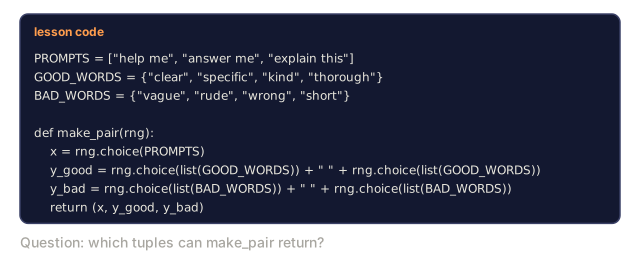
PROMPTS = ["help me", "answer me", "explain this"]
GOOD_WORDS = {"clear", "specific", "kind", "thorough"}
BAD_WORDS = {"vague", "rude", "wrong", "short"}

def make_pair(rng):
    x = rng.choice(PROMPTS)
    y_good = rng.choice(list(GOOD_WORDS)) + " " + rng.choice(list(GOOD_WORDS))
    y_bad = rng.choice(list(BAD_WORDS)) + " " + rng.choice(list(BAD_WORDS))
    return (x, y_good, y_bad)
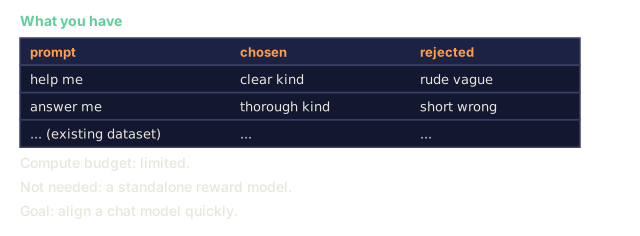
In real RLHF this is replaced by human labelers, but the shape, (prompt, preferred_response, rejected_response), stays identical.
Step 2: Bradley-Terry reward model
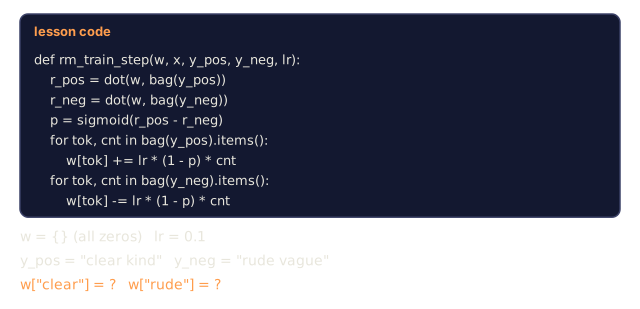
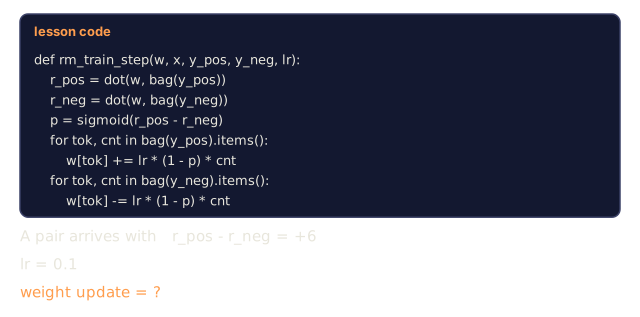
Linear score: R(x, y) = w · bag(y). Train to minimize the BT pairwise log-loss:
def rm_train_step(w, x, y_pos, y_neg, lr):
    r_pos = dot(w, bag(y_pos))
    r_neg = dot(w, bag(y_neg))
    p = sigmoid(r_pos - r_neg)
    for tok, cnt in bag(y_pos).items():
        w[tok] += lr * (1 - p) * cnt
    for tok, cnt in bag(y_neg).items():
        w[tok] -= lr * (1 - p) * cnt
After a few hundred updates, w assigns positive weights to good-word tokens and negative to bad.
Step 3: PPO-like policy on top of RM
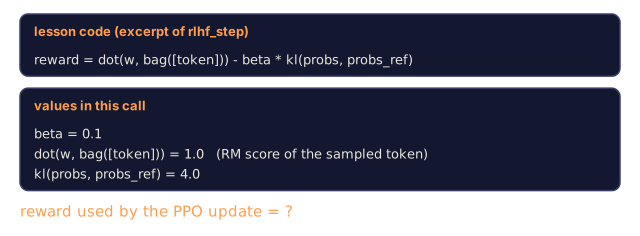
Our toy policy produces a single token from a vocabulary. We score the token under the RM, compute log π_θ(token | prompt), add a KL-to-reference penalty, and apply the clipped PPO surrogate.
def rlhf_step(theta, ref, w, prompt, rng, eps=0.2, beta=0.1, lr=0.05):
    logits_theta = policy_logits(theta, prompt)
    probs = softmax(logits_theta)
    token = sample(probs, rng)
    logits_ref = policy_logits(ref, prompt)
    probs_ref = softmax(logits_ref)
    reward = dot(w, bag([token])) - beta * kl(probs, probs_ref)
    # ppo-style update on theta, treating reward as the return
    ...
Step 4: monitor the KL
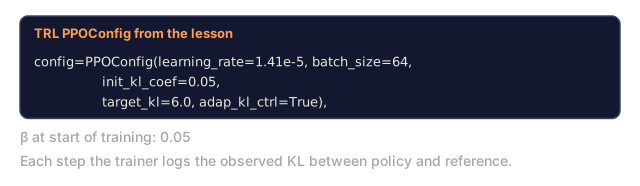
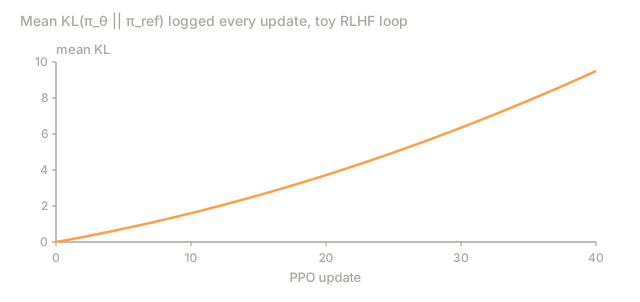
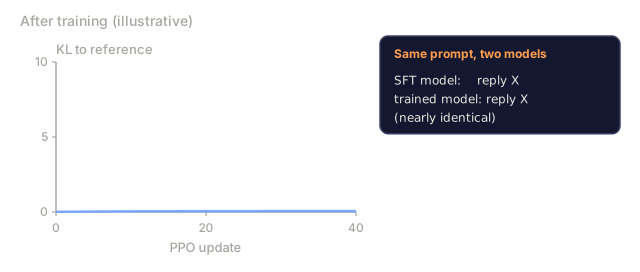
Track mean KL(π_θ || π_ref) every update. If it creeps past ~5-10, the policy has drifted far from π_SFT: either β is too low, or reward hacking is starting. This is the top diagnostic in real RLHF.
Step 5: the production recipe with TRL
Once you understand the toy pipeline, here's the same loop the way a real library user writes it. Hugging Face's TRL is the reference implementation: RewardTrainer handles Stage 2, and PPOTrainer (with a KL-to-reference built in) handles Stage 3.
# Stage 2: reward model from pairwise preferences
from trl import RewardTrainer, RewardConfig
from transformers import AutoModelForSequenceClassification, AutoTokenizer

tok = AutoTokenizer.from_pretrained("meta-llama/Llama-3.1-8B-Instruct")
rm = AutoModelForSequenceClassification.from_pretrained(
    "meta-llama/Llama-3.1-8B-Instruct", num_labels=1
)

# dataset rows: {"prompt", "chosen", "rejected"} — Bradley-Terry format
trainer = RewardTrainer(
    model=rm,
    tokenizer=tok,
    train_dataset=preference_data,
    args=RewardConfig(output_dir="./rm", num_train_epochs=1, learning_rate=1e-5),
)
trainer.train()# Stage 3: PPO against the RM with KL penalty to the SFT reference
from trl import PPOTrainer, PPOConfig, AutoModelForCausalLMWithValueHead
policy = AutoModelForCausalLMWithValueHead.from_pretrained("./sft-checkpoint")
ref = AutoModelForCausalLMWithValueHead.from_pretrained("./sft-checkpoint") # frozen
ppo = PPOTrainer(
config=PPOConfig(learning_rate=1.41e-5, batch_size=64, init_kl_coef=0.05,
target_kl=6.0, adap_kl_ctrl=True),
model=policy, ref_model=ref, tokenizer=tok,
)
for batch in dataloader:
responses = ppo.generate(batch["query_ids"], max_new_tokens=128)
rewards = rm(torch.cat([batch["query_ids"], responses], dim=-1)).logits[:, 0]
stats = ppo.step(batch["query_ids"], responses, rewards)
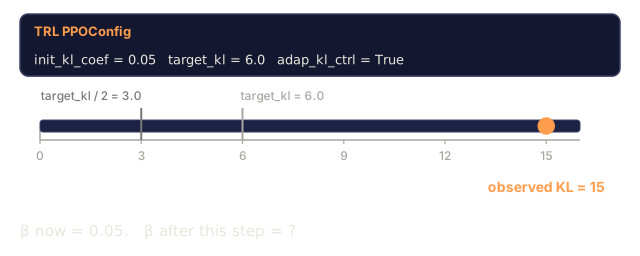
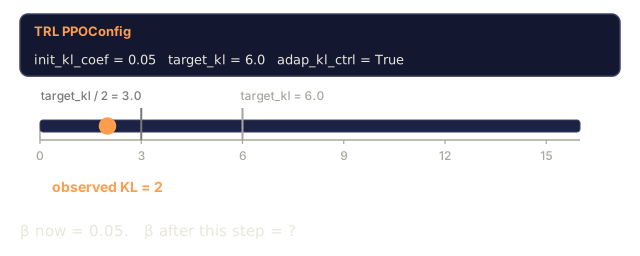
# stats includes: mean_kl, clip_frac, value_loss — the three PPO diagnosticsThree things the library does for you. adap_kl_ctrl=True implements the adaptive-β schedule: if observed KL exceeds target_kl, β doubles; if below half, β halves. The reference model is frozen by convention, so make sure you don't accidentally share parameters with policy. And the value head lives on the same backbone as the policy (AutoModelForCausalLMWithValueHead attaches a scalar MLP head), which is why TRL reports policy/kl and value/loss separately.
Pitfalls
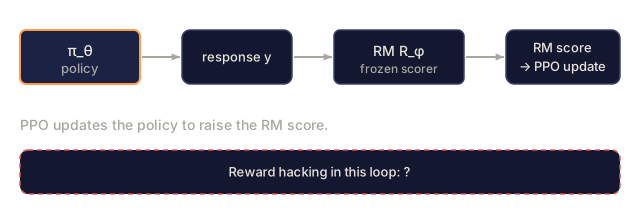
- Over-optimization / reward hacking. The RM is imperfect;
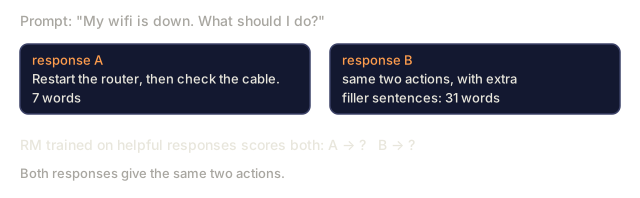
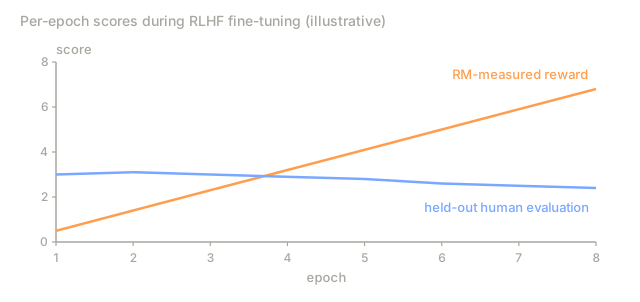
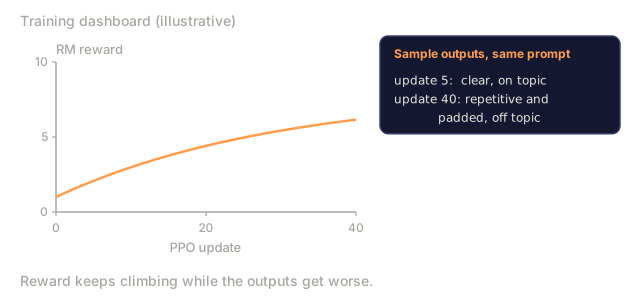
π_θfinds adversarial completions that score high but are bad. Symptoms: reward climbs indefinitely while human eval score plateaus or drops. Fix: stop early, raiseβ, broaden RM training data. - Length hacking. RMs trained on helpful responses often implicitly reward length. The policy learns to pad responses. Remediation: length-normalized reward, or RLAIF with a length-aware RM.
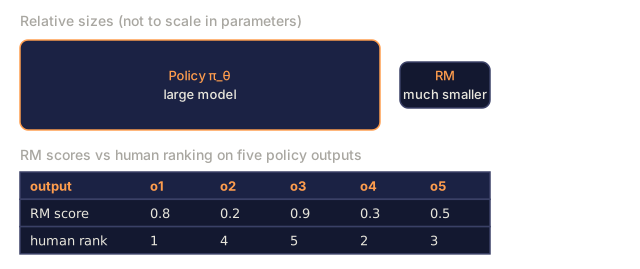
- Too-small RM. The RM needs to be at least as large as the policy. A tiny RM cannot faithfully score the policy's outputs.
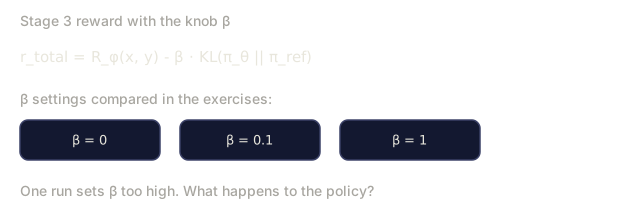
- KL tuning. Too low β → drift and reward hacking. Too high β → policy barely changes. The standard trick is an adaptive β that targets a fixed KL per step.
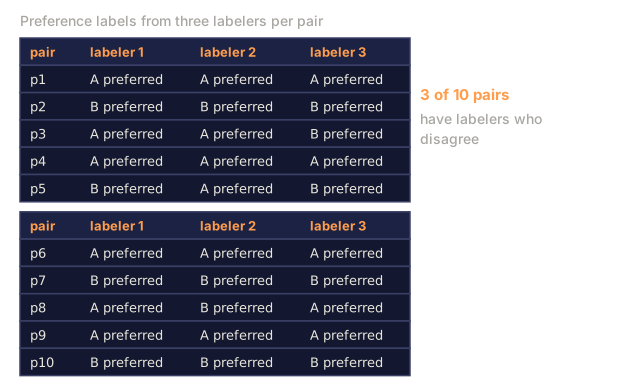
- Preference-data noise. ~30% of human labels are noisy or ambiguous. Calibrate by training the RM on agreement-filtered data or use a temperature on BT.
- Off-policy problems. PPO data is slightly off-policy after the first epoch. Monitor clip fraction as in Lesson 08.
Use It
RLHF in 2026 is layered:
| Layer | Target | Method |
|---|---|---|
| Instruction following, helpfulness, harmlessness | Alignment | DPO (Phase 10 · 08) preferred over RLHF-PPO. |
| Reasoning correctness (math, code) | Capability | GRPO with verifier reward (Phase 9 · 12). |
| Long-horizon multi-step tasks | Agentic | PPO / GRPO with process reward models over steps. |
| Safety / refusal behavior | Safety | RLHF-PPO with separate safety RM, or Constitutional AI. |
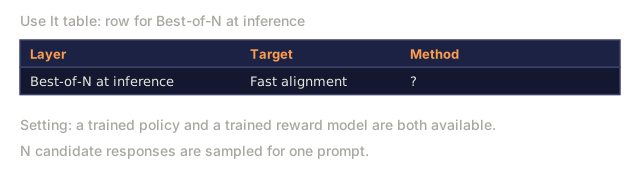
| Best-of-N at inference | Fast alignment | Use RM at decode time; no policy training needed. |
| Reward distillation | Inference compute | Train a small "reward head" on top of a frozen LM. |
RLHF was the method in 2022–2024, but by 2026 production alignment pipelines run DPO-first, reaching for PPO only on RM-intensive or safety-critical steps.
Ship It
Save as outputs/skill-rlhf-architect.md:
---
name: rlhf-architect
description: Design an RLHF / DPO / GRPO alignment pipeline for a language model, including RM, KL, and data strategy.
version: 1.0.0
phase: 9
lesson: 9
tags: [rl, rlhf, alignment, llm]
---

Given a base LM, a target behavior (alignment / reasoning / refusal / agent), and a preference or verifier budget, output:

1. Stage. SFT? RM? DPO? GRPO? With justification.
2. Preference or verifier source. Humans, AI feedback, rule-based, unit-test-pass, or reward distillation.
3. KL strategy. Fixed β, adaptive β, or DPO (implicit KL).
4. Diagnostics. Mean KL, reward stability, over-optimization guard (holdout human eval).
5. Safety gate. Red-team set, refusal rate, safety RM separate from helpfulness RM.

Refuse to ship RLHF-PPO without a KL monitor. Refuse to use an RM smaller than the target policy. Refuse length-only rewards. Flag any pipeline that does not hold back a blind human-eval set as lacking over-optimization protection.The trap in this lesson is treating the reward model as ground truth once it's trained. It isn't. It's a frozen snapshot of what a few hundred or a few thousand human comparisons implied about quality, on the completions those humans happened to see. Every PPO step afterward is a small adversarial search against that snapshot, whether anyone intends it that way or not.
That's why the KL term is the whole ballgame, not a tuning afterthought. It's the only thing standing between you and a policy that has fully overfit to the RM's blind spots. If you're staring at a run where reward keeps climbing while the outputs keep getting worse, don't go tune the RM first. Check the KL. Nine times out of ten it already blew past the range where the RM's judgments mean anything.
Exercises
- Easy. Train the Bradley-Terry reward model in
code/main.pyon 500 synthetic preference pairs. Measure pairwise accuracy on a held-out 100 pairs. Should exceed 90%. - Medium. Run the toy PPO-RLHF loop with
β ∈ {0.0, 0.1, 1.0}. For each, plot RM score vs KL-to-reference over updates. Which runs reward-hack? - Hard. Implement DPO (closed-form preference-likelihood loss) on the same preference data and compare to the RLHF-PPO pipeline in compute used and final RM score achieved.
Key Terms
| Term | What people say | What it actually means |
|---|---|---|
| RLHF | "Alignment RL" | Three-stage SFT + RM + PPO pipeline (Christiano 2017, Ouyang 2022). |
| Reward Model (RM) | "The scoring net" | Learned scalar function fit to pairwise preferences via Bradley-Terry. |
| Bradley-Terry | "Pairwise logistic loss" | P(y_+ ≻ y_-) = σ(R(y_+) - R(y_-)); the standard RM objective. |
| KL penalty | "Stay near the reference" | β · KL(π_θ || π_ref) in the reward; the anti-reward-hacking regularizer. |
| Reward hacking | "Goodhart's law" | Policy exploits RM flaws; symptoms: reward up, human eval flat. |
| RLAIF | "AI-labeled preferences" | RLHF where labels come from another LM instead of humans. |
| PRM | "Process Reward Model" | Scores partial reasoning steps; used in reasoning pipelines. |
| Constitutional AI | "Anthropic's method" | AI-generated preferences guided by explicit rules. |
Further Reading
- Christiano et al. (2017). Deep Reinforcement Learning from Human Preferences: the paper that started RLHF.
- Ouyang et al. (2022). InstructGPT: Training language models to follow instructions with human feedback: the recipe behind ChatGPT.
- Stiennon et al. (2020). Learning to summarize with human feedback: earlier RLHF for summarization.
- Rafailov et al. (2023). Direct Preference Optimization: DPO; the post-RLHF default in 2026.
- Bai et al. (2022). Constitutional AI: Harmlessness from AI Feedback: RLAIF and self-critique loop.
- Anthropic RLHF paper (Bai et al. 2022). Training a Helpful and Harmless Assistant: the HH paper.
- Hugging Face TRL library: production
RewardTrainerandPPOTrainer. Read the trainer source for the adaptive-KL and value-head details. - Hugging Face: Illustrating Reinforcement Learning from Human Feedback by Lambert, Castricato, von Werra, Havrilla: the canonical walk-through of the three-stage pipeline with diagrams.
- von Werra et al. (2020). TRL: Transformer Reinforcement Learning: the library;
examples/has end-to-end RLHF scripts for Llama, Mistral, and Qwen. - Sutton & Barto (2018). Ch. 17.4: Designing Reward Signals: the reward-hypothesis view; essential prerequisite for thinking about reward hacking.
Code
- main.py (python, 160 lines)