Multi-Agent RL
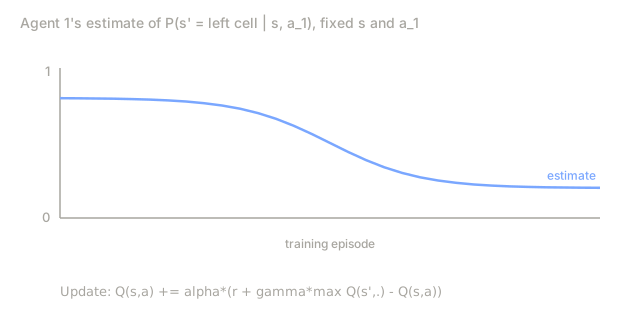
Single-agent RL assumes the environment stays stationary. Put two learning agents in the same world and that assumption breaks: each agent is part of the other's environment, and both are moving targets. Multi-agent RL is the set of tricks that make learning converge anyway, once the Markov assumption no longer holds.
Learning Objectives
- Explain why the Markov property breaks down once multiple learning agents share an environment, and name the five core MARL challenges: non-stationarity, credit assignment, exploration coordination, scalability, and partial observability.
- Distinguish the four dominant MARL regimes, independent learning (IQL/IPPO), centralized-training-decentralized-execution (MADDPG, COMA, MAPPO, QMIX), self-play, and league play, and explain when each one is the right fit.
- Implement independent Q-learning and a centralized joint-Q update on a cooperative two-agent GridWorld, and explain why independent learning converges on loosely-coupled tasks but fails on tightly-coupled ones.
- Diagnose the standard MARL failure modes, including reward hacking via coordination, policy drift, exploration redundancy, and sample explosion, and explain why a rising self-play win rate against a fixed snapshot can be a misleading signal.
The Problem
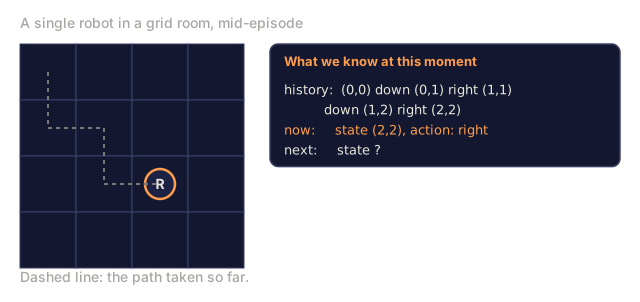
A robot learning to navigate a room is a single-agent RL problem. A soccer team is not. Neither is AlphaStar playing against StarCraft opponents, a marketplace of bidding agents, two cars negotiating a four-way stop, or any other many-on-many problem you can name.
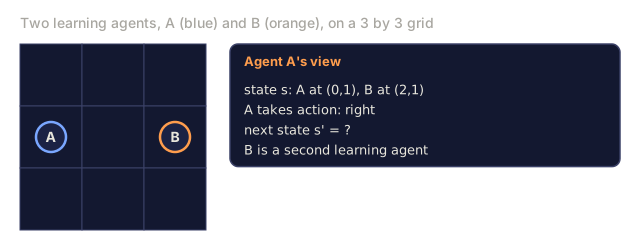
In every multi-agent setting, from the perspective of any one agent, the other agents are part of the environment. As they learn and change their behavior, the environment becomes non-stationary — the ground keeps shifting while you're trying to stand on it. The Markov property (next state depends only on current state and my action) gets violated, because the next state also depends on what the other agents chose, and their policies are moving targets.
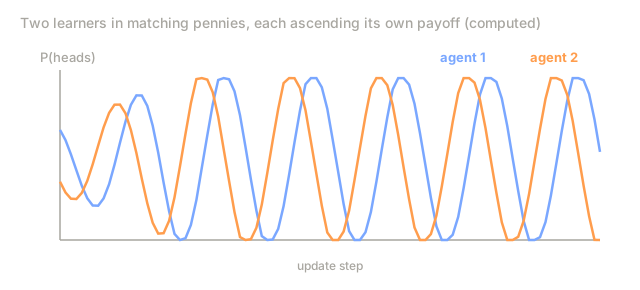
This breaks tabular convergence proofs: Q-learning's guarantee assumes a stationary environment. It breaks naive deep RL too. Agents chase each other in loops and never settle on a stable policy. You need multi-agent-specific techniques: centralized training with decentralized execution, counterfactual baselines, league play, self-play.
2026 applications include robot swarms, traffic routing, autonomous vehicle fleets, market simulators, multi-agent LLM systems (Phase 16), and any game with more than one intelligent player.
The Concept

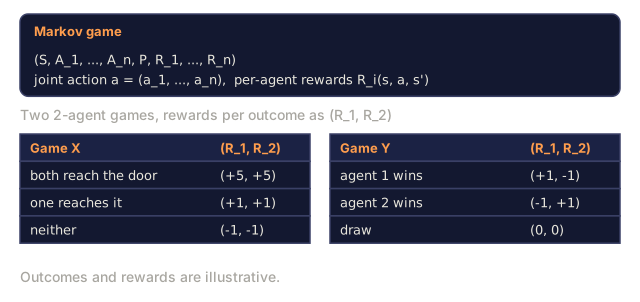
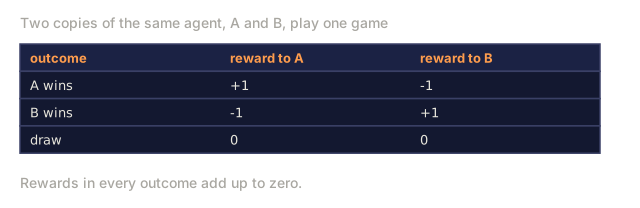
Formalism: Markov Game. A generalization of MDP: states S, a joint action a = (a_1, …, a_n), transition P(s' | s, a), and per-agent rewards R_i(s, a, s'). Each agent i maximizes its own return under its own policy π_i: identical rewards make the game fully cooperative, zero-sum rewards make it adversarial, and mixed rewards make it general-sum.
Core challenges:
- Non-stationarity.
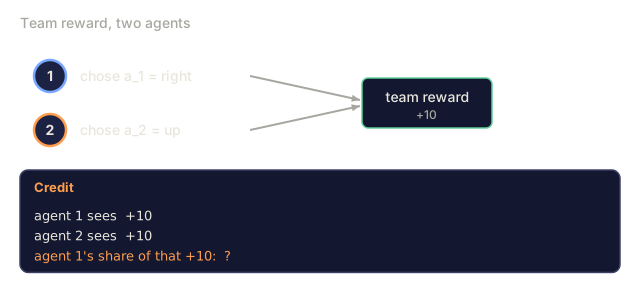
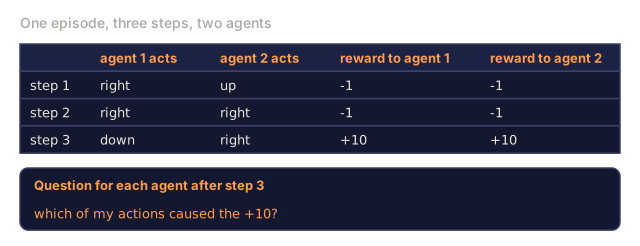
P(s' | s, a_i)from agenti's view depends onπ_{-i}, which is changing. - Credit assignment. With a shared reward, which agent caused it?
- Exploration coordination. Agents need to explore complementary strategies, not redundantly cover the same state.
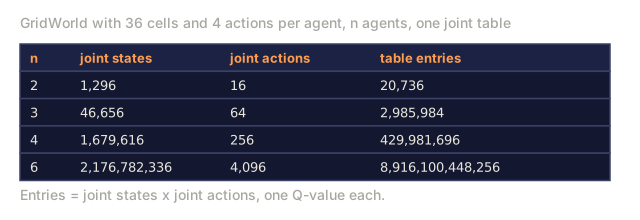
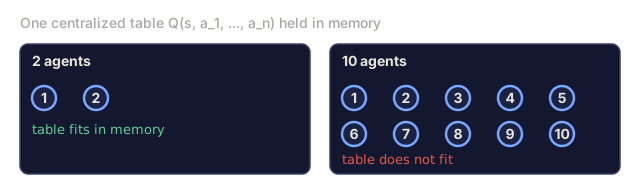
- Scalability. The joint action space grows exponentially in
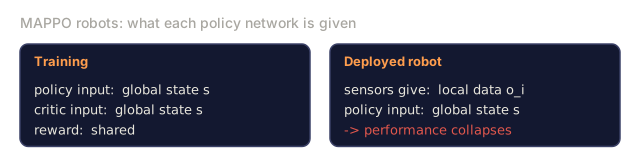
n. - Partial observability. Each agent sees only its own observation; the global state stays hidden.
Four dominant regimes:
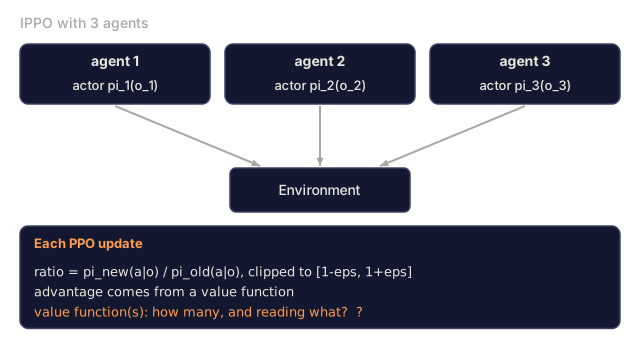
1. Independent Q-learning / independent PPO (IQL, IPPO). Each agent learns its own Q-function or policy and treats everyone else as part of the environment. It's simple, and it sometimes works, especially when experience replay doubles as a smoothing trick for modeling the other agent. Theoretical convergence: none. In practice: fine for loosely-coupled tasks, bad for tightly-coupled ones.
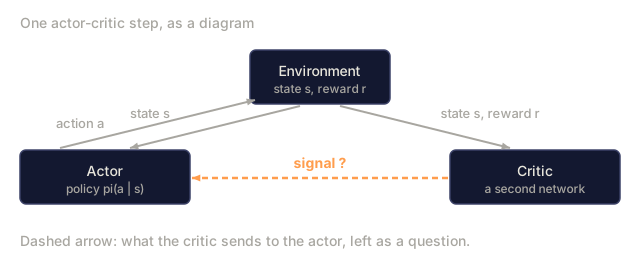
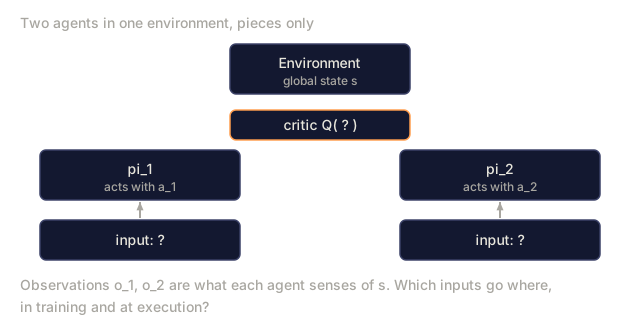
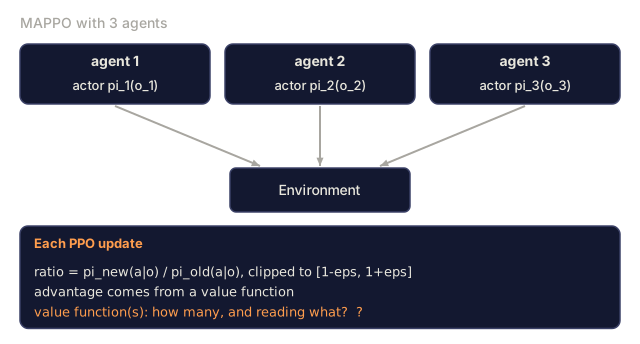
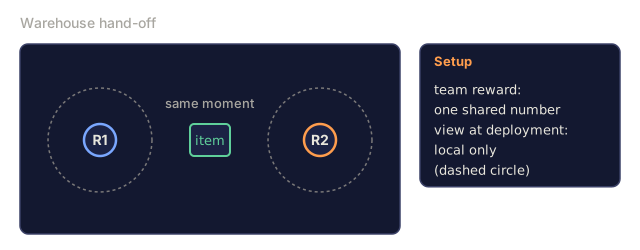
2. Centralized training, decentralized execution (CTDE). The most common modern paradigm. Each agent has its own policy π_i that conditions on local observation o_i, the standard setup for decentralized execution at deployment. During training, a centralized critic Q(s, a_1, …, a_n) conditions on the full global state and joint action. Examples:
- MADDPG (Lowe et al. 2017): DDPG (a continuous-action actor-critic method) with a centralized critic per agent.
- COMA (Foerster et al. 2017): a counterfactual baseline. It asks what my reward would have been had I taken action
a'instead, which isolates my individual contribution. - MAPPO / IPPO with shared critic (Yu et al. 2022): PPO with a centralized value function. Dominant in 2026 for cooperative MARL.
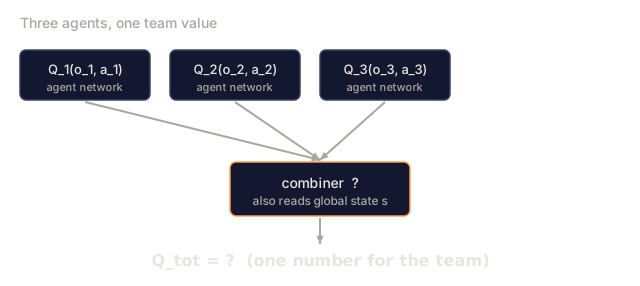
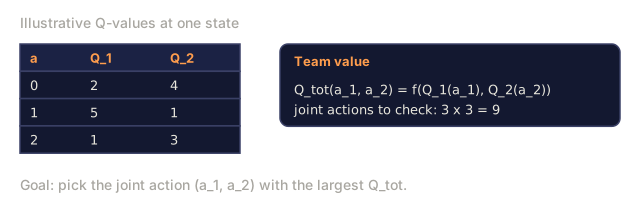
- QMIX (Rashid et al. 2018): value decomposition (
Q_tot(s, a) = f(Q_1(s, a_1), …, Q_n(s, a_n))) with monotonic mixing.
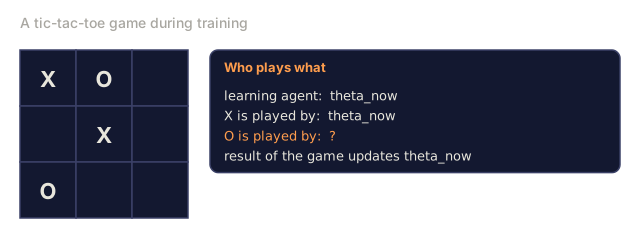
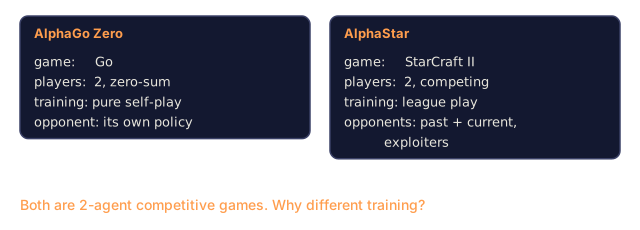
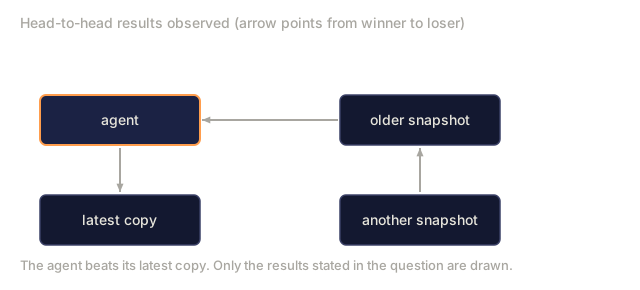
3. Self-play. Two copies of the same agent play against each other. The opponent's policy is my policy from a past snapshot. AlphaGo / AlphaZero / MuZero. OpenAI Five. Works best for zero-sum games, where the training signal stays symmetric.
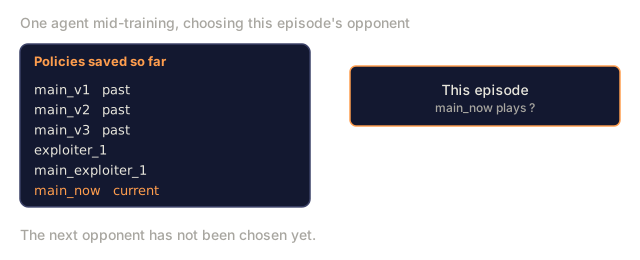
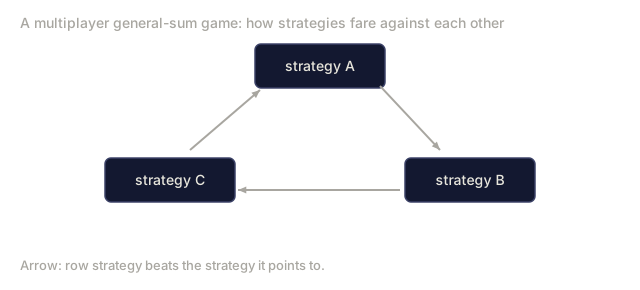
4. League play. An extension of self-play to general-sum / adversarial environments: keep a population of past and current policies, sample an opponent from the league, train against them. Adds exploiters (specialize in beating the current best) and main exploiters (specialize in beating exploiters). AlphaStar (StarCraft II) needed this, because the game admits "rock-paper-scissors" strategy cycles.
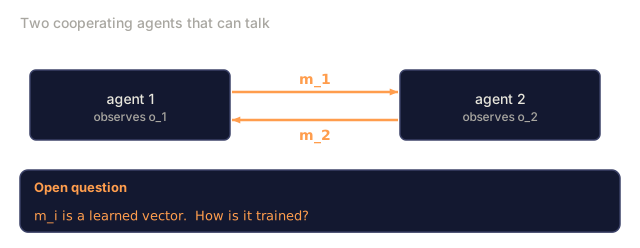
Communication. Let agents send learned messages m_i to each other. This works in cooperative settings. Foerster et al. (2016) showed that differentiable inter-agent communication can be trained end-to-end. Today's LLM-based multi-agent systems (Phase 16) mostly communicate in natural language instead.
Build It
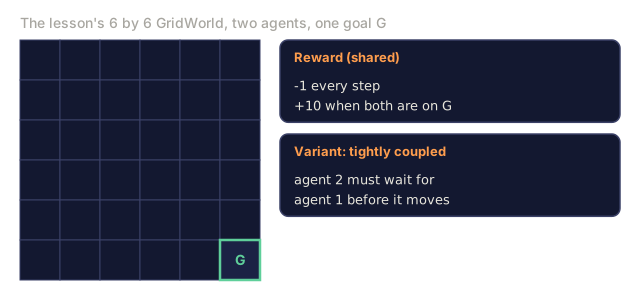
This lesson uses a 6×6 GridWorld with two cooperative agents. They start in opposite corners and must reach a shared goal. Shared reward: -1 per step while either agent is still moving, +10 when both arrive. See code/main.py.
Step 1: the multi-agent env
class CoopGridWorld:
    def __init__(self):
        self.size = 6
        self.goal = (5, 5)

    def reset(self):
        return ((0, 0), (5, 0))  # two agents

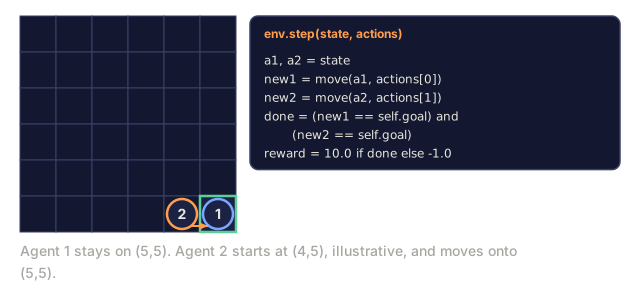
    def step(self, state, actions):
        a1, a2 = state
        new1 = move(a1, actions[0])
        new2 = move(a2, actions[1])
        done = (new1 == self.goal) and (new2 == self.goal)
        reward = 10.0 if done else -1.0
        return (new1, new2), reward, done
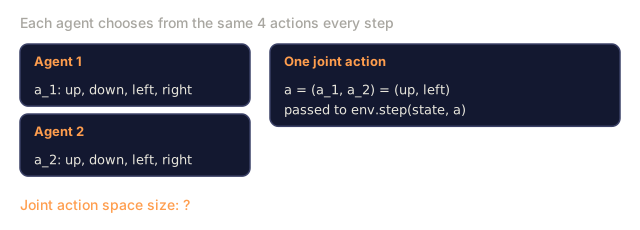
The joint action space is |A|² = 16. The global state is just two positions.
Step 2: independent Q-learning
Each agent keeps its own Q-table keyed on the joint state. Every step, both pick ε-greedy actions, the environment returns a joint transition, and each agent updates its own Q-table off the shared reward.
def independent_q(env, episodes, alpha, gamma, epsilon):
    Q1, Q2 = defaultdict(default_q), defaultdict(default_q)
    for _ in range(episodes):
        s = env.reset()
        while not done:
            a1 = epsilon_greedy(Q1, s, epsilon)
            a2 = epsilon_greedy(Q2, s, epsilon)
            s_next, r, done = env.step(s, (a1, a2))
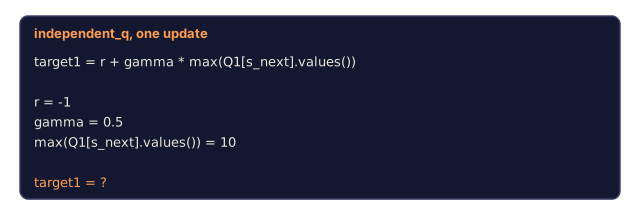
            target1 = r + gamma * max(Q1[s_next].values())
            target2 = r + gamma * max(Q2[s_next].values())
            Q1[s][a1] += alpha * (target1 - Q1[s][a1])
            Q2[s][a2] += alpha * (target2 - Q2[s][a2])
            s = s_next
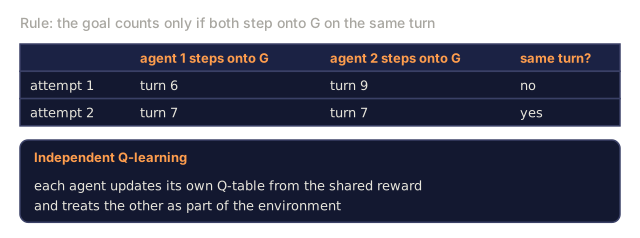
This works here because the rewards are dense and aligned. It fails on tightly-coupled tasks, where one agent has to wait for the other.
Step 3: centralized Q with a decomposed-value update
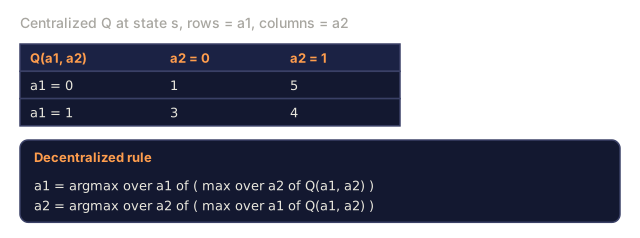
Use one Q over joint actions, Q(s, a_1, a_2), updated from the shared reward. Decentralize at execution time by marginalizing: π_i(s) = argmax_{a_i} max_{a_{-i}} Q(s, a_1, a_2). You trade an exponential joint action space for a correct global view.
Step 4: simple self-play (adversarial 2-agent)
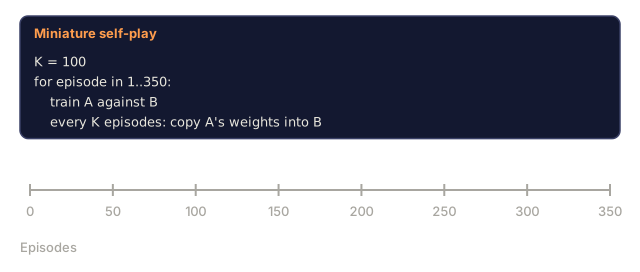
Same agent, two roles. Train agent A against agent B, and every K episodes copy A's weights into B. Training stays symmetric and progress stays consistent. It's the AlphaZero recipe in miniature.
Pitfalls
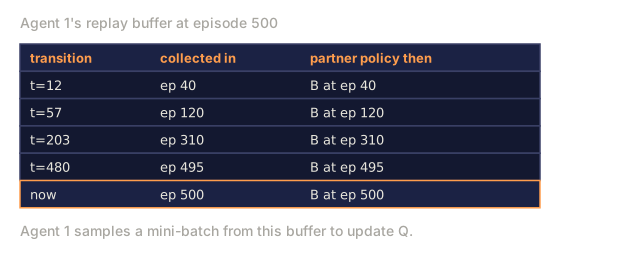
- Non-stationary replay. Experience replay is worse for independent agents than for a single agent, because old transitions came from opponents whose policies have since moved on. Relabel the stored transitions or weight them by recency.
- Credit assignment ambiguity. A shared reward lands at the end of a long episode with no clean way to say which agent caused it. Counterfactual baselines (COMA) or per-agent reward shaping are the usual fixes.
- Policy drift / chasing. Each agent's best response keeps shifting as the others update, so nobody settles. Use a centralized critic, slow the learning rate, or freeze one agent at a time.
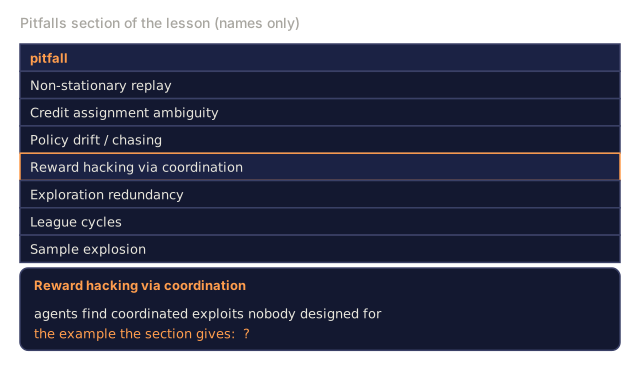
- Reward hacking via coordination. Agents find coordinated exploits nobody designed for: auction agents converging to bid zero is the classic example. Careful reward design and behavioral constraints are the fix.
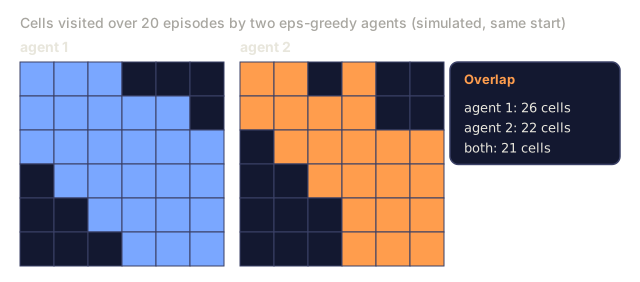
- Exploration redundancy. Both agents explore the same state-action pairs and waste the run. Per-agent entropy bonuses or role-conditioning fix that.
- League cycles. Pure self-play can get stuck in a dominance cycle. League play with diverse opponents breaks it.
- Sample explosion.
nagents × state space × joint actions grows fast. Approximate it: function approximation, factored action spaces, one policy head per agent.
Use It
The 2026 MARL application map:
| Domain | Method | Notes |
|---|---|---|
| Cooperative navigation / manipulation | MAPPO / QMIX | CTDE; shared critic + decentralized actors. Covers robot swarms and warehouse/fleet coordination. |
| Two-player games (chess, Go, poker) | Self-play with MCTS (AlphaZero) | Zero-sum; symmetric training. |
| Complex multiplayer (Dota, StarCraft) | League play + imitation pretraining | OpenAI Five, AlphaStar. |
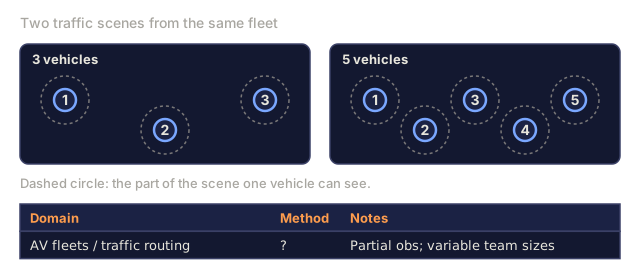
| Autonomous-vehicle fleets / traffic routing | CTDE MAPPO / PPO with attention | Partial obs; variable team sizes. |
| Auction markets | Game-theoretic equilibrium + RL | Mean-field RL when n → ∞. |
| LLM multi-agent systems (Phase 16) | Natural-language comm + role conditioning | RL loop at the agent-planning layer. |
MARL's biggest growth area in 2026 is LLM-based: swarms of language-model agents negotiating, debating, and building software together. The RL there shows up as preference optimization on trajectory-level outputs, not token-level (Phase 16 · 03).
Ship It
Save as outputs/skill-marl-architect.md:
---
name: marl-architect
description: Pick the right multi-agent RL regime (IPPO, CTDE, self-play, league) for a given task.
version: 1.0.0
phase: 9
lesson: 10
tags: [rl, multi-agent, marl, self-play]
---

Given a task with `n` agents, output:

1. Regime classification. Cooperative / adversarial / general-sum. Justify.
2. Algorithm. IPPO / MAPPO / QMIX / self-play / league. Reason tied to coupling tightness and reward structure.
3. Information access. Centralized training (what global info goes to the critic)? Decentralized execution?
4. Credit assignment. Counterfactual baseline, value decomposition, or reward shaping.
5. Exploration plan. Per-agent entropy, population-based training, or league.

Refuse independent Q-learning on tightly-coupled cooperative tasks. Refuse to recommend self-play for general-sum with cycle risks. Flag any MARL pipeline without a fixed-opponent eval (cherry-picked self-play numbers are common).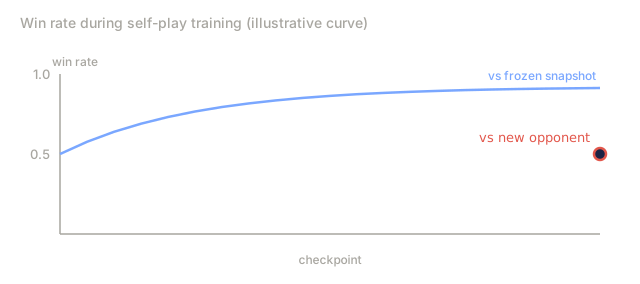
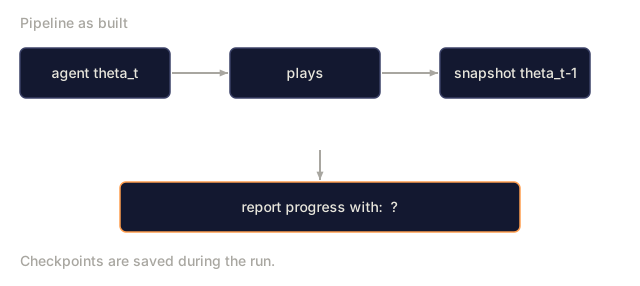
The failure mode that actually got me was self-play. Win rate against a fixed snapshot climbs past 90%, which feels like real progress, right up until you swap in a fresh opponent and it collapses back to 50-50 — both networks got better together, so nothing an outside observer would call "skill" actually moved. If you're shipping a MARL system, freeze an external benchmark opponent early and keep re-running it every checkpoint. Win rate against your own past self is close to meaningless on its own.
Exercises
- Easy. Train independent Q-learning on the 2-agent cooperative GridWorld. How many episodes does it take before mean return crosses 0? Plot the joint learning curve.
- Medium. Add a "coordination" task where the goal only counts if both agents step onto it on the same turn. Does independent Q still converge? What breaks?
- Hard. Implement a centralized critic for MAPPO-style training and compare its convergence speed to independent PPO on the coordination task.
Key Terms
| Term | What people say | What it actually means |
|---|---|---|
| Markov game | "Multi-agent MDP" | (S, A_1, …, A_n, P, R_1, …, R_n); each agent has its own reward. |
| CTDE | "Centralized training, decentralized execution" | Joint critic at training time; each agent's policy uses only local obs. |
| IPPO | "Independent PPO" | Each agent runs PPO separately. Simple baseline; often underrated. |
| MAPPO | "Multi-agent PPO" | PPO with a centralized value function conditioned on global state. |
| QMIX | "Monotonic value decomposition" | Q_tot = f_monotone(Q_1, …, Q_n) allows decentralized argmax. |
| COMA | "Counterfactual multi-agent" | Advantage = my Q minus expected Q marginalizing over my action. |
| Self-play | "Agent vs past self" | Single agent, two roles; standard for zero-sum games. |
| League play | "Population training" | Cache past policies, sample opponents from the pool; handles strategy cycles. |
Further Reading
- Lowe et al. (2017). Multi-Agent Actor-Critic for Mixed Cooperative-Competitive Environments (MADDPG): CTDE with a centralized critic.
- Foerster et al. (2017). Counterfactual Multi-Agent Policy Gradients (COMA): counterfactual baselines for credit assignment.
- Rashid et al. (2018). QMIX: Monotonic Value Function Factorisation: value decomposition with monotonicity.
- Yu et al. (2022). The Surprising Effectiveness of PPO in Cooperative Multi-Agent Games (MAPPO): PPO is surprisingly strong for MARL.
- Vinyals et al. (2019). Grandmaster level in StarCraft II using multi-agent reinforcement learning (AlphaStar): league play at scale.
- Silver et al. (2017). Mastering the game of Go without human knowledge (AlphaGo Zero): pure self-play in zero-sum games.
- Sutton & Barto (2018), Ch. 15 (Neuroscience) and Ch. 17 (Frontiers): includes the textbook's short treatment of multi-agent settings and the non-stationarity problem that CTDE is designed to solve.
- Zhang, Yang & Başar (2021). Multi-Agent Reinforcement Learning: A Selective Overview: survey covering cooperative, competitive, and mixed MARL with convergence results.
Code
- main.py (python, 150 lines)