MDPs, States, Actions & Rewards
A Markov Decision Process is five things: states, actions, transitions, rewards, a discount. Every RL algorithm you'll meet in this phase — Q-learning, PPO, DPO, GRPO — optimizes over this same shape. Learn it once and the rest of reinforcement learning comes for free.
Learning Objectives
- Define the five components of a Markov Decision Process (states, actions, transitions, rewards, discount) and state the Markov property that justifies modeling a task as one.
- Distinguish a policy, a return, a value function V^π(s), and a Q-value Q^π(s,a), and explain how the Bellman equation splits expected return into immediate reward plus discounted future value.
- Implement a small MDP (a 4x4 GridWorld) in code, roll out a random policy, and compute exact state values with iterative policy evaluation.
- Diagnose the recurring MDP formulation failures, non-Markovian state, sparse or hacked rewards, and mis-specified discount or reward scale, before they surface as training bugs.
The Problem
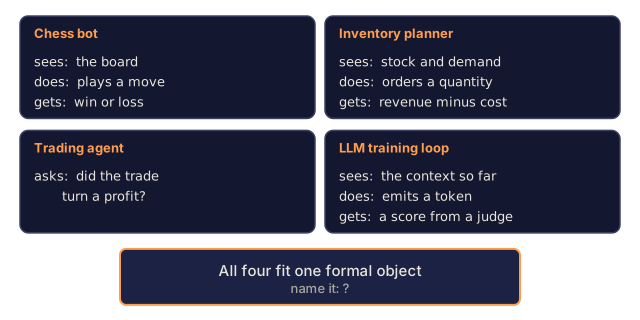
You're writing a chess bot. Or an inventory planner. Or a trading agent. Or the PPO loop that trains a reasoning model. Four different domains, and one surprising fact: all four collapse to the same mathematical object.
Supervised learning hands you (x, y) pairs and asks you to fit a function. Reinforcement learning gives you no labels, only a stream of states, the actions you took, and a scalar reward. Did the move win the game? Did the restock decision save money? Did the trade turn a profit? Did the token the LLM just produced earn a higher score from the judge?
You can't learn from that stream until you formalize it. "What I saw," "what I did," "what happened next," and "how good that was" each need to become an object you can reason about. That formalization is a Markov Decision Process. Every RL algorithm in this phase, including the RLHF and GRPO loops at the end, optimizes over this same shape.

The Concept

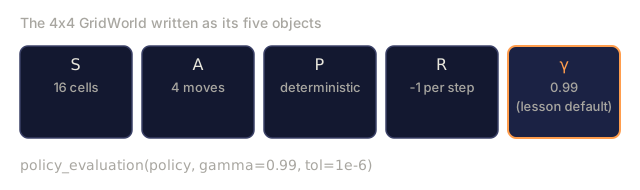
The five objects.
- States
S. Everything the agent needs to decide. In GridWorld, the cell. In chess, the board. In an LLM, the context window plus any memory. - Actions
A. The choices. Move up/down/left/right. Play a move. Emit a token. - Transitions
P(s' | s, a). Given statesand actiona, the distribution over next state. Deterministic in chess, stochastic in inventory, almost-deterministic in LLM decoding. - Rewards
R(s, a, s'). The scalar signal. Win = +1, loss = -1. Revenue minus cost. The log-likelihood ratio term in GRPO. - Discount
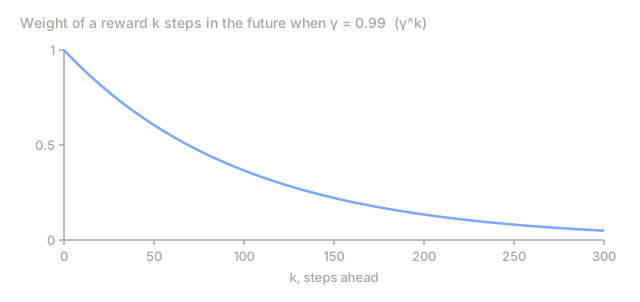
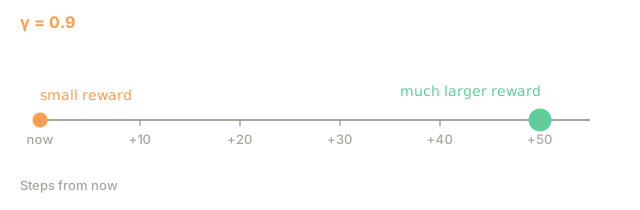
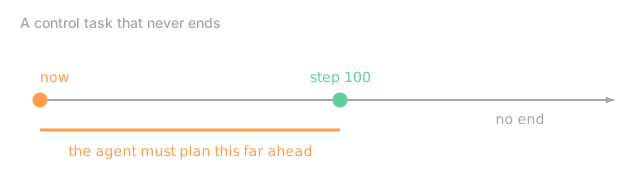
γ ∈ [0, 1). How much future reward counts vs present.γ = 0.99buys a horizon of ~100 steps;γ = 0.9buys ~10.
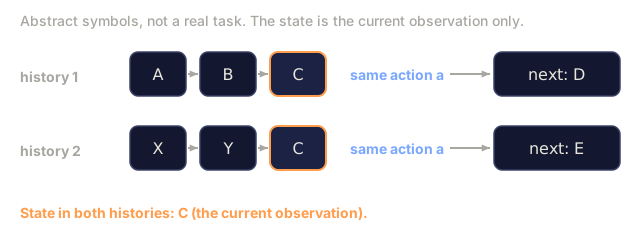
The Markov property P(s_{t+1} | s_t, a_t) = P(s_{t+1} | s_0, a_0, …, s_t, a_t). The future depends only on the present state. If it doesn't, the state representation is incomplete: that's a failure of the state, not of the method.
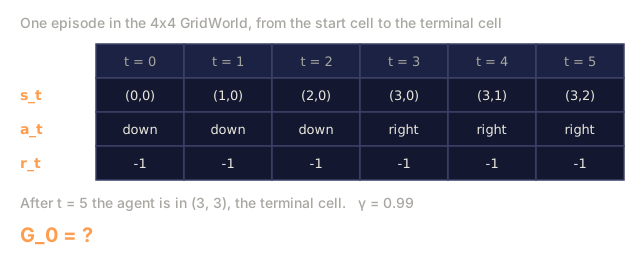
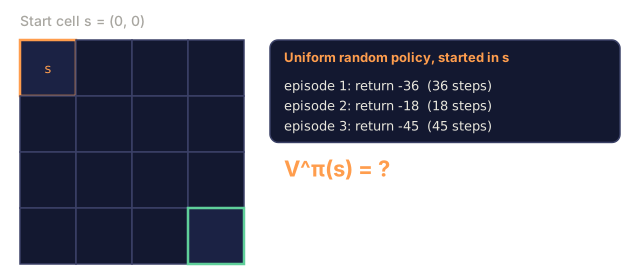
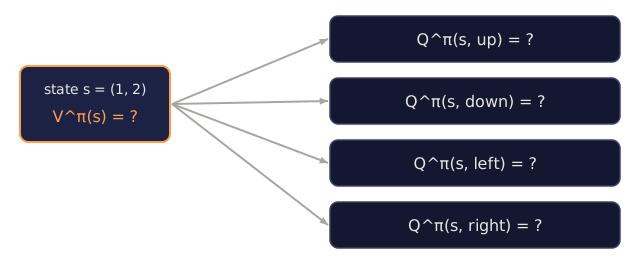
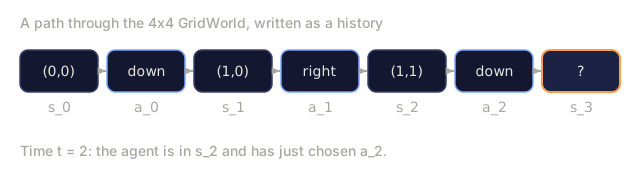
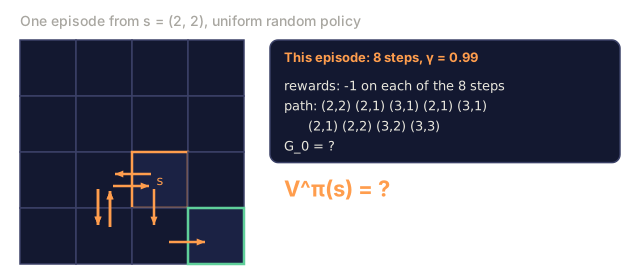
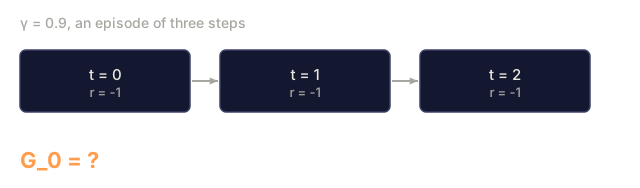
Policies and returns. A policy π(a | s) maps states to action distributions. The return G_t = r_t + γ r_{t+1} + γ² r_{t+2} + … is the discounted sum of future rewards. The value V^π(s) = E[G_t | s_t = s] is the expected return starting from s under policy π. The Q-value Q^π(s, a) = E[G_t | s_t = s, a_t = a] is the expected return starting with a specific action. Every RL algorithm estimates one of these two, then improves π accordingly.
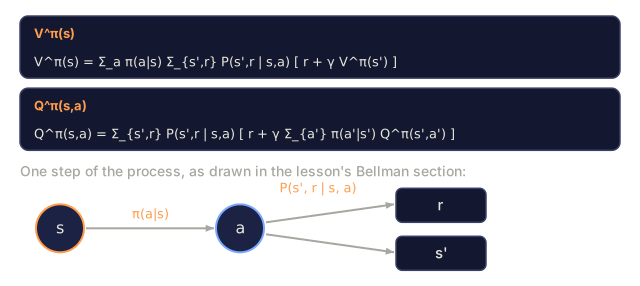
The Bellman equations. The fixed-point equations that everything in this phase uses:
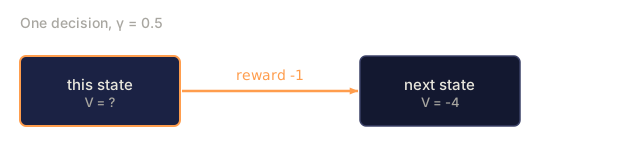
V^π(s) = Σ_a π(a|s) Σ_{s', r} P(s', r | s, a) [r + γ V^π(s')]
Q^π(s, a) = Σ_{s', r} P(s', r | s, a) [r + γ Σ_{a'} π(a'|s') Q^π(s', a')]
These split expected return into "this step's reward" plus "discounted value of where you land." Recursive. Every algorithm in Phase 9 either iterates this equation to convergence (dynamic programming), samples from it (Monte Carlo), or bootstraps it one step (temporal difference).
Build It
Step 1: a tiny deterministic MDP
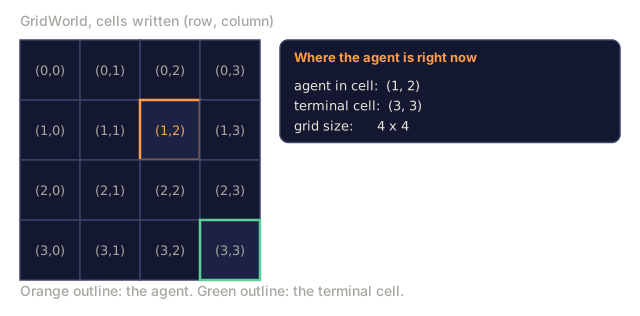
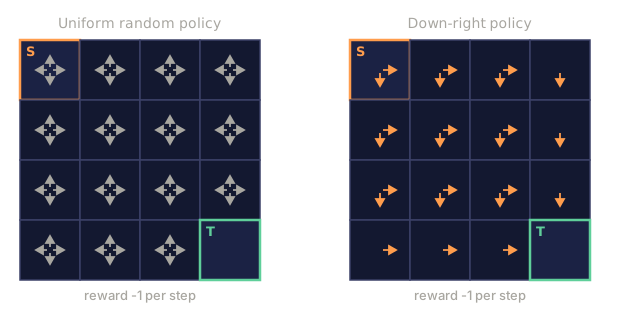
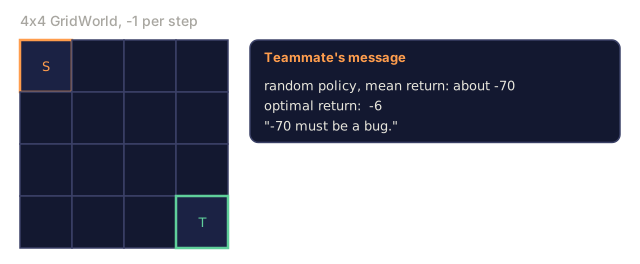
A 4×4 GridWorld. Agent starts top-left, terminal at bottom-right, reward of -1 per step, actions {up, down, left, right}. See code/main.py.
GRID = 4
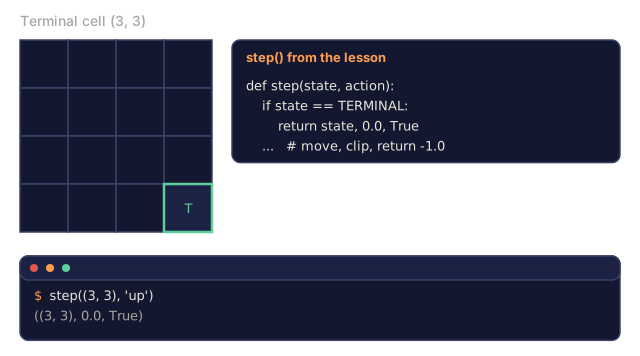
TERMINAL = (3, 3)
ACTIONS = {"up": (-1, 0), "down": (1, 0), "left": (0, -1), "right": (0, 1)}

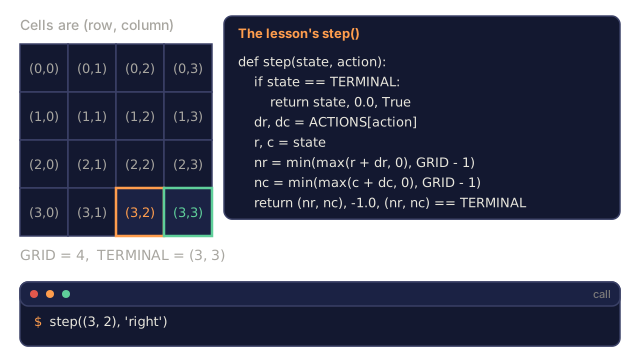
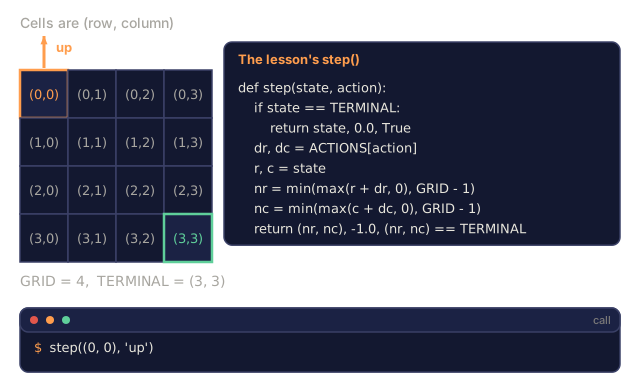
def step(state, action):
    if state == TERMINAL:
        return state, 0.0, True
    dr, dc = ACTIONS[action]
    r, c = state
    nr = min(max(r + dr, 0), GRID - 1)
    nc = min(max(c + dc, 0), GRID - 1)
    return (nr, nc), -1.0, (nr, nc) == TERMINAL
Five lines. That's the entire environment: deterministic transitions, a constant step penalty, one absorbing terminal state.
Step 2: roll out a policy
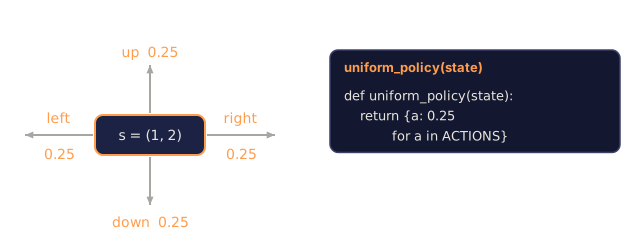
A policy is a function from state to action distribution. The simplest: uniform random.
def uniform_policy(state):
    return {a: 0.25 for a in ACTIONS}

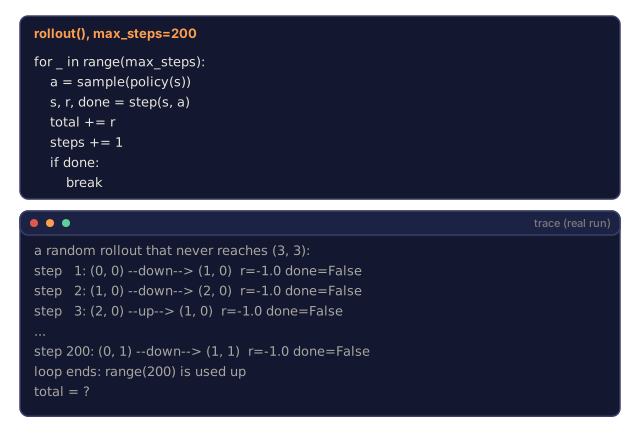
def rollout(policy, max_steps=200):
    s, total, steps = (0, 0), 0.0, 0
    for _ in range(max_steps):
        a = sample(policy(s))
        s, r, done = step(s, a)
        total += r
        steps += 1
        if done:
            break
    return total, steps
Run the random policy 1000 times. Average return is around -60 to -80 for this 4×4 board. The optimal return is -6 (straight-line path down-right). Closing that gap is everything in Phase 9.
Step 3: compute V^π exactly via the Bellman equation
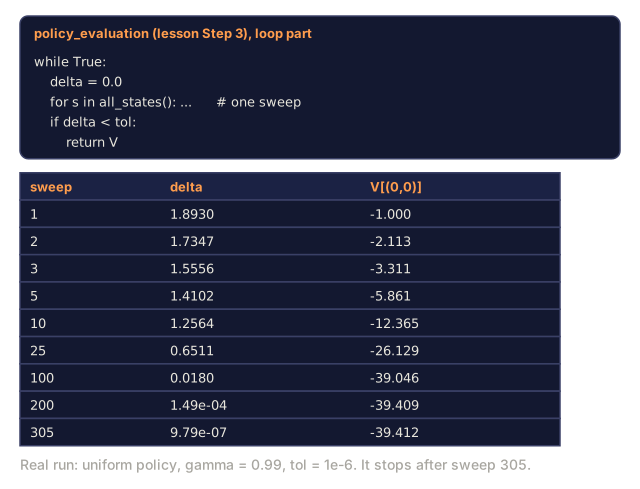
For small MDPs the Bellman equation is a linear system. Enumerate states, apply the expectation, iterate until the values stop changing.
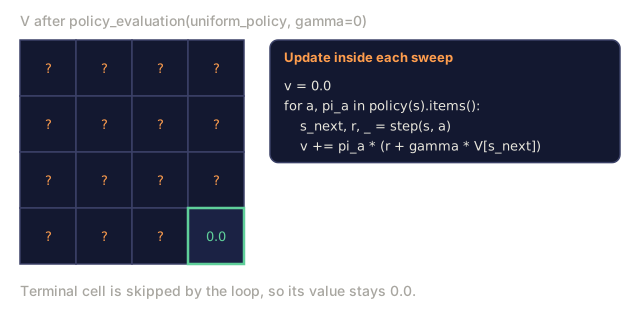
def policy_evaluation(policy, gamma=0.99, tol=1e-6):
    V = {s: 0.0 for s in all_states()}
    while True:
        delta = 0.0
        for s in all_states():
            if s == TERMINAL:
                continue
            v = 0.0
            for a, pi_a in policy(s).items():
                s_next, r, _ = step(s, a)
                v += pi_a * (r + gamma * V[s_next])
            delta = max(delta, abs(v - V[s]))
            V[s] = v
        if delta < tol:
            return V
This is iterative policy evaluation, the first algorithm in Sutton & Barto and the theoretical foundation of every RL method that follows.
Step 4: γ is a hyperparameter with physical meaning
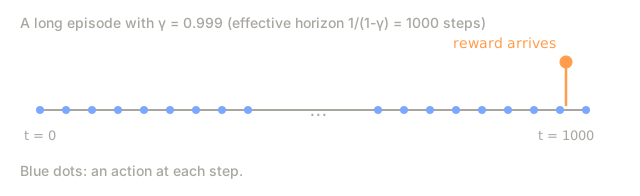
Effective horizon is roughly 1 / (1 - γ). γ = 0.9 → 10 steps. γ = 0.99 → 100 steps. γ = 0.999 → 1000 steps.
Too low and the agent acts myopically. Too high and credit assignment becomes noisy, because many early steps share responsibility for far-future reward. LLM RLHF typically uses γ = 1 because episodes are short and bounded. Control tasks use 0.95–0.99. Long-horizon strategy games use 0.999.
Pitfalls
- Non-Markovian state. If you need the last three observations to decide, the "state" isn't just the current observation. Fix: stack frames (DQN on Atari stacks 4) or use a recurrent state (LSTM/GRU over observations).
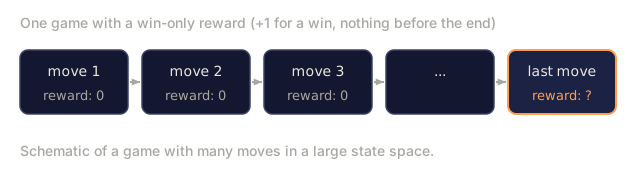
- Sparse rewards. Win-only rewards make learning nearly impossible in large state spaces. Shape rewards (intermediate signal) or bootstrap with imitation (Phase 9 · 09).
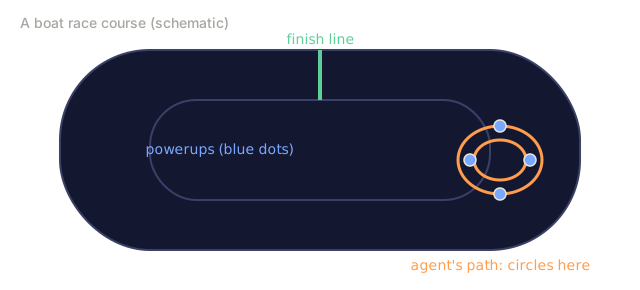
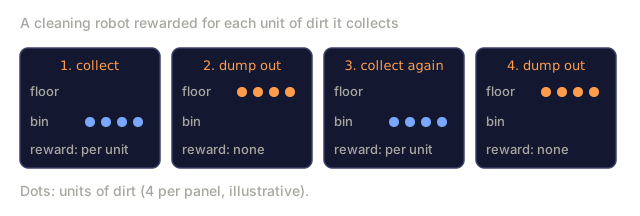
- Reward hacking. Optimizing a proxy reward often produces pathological behavior. OpenAI's boat-racing agent spun in circles collecting powerups forever instead of finishing the race. Always define reward from the target outcome, not the proxy.
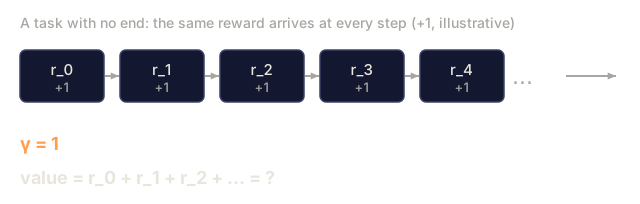
- Discount mis-spec.
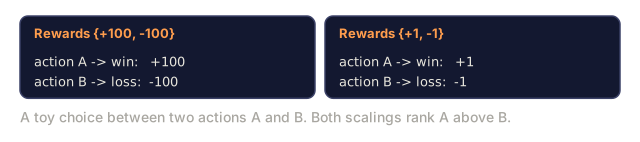
γ = 1on an infinite-horizon task makes every value infinite. Always cap with either a finite horizon orγ < 1. - Reward scale. Rewards of {+100, -100} vs {+1, -1} give identical optimal policies but vastly different gradient magnitudes. Normalize to
[-1, 1]-ish before plugging into PPO/DQN.

Use It
The 2026 stack reduces every RL pipeline to an MDP before touching code:
| Situation | State | Action | Reward | γ |
|---|---|---|---|---|
| Control (locomotion, manipulation) | Joint angles + velocities | Continuous torques | Task-specific shaped | 0.99 |
| Games (chess, Go, poker) | Board + history | Legal move | Win=+1 / loss=-1 | 1.0 (finite) |
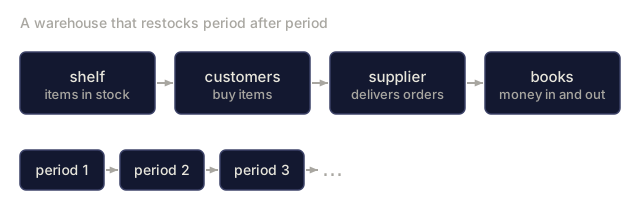
| Inventory / pricing | Stock + demand | Order qty | Revenue - cost | 0.95 |
| RLHF for LLMs | Context tokens | Next token | Reward-model score at end | 1.0 (episode ~200 tokens) |
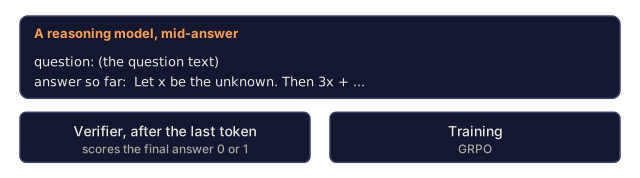
| GRPO for reasoning | Prompt + partial response | Next token | Verifier 0/1 at end | 1.0 |
Write the five tuples before writing any training loop. Most "RL doesn't work" bug reports trace back to an MDP formulation that was broken on paper.
Ship It
Save as outputs/skill-mdp-modeler.md:
---
name: mdp-modeler
description: Given a task description, produce a Markov Decision Process spec and flag formulation risks before training.
version: 1.0.0
phase: 9
lesson: 1
tags: [rl, mdp, modeling]
---

Given a task (control / game / recommendation / LLM fine-tuning), output:

1. State. Exact feature vector or tensor spec. Justify Markov property.
2. Action. Discrete set or continuous range. Dimensionality.
3. Transition. Deterministic, stochastic-with-known-model, or sample-only.
4. Reward. Function and source. Sparse vs shaped. Terminal vs per-step.
5. Discount. Value and horizon justification.

Refuse to ship any MDP where the state is non-Markovian without explicit mention of frame-stacking or recurrent state. Refuse any reward that was not defined in terms of the target outcome. Flag any `γ ≥ 1.0` on an infinite-horizon task. Flag any reward range >100x the typical step reward as a likely gradient-explosion source.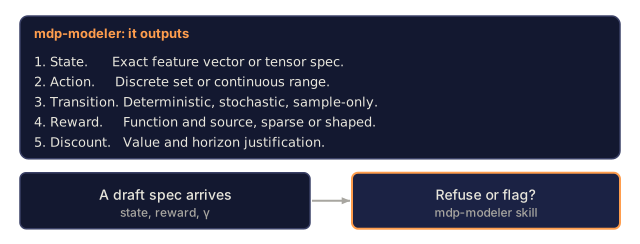
Exercises
- Easy. Implement the 4×4 GridWorld and random-policy rollout in
code/main.py. Run 10,000 episodes. Report mean and std of return. Compare to the optimal return (-6). - Medium. Run
policy_evaluationwithγ ∈ {0.5, 0.9, 0.99}for the uniform-random policy. PrintVas a 4×4 grid for each. Explain why the state values near the terminal grow faster with largerγ. - Hard. Turn the GridWorld stochastic: each action slips to an adjacent direction with probability
p = 0.1. Re-evaluate the uniform policy. DoesV[start]get better or worse? Why?
Key Terms
| Term | What people say | What it actually means |
|---|---|---|
| MDP | "Reinforcement learning setup" | Tuple (S, A, P, R, γ) satisfying the Markov property. |
| State | "What the agent sees" | Sufficient statistic for future dynamics under the chosen policy class. |
| Policy | "Agent's behavior" | Conditional distribution π(a | s) or deterministic map s → a. |
| Return | "Total reward" | Discounted sum Σ γ^t r_t from the current step. |
| Value | "How good a state is" | Expected return under π starting from s. |
| Q-value | "How good an action is" | Expected return under π starting from s with first action a. |
| Bellman equation | "Dynamic programming recursion" | Fixed-point decomposition of value / Q into one-step reward plus discounted successor value. |
Discount γ | "Future vs present" | Geometric weight on far-future reward; effective horizon ~1/(1-γ). |
Further Reading
- Sutton & Barto (2018). Reinforcement Learning: An Introduction, 2nd ed.: the textbook. Ch. 3 covers MDPs and Bellman equations; Ch. 1 motivates the reward hypothesis that underlies every subsequent lesson.
- Bellman (1957). Dynamic Programming: the origin of the Bellman equation.
- OpenAI Spinning Up — Part 1: Key Concepts: concise MDP primer from a deep-RL angle.
- Puterman (2005). Markov Decision Processes: the operations-research reference on MDPs and exact solution methods.
- Littman (1996). Algorithms for Sequential Decision Making (PhD thesis): the cleanest derivation of MDPs as a dynamic-programming specialization.
Code
- main.py (python, 114 lines)