Data Pipelines for Pre-Training
The model is a mirror. It reflects whatever data you feed it. Feed it garbage and it reflects garbage, fluently.
Learning Objectives
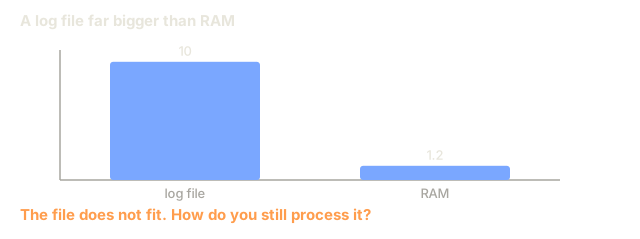
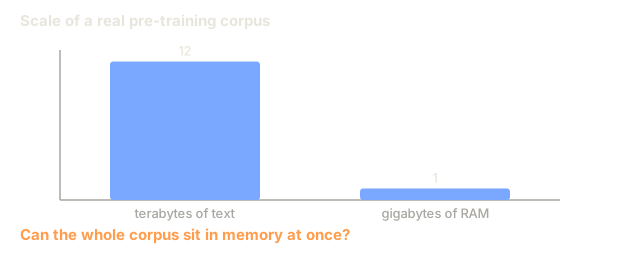
- Build a streaming data pipeline that tokenizes, chunks, shuffles, and batches terabytes of text without loading it all into memory
- Implement data quality filters (deduplication, language detection, content filtering) used in real pre-training pipelines
- Create fixed-length training sequences with proper attention masks and document boundary handling
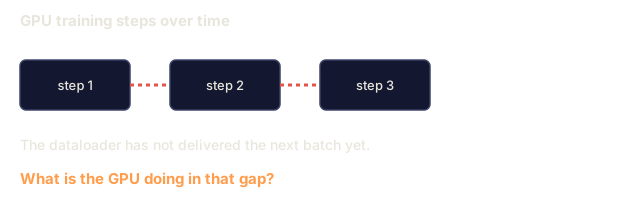
- Profile pipeline throughput to ensure the dataloader keeps up with GPU training speed
The Problem
You have a tokenizer. Now you need data.
Not a dataset. Not a CSV file. Terabytes of text, cleaned, deduplicated, filtered for quality, tokenized into fixed-length sequences, and served in randomized batches fast enough that your 8-GPU cluster isn't left waiting on the next one.
Most people think training an LLM is about the model architecture. Mostly it isn't. Llama 3 used 15.6 trillion tokens. GPT-3 used 300 billion. DeepSeek-V2 used 8.1 trillion. The architecture across all three is roughly the same: stacked transformer blocks with attention and feedforward layers. The difference in output quality comes largely from the data.
The Chinchilla paper from DeepMind made this precise. For a given compute budget, there is an optimal ratio of model parameters to training tokens. Chinchilla showed that most models in 2022 were badly undertrained: they had too many parameters for the amount of data they saw. A 70B parameter model trained on 1.4 trillion tokens (Chinchilla-optimal) outperformed a 280B model trained on 300 billion tokens (Gopher).
Your data pipeline determines whether your model learns language or learns noise.
The Concept
Where the Data Comes From
Large language models are trained on a mix of sources. Most labs guard the exact composition, but we know enough to understand the categories.
| Source | Size | Quality | Used By |
|---|---|---|---|
| Common Crawl | ~250 TB raw | Low (needs heavy filtering) | GPT-3, Llama, most open models |
| Wikipedia | ~20 GB | High | Every major LLM |
| GitHub code | ~1 TB+ | Medium (lots of duplicates, dead code) | StarCoder, CodeLlama, DeepSeek-Coder |
| Books (BookCorpus, Pile) | ~100 GB | High | GPT-2, GPT-3, early models |
| Academic papers (arXiv, S2ORC) | ~100 GB | High for STEM | Llama, Galactica |
| StackOverflow, Reddit | ~100 GB | Medium | Llama, Falcon |
| Curated web (C4, RefinedWeb) | ~5 TB | Medium-High (pre-filtered) | T5, Falcon |
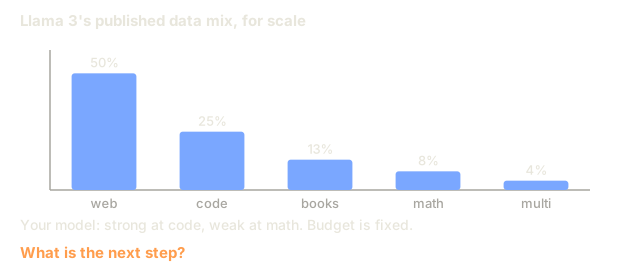
Llama 3 disclosed its data mix: roughly 50% web data, 25% code, 13% books and academic papers, 8% math data, and 4% multilingual web data. The total was 15.6 trillion tokens from sources exceeding 5 TB of raw text.
The ratio matters as much as the total size. Too much web data and the model becomes a Reddit parrot. Too little code and it cannot program. Too little math and it fails at reasoning. Getting this mix right is one of the hardest parts of training an LLM, and there is no formula, so you find it by experimenting and evaluating.
Data Cleaning
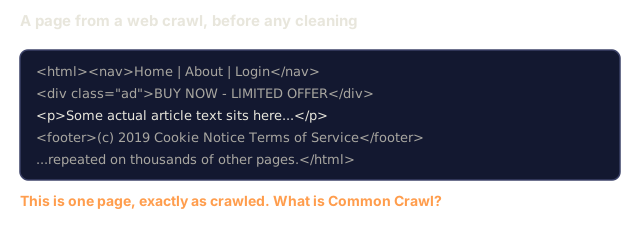
Raw web data is filthy. A typical Common Crawl dump contains:
- HTML tags and JavaScript
- Boilerplate headers, footers, navigation menus
- Duplicate pages (exact and near-duplicate)
- Machine-generated spam
- Personally identifiable information (PII)
- Low-quality text (lists of keywords, SEO spam)
- Non-text content encoded as text
How well you clean it decides whether you get a model that generates coherent paragraphs or one that outputs HTML tags mixed with product listings.

Each step eliminates a category of noise:
HTML stripping: Remove all markup. Keep only the visible text content. Libraries like trafilatura and readability extract article content while discarding navigation, ads, and boilerplate.
Language detection: Use fastText's language identification model (lid.176.bin) to classify each document. Filter to your target languages. A document classified as English with less than 0.8 confidence probably is not clean English.
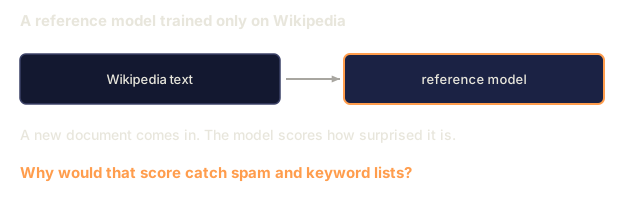
Quality filtering: This is where it gets interesting. RefinedWeb (the dataset behind Falcon) uses a perplexity-based filter: train a small language model on Wikipedia, then score each document. High perplexity means the document is unlike Wikipedia, which usually means spam, keyword lists, or machine-generated content. Documents with perplexity above a threshold get removed.
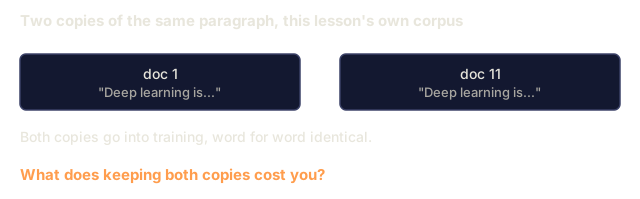
Deduplication: The most impactful cleaning step. Common Crawl contains enormous numbers of duplicated pages: legal disclaimers, cookie notices, terms of service. Training on duplicates wastes compute and can cause the model to memorize and regurgitate specific passages verbatim.
PII removal: Names, email addresses, phone numbers, social security numbers. Regex-based detection for structured PII, NER models for names in context.
Deduplication with MinHash
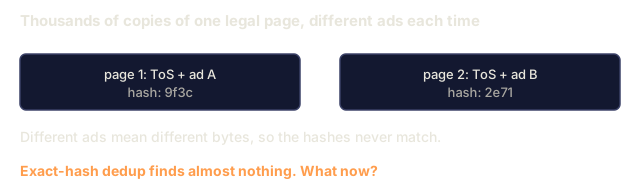
Exact deduplication is easy: hash each document, remove duplicates. But near-duplicates are the real problem. Two copies of the same news article with slightly different ads around it are near-duplicates. The content is 95% identical, but byte-for-byte they differ.
MinHash + Locality-Sensitive Hashing (LSH) solves this efficiently.

The idea:
-
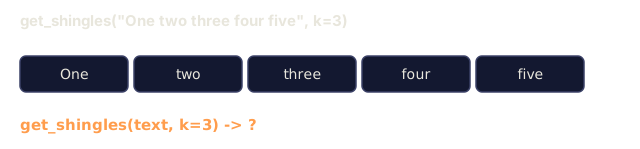
Shingling: Convert each document into a set of n-grams (e.g., 5-grams of words or characters). "the quick brown fox" with 3-word shingles becomes {"the quick brown", "quick brown fox"}.
-
MinHash: For each document's shingle set, compute k hash values. Each hash value is the minimum hash across all shingles under a different hash function. This creates a fixed-size "signature" that approximates the Jaccard similarity between any two documents.
-
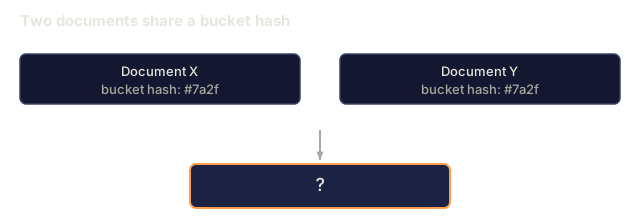
LSH: Group documents into buckets based on bands of their MinHash signature. Documents in the same bucket are candidate near-duplicates. This avoids comparing every pair, so you only compare candidates.
-
Verify: For each candidate pair, compute exact Jaccard similarity. Remove one copy if similarity exceeds a threshold (typically 0.8).
The Llama team reported removing approximately 38% of their web data through deduplication. That is a lot. More than a third of Common Crawl is duplicate or near-duplicate content.
Sequence Packing
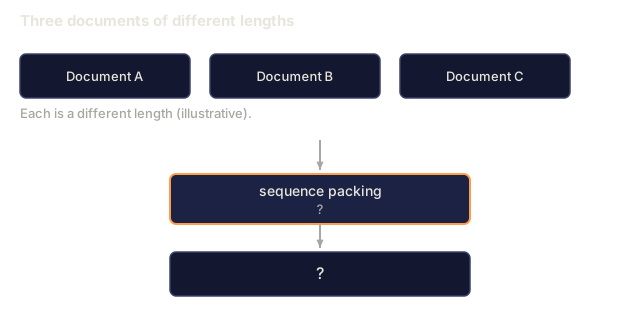
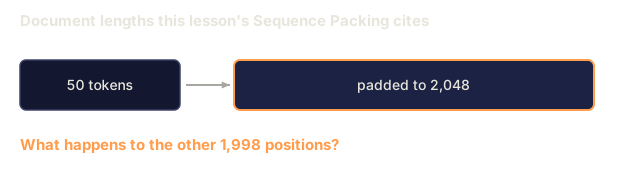
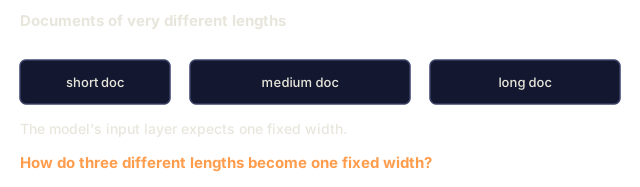
Your model expects fixed-length input sequences. Your documents are variable length. Some are 50 tokens. Some are 50,000 tokens.
Naive approach: pad every document to the maximum sequence length. This wastes a large share of compute on padding tokens that contribute nothing to learning.
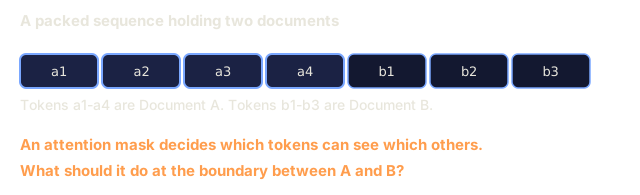
Better approach: pack multiple documents into a single sequence, separated by end-of-sequence tokens. A 2048-token sequence might hold three short documents with [EOS] tokens between them.

The attention mask must be set correctly. Tokens from Document A should not attend to tokens from Document B within the same packed sequence. This requires a block-diagonal attention mask.
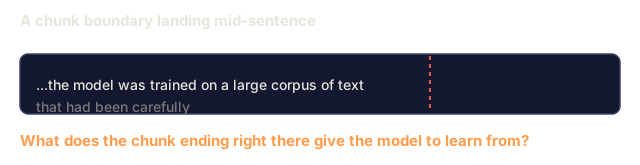
Long documents get truncated or split into chunks at sequence boundaries. The split point matters: splitting mid-sentence forces the model to see incomplete thoughts. Some pipelines align splits to paragraph or sentence boundaries when possible.
The Chinchilla Scaling Law
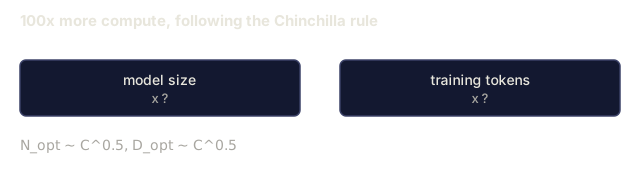
For a fixed compute budget C (measured in FLOPs), the optimal model size N and dataset size D follow:
N_opt ~ C^0.5
D_opt ~ C^0.5
In practice, this means you should scale model size and dataset size roughly equally. A model with 10x more parameters needs roughly 10x more training tokens to reach the same loss.
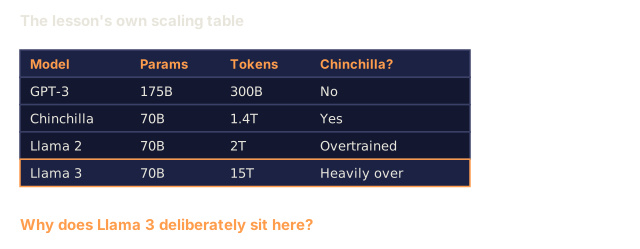
| Model | Parameters | Training Tokens | Chinchilla-Optimal? |
|---|---|---|---|
| GPT-3 | 175B | 300B | No (undertrained 3-4x) |
| Chinchilla | 70B | 1.4T | Yes (by design) |
| Llama 2 | 70B | 2T | Overtrained (intentionally) |
| Llama 3 | 70B | 15T | Heavily overtrained |
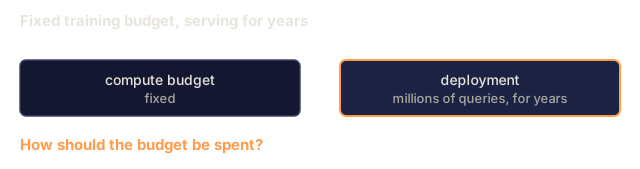
Llama 3 deliberately violates the Chinchilla law. Meta found that training on far more data than the compute-optimal ratio calls for produces a better model to run at inference. The extra training cost is paid once, and the smaller model is cheaper to serve for as long as you run it. This is sometimes called the "inference-optimal" scaling approach, and it has become the industry standard since 2024.
Build It
Step 1: Text Cleaning
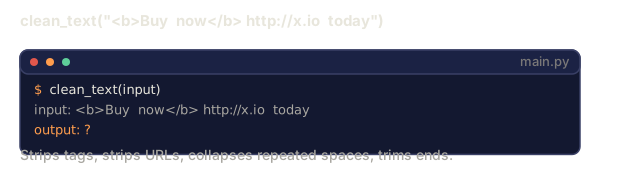
Strip HTML, normalize whitespace, remove non-text content. We will run these steps on a small sample corpus.
import re

def clean_text(text):
    text = re.sub(r"<[^>]+>", "", text)
    text = re.sub(r"http\S+", "", text)
    text = re.sub(r"[^\x20-\x7E\n]", "", text)
    text = re.sub(r"\n{3,}", "\n\n", text)
    text = re.sub(r" {2,}", " ", text)
    return text.strip()

def quality_filter(text, min_words=50, max_ratio_caps=0.3, max_ratio_special=0.1):
    words = text.split()
    if len(words) < min_words:
        return False
    caps_ratio = sum(1 for w in words if w.isupper()) / len(words)
    if caps_ratio > max_ratio_caps:
        return False
    special_chars = sum(1 for c in text if not c.isalnum() and not c.isspace())
    if special_chars / max(len(text), 1) > max_ratio_special:
        return False
    return True
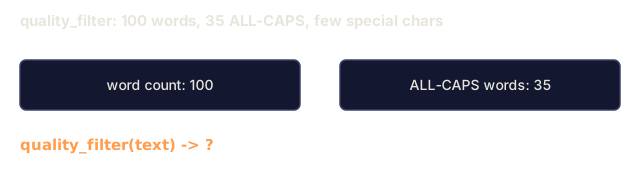
The quality filter catches SEO spam (ALL CAPS), machine-generated noise (high special character ratio), and stub pages (too short). These three checks alone remove a surprising amount of garbage from web crawls.
Step 2: MinHash Deduplication
Implement MinHash from scratch with nothing but hashlib.
import hashlib
from collections import defaultdict

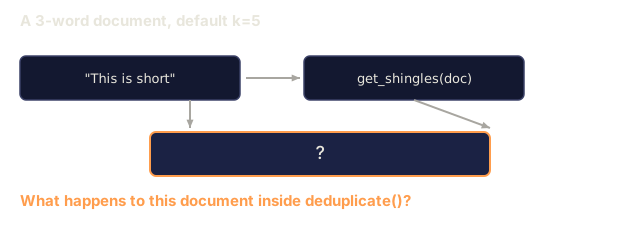
def get_shingles(text, k=5):
    words = text.lower().split()
    if len(words) < k:
        return set()
    return {" ".join(words[i:i+k]) for i in range(len(words) - k + 1)}

def minhash_signature(shingles, num_hashes=128):
    signature = []
    for i in range(num_hashes):
        min_hash = float("inf")
        for shingle in shingles:
            h = int(hashlib.sha256(f"{i}:{shingle}".encode()).hexdigest(), 16)
            min_hash = min(min_hash, h)
        signature.append(min_hash)
    return signature

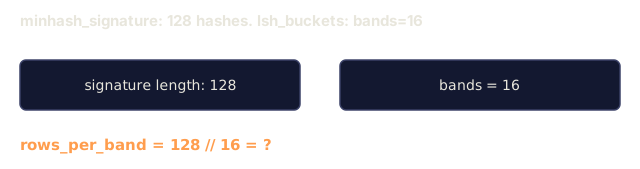
def lsh_buckets(signature, bands=16):
    rows_per_band = len(signature) // bands
    buckets = []
    for b in range(bands):
        start = b * rows_per_band
        band_data = tuple(signature[start:start + rows_per_band])
        bucket_hash = hashlib.md5(str(band_data).encode()).hexdigest()
        buckets.append((b, bucket_hash))
    return buckets

def deduplicate(documents, threshold=0.8, num_hashes=128, bands=16):
    signatures = []
    shingle_sets = []
    for doc in documents:
        shingles = get_shingles(doc)
        shingle_sets.append(shingles)
        signatures.append(minhash_signature(shingles, num_hashes))

    bucket_map = defaultdict(list)
    for doc_idx, sig in enumerate(signatures):
        for band_id, bucket_hash in lsh_buckets(sig, bands):
            bucket_map[(band_id, bucket_hash)].append(doc_idx)

    duplicate_pairs = set()
    for bucket_docs in bucket_map.values():
        if len(bucket_docs) < 2:
            continue
        for i in range(len(bucket_docs)):
            for j in range(i + 1, len(bucket_docs)):
                duplicate_pairs.add((bucket_docs[i], bucket_docs[j]))

    removed = set()
    for i, j in duplicate_pairs:
        if i in removed or j in removed:
            continue
        s1, s2 = shingle_sets[i], shingle_sets[j]
        if not s1 or not s2:
            continue
        jaccard = len(s1 & s2) / len(s1 | s2)
        if jaccard >= threshold:
            removed.add(j)

    return [doc for idx, doc in enumerate(documents) if idx not in removed], len(removed)
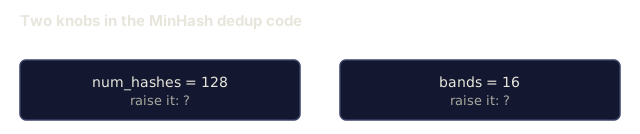
The num_hashes=128 and bands=16 parameters control the precision-recall tradeoff. More hashes give more accurate similarity estimates. More bands increase recall (catch more duplicates) at the cost of more false positives. These values work well for typical web text.
Step 3: Tokenize and Pack Sequences
Take the clean, deduplicated text, tokenize it, and pack into fixed-length sequences for training.
def tokenize_corpus(documents, tokenizer):
    all_tokens = []
    for doc in documents:
        tokens = tokenizer.encode(doc)
        all_tokens.extend(tokens)
        all_tokens.append(tokenizer.eos_id)
    return all_tokens

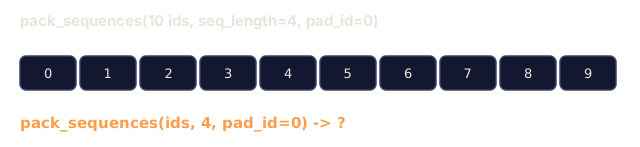
def pack_sequences(token_ids, seq_length, pad_id=0):
    sequences = []
    attention_masks = []
    for i in range(0, len(token_ids), seq_length):
        seq = token_ids[i:i + seq_length]
        mask = [1] * len(seq)
        if len(seq) < seq_length:
            pad_count = seq_length - len(seq)
            seq = seq + [pad_id] * pad_count
            mask = mask + [0] * pad_count
        sequences.append(seq)
        attention_masks.append(mask)
    return sequences, attention_masks
Step 4: DataLoader for Training
Yield randomized batches of packed sequences. This is what the training loop consumes.
import random

class PreTrainingDataLoader:
    def __init__(self, sequences, attention_masks, batch_size, shuffle=True):
        self.sequences = sequences
        self.attention_masks = attention_masks
        self.batch_size = batch_size
        self.shuffle = shuffle

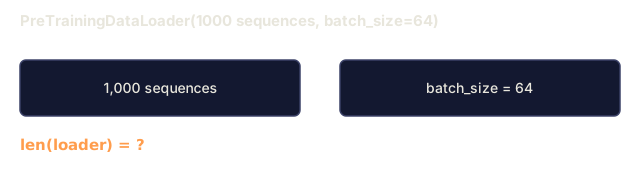
    def __len__(self):
        return (len(self.sequences) + self.batch_size - 1) // self.batch_size

    def __iter__(self):
        indices = list(range(len(self.sequences)))
        if self.shuffle:
            random.shuffle(indices)
        for start in range(0, len(indices), self.batch_size):
            batch_idx = indices[start:start + self.batch_size]
            batch_seqs = [self.sequences[i] for i in batch_idx]
            batch_masks = [self.attention_masks[i] for i in batch_idx]
            yield batch_seqs, batch_masks
Step 5: Dataset Statistics
Compute the numbers that matter: total tokens, unique tokens, compression ratio, document length distribution.
from collections import Counter

def compute_statistics(documents, token_ids, sequences, tokenizer_vocab_size):
    total_chars = sum(len(d) for d in documents)
    total_tokens = len(token_ids)
    unique_tokens = len(set(token_ids))
    compression_ratio = total_chars / total_tokens

    doc_lengths = [len(d.split()) for d in documents]
    avg_doc_length = sum(doc_lengths) / max(len(doc_lengths), 1)
    max_doc_length = max(doc_lengths) if doc_lengths else 0
    min_doc_length = min(doc_lengths) if doc_lengths else 0

    token_counts = Counter(token_ids)
    top_tokens = token_counts.most_common(10)

    non_pad_tokens = sum(sum(1 for t in seq if t != 0) for seq in sequences)
    total_positions = sum(len(seq) for seq in sequences)
    utilization = non_pad_tokens / max(total_positions, 1)

    stats = {
        "total_documents": len(documents),
        "total_characters": total_chars,
        "total_tokens": total_tokens,
        "unique_tokens": unique_tokens,
        "vocab_utilization": unique_tokens / tokenizer_vocab_size,
        "compression_ratio": compression_ratio,
        "avg_doc_length_words": avg_doc_length,
        "max_doc_length_words": max_doc_length,
        "min_doc_length_words": min_doc_length,
        "num_sequences": len(sequences),
        "sequence_utilization": utilization,
        "top_10_tokens": top_tokens,
    }
    return stats
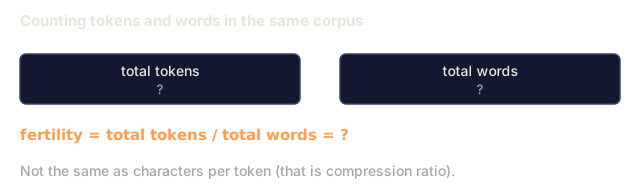
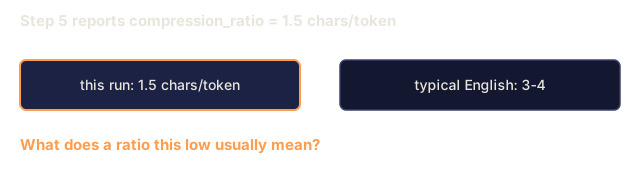
Compression ratio tells you how efficient the tokenizer is on this corpus. English text typically compresses to about 3-4 characters per token. If you see 1.5 characters per token, your tokenizer is splitting too aggressively. If you see 8+, it has learned very domain-specific merges.
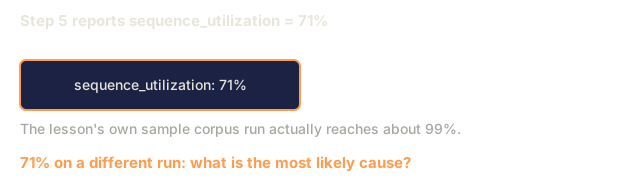
Sequence utilization tells you how much of your packed sequences is real data versus padding. Below 90% means your packing is inefficient and you are spending compute on padding tokens.
Use It
Compare With HuggingFace Datasets
Load the same corpus through HuggingFace's datasets library and compare the pipeline speed.
from datasets import load_dataset
from transformers import AutoTokenizer

ds = load_dataset("wikitext", "wikitext-2-raw-v1", split="train")
tokenizer = AutoTokenizer.from_pretrained("meta-llama/Meta-Llama-3-8B")

import time

start = time.time()
tokenized = ds.map(
    lambda x: tokenizer(x["text"], truncation=True, max_length=2048),
    batched=True,
    num_proc=4,
)
hf_time = time.time() - start
total_tokens = sum(len(t) for t in tokenized["input_ids"])
print(f"HuggingFace: {total_tokens:,} tokens in {hf_time:.2f}s ({total_tokens/hf_time:,.0f} tokens/sec)")
The HuggingFace pipeline uses Rust tokenizers under the hood and parallel processing across 4 cores. Your pure Python pipeline will be 10-50x slower. That gap is why production teams use compiled tokenizers. The algorithm is the same; the implementation language is what changes.
Ship It
This lesson produces a prompt for validating and debugging data quality in LLM training pipelines. See outputs/prompt-data-quality-checker.md.
I'd run main.py before reading any of the stages closely. It prints a count after each one (cleaning, quality filter, MinHash dedup, tokenization, packing, batching), so you can see where documents and tokens drop out. The corpus comes from generate_sample_corpus(), so the numbers tell you whether each filter fires, not what a real crawl would give you.
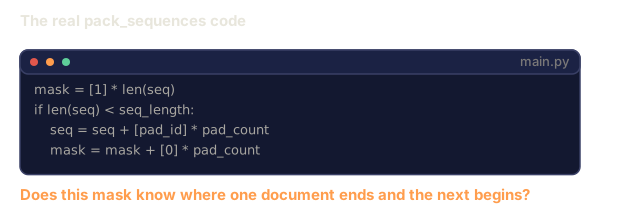
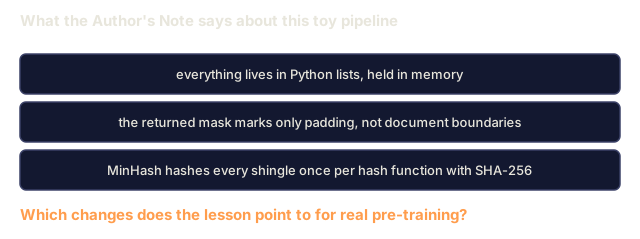
The part I'd reread is pack_sequences. It cuts one flat stream of token ids into seq_length chunks, with an EOS id after each document and padding only on the last chunk. The attention mask it returns marks padding, nothing else. That means the block-diagonal mask described in Sequence Packing is not what the code builds: tokens from neighboring documents in the same sequence can attend to each other here. For a toy that's fine. For real pre-training I'd build the document-boundary mask.
I'd also keep the scale in proportion. Everything lives in Python lists, the shuffle is random.shuffle over indices, and the MinHash loop hashes every shingle once per hash function with SHA-256. None of that streams, and none of it is fast. Treat it as the shape of the pipeline, then reach for the HuggingFace version in Use It when throughput matters.
Exercises
- Easy: Add language detection to the cleaning pipeline using a simple heuristic (character set analysis). Filter to only English documents and measure how many documents get removed.
- Medium: Implement exact deduplication using SHA-256 hashes alongside the MinHash near-deduplication. Compare the number of duplicates caught by each method on a web-scraped corpus.
- Hard: Build a perplexity-based quality filter. Train a small bigram language model on Wikipedia text, score each document by perplexity, and remove the bottom 20%. Compare model output quality when training on filtered vs unfiltered data.
Key Terms
| Term | What people say | What it actually means |
|---|---|---|
| Common Crawl | "The internet" | A non-profit that crawls the web monthly -- ~250TB raw, the starting point for most LLM training data |
| MinHash | "Some hashing trick" | A technique to estimate Jaccard similarity between sets using fixed-size signatures -- enables near-duplicate detection at scale |
| LSH | "Locality-Sensitive Hashing" | A method to group similar items into the same bucket -- reduces pairwise comparisons from O(n^2) to near-linear |
| Sequence packing | "Concatenating documents" | Fitting multiple documents into fixed-length sequences with proper attention masks -- eliminates padding waste |
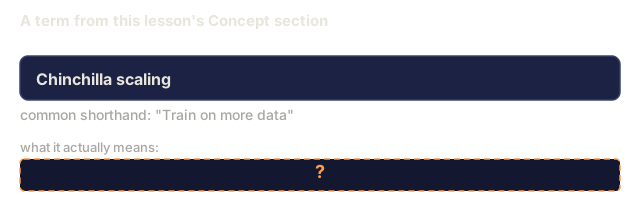
| Chinchilla scaling | "Train on more data" | For a fixed compute budget, optimal performance requires scaling model size and training tokens roughly equally |
| Fertility | "Tokens per word" | Average number of tokens per word -- 1.3 for English in GPT-4, higher for non-Latin scripts |
| Data mixing | "Choosing training data" | The ratio of code vs text vs math vs multilingual data -- no formula, requires experimentation |
| Perplexity filter | "Quality scoring" | Use a small language model to score documents -- high perplexity means the text is unlike clean reference data |
| Deduplication | "Removing copies" | Eliminating exact and near-duplicate documents -- typically removes 30-40% of raw web data |
| Attention mask | "Which tokens to look at" | A binary mask that prevents attention across document boundaries in packed sequences |
Further Reading
- Hoffmann et al., 2022 -- Training Compute-Optimal Large Language Models (Chinchilla): the paper that changed how we think about data scale
- Penedo et al., 2023 -- The RefinedWeb Dataset for Falcon LLM: how to filter Common Crawl to high quality
- Touvron et al., 2023 -- Llama 2: Open Foundation and Fine-Tuned Chat Models: data pipeline details for Llama 2
- Lee et al., 2022 -- Deduplicating Training Data Makes Language Models Better: why deduplication matters more than you think
- Broder, 1997 -- On the Resemblance and Containment of Documents: the original MinHash paper
- Meta, 2024 -- Llama 3 Technical Report: 15.6T tokens, data mixing ratios, filtering pipeline
Code
- main.py (python, 418 lines)