Gradient Checkpointing and Activation Recomputation
Backprop keeps every intermediate activation. At 70B parameters and 128K context that is 3 TB of activations per rank. Checkpointing trades FLOPs for memory: recompute instead of save. The question is which segments to drop, and the answer is not "all of them."
Learning Objectives
- Explain why backprop stores activations and how checkpointing trades extra forward FLOPs for memory.
- Compute activation memory and recompute overhead for a given model shape and segment size k.
- Implement checkpoint-every-k in NumPy and verify its gradients match the full-activation backward.
- Choose between full recompute, selective recompute and offload for a given model config.
The Problem
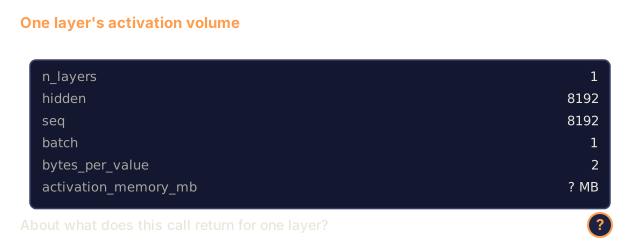
Training a transformer stores, for each layer, the inputs to every op that is differentiated in backward: the attention inputs, the Q/K/V projections, the softmax output, the FFN inputs, the norm outputs, and the residual stream. For a layer with hidden size d, sequence length L, batch B, this is on the order of 12 * B * L * d floats per layer.
For d=8192, L=8192, B=1, that's about 1.6 GB/layer in BF16. A 64-layer model is 103 GB of activations. That is before you multiply by microbatch size, add the attention-softmax intermediates (L^2 per head), or count tensor-parallel partial copies.
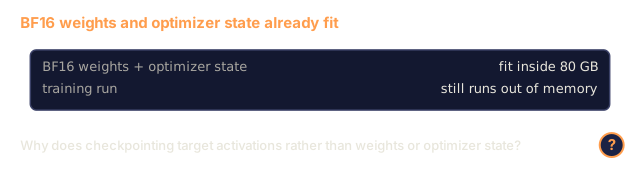
BF16 weights plus optimizer state might fit in 80GB, and activations are what push you past it. Gradient checkpointing (also called activation recomputation) is the standard fix: drop most activations, then redo the forward during backward to get them back. You pay extra FLOPs, and memory drops by the ratio of checkpoint segments to total layers.
Done naively, checkpointing costs roughly 33% more forward-pass FLOPs per step. Done well, with the selective scheme from Korthikanti et al., you save 5x memory for under 5% FLOP overhead. With FP8 matmuls, FSDP offload, and expert-parallel MoE the choice matters, because you can afford neither the memory nor the wasted compute.
The Concept
What Backward Actually Needs
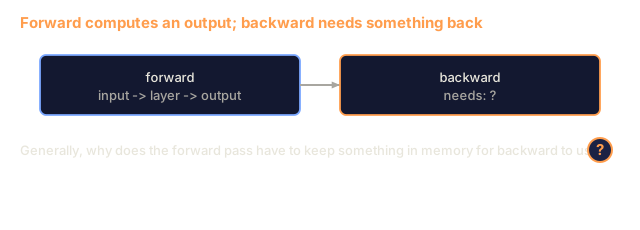
output = layer(input). Backward wants grad_input and grad_params. To compute them it needs:
input(to computegrad_params = input.T @ grad_outputfor linear layers)- some activation derivative intermediates (the derivative of ReLU/GELU/softmax depends on the activation value)
The forward pass stores these automatically in the autograd graph: any op that needs its input in backward keeps a reference to it.
Naive Full Checkpointing
Split the network into N segments. During forward, store only the input to each segment. When backward needs intermediates, rerun the segment's forward pass to materialize them, then differentiate.
Example: 32-layer transformer split into 32 segments of 1 layer each.
- Memory: 32 layer-inputs (small) vs 32 * (activation volume per layer) (huge).
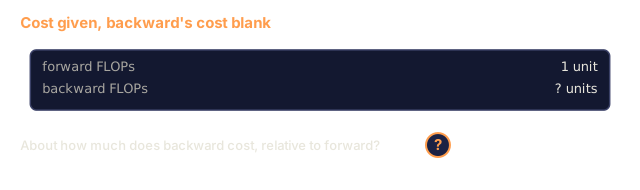
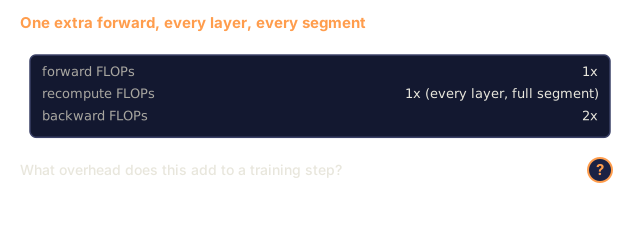
- Extra compute: 1 extra forward per segment, i.e., ~33% more forward FLOPs total (since backward is 2x forward, full step becomes 1 + 1 + 2 = 4 units instead of 1 + 2 = 3).
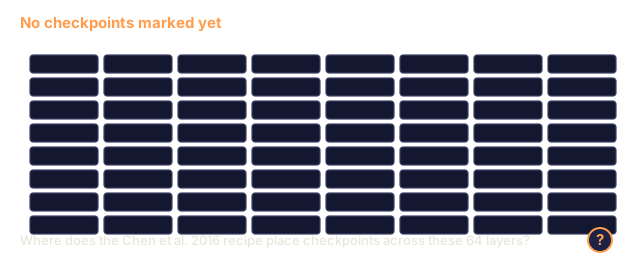
This is the original Chen et al. 2016 recipe: one checkpoint every sqrt(L) layers to balance memory and compute. For L=64, that's 8 checkpoints.
Selective Checkpointing (Korthikanti 2022)
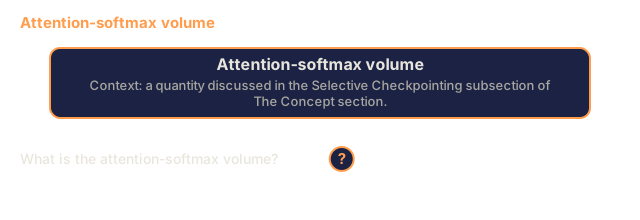
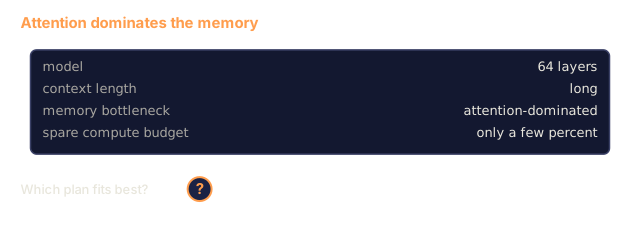
Not all activations cost the same. The attention softmax output is B*L*L*heads and grows quadratically with sequence length. The FFN hidden activation is B*L*4d and grows linearly. For long sequences the softmax dominates.
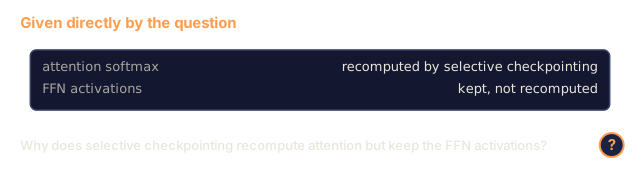
Selective checkpointing keeps the cheap-to-store activations (linear projections, residuals) and recomputes only the expensive ones (attention). You pay minimal FLOPs to recompute but save the O(L^2) memory.
Megatron-Core implements this as "selective" activation recomputation, used in most 2024+ frontier training runs.
Offload
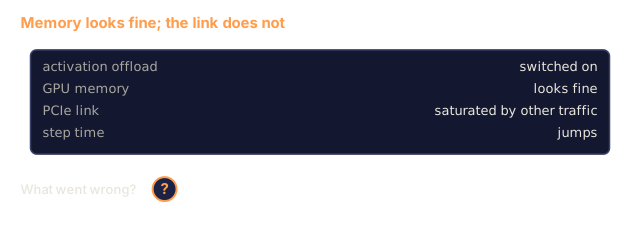
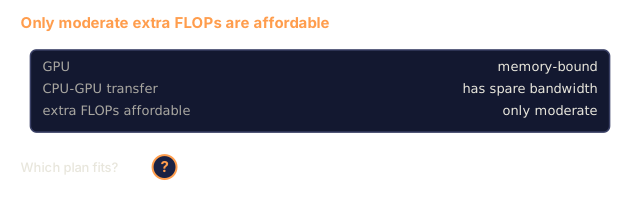
Alternative to recompute: ship activations to CPU RAM between forward and backward. It needs PCIe bandwidth, so it pays off when idle bandwidth exceeds the cost of rematerialization. You can mix the two: checkpoint some layers, offload others.
FSDP2 ships offload as a first-class option. Offload shines when GPU is bottlenecked on memory but CPU-GPU transfer has headroom.
Recompute Cost Model
Per-step FLOPs with naive checkpointing every k layers out of L:
flops_fwd_normal = L * f_layer
flops_bwd_normal = 2 * L * f_layer
flops_total_normal = 3 * L * f_layer

flops_fwd_ckpt = L * f_layer
flops_recompute = L * f_layer  # one extra forward per layer in the segment
flops_bwd_ckpt = 2 * L * f_layer
flops_total_ckpt = 4 * L * f_layer
overhead = 4 / 3 - 1 = 0.33 = 33%
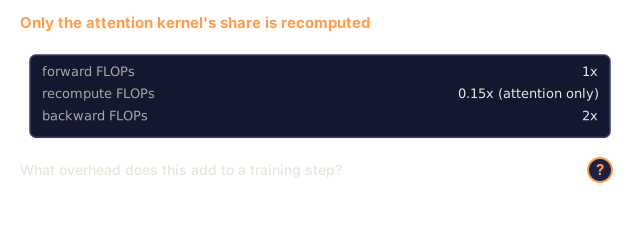
With selective checkpointing you recompute only the attention kernel, not the whole layer:
flops_recompute_selective = L * f_attention ~= L * f_layer * 0.15
overhead_selective = (3 + 0.15) / 3 - 1 = 0.05 = 5%
Memory Savings Model
Activation volume per layer: A. For L layers, total activation memory: L * A.
Full checkpoint (segment size 1): store only L * input_volume (~L * 1/10 A for a standard transformer). Saves ~9 * L * A * 1/10.
Checkpoint every k layers: store L/k * A plus k-1 layers' worth within the active segment.
At k = sqrt(L), memory and recompute cost both scale with sqrt(L), which is the best tradeoff for uniform-cost layers.
When Not to Checkpoint
- The innermost layers of a pipeline stage already in-flight. They have to finish anyway.
- The first and last layers if they dominate the stage's compute (rare in transformers).
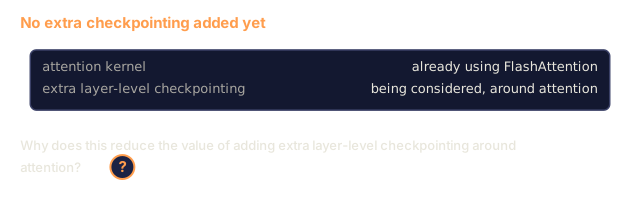
- Attention kernels already using FlashAttention. Flash recomputes the softmax quickly, so additional layer-level checkpointing adds little on top.
Implementation Patterns
-
Function wrapper: wrap a segment in
torch.utils.checkpoint.checkpoint(fn, input). PyTorch stores onlyinput, recomputes everything else on backward. -
Decorator-based: label layers as checkpointable; the trainer decides at config time which segments get wrapped.
-
Manual explicit recompute: write the backward pass yourself, calling a custom
recompute_forwardthat duplicates the forward with the stored input.
The three give the same result. Wrappers are the usual choice.
Interaction with TP / PP / FP8
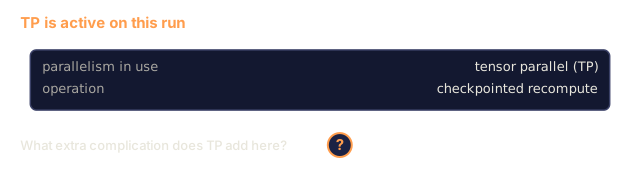
- Tensor parallel: checkpoint inputs must be gathered or rescattered on recompute; handle the communication cost.
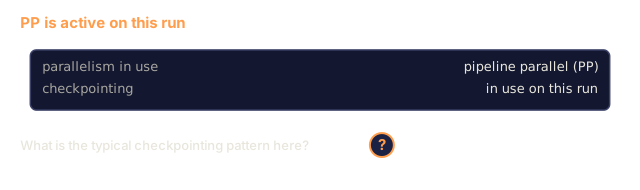
- Pipeline parallel: typical pattern is to checkpoint each pipeline-stage's forward so reverse-order microbatches can reuse activation memory.
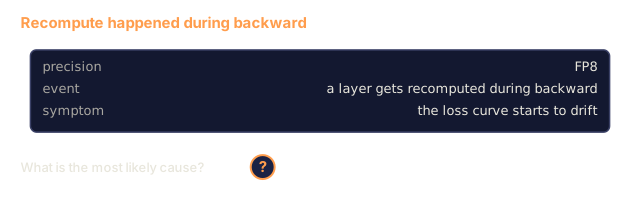
- FP8 recompute: amax histories updated during recompute must match the original forward's, or the FP8 scale drifts. Most frameworks snapshot the scale.

Build It
Step 1: A Toy Model With Segments
import numpy as np


def linear_forward(x, w, b):
    return x @ w + b


def relu(x):
    return np.maximum(x, 0)


def layer_forward(x, w1, b1, w2, b2):
    h = relu(linear_forward(x, w1, b1))
    return linear_forward(h, w2, b2)


def model_forward(x, params):
    activations = [x]
    h = x
    for w1, b1, w2, b2 in params:
        h = layer_forward(h, w1, b1, w2, b2)
        activations.append(h)
    return h, activations
Step 2: Naive Backward Needing All Activations
def model_backward(grad_output, activations, params):
    grads = [None] * len(params)
    g = grad_output
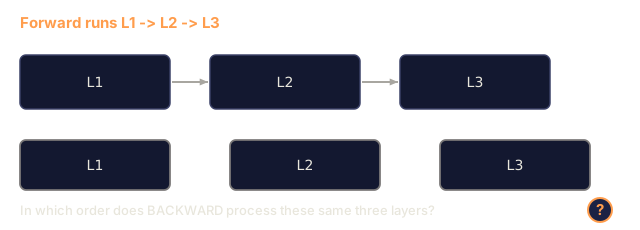
    for i in range(len(params) - 1, -1, -1):
        w1, b1, w2, b2 = params[i]
        x_in = activations[i]
        h_pre = linear_forward(x_in, w1, b1)
        h = relu(h_pre)
        gh = g @ w2.T
        gw2 = h.T @ g
        gb2 = g.sum(axis=0)
        g_pre = gh * (h_pre > 0)
        gx = g_pre @ w1.T
        gw1 = x_in.T @ g_pre
        gb1 = g_pre.sum(axis=0)
        grads[i] = (gw1, gb1, gw2, gb2)
        g = gx
    return g, grads
Step 3: Checkpoint-Every-k Memory
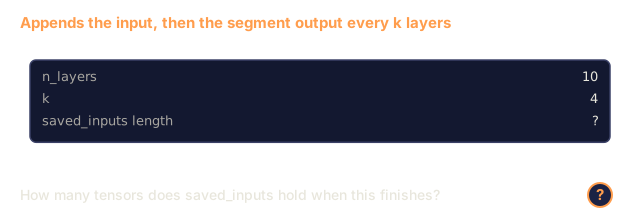
def model_forward_checkpointed(x, params, k=4):
    saved_inputs = [x]
    h = x
    for i, (w1, b1, w2, b2) in enumerate(params):
        h = layer_forward(h, w1, b1, w2, b2)
        if (i + 1) % k == 0:
            saved_inputs.append(h)
    return h, saved_inputs


def model_backward_checkpointed(grad_output, saved_inputs, params, k=4):
    grads = [None] * len(params)
    g = grad_output
    segments = [(j * k, min((j + 1) * k, len(params))) for j in range(len(saved_inputs))]
    for seg_idx in range(len(saved_inputs) - 1, -1, -1):
        start, end = segments[seg_idx]
        if start >= end:
            continue
        x_in = saved_inputs[seg_idx]
        _, seg_acts = model_forward(x_in, params[start:end])
        g, seg_grads = model_backward(g, seg_acts, params[start:end])
        for j, gr in enumerate(seg_grads):
            grads[start + j] = gr
    return g, grads
Step 4: Cost Model
def checkpoint_cost(n_layers, segment_size, flops_per_layer=1.0):
    fwd = n_layers * flops_per_layer
    recompute = n_layers * flops_per_layer
    bwd = 2 * n_layers * flops_per_layer
    return {
        "fwd": fwd,
        "recompute": recompute,
        "bwd": bwd,
        "total": fwd + recompute + bwd,
        "overhead_vs_no_ckpt": (fwd + recompute + bwd) / (fwd + bwd) - 1.0,
    }


def selective_checkpoint_cost(n_layers, attention_fraction=0.15,
                              flops_per_layer=1.0):
    fwd = n_layers * flops_per_layer
    recompute = n_layers * attention_fraction * flops_per_layer
    bwd = 2 * n_layers * flops_per_layer
    return {
        "fwd": fwd,
        "recompute": recompute,
        "bwd": bwd,
        "total": fwd + recompute + bwd,
        "overhead_vs_no_ckpt": (fwd + recompute + bwd) / (fwd + bwd) - 1.0,
    }
Step 5: Memory Estimator
def activation_memory_mb(n_layers, hidden=8192, seq=8192,
                        batch=1, bytes_per_value=2):
    per_layer = 12 * batch * seq * hidden * bytes_per_value
    return n_layers * per_layer / 1e6


def memory_after_checkpoint(n_layers, segment_size, hidden=8192,
                           seq=8192, batch=1, bytes_per_value=2):
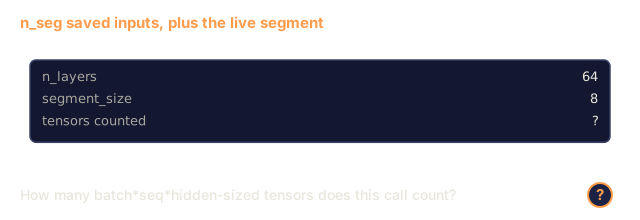
    n_seg = (n_layers + segment_size - 1) // segment_size
    saved = (n_seg + segment_size) * batch * seq * hidden * bytes_per_value
    return saved / 1e6
Step 6: Optimal Segment Size
def optimal_segment(n_layers):
    return max(1, int(round(np.sqrt(n_layers))))
Step 7: Selective Checkpoint Decision
def should_recompute(layer_type, activation_bytes, recompute_flops_ratio):
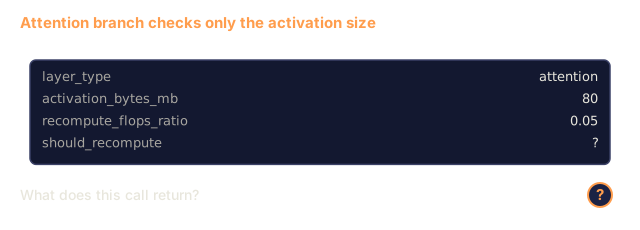
    if layer_type == "attention" and activation_bytes > 100 * 1e6:
        return True
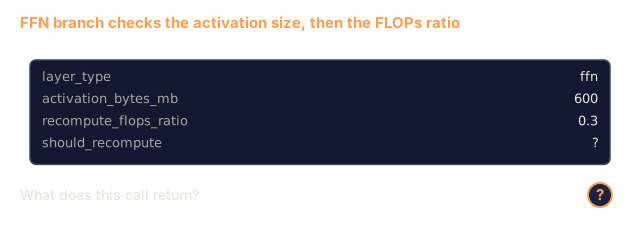
    if layer_type == "ffn" and activation_bytes > 500 * 1e6:
        return recompute_flops_ratio < 0.1
    return False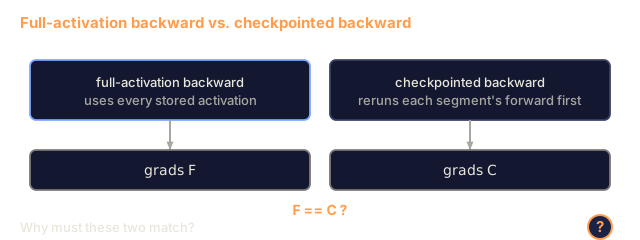
Use It
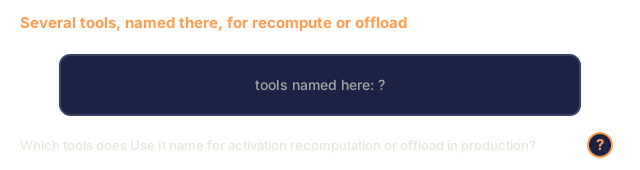
- torch.utils.checkpoint:
from torch.utils.checkpoint import checkpointis the standard wrapper in PyTorch. It wraps a function, stores only the inputs, and recomputes on backward. - Megatron-Core activation recomputation: supports
selective,full, andblockmodes. Standard in 2024+ frontier training. - FSDP2 offload:
module.to_empty(device="cpu")withoffload_policyin FSDP2 shards activations to CPU instead of recomputing. - DeepSpeed ZeRO-Offload: CPU offload for optimizer states and activations, complementing checkpointing.
Ship It
This lesson produces outputs/prompt-activation-recompute-policy.md, a prompt that takes your model config (layers, hidden, seq, batch) and available GPU memory and emits a per-layer recompute policy (none / selective / full / offload).
I'd run main.py before trusting any of the numbers above. verify_equivalence() runs the plain backward and the checkpointed backward on the same weights and the same upstream gradient, and reports whether the outputs match and the largest gradient difference. That check is the whole point of the technique: recomputing a segment has to give back the activations you dropped.
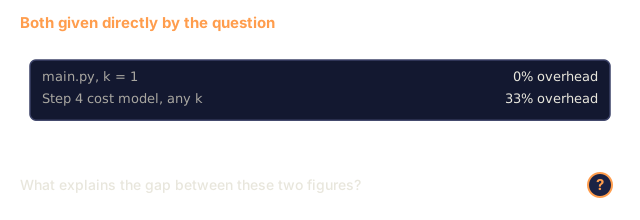
The cost model deserves a skeptical read. The checkpoint_cost in main.py scales non-selective recompute by (segment_size - 1) / segment_size, so k=1 prints 0% overhead, while the Step 4 version above ignores segment_size and always charges a full extra forward (33%). The checkpointed backward behaves like neither. It reruns model_forward over every layer in each segment, including when the segment is one layer. Treat the cost model as the textbook approximation and the code as the thing that actually runs.
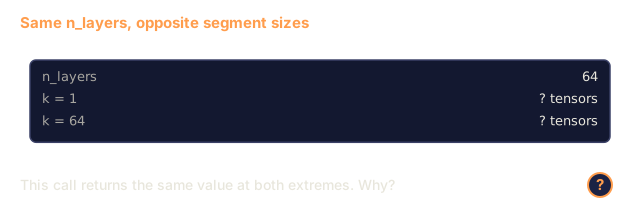
memory_after_checkpoint is a rough estimate too. It counts each saved input and each layer inside the live segment as one batch * seq * hidden tensor, while activation_memory_mb charges a full layer 12 of them. That gap is why I'd sweep k in the exercises and look for where the curve flattens, rather than just plugging in sqrt(L). For a real model I'd measure peak memory with the PyTorch wrapper and use Megatron's selective mode once attention dominates.
Exercises
-
Verify correctness. Run
model_forward+model_backward(full activations) vsmodel_forward_checkpointed+model_backward_checkpointed(segments). Parameter gradients must be identical to machine precision. -
Sweep segment size
kfrom 1 toL. Plot FLOP overhead and memory. Find the knee of the curve. -
Implement selective checkpointing: store the attention-module input but not its intermediates. Measure the FLOP overhead vs full-layer checkpointing for a 32-layer model at seq=8192.
-
Add offload. Save segment inputs to a simulated "CPU buffer" (a separate list). Measure "PCIe bandwidth" as bytes/time and find the breakeven point between offload and recompute.
-
Benchmark a real PyTorch transformer with and without
torch.utils.checkpoint. Measure memory (viatorch.cuda.max_memory_allocated) and step time.
Key Terms
| Term | What people say | What it actually means |
|---|---|---|
| Gradient checkpointing | "Save memory by redoing forward" | Store segment inputs only; recompute intermediates during backward to get gradient-support tensors |
| Activation recomputation | "Same as checkpointing" | The HPC-flavored name for the same technique |
| Segment size (k) | "How many layers per checkpoint" | Number of layers whose intermediates are dropped and rematerialized together |
| Selective checkpointing | "Korthikanti's trick" | Recompute only expensive-to-store activations (attention softmax); keep cheap ones |
| Full checkpointing | "The naive version" | Recompute every layer's intermediates in every segment |
| Block checkpointing | "Coarse-grained" | Checkpoint whole transformer blocks; largest granularity |
| FLOP overhead | "The compute tax" | Extra FLOPs per step = (recompute FLOPs) / (fwd + bwd FLOPs); 33% naive, 5% selective |
| Activation offload | "Ship to CPU" | Move activations to CPU RAM across forward->backward; alternative to recompute |
| sqrt-L rule | "The classical optimum" | For uniform-cost layers, optimal checkpoint spacing is sqrt(L) layers |
| Attention-softmax volume | "The O(L^2) problem" | L^2 * heads * batch floats; dominates activation memory at long contexts |
Further Reading
- Chen et al., 2016 -- "Training Deep Nets with Sublinear Memory Cost" -- the original paper that formalized gradient checkpointing
- Korthikanti et al., 2022 -- "Reducing Activation Recomputation in Large Transformer Models" -- selective activation recomputation and the formal cost analysis
- Pudipeddi et al., 2020 -- "Training Large Neural Networks with Constant Memory using a New Execution Algorithm" -- alternative constant-memory approach via reverse-mode rematerialization
- Ren et al., 2021 -- "ZeRO-Offload: Democratizing Billion-Scale Model Training" -- activation offload at scale
- PyTorch torch.utils.checkpoint docs -- the standard API
- Megatron-Core activation recomputation documentation -- selective, full, and block modes
Code
- main.py (python, 163 lines)