Flamingo and Gated Cross-Attention for Few-Shot VLMs
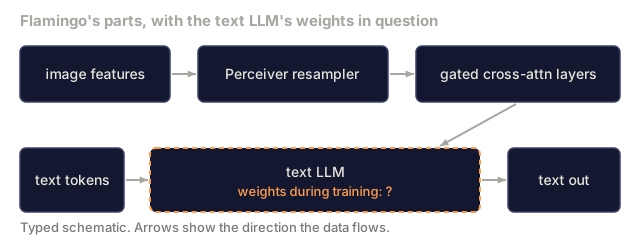
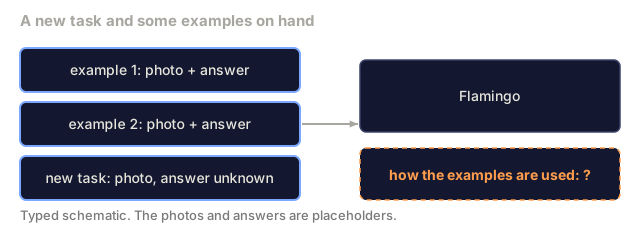
Flamingo (DeepMind, 2022) showed two things before anyone else. One model could process arbitrarily interleaved images, video, and text. And a VLM could learn in context: give it three (image, caption) examples and it captions a new image with no gradient step. The mechanism is a set of gated cross-attention layers inserted between a frozen LLM's existing layers, with a learned tanh gate that starts at zero so the text capability is intact at initialization. The Perceiver resampler and gated cross-attention are the ancestors of Gemini's interleaved inputs and Idefics2's visual tokens.
Learning Objectives
- Explain how gated cross-attention preserves a frozen LLM's text capability at initialization via tanh(gate) = 0.
- Walk through a Perceiver resampler: N image patches → K fixed "latent" queries via cross-attention.
- Describe how Flamingo handles interleaved image-text sequences with causal masking that respects image placement.
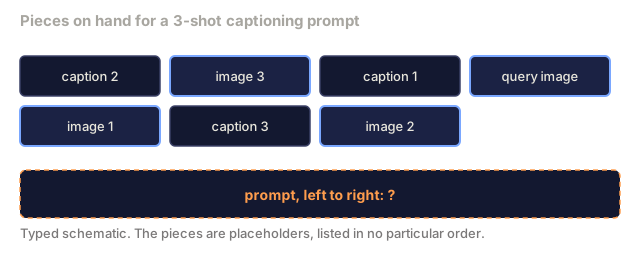
- Reproduce a few-shot multimodal prompt structure (3 image-caption examples then a query image).
The Problem
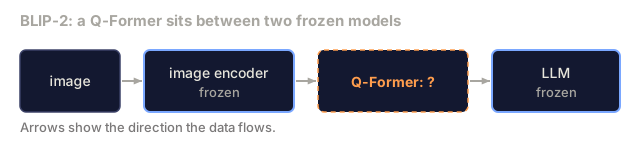
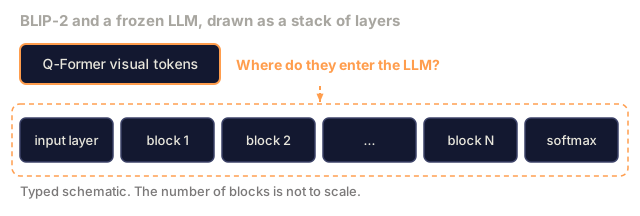
BLIP-2 feeds 32 visual tokens into a frozen LLM's input layer. That works for one image per prompt. Now try interleaving many images with text: "here is image A, caption it; here is image B, caption it; now here is image C, caption it." The LLM's self-attention would have to handle image tokens and text tokens in a single stream, and deciding which positions can attend to which images gets fussy.
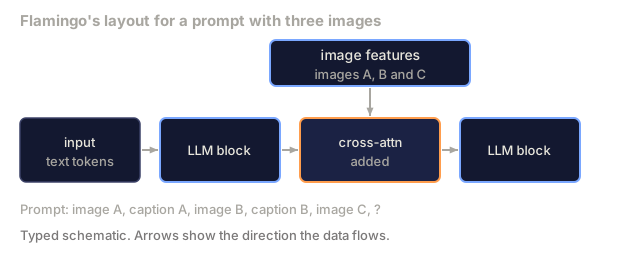
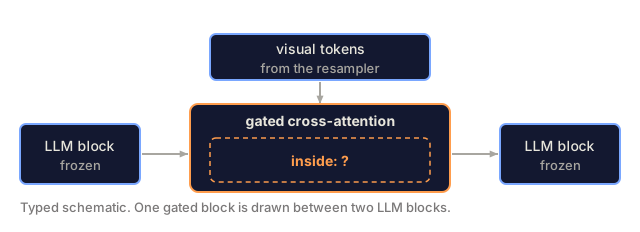
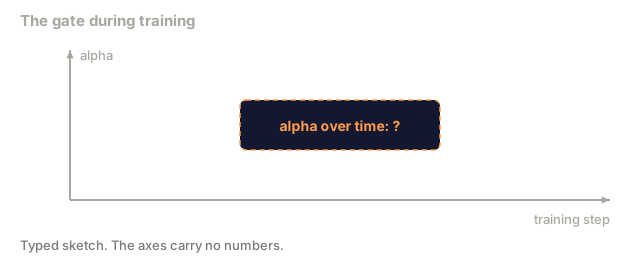
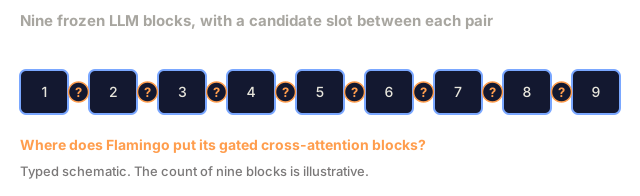
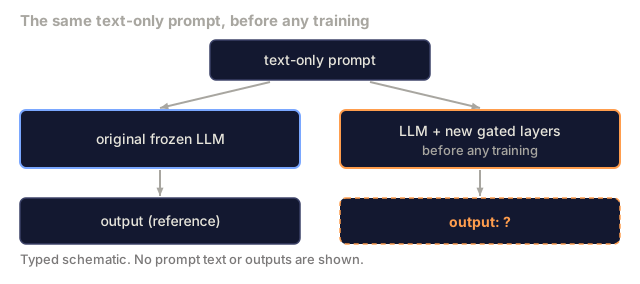
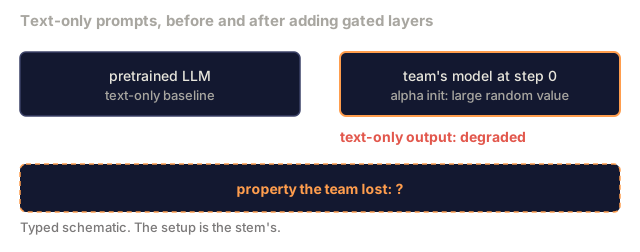
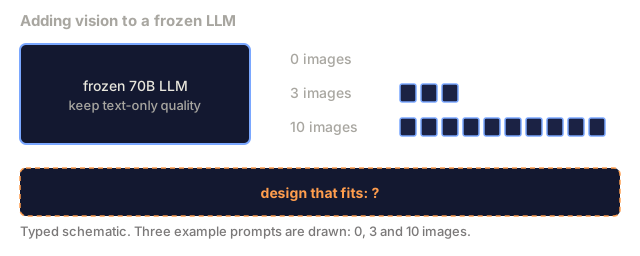
Flamingo's answer is to leave the LLM's input stream alone. Insert extra cross-attention layers between existing LLM blocks. Text tokens still flow through the LLM's causal self-attention as usual, and every few blocks they also cross-attend to image features through a new gated layer. The gate starts at zero, so at step zero the new layers are no-ops and the model behaves like the pretrained LLM. As training progresses the gate opens and visual information starts flowing.
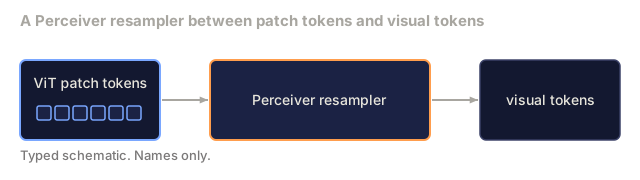
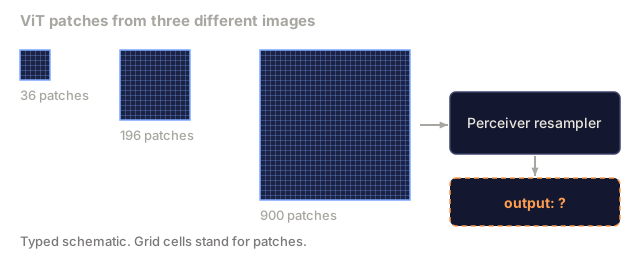
The second question Flamingo had to answer: how do you handle a variable number of images (0, 1, or many) per prompt? A Perceiver resampler, a small cross-attention module, takes whatever number of patches you have and produces a fixed number of visual latent tokens. The LLM's cross-attention layer sees the same shape however many images are in the prompt.
The Concept
The frozen LLM
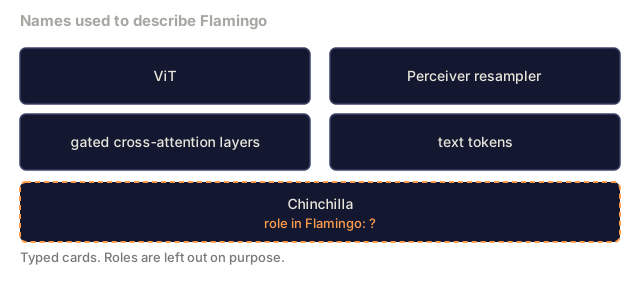
Flamingo starts with a frozen Chinchilla 70B LLM. None of the 70B weights change, and the existing text self-attention and FFN run as they did before.
Perceiver resampler
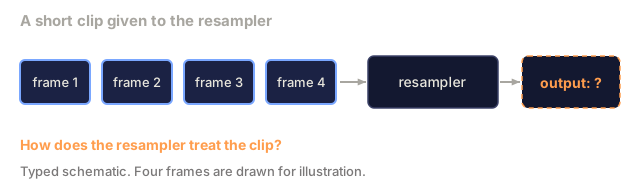
For each image in the prompt, the ViT produces N patch tokens. The Perceiver resampler has K fixed learnable latents (Flamingo uses K=64). Each resampler block has two sub-steps:
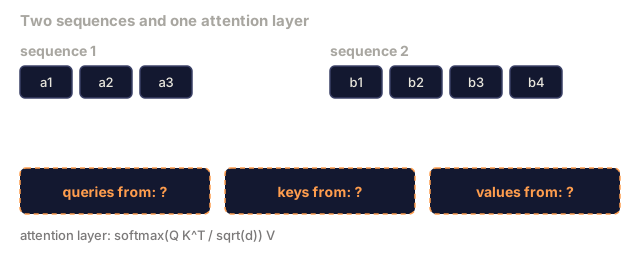
- Cross-attention: the K latents attend over the N patch tokens (Q from latents, K/V from patches).
- Self-attention + FFN within the latents.
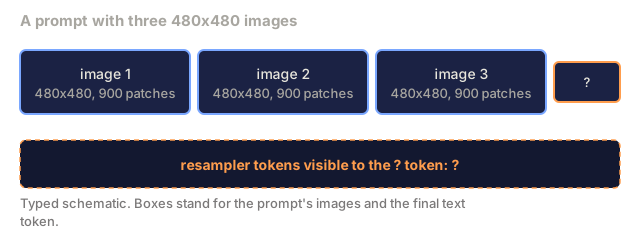
After 6 resampler blocks, the output is K=64 visual tokens of dim 1024, whatever the ViT's patch count. A 224x224 image (196 patches) and a 480x480 image (900 patches) both exit as 64 resampler tokens.
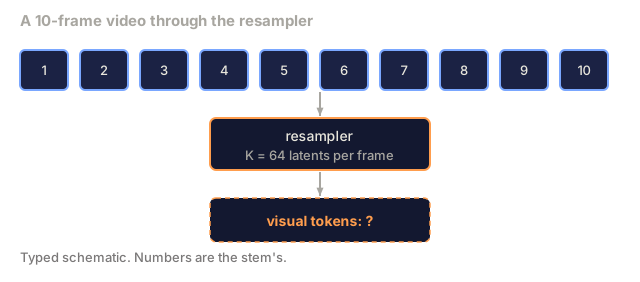
For video, the resampler is applied temporally: each frame's patches produce 64 latents, and a temporal positional encoding lets the model distinguish t=0 from t=N. The full video becomes T * 64 visual tokens.
Gated cross-attention
Between every M layers of the frozen LLM (Flamingo uses M=4), insert a new gated cross-attention block:
x_after_llm_block = llm_block(x_before)
cross = cross_attn(x_after, resampler_output)
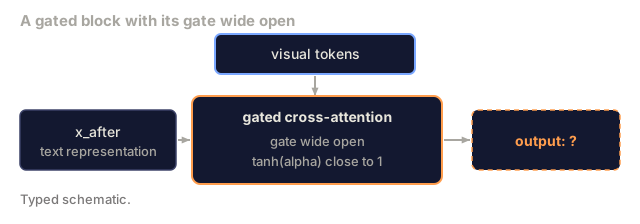
gated = tanh(alpha) * cross + x_after
x_before_next_block = gated
alphais a learnable scalar initialized to zero.tanh(0) = 0, so at init the gated branch contributes zero.- As
alphamoves away from zero, the cross-attention contribution grows smoothly. - Because of the residual connection, even a wide-open gate does not overwrite the LLM's text representation. It adds visual information on top.
This is the design choice that matters most in Flamingo. Visual conditioning is additive, gated, and zero at initialization, so on text-only inputs a Flamingo at step 0 behaves like Chinchilla 70B.
Masked cross-attention for interleaved inputs
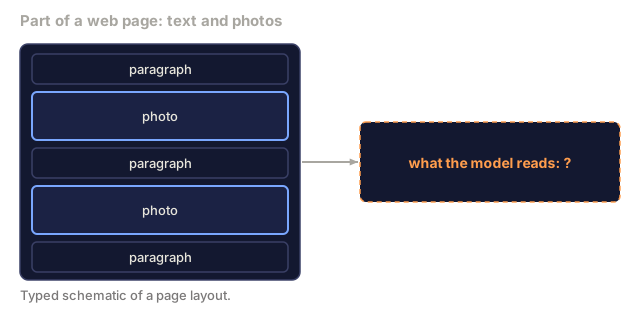
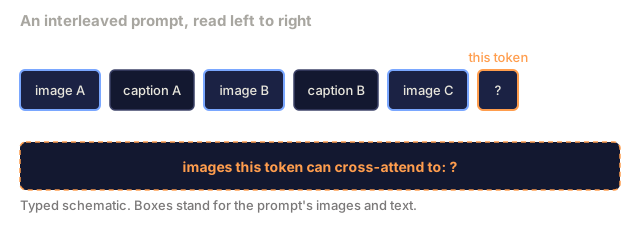
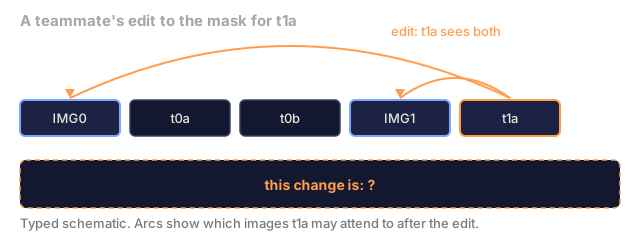
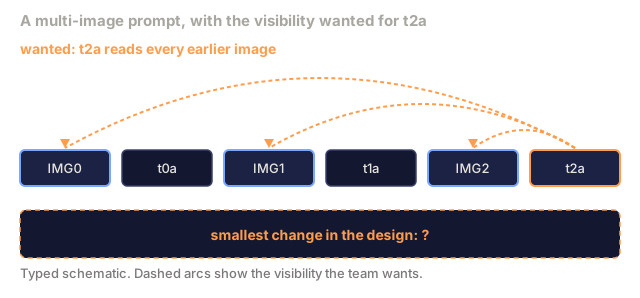
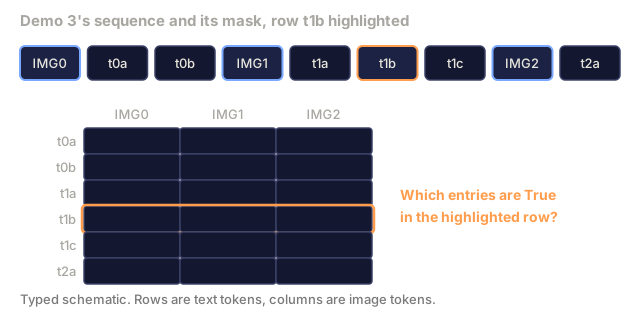
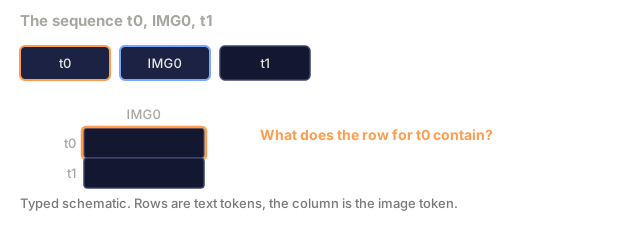
In a prompt like " caption A caption B ?", each text token should only see images that came before it in the sequence. The cross-attention mask enforces this: the text token at position t attends only to resampler tokens of image i_t, the most recent image before position t. "Sees only the last preceding image" and "sees all preceding images" are both valid choices, and Flamingo chose the former.
In-context few-shot learning
A Flamingo prompt looks like:
<image1> A photo of a cat. <image2> A photo of a dog. <image3> A photo of a
The model sees the completion pattern and outputs "bird" (or whatever image3 shows), with no gradient steps. The frozen LLM's in-context learning carries through the gated cross-attention. That is the punchline of the paper.
Training data
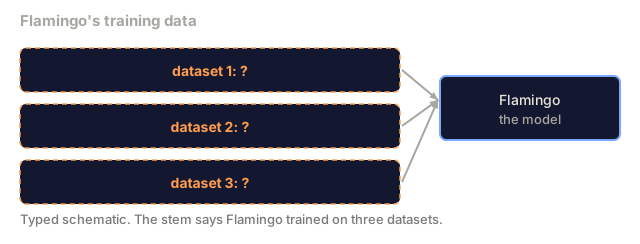
Flamingo trained on three datasets:
- MultiModal MassiveWeb (M3W): 43M web pages with interleaved images and text, in reading order.
- Image-Text Pairs (ALIGN + LTIP): 4.4B pairs.
- Video-Text Pairs (VTP): 27M short video clips.
OBELICS (2023) is an open reproduction of the interleaved web corpus, which Idefics, Idefics2, and most open "Flamingo-like" models train on.
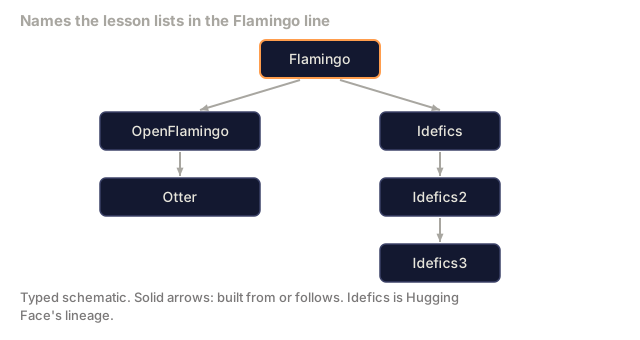
OpenFlamingo and Otter
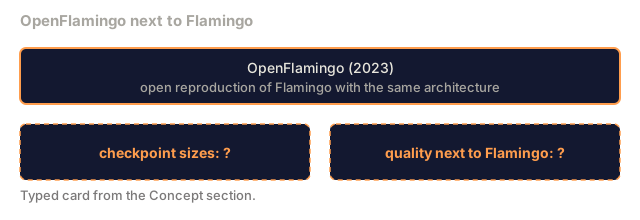
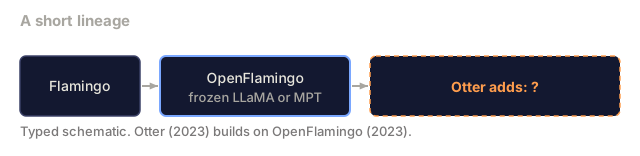
OpenFlamingo (2023) is the open reproduction. The architecture is the same (Perceiver resampler + gated cross-attention on a frozen LLaMA or MPT), with checkpoints at 3B, 4B, and 9B. Quality lags Flamingo because of the smaller base LLM and less data.
Otter (2023) builds on OpenFlamingo with instruction tuning on MIMIC-IT (a dataset of multimodal instructions), which shows gated cross-attention works for instruction following too.
The descendants
- Idefics / Idefics2 / Idefics3: Hugging Face's gated cross-attention lineage, getting simpler over time. Idefics2 dropped the resampler for direct patch tokens with adaptive pooling.
- Flamingo-to-Chameleon transition: by 2024 many teams had moved to early fusion (Lesson 12.11). Flamingo-style gated cross-attention still shows up in production where the backbone has to stay frozen.
- Gemini's interleaved input: conceptually inherits Flamingo's interleaved-format flexibility, though the mechanism is proprietary.
Comparison to BLIP-2
| BLIP-2 | Flamingo | |
|---|---|---|
| Visual bridge | Q-Former once at input | Gated cross-attention at every M layers |
| Visual tokens | 32 per image | 64 per image per cross-attn layer |
| Frozen LLM | Yes | Yes |
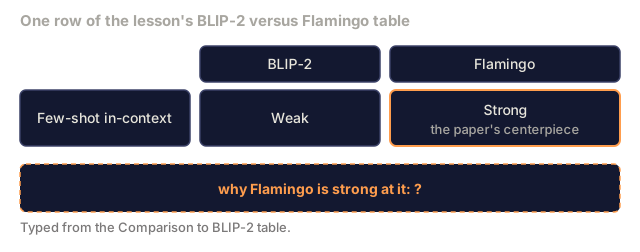
| Few-shot in-context | Weak | Strong, the paper's centerpiece |
| Interleaved inputs | No native support | Yes, the design target |
| Training data | 130M pairs | 1.3B pairs + 43M interleaved pages |
| Parameter count | 188M trained | ~10B trained (cross-attn layers) |
| Compute | Days on 8 A100s | Weeks on thousands of TPUv4 |
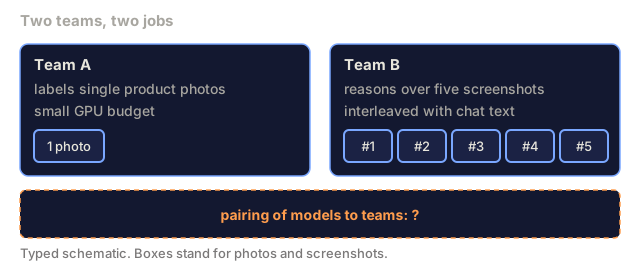
Pick BLIP-2 for single-image VQA on a budget. Pick Flamingo/Idefics2 for interleaved, few-shot, or multi-image reasoning.
Use It
code/main.py runs three demos:
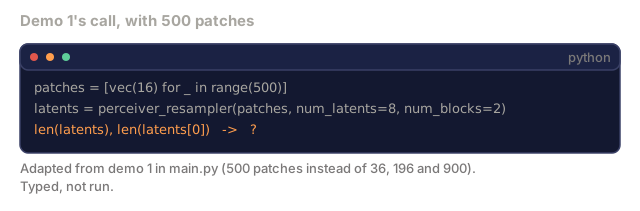
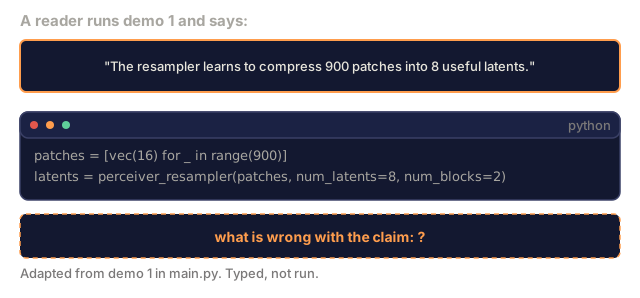
- A Perceiver resampler on 36, 196, and 900 random patch tokens, each reduced to 8 latents with pure Python cross-attention. The output shape is the same for all three.
- A gated cross-attention step with
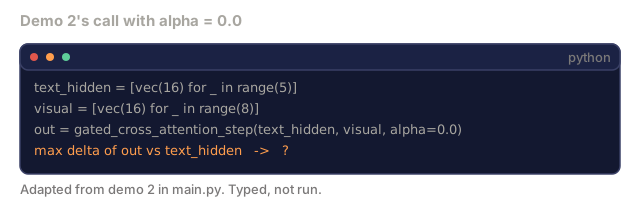
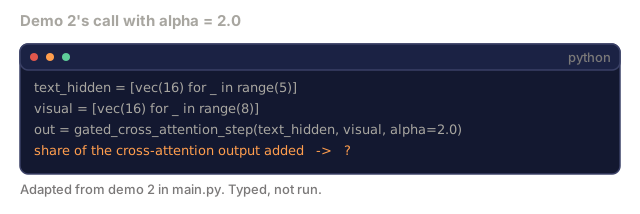
alpha = 0, where the output equals the input (LLM unchanged), thenalpha = 2.0, where the visual contribution is mixed in (tanh(2.0) is about 0.96). - An interleaved-mask builder that produces the 2D attention mask for a sequence of images and text, where each text token sees only the most recent preceding image.
Ship It
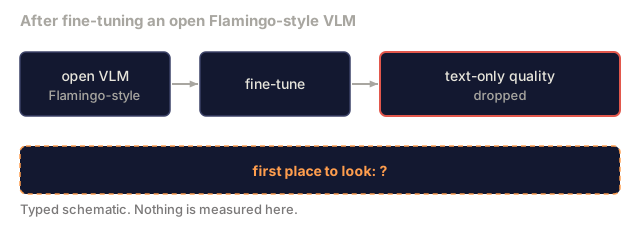
This lesson produces outputs/skill-gated-bridge-diagnostic.md. Given an open VLM's config (resampler Y/N, cross-attn frequency, gate scheme), it identifies the Flamingo lineage elements and explains the freezing strategy. It helps when a fine-tune has degraded text performance, where the likely cause is a gate that got too wide too fast.
I'd run main.py and read the second demo before anything else. With alpha=0.0 it prints a max delta of 0.000000 against the input, which is the argument for the gate in one line. With alpha=2.0 the average delta is nonzero, because the cross-attention output is added at about 0.96 of its full weight.
I'd also keep the toy in proportion. Nothing trains here. The resampler draws its latents as fresh random vectors on each call, runs 2 blocks of plain cross-attention with a residual, and has no projections, no self-attention, and no FFN. So the 36, 196, and 900 patch runs all coming out as 8 latents shows why the output size is fixed, and says nothing about what a trained resampler learns. The gate is only checked at two fixed values of alpha, which means the schedule for how fast it opens is not in the code. When a fine-tune loses text quality, that schedule is where I'd look first.
The mask is the piece I'd poke at. Changing the rule from the last preceding image to all preceding images is a small edit to which entries get set to True, and I'd try both on the 9-token demo sequence before reading the paper's argument for its choice.
Exercises
-
Compute Flamingo-9B's visual parameter count: 9B LLM + 1.4B gated cross-attention layers + 64M resampler. What fraction of total params is trained?
-
Implement the gated residual
y = tanh(alpha) * cross + xin PyTorch. Show experimentally that withalpha=0,y==xexactly at init. -
Read OpenFlamingo Section 3.2 (arXiv:2308.01390) on how they handle multiple images in a batch when each prompt has a different image count. Describe the padding strategy.
-
Why does Flamingo's cross-attention mask let a text token attend to only the most recent preceding image rather than all preceding images? Read the Flamingo paper Section 2.4 and explain the tradeoff.
-
In-context few-shot: construct a prompt with 4 examples of "image → color of main object" for a new Flamingo variant. Describe the expected accuracy pattern as you vary the number of examples from 0 to 8.
Key Terms
| Term | What people say | What it actually means |
|---|---|---|
| Perceiver resampler | "Fixed-latent cross-attention" | Module that produces K fixed tokens from a variable number of input patches |
| Gated cross-attention | "Tanh-gated bridge" | Residual layer y = tanh(alpha)*cross + x, learnable alpha, init 0 |
| Interleaved input | "Mixed sequence" | Prompt format with images and text mixed freely in reading order |
| Frozen LLM | "No LLM gradients" | The text LLM's weights do not update; only resampler + cross-attn layers train |
| Few-shot | "In-context examples" | Give a few (image, answer) pairs in the prompt; model generalizes without finetuning |
| OBELICS | "Interleaved web corpus" | Open dataset of 141M web pages with images and text in reading order |
| Chinchilla | "70B frozen base" | Flamingo's frozen text LLM, from DeepMind's Chinchilla paper |
| Gate schedule | "How alpha moves" | The rate at which the cross-attention gate opens during training |
| Cross-attn frequency | "Every M layers" | How often a gated cross-attention block is inserted; Flamingo uses M=4 |
| OpenFlamingo | "Open reproduction" | MosaicML/LAION open checkpoint at 3-9B; architecture-identical to Flamingo |
Further Reading
- Alayrac et al.: Flamingo (arXiv:2204.14198): the original paper.
- Awadalla et al.: OpenFlamingo (arXiv:2308.01390): open reproduction.
- Laurençon et al.: OBELICS (arXiv:2306.16527): interleaved web corpus.
- Jaegle et al.: Perceiver IO (arXiv:2107.14795): the general Perceiver architecture.
- Li et al.: Otter (arXiv:2305.03726): instruction-tuned Flamingo descendant.
- Laurençon et al.: Idefics2 (arXiv:2405.02246): modern simplification of the Flamingo approach.
Code
- main.py (python, 176 lines)