Heritage of FIPA-ACL and Speech Acts
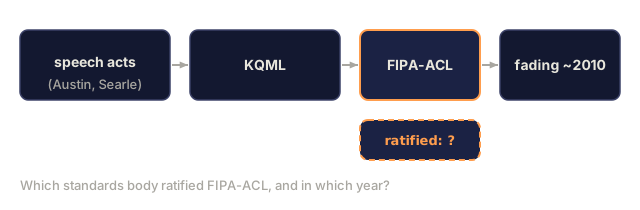
Before MCP and A2A there was FIPA-ACL. In 2000 the IEEE Foundation for Intelligent Physical Agents ratified an agent communication language with twenty performatives, two content languages, and a set of interaction protocols: contract net, subscribe/notify, request-when. It faded from industry because the ontology overhead was too heavy for the web. The LLM revival of multi-agent systems is reimplementing the same ideas without the formal semantics, with JSON contracts standing in for performatives and natural language standing in for ontologies. Reading FIPA-ACL seriously shows you which 2026 protocol decisions are reinvention, which are novelty, and where the current wave is going to rediscover problems the 2000s already solved.
Learning Objectives
- Explain how speech-act theory, KQML, and FIPA-ACL connect, and what a performative is.
- Map MCP, A2A, and CA-MCP message shapes onto FIPA performatives and interaction protocols.
- Name why FIPA-ACL faded and which of its costs (ontology, formal semantics, tooling) modern specs dropped.
- Pick the interaction protocol (contract-net, subscribe/notify, request-when) that fits a given coordination problem.
- Diagnose semantic drift and choose a mitigation that stops short of a full ontology.
Problem
The 2026 agent-protocol landscape is crowded: MCP for tools, A2A for agents, ACP for enterprise audit, ANP for decentralized trust, NLIP for natural-language content, plus CA-MCP and two dozen research proposals. Each spec announces itself as foundational.
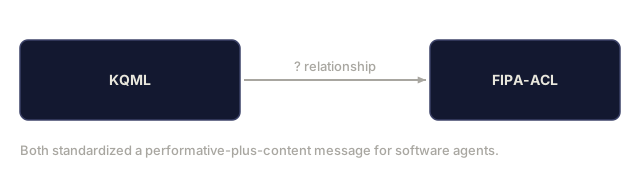
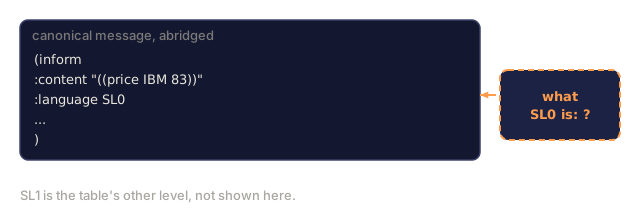
Most of them are rediscovering a twenty-year-old decision tree. Austin (1962) and Searle (1969) gave us speech-act theory, the idea that utterances are actions. KQML (1993) turned that into a wire protocol. FIPA-ACL (ratified 2000) was the reference standardization: twenty performatives, content languages SL0/SL1, and interaction protocols for contract-net and subscribe-notify. JADE and JACK were the Java reference platforms. The effort faded around 2010 because the ontology overhead was too heavy and the web was winning.
Look at MCP's tools/call, A2A's task lifecycle, or CA-MCP's shared context store and you are looking at a softer, JSON-native rehash of FIPA decisions. That tells you which new "innovations" are reinventions, and which old failure modes the new specs will hit again.
Concept
Speech acts, in one paragraph
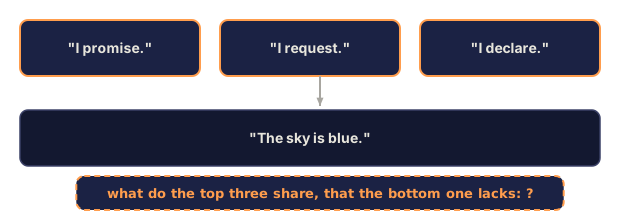
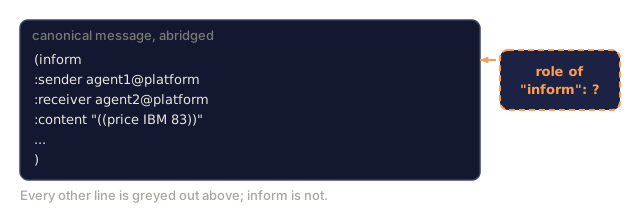
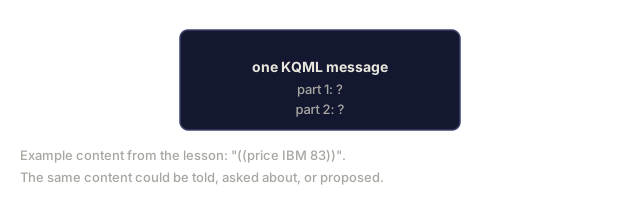
Austin noticed that some sentences do not describe the world. They change it: "I promise." "I request." "I declare." He called these performative utterances. Searle formalized five categories: assertive, directive, commissive, expressive, declarative. KQML (Finin et al., 1993) made this operational for software agents. A message is a performative (the action) plus content (what the action is about). FIPA-ACL cleaned up KQML's gaps and standardized around twenty performatives.
The twenty FIPA performatives (partial list)
| Performative | Intent |
|---|---|
inform | "I tell you P is true" |
request | "I ask you to do X" |
query-if | "Is P true?" |
query-ref | "What is the value of X?" |
propose | "I propose we do X" |
accept-proposal | "I accept the proposal" |
reject-proposal | "I reject the proposal" |
agree | "I agree to do X" |
refuse | "I refuse to do X" |
confirm | "I confirm P is true" |
disconfirm | "I deny P" |
not-understood | "Your message did not parse" |
cfp | "Call for proposals on X" |
subscribe | "Notify me when X changes" |
cancel | "Cancel the ongoing X" |
failure | "I tried X and failed" |
The full list is in fipa00037.pdf (FIPA ACL Message Structure). Don't memorize it. What matters is that each of these maps to a primitive an LLM protocol ends up re-adding.
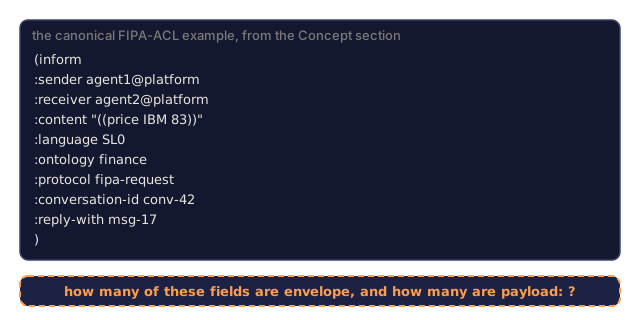
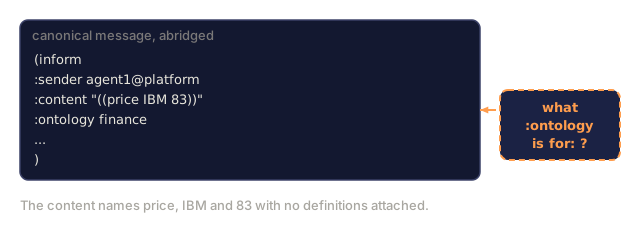
Canonical FIPA-ACL message
(inform
  :sender       agent1@platform
  :receiver     agent2@platform
  :content      "((price IBM 83))"
  :language     SL0
  :ontology     finance
  :protocol     fipa-request
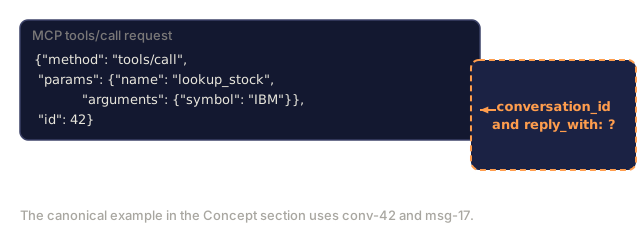
  :conversation-id   conv-42
  :reply-with   msg-17
)
Seven fields carry the protocol envelope and one field (content) carries the payload. Those seven are what you end up reinventing when you bolt retries, threading, and ontology onto a JSON protocol.
The two legacy platforms
JADE (Java Agent DEvelopment framework, 1999–2020s) was the most-used FIPA-compliant runtime. Agents extended a base class, exchanged ACL messages, ran inside containers, and coordinated through "behaviors." Its interaction-protocol library shipped with contract-net, subscribe-notify, request-when, and propose-accept.
JACK (Agent Oriented Software, commercial) emphasized BDI (Belief-Desire-Intention) reasoning on top of FIPA messages. More formal, less adopted.
Both declined once the web stack took over multi-agent use cases. MCP and A2A play the role of the runtime "containers" in 2026.
Why FIPA faded
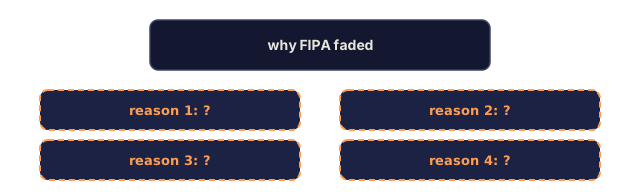
- Ontology overhead. FIPA required a shared ontology to parse
content, and agreeing on an ontology is a years-long standards process. The web just used HTTP + JSON. - Formal semantics few people used. SL (Semantic Language) gave rigorous truth conditions, but most production systems used free-form content and ignored the formalism.
- Tooling lock-in. JADE was Java-only and JACK was commercial. Polyglot teams routed around both.
- The internet won the stack. REST, then JSON-RPC, then gRPC replaced ACL's transport.
The LLM revival is FIPA-lite
Compare a FIPA request to an MCP tools/call:
(request                                {
  :sender  agent1                         "jsonrpc": "2.0",
  :receiver tool-server                   "method":  "tools/call",
  :content "(lookup stock IBM)"           "params":  {"name":"lookup_stock",
  :ontology finance                                   "arguments":{"symbol":"IBM"}},
  :conversation-id c42                    "id": 42
)                                        }
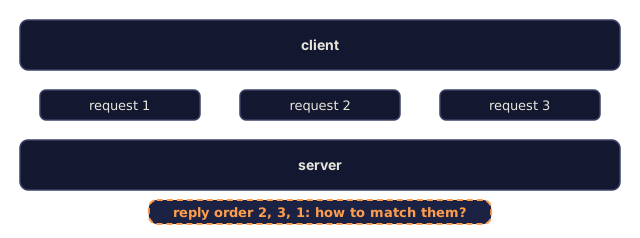
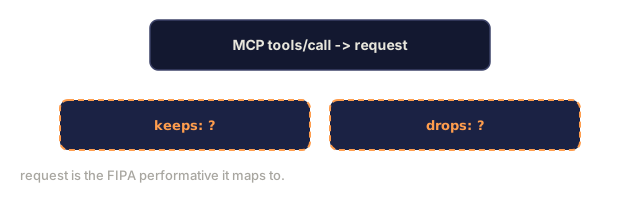
Same envelope, different syntax. Both carry who, whom, intent, payload, and a correlation id. Neither is a revolution over the other. They are different trade-offs on the same design.
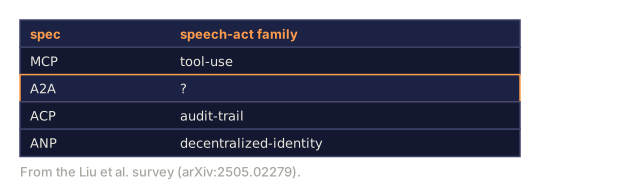
The 2025 survey by Liu et al. ("A Survey of Agent Interoperability Protocols: MCP, ACP, A2A, ANP", arXiv:2505.02279) makes the lineage explicit. MCP corresponds to tool-use speech acts, A2A to agent-peer speech acts, ACP to audit-trail speech acts, and ANP to decentralized-identity extensions. The new specs are ACL descendants with JSON syntax and looser semantics.
The trade-off, stated plainly
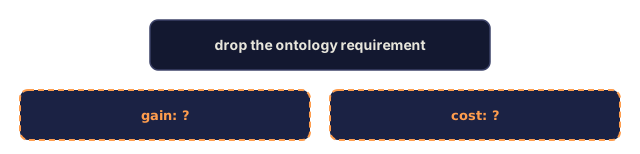
What FIPA gave you and modern specs drop:
- Formal semantics, so you can prove
informimplies the sender believes the content. - A canonical catalog of performatives, so you do not have to re-argue "should we have a
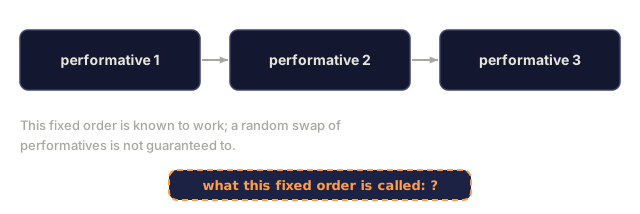
cancel?". - Decades of interaction-protocol patterns (contract-net, subscribe-notify, propose-accept) with known correctness properties.
What modern specs give you and FIPA did not:
- JSON-native payloads compatible with every modern tool.
- Natural-language content that LLMs can interpret without a hand-coded ontology.
- Web-stack transport (HTTP, SSE, WebSocket).
- Capability discovery via self-describing documents (MCP
listTools, A2A Agent Card).
The price is looser intent semantics. That is the trade, and it buys you easier implementation.
Interaction protocols worth porting
FIPA shipped ~15 interaction protocols. Three are worth carrying forward into LLM multi-agent systems:
- Contract Net Protocol (CNP). Manager issues
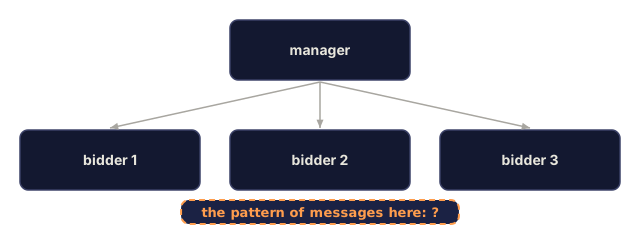
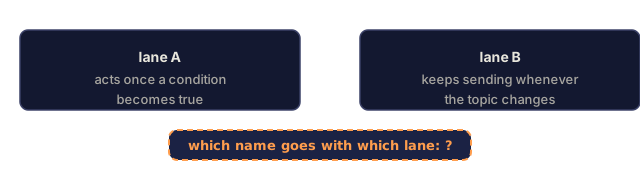
cfp(call for proposals); bidders respond withpropose; manager accepts/rejects. This is the canonical task-market pattern (Phase 16 · 16 Negotiation). - Subscribe/Notify. Subscriber sends
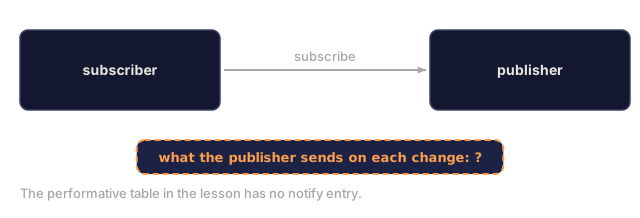
subscribe; publisher sendsinformwhenever the topic changes. Most event buses in 2026 are this pattern. - Request-When. "Do X when condition Y holds." Delayed-action with pre-conditions. The 2026 analog is deferred tasks in durable workflow engines (Phase 16 · 22 Production Scaling).
Each maps onto modern message queues, HTTP + polling, or SSE streaming without much strain.
What breaks when you drop the ontology
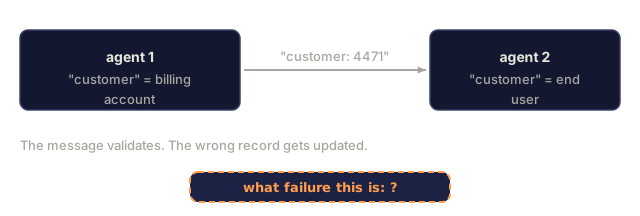
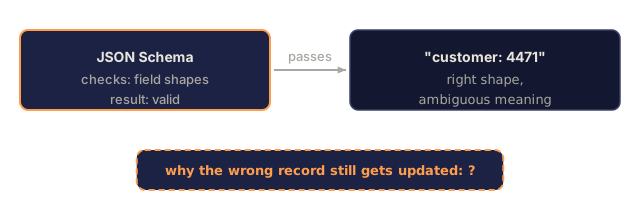
Without a shared ontology, agents infer meaning from natural-language content. The documented 2026 failure mode is semantic drift. Two agents use the same word ("customer") for subtly different concepts, the receiving agent acts on the wrong interpretation, and no schema validator catches it. FIPA's ontology requirement would have rejected the message at parse time.
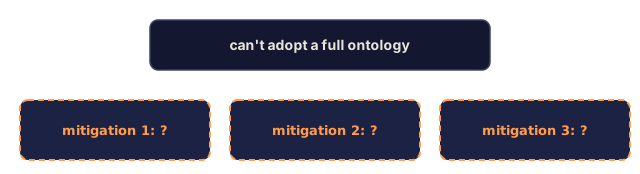
Mitigations without going full ontology:
- JSON Schema on
contentrejects structural errors at the wire. - Typed artifacts (A2A) reject the wrong modality.
- An explicit performative in the envelope makes intent unambiguous even when content is natural language.
The 2026 specs, mapped to speech-act heritage
| Modern spec | FIPA analog | What it keeps | What it drops |
|---|---|---|---|
MCP tools/call | request | explicit intent, correlation id | formal semantics, ontology |
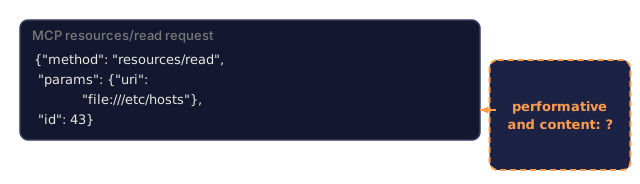
MCP resources/read | query-ref | explicit intent, correlation id | formal semantics |
| A2A Task lifecycle | contract-net + request-when | async lifecycle, state transitions | formal completeness guarantees |
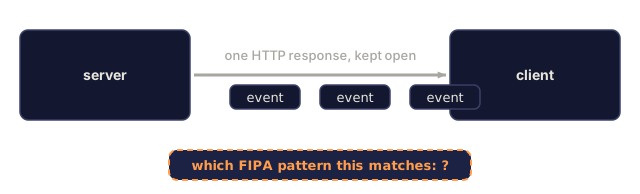
| A2A streaming events | subscribe/notify | async push | typed-predicate subscription |
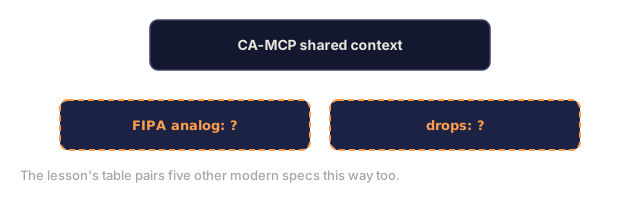
| CA-MCP shared context | blackboard (Hayes-Roth 1985) | multi-writer shared memory | logical consistency model |
| NLIP | natural-language content | LLM-native | schema |
Read the table top to bottom and the pattern is clear: keep the structural primitive, drop the formalism, and let the LLM paper over the ambiguity.


Build It
code/main.py is a pure-stdlib FIPA-ACL translator. It renders the canonical ACL envelope and shows how MCP and A2A message shapes reduce to the same seven envelope fields. The demo:
- Translates four MCP-style and A2A-style messages (
tools/call,resources/read, task creation, and an SSE subscription) into FIPA-ACL. - Runs a toy Contract Net negotiation between one manager and three bidders using
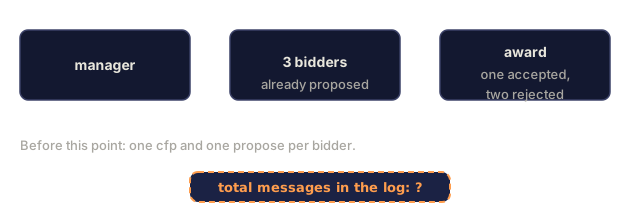
cfp,propose,accept-proposal,reject-proposal.
Run:
python3 code/main.py
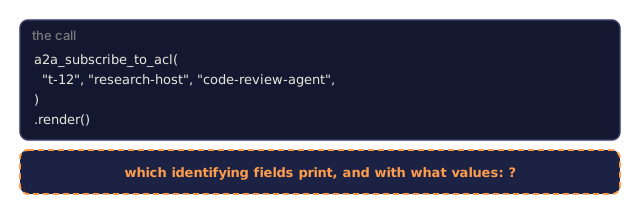
The output prints each modern message in its 2026 JSON form followed by its FIPA-ACL form, then the full contract-net message log. The structural primitives carry over unchanged; only the syntax differs.

Use It
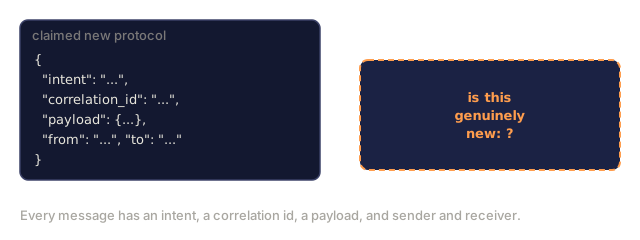
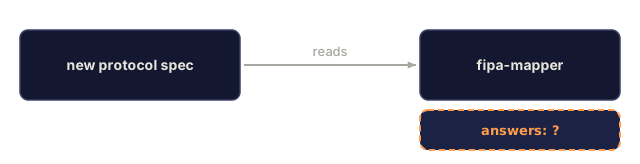
outputs/skill-fipa-mapper.md is a skill that reads an agent-protocol spec and produces the FIPA-ACL mapping. Run it before adopting a new protocol to answer one question: is this genuinely new, or is it inform with JSON syntax?
Ship It
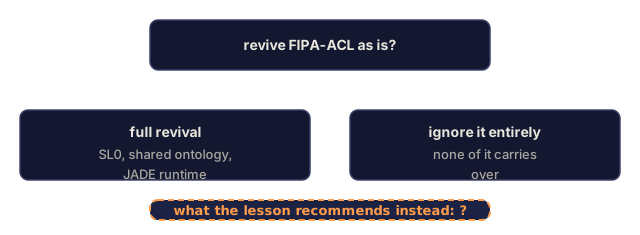
Don't bring FIPA-ACL back. Bring back its checklist:
- What is the intent primitive (performative) of each message?
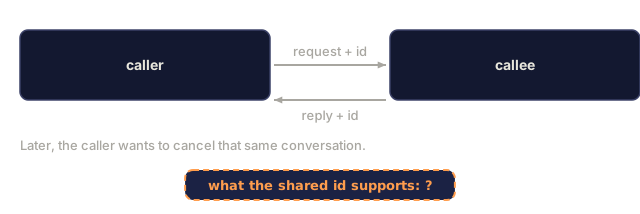
- Is there a correlation id for request-response and cancellation?
- Is there an explicit content language (JSON-RPC, plain text, structured typed artifact)?
- Are interaction protocols first-class, or are you re-implementing contract-net from scratch?
- What happens when two agents disagree about content meaning (semantic drift)?
Write these five answers down for any new protocol before it reaches production.
I'd run main.py before reading the mapping table. It prints each MCP or A2A message next to its ACL rendering, and seeing tools/call come out as a request with the same seven envelope fields makes the heritage argument concrete in a way the prose can't.
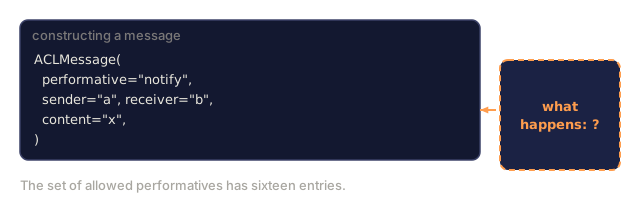
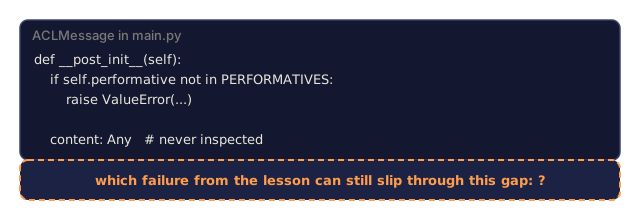
My bet is that the part worth studying is what the code does not check. ACLMessage raises a ValueError if the performative isn't in its set of sixteen, so intent is validated. content is typed as Any and never inspected, so a customer that means two different things sails straight through. That gap is the semantic-drift failure from the body, and the JSON Schema mitigation would slot in right at that boundary.
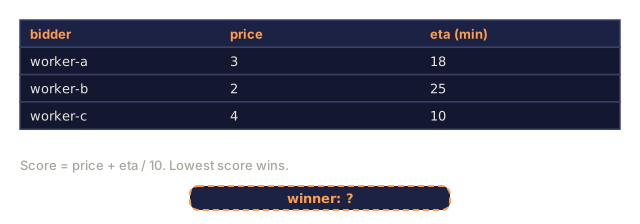
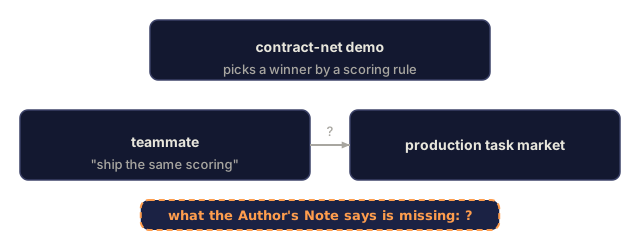
I'd also keep the toy in proportion. The translators only go one way, JSON to ACL, and the MCP conversation ids are built from the JSON-RPC id by string formatting. The contract-net winner comes from a scoring rule I picked, price plus a tenth of the ETA in minutes, so change the weights and a different bidder wins. Treat the negotiation as a message-flow demo. A real task market needs timeouts, a cancel, and a plan for bidders that never answer, which Exercise 2 starts on with cancel.
Exercises
- Run
code/main.py. Observe how each message is translated to ACL. Identify which FIPA performative corresponds totools/call,resources/read, and A2A task creation. - Extend the contract-net demo with a
cancelperformative that lets the manager withdraw the task mid-bid. What failure case doescancelsolve that retries alone do not? - Read FIPA ACL Message Structure (http://www.fipa.org/specs/fipa00037/) sections 4.1–4.3. Pick one performative not covered in this lesson and describe its modern JSON-RPC analog.
- Read Liu et al., arXiv:2505.02279. For each of MCP, A2A, ACP, ANP, list the FIPA performative families they keep and drop.
- Design a minimal JSON-Schema for the
contentfield of arequestperformative in your own system. What does that schema give you that pure natural-language does not, and what does it cost?
Key Terms
| Term | What people say | What it actually means |
|---|---|---|
| Speech act | "An utterance that does something" | Austin/Searle: utterances as actions. The theoretical parent of ACL. |
| FIPA | "That old XML thing" | IEEE Foundation for Intelligent Physical Agents. Standardized ACL in 2000. |
| ACL | "Agent Communication Language" | FIPA's envelope format: performative + content + metadata. |
| Performative | "The verb" | The intent class of a message: inform, request, propose, cfp, etc. |
| KQML | "FIPA's predecessor" | Knowledge Query and Manipulation Language (1993). Simpler, narrower. |
| Ontology | "Shared vocabulary" | A formal definition of the concepts the content language talks about. |
| SL0 / SL1 | "FIPA content languages" | Semantic Language levels 0 and 1, the formal content language family. |
| Contract Net | "Task market" | Manager issues cfp; bidders propose; manager accepts. The canonical interaction protocol. |
| Interaction protocol | "Pattern of messages" | A sequence of performatives with known correctness: request-when, subscribe-notify, etc. |
Further Reading
- Liu et al.: A Survey of Agent Interoperability Protocols: MCP, ACP, A2A, ANP: the canonical 2025 survey connecting modern specs to FIPA heritage
- FIPA ACL Message Structure Specification (fipa00037): the ratified 2000 envelope format
- FIPA Communicative Act Library Specification (fipa00037): the full performative catalog
- MCP specification 2025-11-25: the modern tool-use equivalent of
request/query-ref - A2A specification: the modern agent-peer equivalent of contract-net and subscribe-notify
Code
- main.py (python, 252 lines)