SRE for AI — Multi-Agent Incident Response, Runbooks, Predictive Detection
AI SRE grounds LLMs in infrastructure data (logs, runbooks, service topology) via RAG to automate the investigation, documentation, and coordination phases of an incident. The 2026 pattern is multi-agent orchestration: specialized agents for logs, metrics, and runbooks, coordinated by a supervisor. The AI proposes hypotheses and queries, and humans approve the judgment calls. Datadog Bits AI and Azure SRE Agent ship this as managed products. Runbooks are changing too. NeuBird Hawkeye uses adversarial evaluation, where two models analyze the same incident and agreement means confidence while disagreement means uncertainty, and operational memory persists across team changes. Auto-remediation stays cautious. The AI suggests and humans approve. Autonomous action covers a narrow set (restart a pod, roll back a specific deploy) behind tight guardrails, and anyone selling "set it and forget it" is overselling. The emerging frontier is pre-incident prediction: MIT research reports an LLM trained on historical logs, GPU temperatures, and API error patterns predicted 89% of outages 10-15 min early. Projection: 95% of enterprise LLMs have automated failover by end-2026.
Learning Objectives
- Diagram the multi-agent AI SRE architecture: supervisor + specialized agents (logs, metrics, runbooks) + human approval gate.
- Explain why auto-remediation is narrow (restart pod, revert deploy) rather than broad (re-architect service).
- Name the adversarial evaluation pattern (NeuBird Hawkeye): two models agree = confidence; disagree = escalate.
- Cite the MIT 89% early-detection result and the operational constraint: predictions without actuation are just dashboards.
The Problem
An on-call engineer gets paged at 3 a.m. "High error rate in checkout." They check Datadog, Loki, three runbooks, and the deploy log. Thirty minutes later they find the root cause: a vLLM OOM from a KV cache spike. They restart the pod and the error clears.
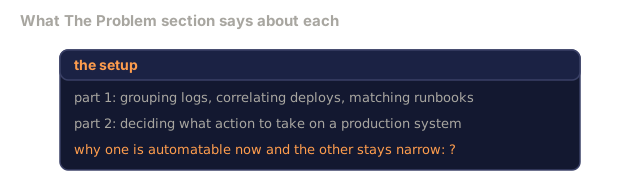
In 2026 the first 20 minutes of that investigation can be automated. Grouping logs by service, correlating with recent deploys, and matching against runbooks are all RAG plus tool use. A supervised agent can do first-pass triage and hand over a hypothesis before the human has opened Datadog.
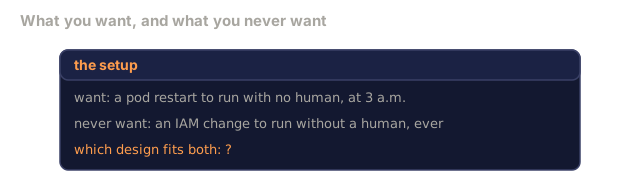
Fully autonomous remediation is a different problem. Restarting a pod is safe. Scaling the GPU pool is safe if policy allows it. Re-architecting the service is not something an agent should touch. The discipline is drawing that line narrowly.
The Concept
Multi-agent architecture
          Incident
             │
             ▼
        Supervisor
        /    |    \
       ▼     ▼     ▼
  Log agent  Metric agent  Runbook agent
       │     │     │
       └─────┴─────┘
             │
             ▼
        Hypothesis + evidence
             │
             ▼
        Human approval gate
             │
             ▼
        Action (narrow set)
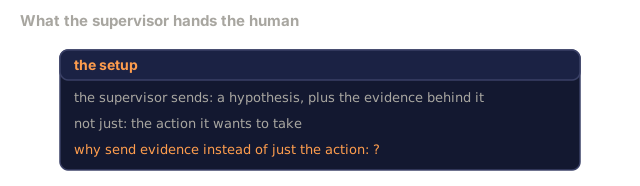
The supervisor breaks the incident into sub-queries. Specialized agents have tool access (log search, PromQL, doc retrieval). The supervisor synthesizes their answers and presents a hypothesis with evidence. A human approves or redirects it, unless two agents agree and the proposed action sits in the narrow safe set below, in which case it can run pre-approved.
Auto-remediation scope
Safe (narrow): restart pod, revert specific deploy, scale pool within pre-approved bounds, enable pre-approved feature flag.
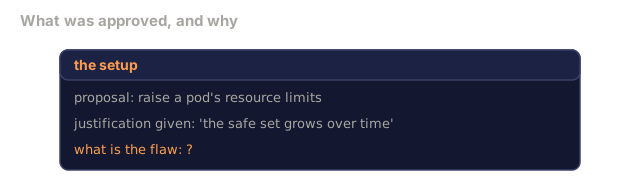
Not safe (broad): change service topology, modify resource limits, deploy new code, change IAM, alter databases.
Anyone selling "set it and forget it" is overselling. The safe set grows as AI SRE matures, but the boundary stays.
Adversarial evaluation (NeuBird Hawkeye)
Two models analyze the same incident independently. If they agree on the root cause, confidence is high. If they disagree, the incident goes to a human with both hypotheses visible. It is a simple pattern and an effective filter against hallucinated root causes.
Operational memory
Team turnover quietly hurts traditional SRE because tribal knowledge leaves with the people. AI SRE stores runbooks and post-mortems in a vector DB, and agents retrieve from it on each new incident. When new engineers join, the AI already has the history.
Pre-incident prediction
MIT 2025 research: LLM trained on historical logs, GPU temperatures, API error patterns predicted 89% of outages 10-15 minutes before they happened on the test set.
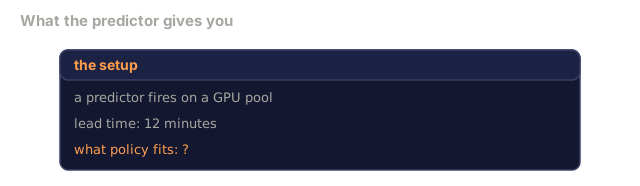
Reality check: predictions without actuation are dashboards. The operational question is what you do when a prediction fires. Pre-emptive drain, page someone, auto-scale? The answer depends on your policy.
Products in 2026
- Datadog Bits AI: managed SRE copilot inside Datadog.
- Azure SRE Agent: Azure-native.
- NeuBird Hawkeye: adversarial eval and operational memory.
- PagerDuty AIOps: triage and deduplication.
- Incident.io Autopilot: incident commander and coordination.
Runbooks as code
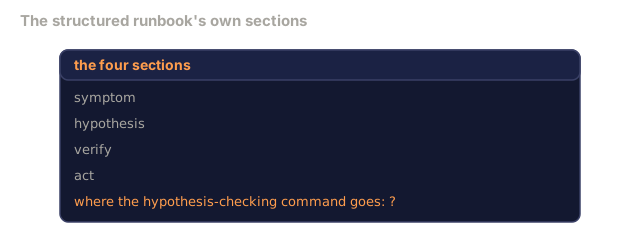
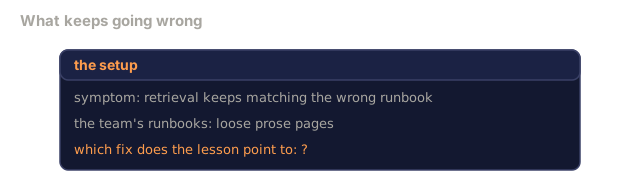
Runbooks are moving from Confluence pages to versioned markdown with structured sections (symptom, hypothesis, verify, act). Structured runbooks give RAG better retrieval, so start an AI-SRE rollout by converting the unstructured ones.
Numbers you should remember
- MIT early-detection: 89% of outages, 10-15 min lead time.
- Multi-agent triage: supervisor + (logs, metrics, runbooks) + human.
- Safe auto-remediation set: restart pod, revert deploy, scale within bounds.
- Adversarial eval: two independent models; agreement = confidence.
Use It
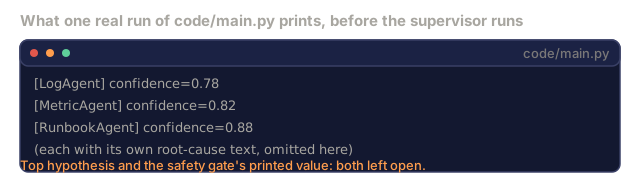
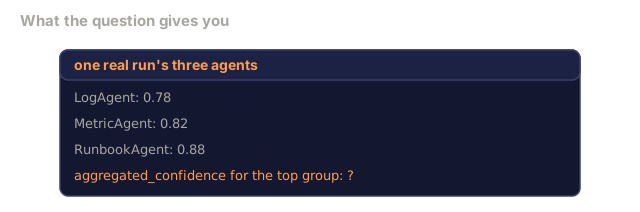
code/main.py simulates a multi-agent triage. The log agent finds the error, the metric agent finds the GPU memory spike, and the runbook agent matches the incident to a known issue. The supervisor then ranks the hypotheses.
Ship It
This lesson produces outputs/skill-ai-sre-plan.md. Given the current on-call setup, incident volume, and team maturity, it designs an AI SRE rollout.
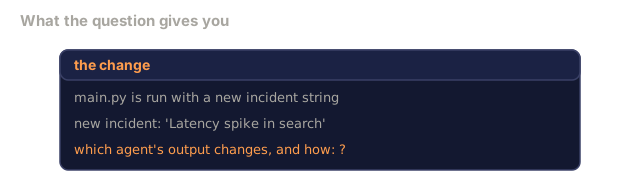
I'd run main.py and read the supervisor block before trusting the architecture diagram. The three agents are canned: the metric and runbook agents ignore the incident text, and the log agent only returns a confident answer if the word "checkout" appears in it. So the interesting part is the supervisor, not the agents.
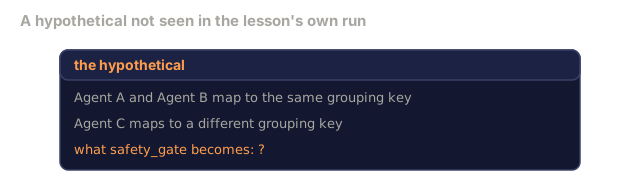
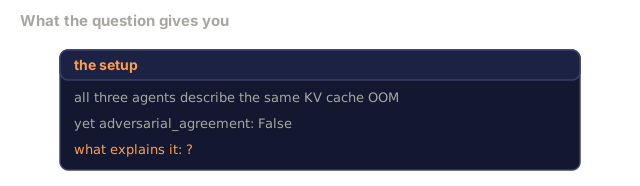
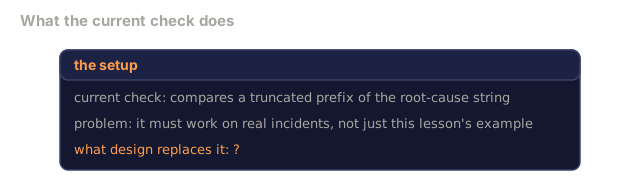
Here is what surprised me. All three agents are describing the same incident (a KV cache OOM), but the supervisor groups them by a prefix of the root-cause string, so they land in three separate groups. Only the runbook agent supports the top hypothesis, adversarial_agreement comes out False, and the gate prints "human approval required". The agreement check is the adversarial pattern from the Concept section, and a string-prefix match is a brittle way to implement it. Real agreement needs a judgment about whether two analyses mean the same thing, which probably means another model call.
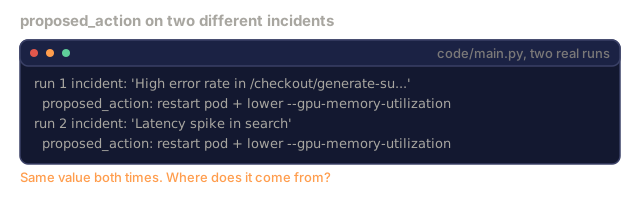
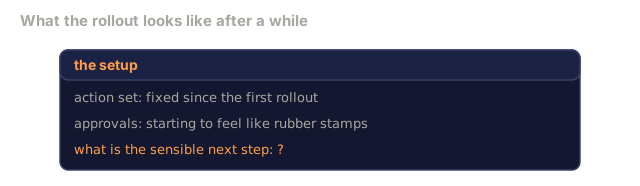
The proposed_action is a constant. The supervisor never picks it from the evidence, and that is the narrow-scope idea in its crudest form: the action set is fixed ahead of time and the only thing the agents decide is whether a human signs off. I'd keep it that way for the first rollout and widen the set only after the approvals start to feel like rubber stamps.
Exercises
- Run
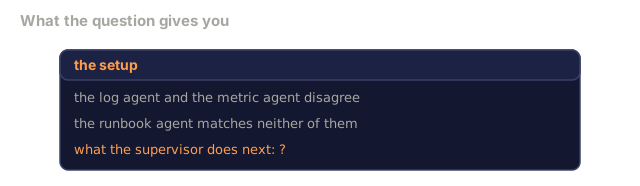
code/main.py. What if the log and metric agents disagree? How does the supervisor resolve it? - Define three "safe" auto-remediation actions for your service. Justify each.
- Write a structured runbook template: sections, required fields, verification commands.
- Predictive detection fires with a 12 min lead. What is your policy: pager, pre-drain, or both?
- Argue whether a 3-person team should adopt AI SRE in 2026 or wait. Weigh maturity, volume, and risk.
Key Terms
| Term | What people say | What it actually means |
|---|---|---|
| AI SRE | "agent for on-call" | LLM-backed incident investigation + coordination |
| Supervisor agent | "the orchestrator" | Top-level agent breaking incidents into sub-queries |
| Specialized agent | "domain agent" | Sub-agent with tool access (logs, metrics, runbooks) |
| Auto-remediation | "AI fixes it" | Narrow pre-approved action; NOT broad re-architecture |
| Operational memory | "vector runbooks" | Post-mortems + runbooks in vector DB for RAG |
| Adversarial eval | "two-model check" | Independent analyses; agreement = confidence |
| NeuBird Hawkeye | "the adversarial one" | Product with adversarial-eval + memory pattern |
| Bits AI | "Datadog's SRE agent" | Datadog-managed AI SRE |
| Pre-incident prediction | "early detection" | 10-15 min lead time on outage prediction |
Code
- main.py (python, 102 lines)