Regulatory Frameworks — EU, US, UK, Korea
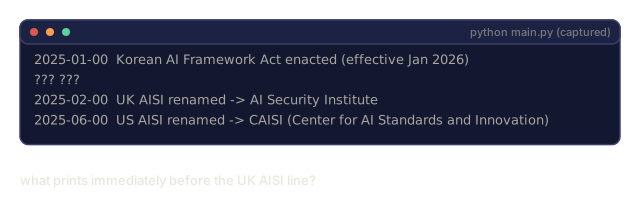
Four primary regulatory regimes define the 2026 AI governance landscape. EU AI Act (in force 1 August 2024): prohibited practices and AI literacy from 2 February 2025; GPAI obligations from 2 August 2025; full applicability and Article 50 transparency 2 August 2026; legacy GPAI and embedded high-risk systems 2 August 2027; penalties up to 15M EUR or 3% of global turnover. GPAI Code of Practice (10 July 2025): three chapters (Transparency, Copyright, Safety and Security) and 12 commitments; enforcement begins August 2026. UK AISI -> AI Security Institute (February 2025): rename signals narrower scope. US AISI -> CAISI (June 2025): Center for AI Standards and Innovation under NIST; shift toward pro-growth posture. Korean AI Framework Act (passed December 2024, effective January 2026): Article 12 establishes AISI under MSIT; mandates local representatives for foreign AI companies, risk assessment, safety measures for high-impact and generative AI.
Learning Objectives
- Describe the EU AI Act risk tiers (prohibited, high-risk, general-purpose, limited-risk) and the August 2025 / August 2026 / August 2027 timeline.
- Describe the three chapters of the GPAI Code of Practice and which providers each binds.
- Describe the 2025 rebrands: UK AISI -> AI Security Institute; US AISI -> CAISI; what each rebrand implies about policy direction.
- State the core provision of Korea's AI Framework Act.
The Problem
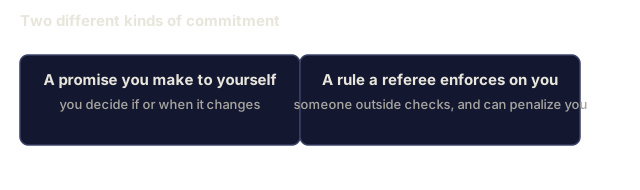
Lab frameworks (Lesson 18) are voluntary. Regulation is compulsory. The 2024-2026 period saw the first wave of comprehensive AI law enter force, and a deployer has to map its technical controls onto obligations that differ by jurisdiction.
The Concept
EU AI Act
In force 1 August 2024. The Act sorts systems into risk tiers:
- Prohibited practices (Article 5). Social scoring, real-time remote biometric identification in public (with law-enforcement exceptions), and exploitative manipulation of vulnerable groups. Applied 2 February 2025.
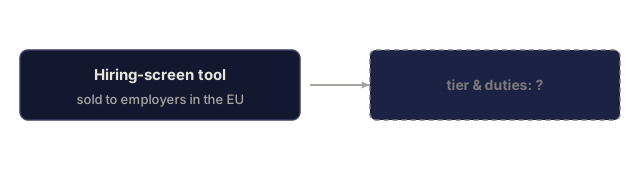
- High-risk systems (Annex III). Employment, education, credit, law enforcement, justice, migration. These require conformity assessment, risk management, logging, and transparency.
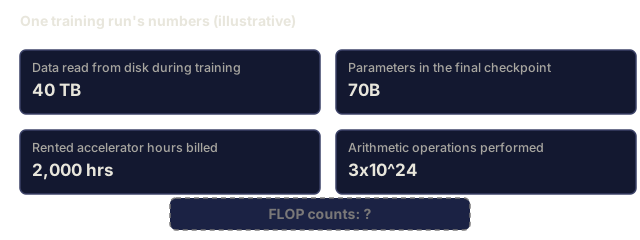
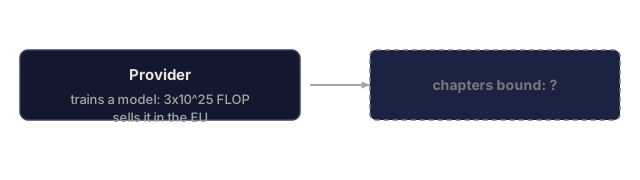
- General-Purpose AI (GPAI) models. Applied 2 August 2025. All GPAI providers have obligations, and systemic-risk GPAI (>1e25 FLOP training compute) carries additional ones.
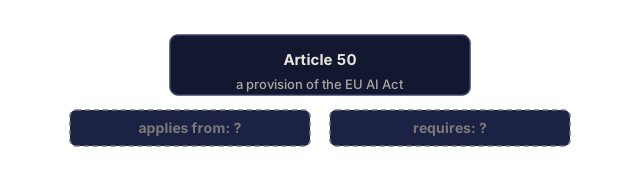
- Limited-risk systems. Transparency obligations under Article 50, which covers labelling of AI-generated content. Applied 2 August 2026.
Timeline:
- 2 Feb 2025: prohibited practices + AI literacy.
- 2 Aug 2025: GPAI + governance.
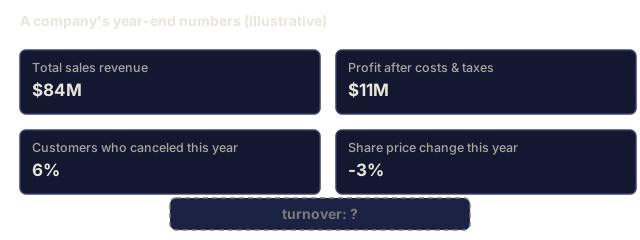
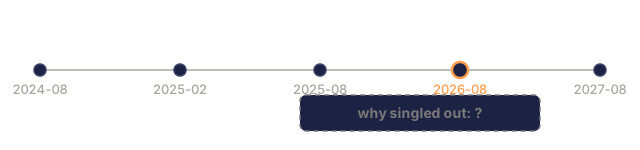
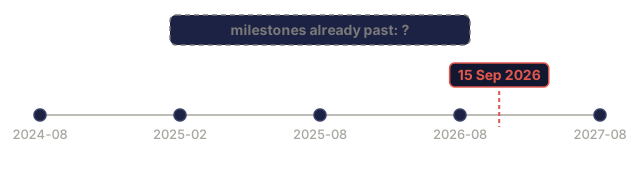
- 2 Aug 2026: full applicability + Article 50 transparency + penalties up to 15M EUR / 3% global turnover.
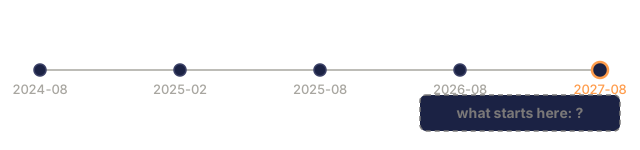
- 2 Aug 2027: legacy GPAI + embedded high-risk.
In late 2025 the Commission proposed adjusting the high-risk timeline to 16 months.
GPAI Code of Practice
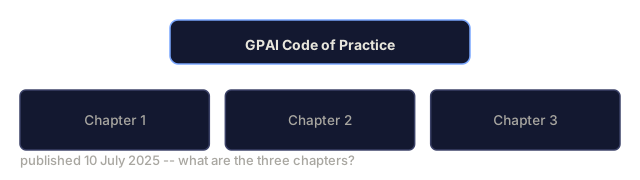
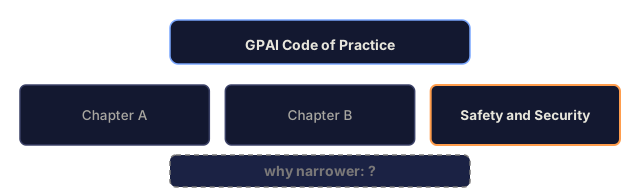
Published 10 July 2025, in three chapters:
- Transparency. All GPAI providers.
- Copyright. All GPAI providers.
- Safety and Security. Systemic-risk GPAI providers (estimated 5-15 companies).
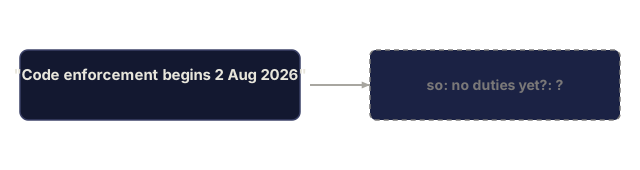
That is 12 commitments in total. A Signatory Taskforce chaired by the AI Office manages implementation. Enforcement begins 2 August 2026, and good-faith compliance is accepted until then.
Transparency Code for Article 50
First draft 17 December 2025, second draft March 2026, final version June 2026. It covers labelling of AI-generated content, deepfakes included. This is the regulatory layer that requires Lesson 23's watermarking technology.
UK AI Security Institute (February 2025)
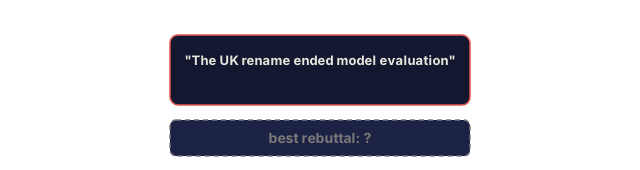
Renamed from AI Safety Institute. The rebrand narrows scope: it drops the algorithmic bias and free-speech framings and focuses on security of frontier capabilities. The institute open-sourced the Inspect evaluation tool (May 2024) and collaborates with Redwood (Lesson 10) on control safety cases.
US CAISI (June 2025)
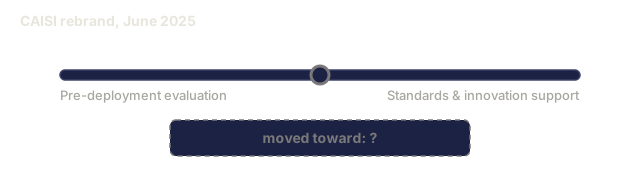
The Trump administration turned NIST's AI Safety Institute into the Center for AI Standards and Innovation. The shift toward "pro-growth AI policies" is per VP Vance's remarks at the Paris AI Action Summit. Pre-deployment evaluation gets less emphasis, and standards and innovation support get more. It works as a domestic counterweight to the EU AI Act's regulatory posture.
Korean AI Framework Act
Passed December 2024, enacted January 2025, effective January 2026. It consolidates 19 separate AI bills.
Article 12 establishes an AISI under the Ministry of Science and ICT (MSIT). The Act mandates:
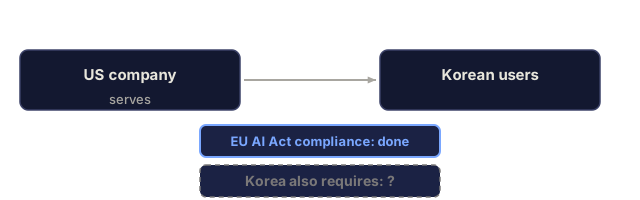
- Local representatives for foreign AI companies operating in Korea.
- Risk assessment for "high-impact" AI systems.
- Safety measures for generative AI and high-impact AI.
It is the first comprehensive horizontal AI regulation in an Asian jurisdiction.
Cross-jurisdiction dynamics
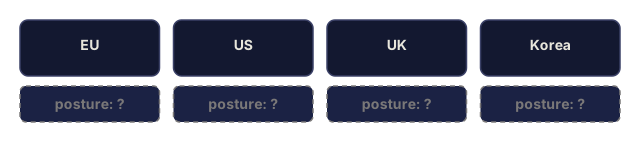
- EU: strict, risk-tiered, heavy penalties. The benchmark for privacy-adjacent regulation.
- US: innovation-favouring and decentralized. States fill federal gaps (California AB 2013, covered in Lesson 27).
- UK: narrow security focus, strong evaluation infrastructure.
- Korea: MSIT-led, aimed at foreign providers.
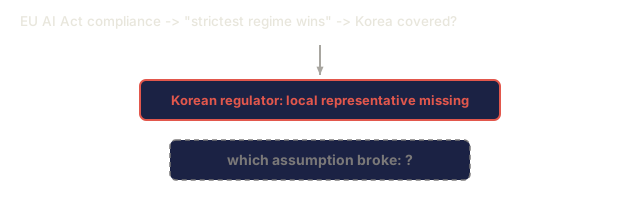
These are competing regulatory philosophies. A deployer in several jurisdictions has to comply with the strictest, which in 2026 is typically the EU AI Act.
Where this fits in Phase 18
Lesson 18 covers voluntary lab governance and Lesson 24 covers regulation. Lesson 25 turns to an emerging class of CVEs for AI systems, and Lessons 26-27 cover documentation (cards) and training-data governance.










Use It
There is no code to run here. Read the primary sources: the EU AI Act text, the GPAI Code of Practice, and the UK AISI Inspect framework. Then map your own deployment to the obligations that apply in each jurisdiction.
Ship It
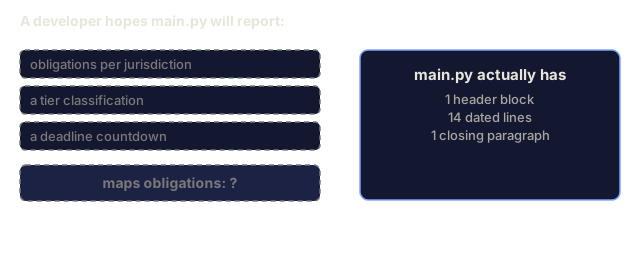
This lesson produces outputs/skill-regulatory-map.md. Given a deployment description, it maps the applicable jurisdictions, the tier classification in each, the per-jurisdiction obligations, and the deadline structure.

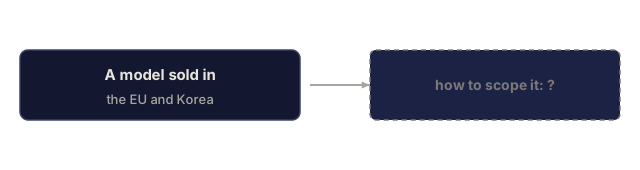
If I were scoping a deployment, I'd start from 2 August 2026. That date carries full applicability, Article 50 transparency, penalties, and the start of GPAI Code enforcement, so most of the work lands there. I'd read the 2027 date as a tail for legacy GPAI and embedded high-risk systems.
I'd also treat the Korean and EU rules as separate checklists. Korea's local-representative requirement applies to foreign providers, and nothing in the EU tiers replaces it. The cross-jurisdiction section says the strictest regime usually wins, but that only helps on questions both regimes answer.
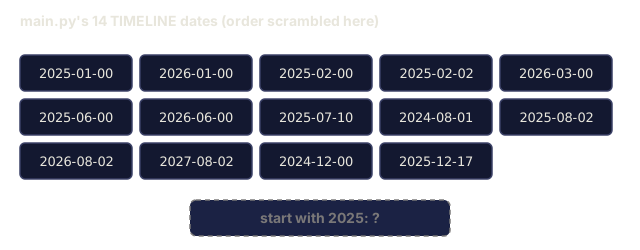
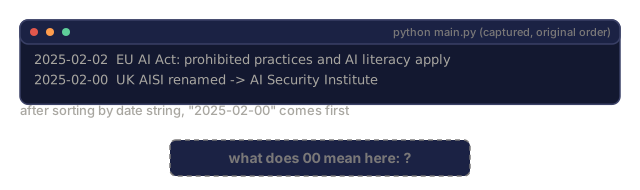
main.py is stdlib Python and only prints a timeline. It maps nothing to obligations, and that job belongs to the skill in Ship It. Some entries carry 00 as the day, like 2025-02-00 for the UK rename, because the source gives only a month. The list is in rough order, not sorted: 2025-02-02 comes before 2025-02-00. If I extended it, I'd sort it and flag the month-only entries explicitly.
Exercises
-
Read the EU AI Act (regulation 2024/1689) and the GPAI Code of Practice (10 July 2025). Identify three obligations that apply to every GPAI provider and three that apply only to systemic-risk GPAI.
-
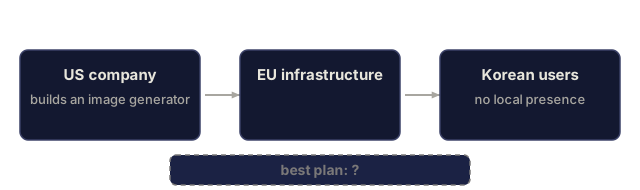
A deployment is made by a US company, runs on EU infrastructure, and serves Korean users. Which three jurisdictions' rules apply, and which rule binds on each substantive question?
-
The UK AI Security Institute's rename narrows scope. Argue for and against the narrower framing. Identify the policy assumption each position depends on.
-
CAISI's "pro-growth" framing is a departure from the 2022-2024 AI safety institute model. Identify two measurable policy shifts that would follow from this framing.
-
Korea's AI Framework Act requires local representatives for foreign providers. Describe the operational implications for a Bay Area company serving Korean users.
Key Terms
| Term | What people say | What it actually means |
|---|---|---|
| EU AI Act | "the regulation" | Risk-tier-based horizontal AI regulation; in force Aug 2024 |
| GPAI | "general-purpose AI" | Large foundation models; systemic-risk subset has additional obligations |
| Article 50 | "transparency obligations" | AI-generated content labelling; applies Aug 2026 |
| UK AISI | "AI Security Institute" | Renamed Feb 2025; narrower frontier-security focus |
| CAISI | "US center for AI standards" | Renamed Jun 2025 from AI Safety Institute; pro-growth posture |
| Korean AI Framework Act | "MSIT horizontal regulation" | First Asian comprehensive AI law; effective Jan 2026 |
| Systemic-risk GPAI | "the 1e25 FLOP threshold" | Additional obligations tier; estimated 5-15 companies bound |
Further Reading
- EU AI Act text (Regulation 2024/1689): the regulation and timeline
- GPAI Code of Practice (10 July 2025): three-chapter code
- UK AI Security Institute (renamed Feb 2025): official page
- CSET: South Korea AI Framework Act Analysis (2025): Korean framework analysis
Code
- main.py (python, 48 lines)