Data Provenance and Training-Data Governance
EU AI Act requires machine-readable opt-out standards for GPAI by August 2025 (via the EU Copyright Directive TDM exception). California AB 2013 (signed 2024), the Generative AI training-data transparency law, requires developers to publish a summary of their training datasets with 12 mandated fields. 2025 DPA alignment on legitimate interest: Irish DPC (21 May 2025) accepts Meta's LLM training on first-party public EU/EEA adult content with safeguards after the EDPB opinion; Cologne Higher Regional Court (23 May 2025) dismisses the injunction; Hamburg DPA drops its urgency procedure; UK ICO (23 September 2025) issues a positive regulatory response to LinkedIn's AI-training safeguards (transparency, simplified opt-out, extended objection windows) and keeps monitoring, which is not a formal clearance. Brazilian ANPD (2 July 2024) suspended Meta's processing over insufficient information transparency, and lifted the preventive measure on 30 August 2024 after Meta submitted a compliance plan. The irreversibility problem: cookie-consent frameworks are built for real-time, reversible tracking, but once data is in model weights there is no practical surgical erasure, and so no practical GDPR right-to-erasure for trained neural networks. The compliance window is collection time. Data Provenance Initiative (dataprovenance.org; Longpre, Mahari, Lee et al., "Consent in Crisis", July 2024): a large-scale audit shows the AI data commons shrinking quickly as publishers add robots.txt restrictions.
Learning Objectives
- Describe California AB 2013's 12 mandated fields for Generative AI training-data transparency.
- State the 2025 DPA position on legitimate-interest LLM training (Irish DPC, UK ICO, Hamburg, Cologne).
- Describe the irreversibility problem: why GDPR right-to-erasure has no practical equivalent for trained neural networks.
- State the Data Provenance Initiative's "Consent in Crisis" finding.
The Problem
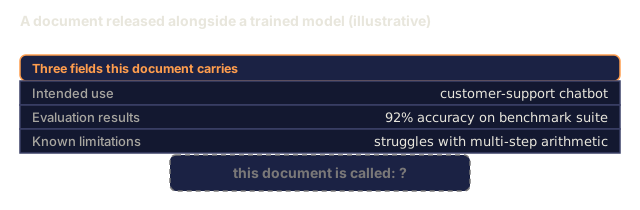
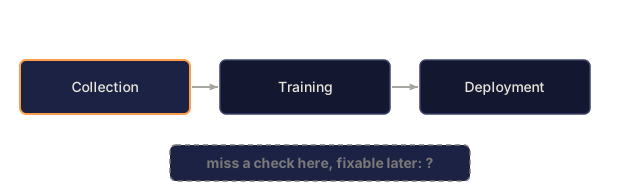
Training-data governance sits upstream of every model card (Lesson 26) and every regulatory obligation (Lesson 24). Between 2024 and 2025 the rules settled around three principles: opt-out infrastructure, per-dataset disclosure, and legitimate-interest accommodations for publicly available data. A provider that misses the compliance window at collection time cannot remediate downstream.
The Concept
California AB 2013
Signed 2024. Documentation must be posted on or before January 1, 2026 for systems released on or after January 1, 2022. Section 3111(a) requires developers to publish a high-level summary of datasets used in training with 12 statutory items:
- Sources or owners of the datasets.
- Description of how the datasets further the intended purpose of the AI system.
- Number of data points in the datasets (general ranges acceptable; estimates for dynamic datasets).
- Description of the types of data points (label types for labeled datasets; general characteristics for unlabeled).
- Whether the datasets include any data protected by copyright, trademark, or patent, or are entirely in the public domain.
- Whether the datasets were purchased or licensed.
- Whether the datasets include personal information (per Cal. Civ. Code §1798.140(v)).
- Whether the datasets include aggregate consumer information (per Cal. Civ. Code §1798.140(b)).
- Cleaning, processing, or other modification by the developer, with intended purpose.
- Time period during which the data was collected, with notice if collection is ongoing.
- Dates the datasets were first used during development.
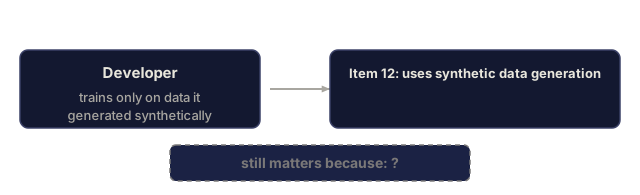
- Whether the system uses or continuously uses synthetic data generation.
Item 12 (synthetic data) is new relative to the Gebru et al. 2018 datasheets. Item 7 (personal information) brings in California Privacy Rights Act (CPRA) obligations. The statute exempts security/integrity systems, aircraft operation, and federal-only national-security systems (Section 3111(b)).
EU AI Act (Lesson 24) and TDM opt-out
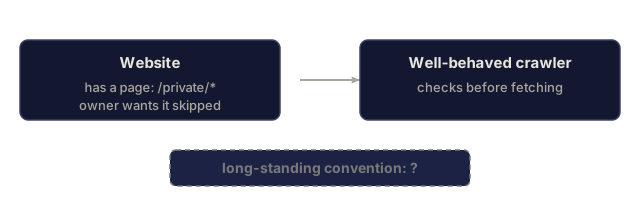
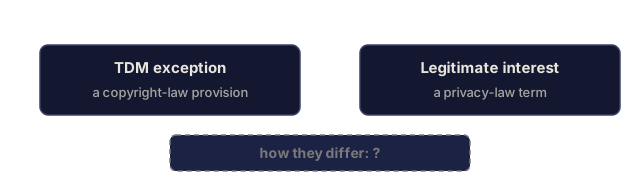
The EU Copyright Directive's text-and-data-mining exception allows training on publicly available content unless the rightholder opts out. The Copyright chapter of the EU AI Act GPAI Code of Practice requires GPAI providers to respect machine-readable opt-out signals such as robots.txt or the C2PA "No AI Training" claim.
2025 DPA convergence on legitimate interest
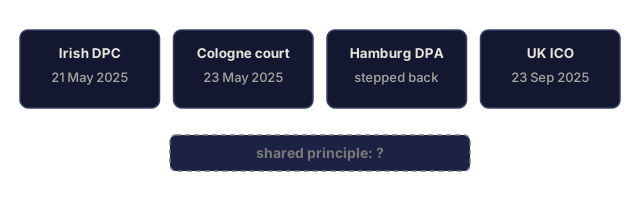
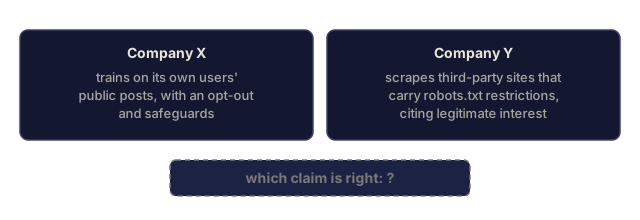
The Irish DPC (21 May 2025) accepted Meta's plan to train on first-party public EU/EEA adult-user content, with safeguards, after the EDPB opinion. The Cologne Higher Regional Court (23 May 2025) dismissed the injunction against Meta on the grounds that opt-out is sufficient. The Hamburg DPA dropped its urgency procedure for EU-wide consistency. The UK ICO (23 September 2025) issued a positive regulatory response to LinkedIn's resumption of AI training, which had similar safeguards and ongoing monitoring. That is not a formal clearance.
The shared principle: legitimate interest can justify training on publicly available first-party content when there is an opt-out. Consent is not required in these cases.
Brazilian ANPD (June 2024)
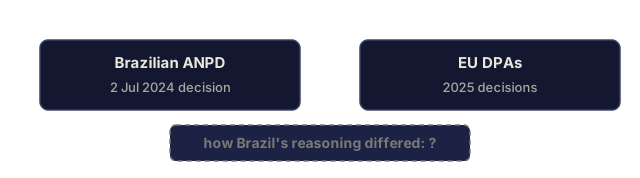
The ANPD suspended Meta's processing of Brazilian user data for AI training over insufficient information transparency. That is a different result from the EU DPAs, because the ANPD put transparency ahead of whether legitimate interest was admissible. The preventive measure was lifted on 30 August 2024 after Meta submitted a compliance plan.
The irreversibility problem
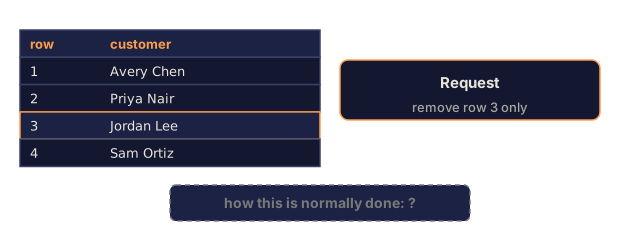
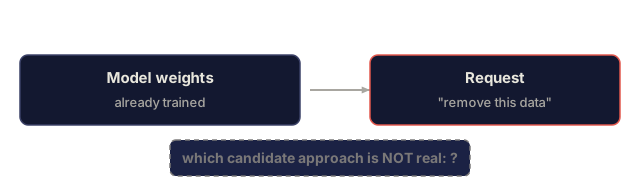
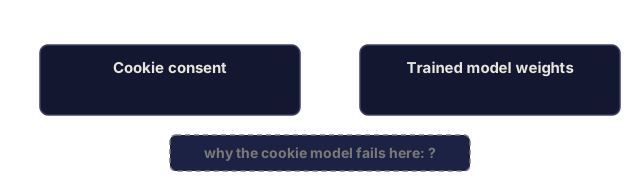
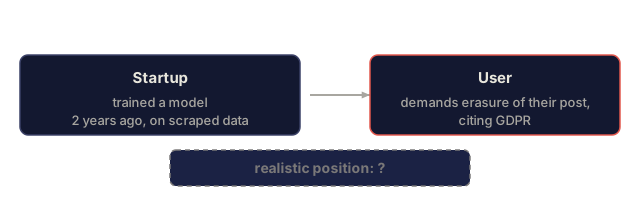
Cookie consent was designed for real-time, reversible tracking. Training data is different. Once data enters the model weights, there is no practical way to erase it surgically. Retraining from scratch is the one complete remedy, and it is prohibitively expensive.
Partial remediations:
- Unlearning. Approximate removal; measured by MIA (Lesson 22).
- Influence function-based localization. Identify weights most influenced by the data; selectively update.
- Fine-tune-suppression. Train the model to refuse outputs derived from the data.
None of these fully solves the problem, which is why the compliance window is collection time.
Data Provenance Initiative
dataprovenance.org. Longpre, Mahari, Lee et al., "Consent in Crisis" (July 2024), audited the AI training data commons at scale. Publishers are adding robots.txt restrictions at an accelerating rate, so the commons that is openly trainable is contracting quickly. From 2023 to 2024, about 25% of the top training sources added some restriction. Future training-data availability will depend on new acquisition paradigms: licensing, synthetic generation, and incentivized participation.
Where this fits in Phase 18
Lesson 26 covers model-level documentation and this one covers dataset-level governance. Together they make up the transparency layer. Lesson 28 maps the research ecosystem working on these questions.














Use It
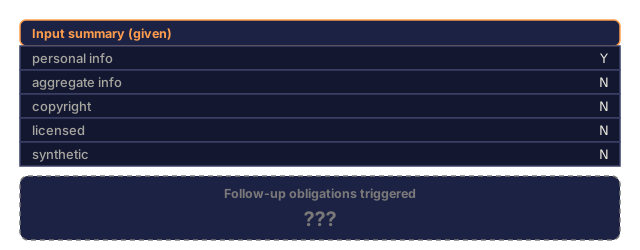
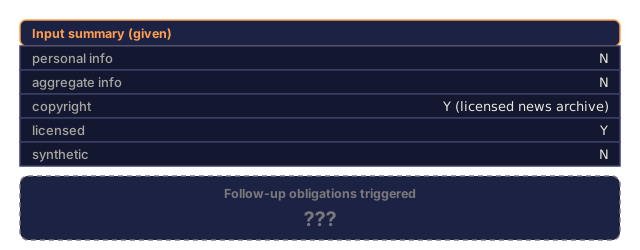
code/main.py prints a California AB 2013 12-field dataset summary for a toy dataset. Fill in the fields yourself and watch which ones trigger privacy or copyright follow-on obligations.
Ship It
This lesson produces outputs/skill-provenance-check.md. Given a dataset used in training, it checks for AB 2013 12-field coverage, opt-out infrastructure compliance, DPA alignment, and irreversibility-risk assessment.
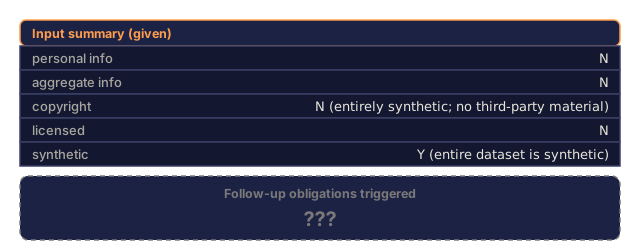
I'd run main.py first and read the output with the 12 items in front of you. The toy dataset is a hand-written dict with one key per statutory item, and render_markdown prints them in order. Nothing generates the data. The dict just describes a synthetic set, so the summary tells you what a filled-in answer looks like, not how to produce one.
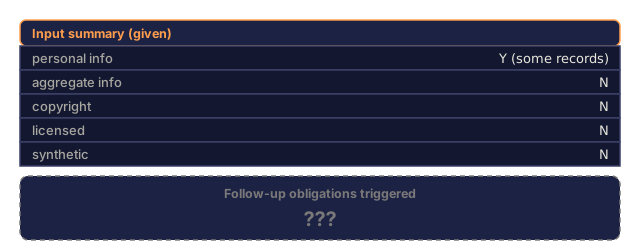
The part worth your time is flag_followups. It reads a few of the answers and emits the obligations they trigger: personal information points at CPRA, a copyright flag points at EU TDM opt-out, synthetic data points at the base model used to generate it, and a license points at keeping provenance records. Because the toy set is entirely synthetic, only the synthetic-data flag fires. Edit a field to "Y" and rerun to see the others show up.
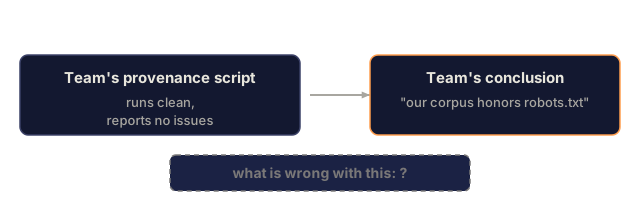
Know where the scaffold stops. The personal-information and aggregate-consumer checks compare against exactly "Y", so an answer like "Y (some records)" slips past them, while the copyright and synthetic checks only look at the first character. It also does not inspect robots.txt or any opt-out signal. It reminds you that you owe that respect, and the collection-time work stays with you.
Exercises
-
Run
code/main.py. Produce a 12-field summary for a toy dataset and identify which fields are under-specified. -
The EU Copyright Directive TDM opt-out is machine-readable. Propose a standard format for the opt-out signal and compare it to robots.txt and C2PA "No AI Training."
-
Read the Data Provenance Initiative's "Consent in Crisis" (July 2024). Describe the three fastest-restricting content categories and argue one economic consequence.
-
The 2025 DPA alignment accepts legitimate interest for public-content training. Construct a scenario in which legitimate interest would not suffice and identify the legal basis a provider would need instead.
-
Sketch a training-data-provenance manifest that composes with the AB 2013 fields and a C2PA-signed provenance chain for each dataset. Identify one technical and one legal barrier.
Key Terms
| Term | What people say | What it actually means |
|---|---|---|
| AB 2013 | "the California law" | Generative AI training-data transparency; 12 mandated fields |
| TDM exception | "text-and-data-mining" | EU Copyright Directive training-data exception with opt-out |
| Legitimate interest | "the EU basis" | GDPR Article 6 basis that may justify training on public content |
| Opt-out signal | "machine-readable no-train" | robots.txt, C2PA "No AI Training," TDM.Reservation |
| Irreversibility | "cannot un-train" | Data in model weights is not surgically removable |
| Unlearning | "approximate removal" | Post-training interventions to reduce model dependence on specific data |
| Consent in Crisis | "the DPI audit" | July 2024 finding of accelerating robots.txt restrictions |
Further Reading
- California AB 2013: Generative AI training-data transparency law
- EU AI Act + GPAI Code of Practice (Lesson 24): Copyright chapter
- Longpre, Mahari, Lee et al.: Consent in Crisis (dataprovenance.org, July 2024): DPI audit
- IAPP: EU Digital Omnibus GDPR amendments (2025): regulatory context
Code
- main.py (python, 93 lines)