Object Detection — YOLO from Scratch
Detection is classification plus regression, applied at every position in a feature map and cleaned up afterward with non-maximum suppression.
Learning Objectives
- Explain the grid-and-anchor design that turns detection into a dense prediction problem and state what every number in the output tensor means
- Compute Intersection-over-Union between boxes and implement non-maximum suppression from scratch
- Build a minimal YOLO-style head on top of a pretrained backbone, including the classification, objectness, and box-regression losses
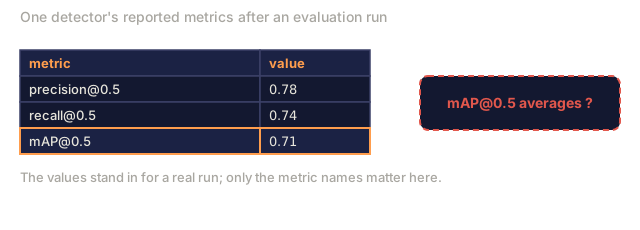
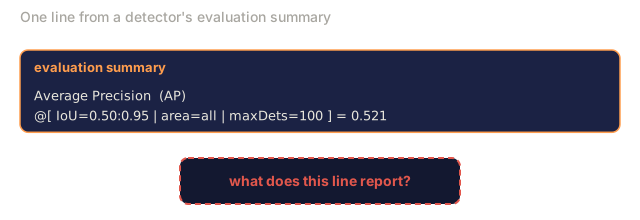
- Read a detection metric row ([email protected], recall, [email protected], [email protected]:0.95) and pick which knob to turn next
The Problem
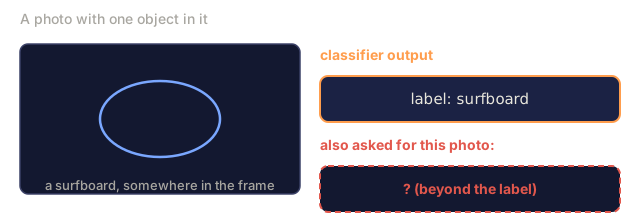
Classification says "this image is a dog." Detection says "there is a dog at pixels (112, 40, 280, 210), there is a cat at (400, 180, 560, 310), and nothing else in the frame." That one structural change (predicting a variable number of labelled boxes instead of a single label per image) is what every autonomous system, every surveillance product, every document layout parser, and every factory vision line depends on.
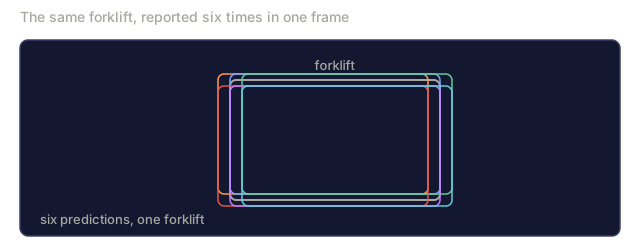
Detection is also where every engineering trade-off in vision shows up at once: boxes need to be accurate (the regression head's job), each box needs the right class (classification head), the model needs to know when there's nothing there (objectness score), and every real object should get exactly one prediction, not five (non-maximum suppression). Miss any one of these and the pipeline misses objects, hallucinates boxes that aren't there, or reports the same object fifteen times in slightly different positions.
YOLO (You Only Look Once, Redmon et al. 2016) made all of this run in real time with a single forward pass through a conv net. The same structural decisions still underlie most modern detectors: YOLOv8, YOLOv9, and YOLO-NAS all keep the grid-anchor-NMS core intact. Even RT-DETR, which replaces anchors and NMS with a transformer decoder, is still answering the same three questions: where, what, and how confident. Learn the core once and every variant becomes a rearrangement, or a deliberate removal, of the same parts.
The Concept
Detection as dense prediction
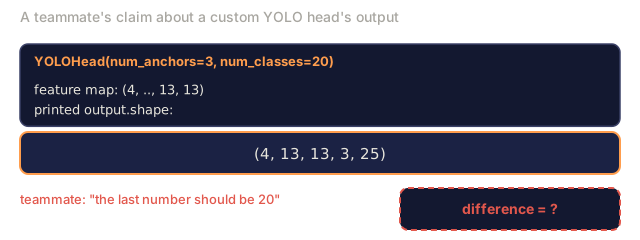
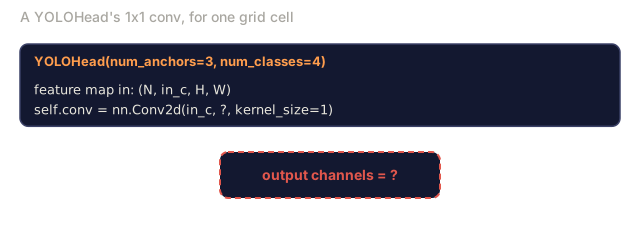
A classifier outputs C numbers per image. A YOLO-style detector outputs (S x S x B x (5 + C)) numbers per image, where S is the spatial grid size and B is the number of boxes (anchors) per cell.

Each of the S * S grid cells predicts B boxes. For each box:
- 4 numbers describe geometry:
tx, ty, tw, th. - 1 number is the objectness score: "is there an object centred in this cell?"
- C numbers are class probabilities.
Total per cell: B * (5 + C). For VOC (the PASCAL VOC detection dataset) with S=13, B=2, C=20, that is 50 numbers per cell.
Why grids and anchors
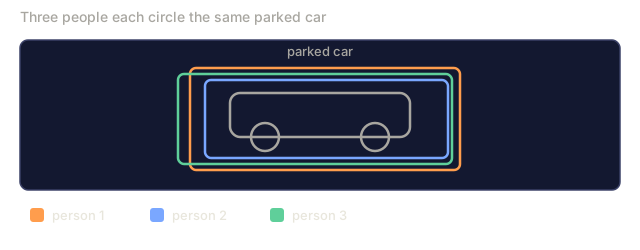
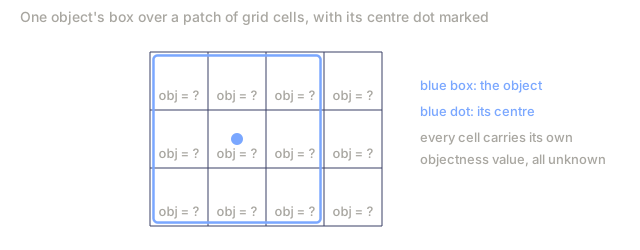
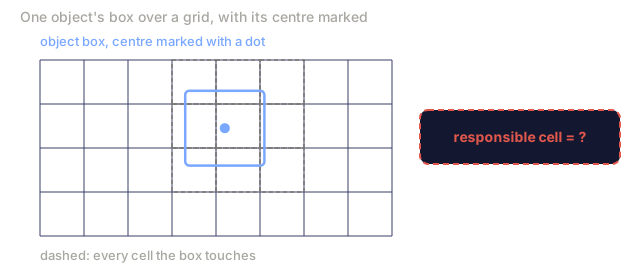
Plain regression would predict (x, y, w, h) for every object as an absolute coordinate. That is hard for a conv network because translating the image should not translate every prediction by the same amount: each object is anchored to a specific position in the frame. The grid answers this by assigning each ground-truth box to the grid cell its centre falls in; only that cell is responsible for that object.
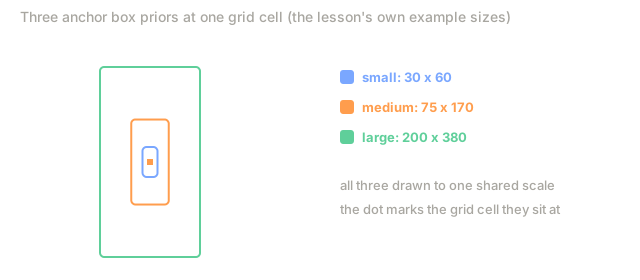
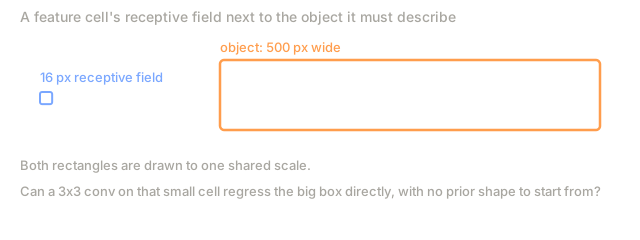
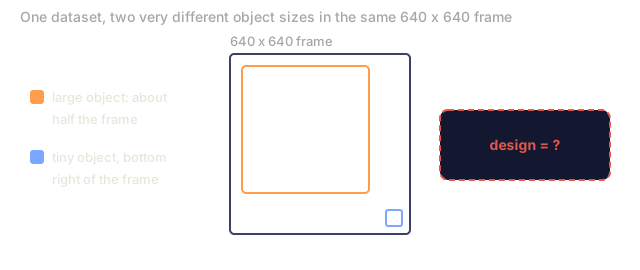
Anchors address a second problem. A 3x3 conv cannot easily regress a 500-pixel-wide box out of a 16-pixel receptive field feature cell. Instead, we pre-define B prior box shapes (anchors) per cell and predict small deltas from each anchor. The model learns to pick the right anchor and nudge it rather than regress from nothing.
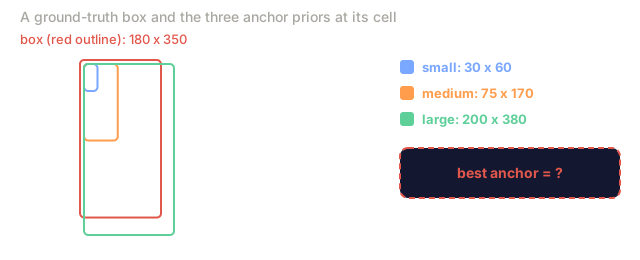
Anchor box priors (example for 416x416 input):

  small:   (30,  60)
  medium:  (75,  170)
  large:   (200, 380)

At each grid cell, every anchor emits (tx, ty, tw, th, obj, c_1, ..., c_C).
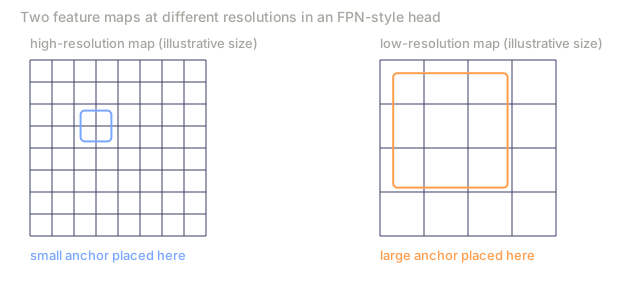
Modern detectors often use an FPN (Feature Pyramid Network: a stack of feature maps at different resolutions) with different anchor sets per resolution: small anchors on shallow, high-resolution maps, large anchors on deep, low-resolution ones. Same idea, more scales.
Decoding predictions
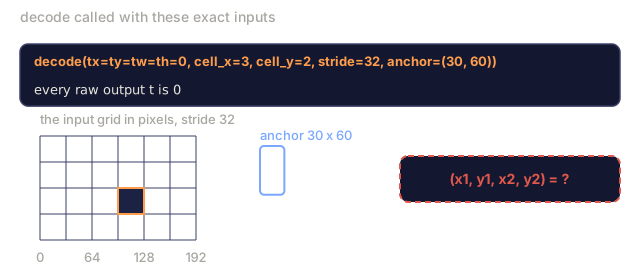
The raw tx, ty, tw, th are not box coordinates; they are regression targets to be transformed before plotting:
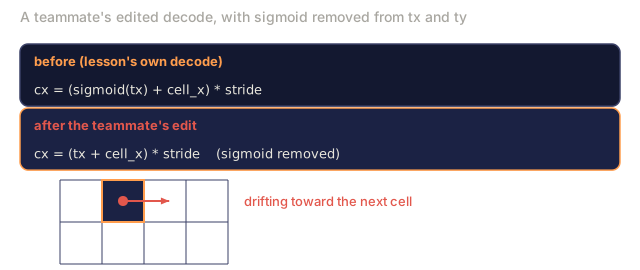
centre x  = (sigmoid(tx) + cell_x) * stride
centre y  = (sigmoid(ty) + cell_y) * stride
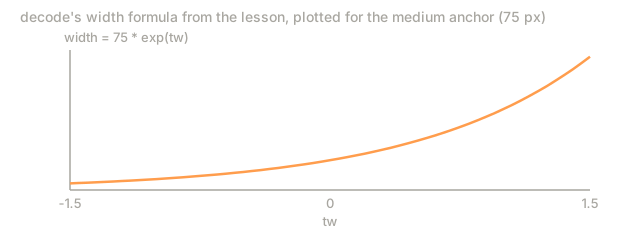
width     = anchor_w * exp(tw)
height    = anchor_h * exp(th)
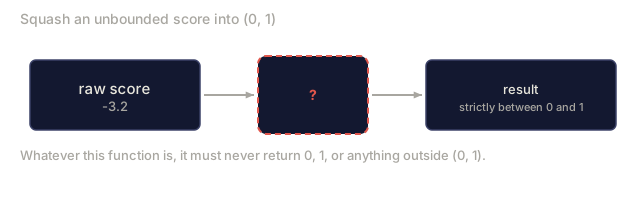
sigmoid keeps centre offsets inside the cell. exp lets the width scale freely from the anchor without a sign flip. stride scales the grid coordinates back to pixels. This decode step is the same in every YOLO version since v2.
IoU
Detection's universal similarity metric between two boxes:
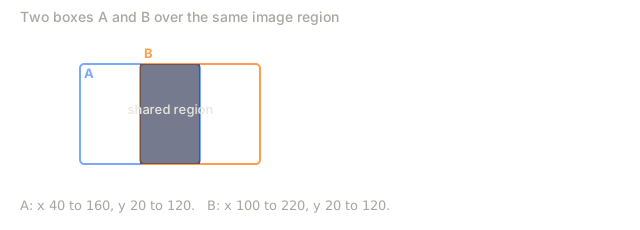
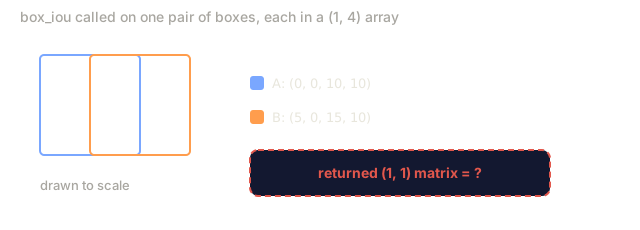
IoU(A, B) = area(A intersect B) / area(A union B)
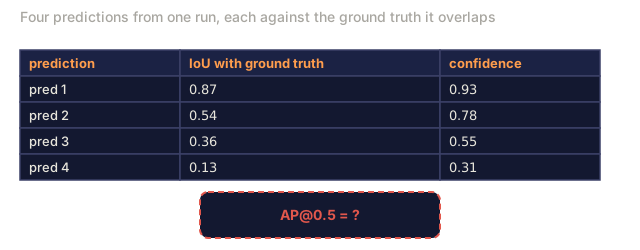
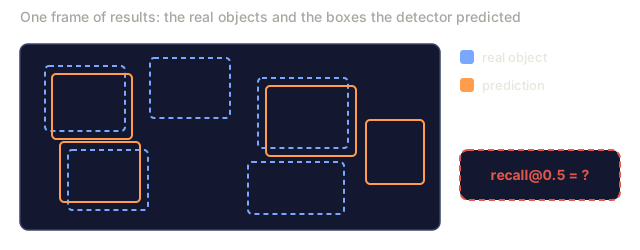
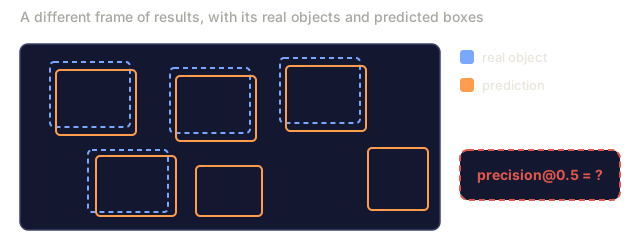
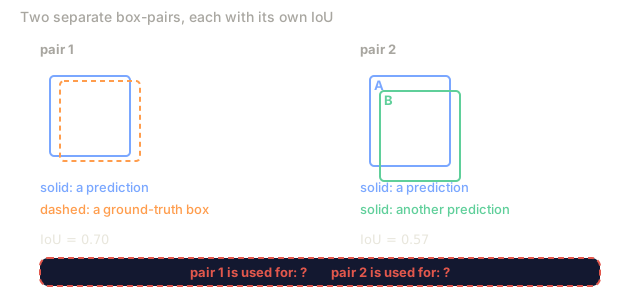
IoU = 1 means identical; IoU = 0 means no overlap. IoU between the prediction and the ground-truth box is what decides whether a prediction counts as a true positive (typically IoU >= 0.5). IoU between two predictions is what NMS uses to deduplicate.
Non-maximum suppression
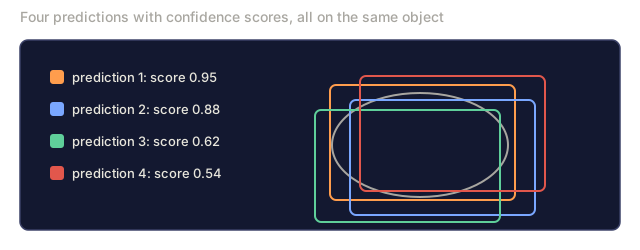
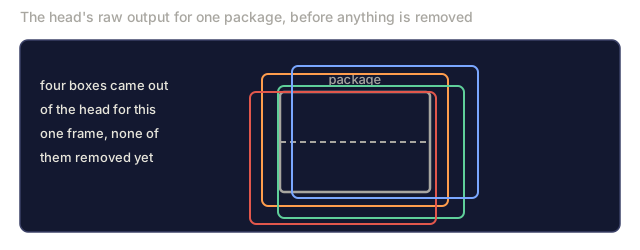
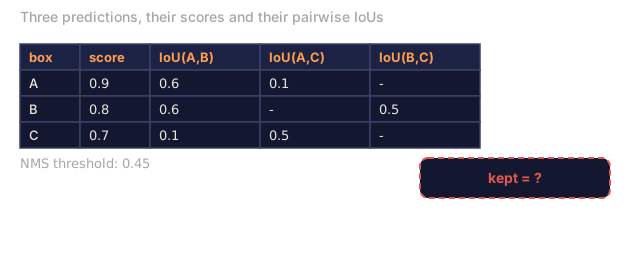
A conv network trained on adjacent anchors will often predict overlapping boxes for the same object. NMS keeps the highest-confidence prediction and deletes any other prediction with IoU above a threshold.
NMS(boxes, scores, iou_threshold):
    sort boxes by score descending
    keep = []
    while boxes not empty:
        pick the top-scoring box, add to keep
        remove every box with IoU > iou_threshold to the picked box
    return keep
Typical threshold: 0.45 for object detection. Recent detectors replace standard NMS with soft-NMS, DIoU-NMS, or learn the suppression directly (RT-DETR), but the structural purpose is the same.
The loss
YOLO loss is three losses added with weights:
L = lambda_coord * L_box(pred, target, where obj=1)
  + lambda_obj   * L_obj(pred, 1,     where obj=1)
  + lambda_noobj * L_obj(pred, 0,     where obj=0)
  + lambda_cls   * L_cls(pred, target, where obj=1)
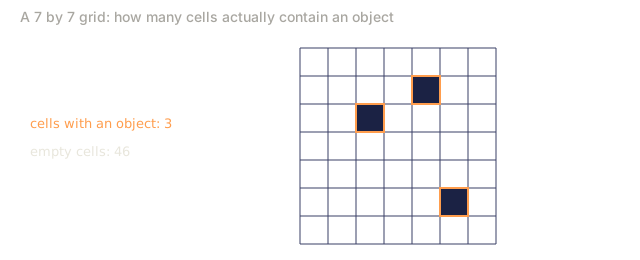
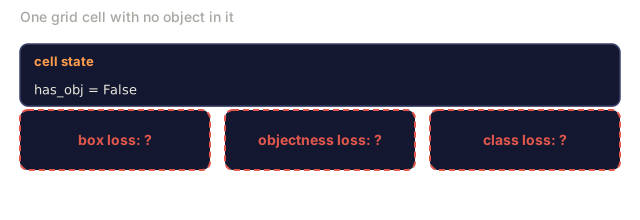
Only cells that contain an object contribute to the box-regression and classification losses. Cells without objects contribute only to the objectness loss (teaching the model to stay silent). lambda_noobj is usually small (~0.5) because the vast majority of cells are empty and would otherwise dominate the total loss.
Modern variants swap MSE box loss for CIoU / DIoU (which optimise IoU directly), use focal loss for class imbalance, and balance objectness with quality focal loss. The three-component structure is unchanged.
Detection metrics
Accuracy does not transfer to detection. Four numbers that do:
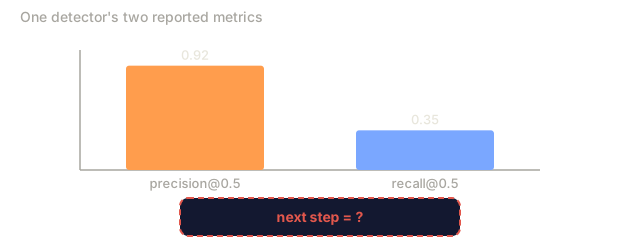
- Precision@IoU=0.5: of the predictions counted as positives, how many are actually correct.
- Recall@IoU=0.5: of the real objects, how many did we find.
- [email protected]: precision-recall curve area at IoU threshold 0.5; one number per class.
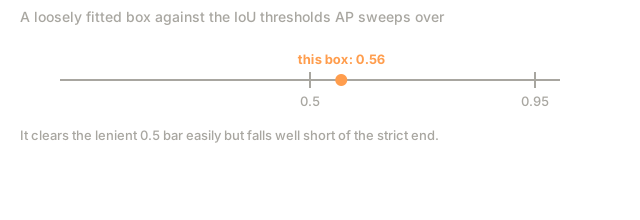
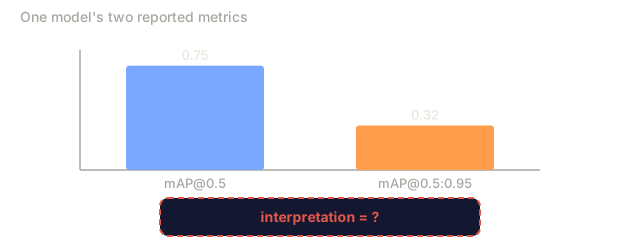
- [email protected]:0.95: average of AP over IoU thresholds 0.5, 0.55, ..., 0.95. The COCO metric; strictest and most informative.
Report all four. A detector that's strong on [email protected] but weak on [email protected]:0.95 is localising roughly but not tightly; fix with a better box-regression loss. A detector with high precision and low recall is too conservative; lower the confidence threshold or increase the objectness weight.
Build It
Step 1: IoU
The workhorse of the whole lesson. Works on two arrays of boxes in (x1, y1, x2, y2) format.
import numpy as np

def box_iou(boxes_a, boxes_b):
    ax1, ay1, ax2, ay2 = boxes_a[:, 0], boxes_a[:, 1], boxes_a[:, 2], boxes_a[:, 3]
    bx1, by1, bx2, by2 = boxes_b[:, 0], boxes_b[:, 1], boxes_b[:, 2], boxes_b[:, 3]

    inter_x1 = np.maximum(ax1[:, None], bx1[None, :])
    inter_y1 = np.maximum(ay1[:, None], by1[None, :])
    inter_x2 = np.minimum(ax2[:, None], bx2[None, :])
    inter_y2 = np.minimum(ay2[:, None], by2[None, :])

    inter_w = np.clip(inter_x2 - inter_x1, 0, None)
    inter_h = np.clip(inter_y2 - inter_y1, 0, None)
    inter = inter_w * inter_h

    area_a = (ax2 - ax1) * (ay2 - ay1)
    area_b = (bx2 - bx1) * (by2 - by1)
    union = area_a[:, None] + area_b[None, :] - inter
    return inter / np.clip(union, 1e-8, None)
Returns an (N_a, N_b) matrix of pairwise IoUs. Use it against a single ground-truth box by making one of the arrays shape (1, 4).
Step 2: Non-max suppression
def nms(boxes, scores, iou_threshold=0.45):
    order = np.argsort(-scores)
    keep = []
    while len(order) > 0:
        i = order[0]
        keep.append(i)
        if len(order) == 1:
            break
        rest = order[1:]
        ious = box_iou(boxes[[i]], boxes[rest])[0]
        order = rest[ious <= iou_threshold]
    return np.array(keep, dtype=np.int64)
Deterministic, O(N log N) from the sort, and matches the behaviour of torchvision.ops.nms on identical inputs.
Step 3: Box encoding and decoding
Convert between pixel coordinates and the (tx, ty, tw, th) targets that the network actually regresses.
def encode(box_xyxy, cell_x, cell_y, stride, anchor_wh):
    x1, y1, x2, y2 = box_xyxy
    cx = 0.5 * (x1 + x2)
    cy = 0.5 * (y1 + y2)
    w = x2 - x1
    h = y2 - y1
    tx = cx / stride - cell_x
    ty = cy / stride - cell_y
    tw = np.log(w / anchor_wh[0] + 1e-8)
    th = np.log(h / anchor_wh[1] + 1e-8)
    return np.array([tx, ty, tw, th])


def decode(tx_ty_tw_th, cell_x, cell_y, stride, anchor_wh):
    tx, ty, tw, th = tx_ty_tw_th
    cx = (sigmoid(tx) + cell_x) * stride
    cy = (sigmoid(ty) + cell_y) * stride
    w = anchor_wh[0] * np.exp(tw)
    h = anchor_wh[1] * np.exp(th)
    return np.array([cx - w / 2, cy - h / 2, cx + w / 2, cy + h / 2])


def sigmoid(x):
    return 1.0 / (1.0 + np.exp(-x))
Test it: encode a box, then decode it. You should get back something very close to the original box, up to the sigmoid inverse not being perfectly invertible when tx falls outside the post-sigmoid range.
Step 4: A minimal YOLO head
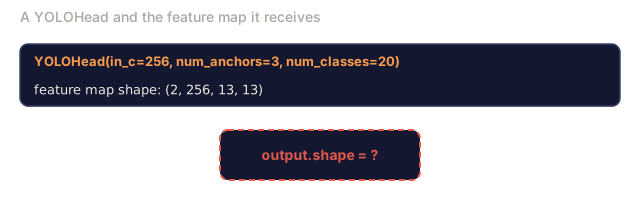
One 1x1 conv on a feature map, reshaping to (B, S, S, num_anchors, 5 + C).
import torch
import torch.nn as nn

class YOLOHead(nn.Module):
    def __init__(self, in_c, num_anchors, num_classes):
        super().__init__()
        self.num_anchors = num_anchors
        self.num_classes = num_classes
        self.conv = nn.Conv2d(in_c, num_anchors * (5 + num_classes), kernel_size=1)

    def forward(self, x):
        n, _, h, w = x.shape
        y = self.conv(x)
        y = y.view(n, self.num_anchors, 5 + self.num_classes, h, w)
        y = y.permute(0, 3, 4, 1, 2).contiguous()
        return y
Output shape: (N, H, W, num_anchors, 5 + C). The last dimension holds [tx, ty, tw, th, obj, cls_0, ..., cls_{C-1}].
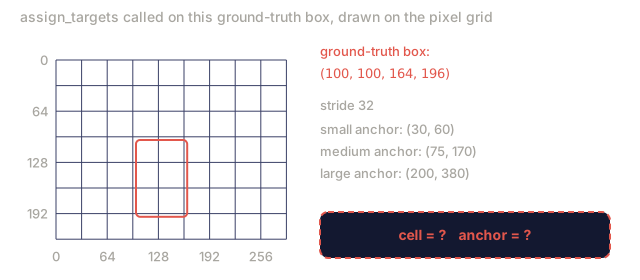
Step 5: Ground-truth assignment
For every ground-truth box, decide which (cell, anchor) is responsible.
def assign_targets(boxes_xyxy, classes, anchors, stride, grid_size, num_classes):
    num_anchors = len(anchors)
    target = np.zeros((grid_size, grid_size, num_anchors, 5 + num_classes), dtype=np.float32)
    has_obj = np.zeros((grid_size, grid_size, num_anchors), dtype=bool)

    for box, cls in zip(boxes_xyxy, classes):
        x1, y1, x2, y2 = box
        cx, cy = 0.5 * (x1 + x2), 0.5 * (y1 + y2)
        gx, gy = int(cx / stride), int(cy / stride)
        bw, bh = x2 - x1, y2 - y1

        ious = np.array([
            (min(bw, aw) * min(bh, ah)) / (bw * bh + aw * ah - min(bw, aw) * min(bh, ah))
            for aw, ah in anchors
        ])
        best = int(np.argmax(ious))
        aw, ah = anchors[best]

        target[gy, gx, best, 0] = cx / stride - gx
        target[gy, gx, best, 1] = cy / stride - gy
        target[gy, gx, best, 2] = np.log(bw / aw + 1e-8)
        target[gy, gx, best, 3] = np.log(bh / ah + 1e-8)
        target[gy, gx, best, 4] = 1.0
        target[gy, gx, best, 5 + cls] = 1.0
        has_obj[gy, gx, best] = True
    return target, has_obj
Anchor selection here is just best-shape IoU with the ground truth, a cheap proxy that matches the YOLOv2/v3 assignment. v5 and later use more sophisticated strategies (task-aligned matching, dynamic k) that refine the same idea.
Step 6: The three losses
def yolo_loss(pred, target, has_obj, lambda_coord=5.0, lambda_obj=1.0, lambda_noobj=0.5, lambda_cls=1.0):
    has_obj_t = torch.from_numpy(has_obj).bool()
    target_t = torch.from_numpy(target).float()

    # box-regression loss: only on cells with objects
    box_pred = pred[..., :4][has_obj_t]
    box_true = target_t[..., :4][has_obj_t]
    loss_box = torch.nn.functional.mse_loss(box_pred, box_true, reduction="sum")

    # objectness loss
    obj_pred = pred[..., 4]
    obj_true = target_t[..., 4]
    loss_obj_pos = torch.nn.functional.binary_cross_entropy_with_logits(
        obj_pred[has_obj_t], obj_true[has_obj_t], reduction="sum")
    loss_obj_neg = torch.nn.functional.binary_cross_entropy_with_logits(
        obj_pred[~has_obj_t], obj_true[~has_obj_t], reduction="sum")

    # classification loss on cells with objects
    cls_pred = pred[..., 5:][has_obj_t]
    cls_true = target_t[..., 5:][has_obj_t]
    loss_cls = torch.nn.functional.binary_cross_entropy_with_logits(
        cls_pred, cls_true, reduction="sum")

    total = (lambda_coord * loss_box
             + lambda_obj * loss_obj_pos
             + lambda_noobj * loss_obj_neg
             + lambda_cls * loss_cls)
    return total, {"box": loss_box.item(), "obj_pos": loss_obj_pos.item(),
                   "obj_neg": loss_obj_neg.item(), "cls": loss_cls.item()}
Five hyper-parameters that every YOLO tutorial either hardcodes or sweeps. The ratios matter: lambda_coord=5, lambda_noobj=0.5 mirrors the original YOLOv1 paper and still works as a reasonable default.
Step 7: Inference pipeline
Decode the raw head output, apply sigmoid/exp, threshold on objectness, and NMS.
def postprocess(pred_tensor, anchors, stride, img_size, conf_threshold=0.25, iou_threshold=0.45):
    pred = pred_tensor.detach().cpu().numpy()
    grid_h, grid_w = pred.shape[1], pred.shape[2]
    num_anchors = len(anchors)

    boxes, scores, classes = [], [], []
    for gy in range(grid_h):
        for gx in range(grid_w):
            for a in range(num_anchors):
                tx, ty, tw, th, obj, *cls = pred[0, gy, gx, a]
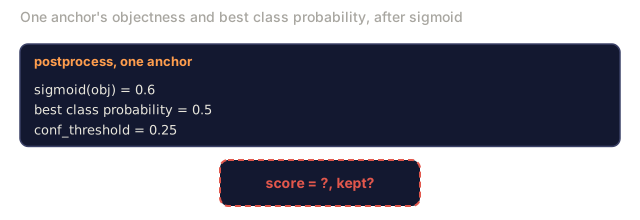
                score = sigmoid(obj) * sigmoid(np.array(cls)).max()
                if score < conf_threshold:
                    continue
                cls_idx = int(np.argmax(cls))
                cx = (sigmoid(tx) + gx) * stride
                cy = (sigmoid(ty) + gy) * stride
                w = anchors[a][0] * np.exp(tw)
                h = anchors[a][1] * np.exp(th)
                boxes.append([cx - w / 2, cy - h / 2, cx + w / 2, cy + h / 2])
                scores.append(float(score))
                classes.append(cls_idx)

    if not boxes:
        return np.zeros((0, 4)), np.zeros((0,)), np.zeros((0,), dtype=int)
    boxes = np.array(boxes)
    scores = np.array(scores)
    classes = np.array(classes)
    keep = nms(boxes, scores, iou_threshold)
    return boxes[keep], scores[keep], classes[keep]
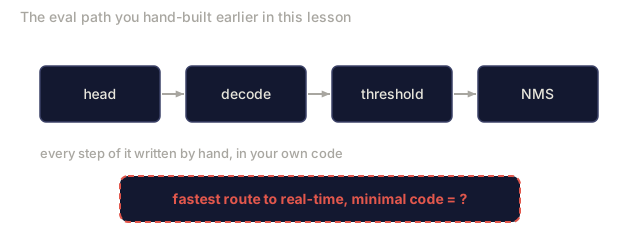
That is the complete eval path: head -> decode -> threshold -> NMS.
Use It
torchvision.models.detection ships production detectors with the same conceptual structure. Loading a pretrained model takes three lines.
import torch
from torchvision.models.detection import fasterrcnn_resnet50_fpn_v2

model = fasterrcnn_resnet50_fpn_v2(weights="DEFAULT")
model.eval()
with torch.no_grad():
    predictions = model([torch.randn(3, 400, 600)])
print(predictions[0].keys())
print(f"boxes:  {predictions[0]['boxes'].shape}")
print(f"scores: {predictions[0]['scores'].shape}")
print(f"labels: {predictions[0]['labels'].shape}")
For real-time inference pipelines, ultralytics (YOLOv8/v9) is the standard: from ultralytics import YOLO; model = YOLO('yolov8n.pt'); model(img). The model handles decoding and NMS internally and returns the same boxes / scores / labels triple you built above.
Ship It
This lesson produces:
outputs/prompt-detection-metric-reader.md, a prompt that turns aprecision, recall, AP, [email protected]:0.95row into a one-line diagnosis and the single most useful next experiment.outputs/skill-anchor-designer.md, a skill that, given a dataset of ground-truth boxes, runs k-means on(w, h)and returns anchor sets per FPN level plus the coverage statistics you need to pick the right number of anchors.
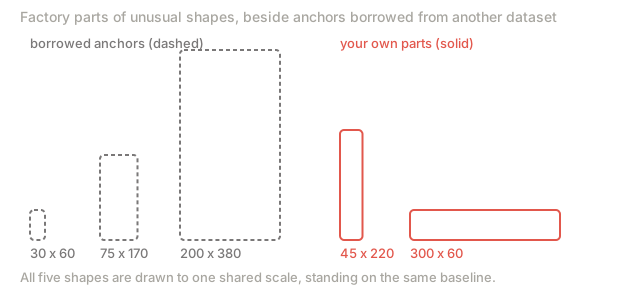
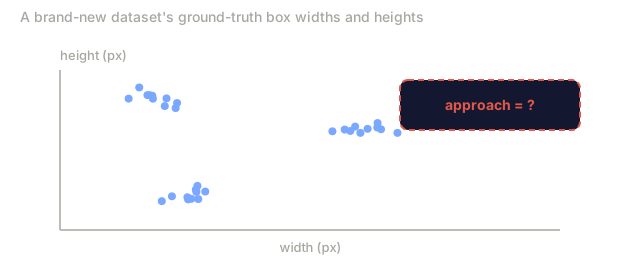
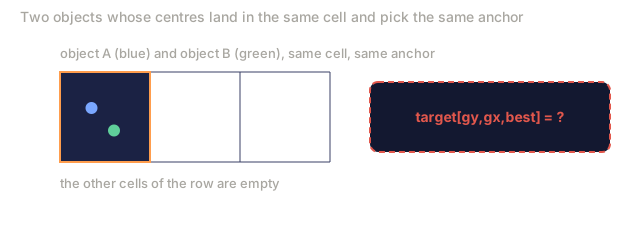
The bug that costs the most time here almost never lives in the loss function or the head. It lives in ground-truth assignment. I've watched a detector train to a suspiciously flat loss curve because two objects landed in the same grid cell and only one survived assignment, or because someone borrowed an anchor set from a completely different dataset and never checked whether it matched their own box shapes. skill-anchor-designer above exists because running k-means on your own box widths and heights takes five minutes and will tell you immediately whether the anchors you inherited actually fit your objects.
NMS looks like a footnote until you're staring at a detector that reports the same forklift six times in one frame. Once you've implemented it by hand, every "why are there duplicate boxes" bug report turns from a mystery into a five-minute fix. That's the real argument for building this from scratch even though ultralytics will do all of it for you in three lines: you want the mental model in place before the library's defaults ever surprise you.
Exercises
- (Easy) Implement
box_iouand run it againsttorchvision.ops.box_iouon 1,000 random box pairs. Verify max absolute difference is below1e-6. - (Medium) Port
yolo_lossto a version that usesCIoUbox loss instead of MSE. Show on a 100-image synthetic dataset that CIoU converges to a better final [email protected]:0.95 than MSE in the same number of epochs. - (Hard) Implement multi-scale inference: feed the same image at three resolutions through the model, union the box predictions, and run a single NMS at the end. Measure the mAP lift vs single-scale inference on a held-out set.
Key Terms
| Term | What people say | What it actually means |
|---|---|---|
| Anchor | "Box prior" | A pre-defined box shape at each grid cell from which the network predicts deltas instead of absolute coordinates |
| IoU | "Overlap" | Intersection-over-union of two boxes; the universal similarity measure in detection |
| NMS | "Deduplicate" | Greedy algorithm that keeps highest-score predictions and removes overlapping ones above a threshold |
| Objectness | "Is there something here" | Per-anchor, per-cell scalar predicting whether an object is centred in that cell |
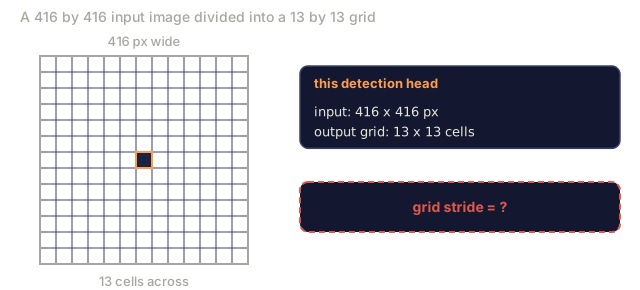
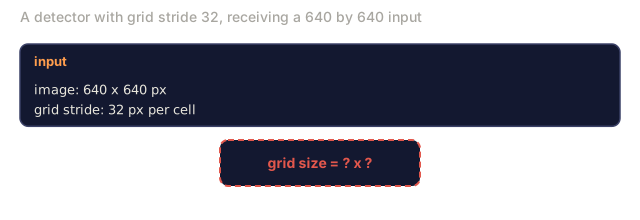
| Grid stride | "Downsample factor" | Pixels per grid cell; a 416-px input with a 13-grid head has stride 32 |
| mAP | "Mean average precision" | Average of the area under the precision-recall curve, averaged over classes and (for COCO) IoU thresholds |
| [email protected] | "PASCAL VOC AP" | Average precision with IoU threshold 0.5; the lenient version of the metric |
| [email protected]:0.95 | "COCO AP" | Average over IoU thresholds 0.5..0.95 step 0.05; the strict version and current community standard |
Further Reading
- YOLOv1: You Only Look Once (Redmon et al., 2016) — the founding paper; every YOLO since is a refinement of this structure
- YOLOv3 (Redmon & Farhadi, 2018) — the paper that introduced multi-scale FPN-style heads; still the clearest diagram
- Ultralytics YOLOv8 docs — the current production reference; covers dataset formats, augmentations, training recipes
- The Illustrated Guide to Object Detection (Jonathan Hui) — best plain-English tour of the full detector zoo; priceless for understanding how DETR, RetinaNet, FCOS, and YOLO relate
Code
- main.py (python, 251 lines)