Instance Segmentation — Mask R-CNN
Add a small mask branch to a Faster R-CNN detector and you have instance segmentation. RoIAlign is the part that actually matters, and it's trickier than it looks.
Learning Objectives
- Trace the Mask R-CNN architecture end-to-end: backbone, FPN, RPN, RoIAlign, box head, mask head
- Implement RoIAlign from scratch and explain why RoIPool is no longer used
- Use the torchvision `maskrcnn_resnet50_fpn_v2` pretrained model for production-quality instance masks and read its output format correctly
- Fine-tune Mask R-CNN on a small custom dataset by replacing the box and mask heads and keeping the backbone frozen
The Problem
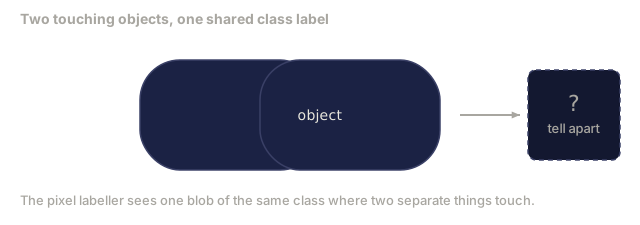
Semantic segmentation gives you one mask per class. Instance segmentation gives you one mask per object, even when two objects share a class. Counting individuals, tracking across frames, and measuring things (the bounding box of each brick in a wall, each cell in a microscope image) all demand instance segmentation.
Mask R-CNN (He et al., 2017) solved this by reframing instance segmentation as detection-plus-a-mask. The design was so clean that for the next five years almost every instance segmentation paper was a Mask R-CNN variant, and the torchvision implementation is still the production default for small to medium datasets.
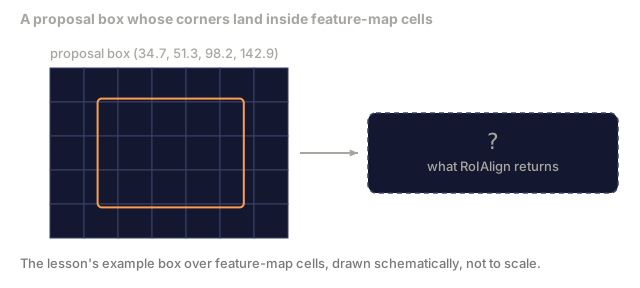
The hard engineering problem is sampling: how do you crop a fixed-size feature region out of a proposal box whose corners do not align with pixel boundaries? Getting that wrong costs tenths of a mAP point everywhere. RoIAlign is the answer.
The Concept
The architecture

Five pieces to understand:
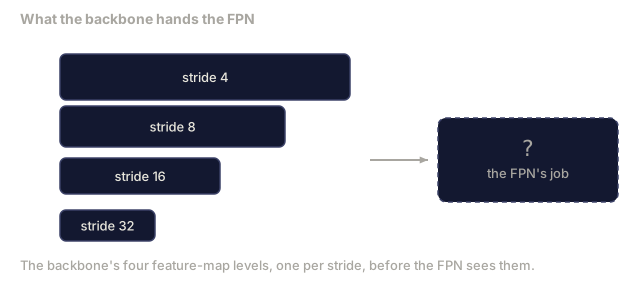
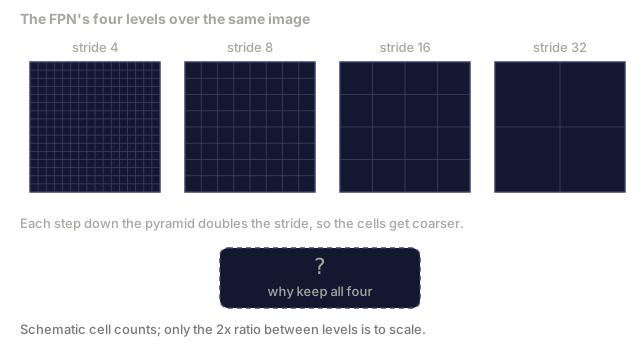
- Backbone: ResNet-50 or ResNet-101, pretrained on ImageNet, producing a hierarchy of feature maps at strides 4, 8, 16, 32.
- FPN (Feature Pyramid Network): top-down and lateral connections that give every level C channels of semantic-rich features, so detection can query the FPN level that matches the object's size.
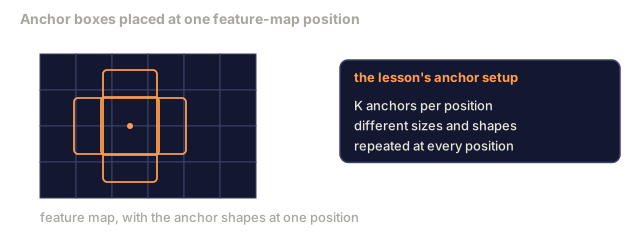
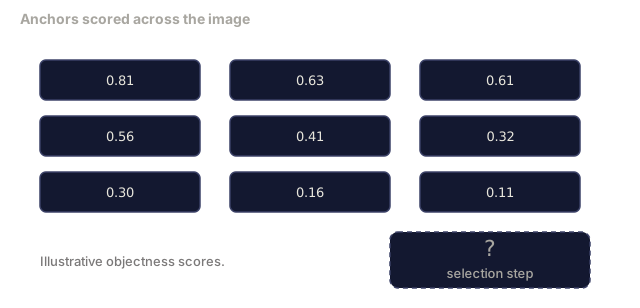
- RPN (Region Proposal Network): a small conv head that, at every anchor position, predicts "is there an object here?" and "how do I refine the box?" It produces ~1,000 proposals per image.
- RoIAlign: samples a fixed-size (e.g. 7x7) feature patch from any box on any FPN level, using bilinear sampling with no quantisation.
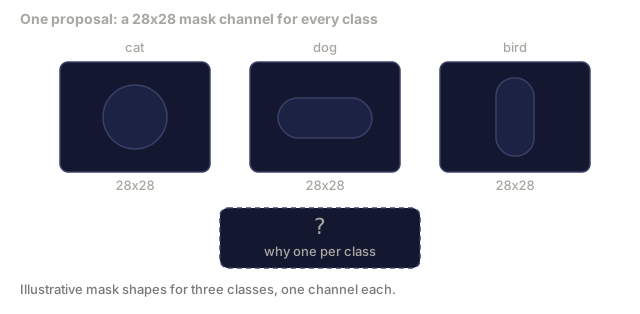
- Heads: a two-layer box head that refines the box and picks a class, and a small conv head that outputs a
28x28binary mask for each proposal.
Why RoIAlign, not RoIPool
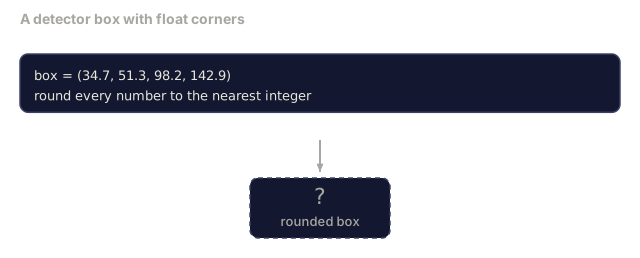
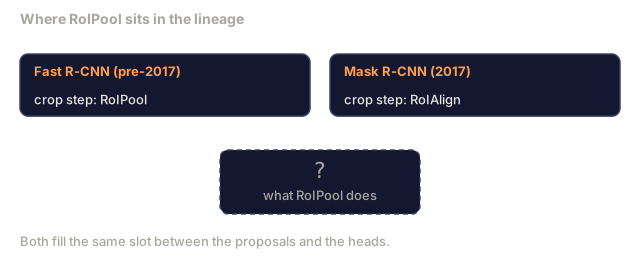
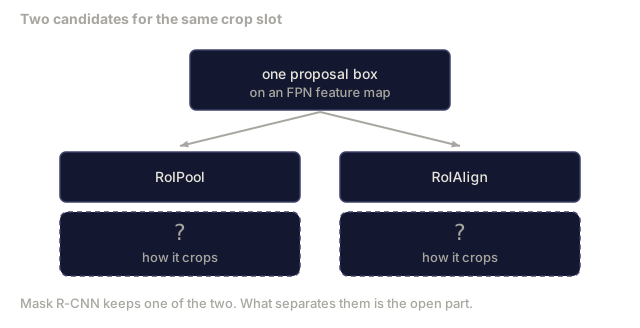
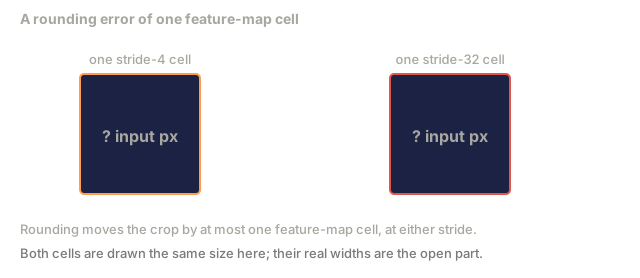
The original Fast R-CNN used RoIPool, which splits a proposal box into a grid, takes the maximum feature in each cell, and rounds all coordinates to integers. That rounding misaligns the feature map from the input pixel coordinates by up to a full feature-map pixel: barely noticeable on a 224x224 image, catastrophic once the feature map is stride 32.
RoIPool:
  box (34.7, 51.3, 98.2, 142.9)
  round -> (34, 51, 98, 142)
  split grid -> round each cell boundary
  misalignment accumulates at every step

RoIAlign:
  box (34.7, 51.3, 98.2, 142.9)
  sample at exact float coordinates using bilinear interpolation
  no rounding anywhere
RoIAlign lifts mask AP by 3-4 points on COCO for free. Every detector that cares about localisation now uses it, from YOLOv7-seg to RT-DETR to Mask2Former.
The RPN in one paragraph
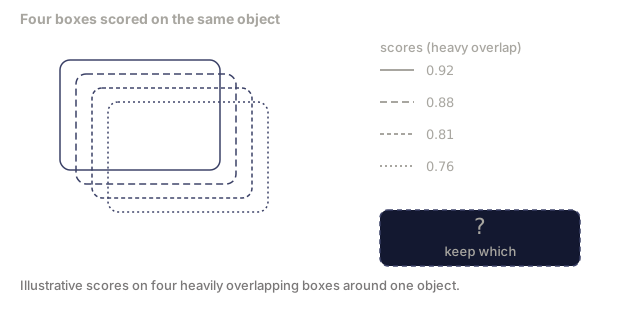
At every position of a feature map, place K anchor boxes of different sizes and shapes. Predict an objectness score for each anchor and a regression offset to turn the anchor into a better-fitting box. Keep the top ~1,000 boxes by score, apply NMS at IoU 0.7, and hand the survivors to the heads. The RPN trains against its own mini-loss, the same structure as the YOLO loss from Lesson 6, just with two classes: object or no object.
The mask head
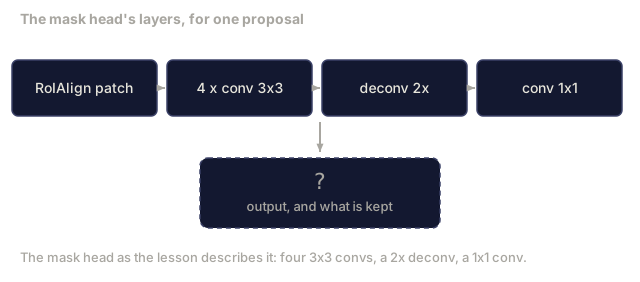
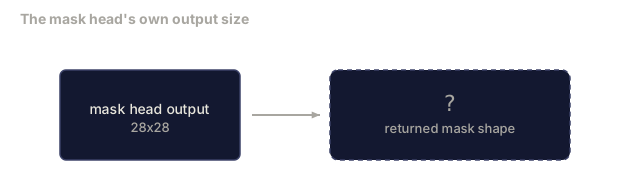
For each proposal, after RoIAlign, the mask head is a tiny FCN: four 3x3 convs, a 2x deconv, a final 1x1 conv that produces num_classes output channels at 28x28 resolution. Only the channel corresponding to the predicted class is kept; the others are ignored. This decouples mask prediction from classification.
Upsample the 28x28 mask to the proposal's original pixel size to produce the final binary mask.
Losses
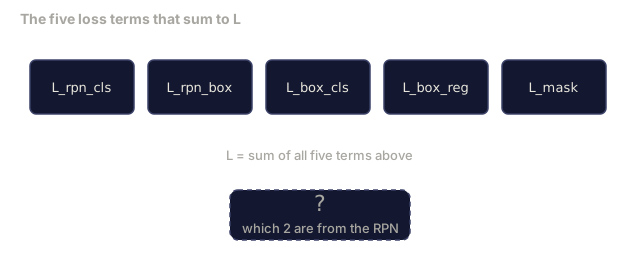
Mask R-CNN has five losses added together:
L = L_rpn_cls + L_rpn_box + L_box_cls + L_box_reg + L_mask
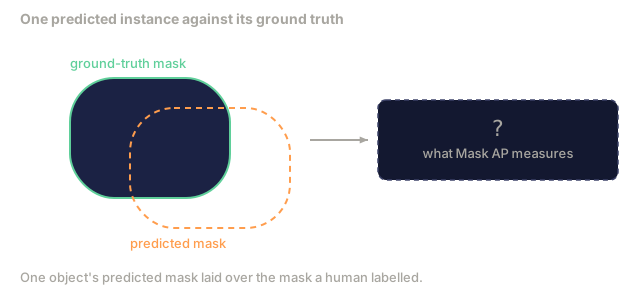
L_rpn_clsandL_rpn_box: objectness and box regression for the RPN's proposals.L_box_cls: cross-entropy over (C+1) classes, including background, on the head's classifier.L_box_reg: smooth L1 on the head's box refinement.L_mask: per-pixel binary cross-entropy on the 28x28 mask output.
Each loss has its own default weight; the torchvision implementation exposes them as constructor arguments.
Output format
torchvision.models.detection.maskrcnn_resnet50_fpn_v2 returns a list of dicts, one per image:
{
    "boxes":  (N, 4) in (x1, y1, x2, y2) pixel coordinates,
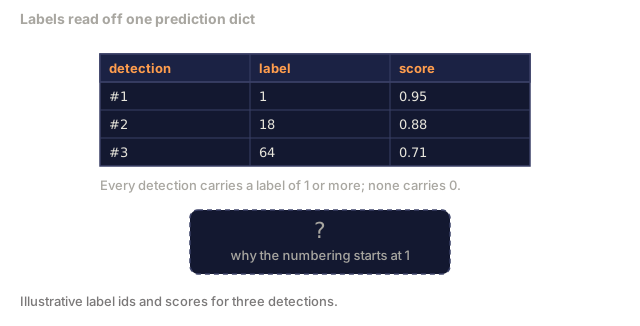
    "labels": (N,) class IDs, 0 = background so indices are 1-based,
    "scores": (N,) confidence scores,
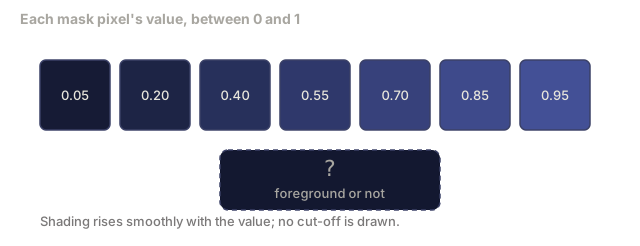
    "masks":  (N, 1, H, W) float masks in [0, 1] — threshold at 0.5 for binary,
}
The mask is already at full image resolution; the 28x28 head output has been upsampled internally.
Build It
Step 1: RoIAlign from scratch
This is the one component of Mask R-CNN that is simpler to understand as code than as prose.
import torch
import torch.nn.functional as F

def roi_align_single(feature, box, output_size=7, spatial_scale=1 / 16.0):
    """
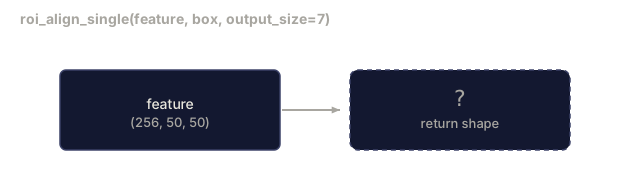
    feature: (C, H, W) single-image feature map
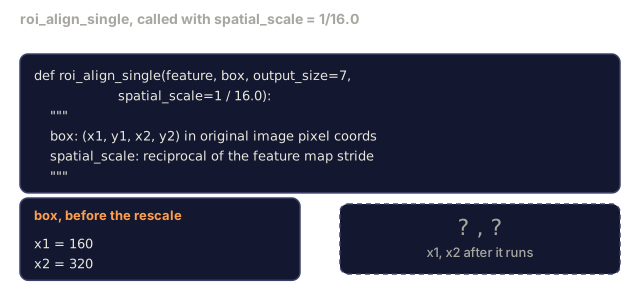
    box: (x1, y1, x2, y2) in original image pixel coordinates
    output_size: side of the output grid (7 for box head, 14 for mask head)
    spatial_scale: reciprocal of the feature map stride
    """
    C, H, W = feature.shape
    x1, y1, x2, y2 = [c * spatial_scale - 0.5 for c in box]
    bin_w = (x2 - x1) / output_size
    bin_h = (y2 - y1) / output_size

    grid_y = torch.linspace(y1 + bin_h / 2, y2 - bin_h / 2, output_size)
    grid_x = torch.linspace(x1 + bin_w / 2, x2 - bin_w / 2, output_size)
    yy, xx = torch.meshgrid(grid_y, grid_x, indexing="ij")

    gx = 2 * (xx + 0.5) / W - 1
    gy = 2 * (yy + 0.5) / H - 1
    grid = torch.stack([gx, gy], dim=-1).unsqueeze(0)
    sampled = F.grid_sample(feature.unsqueeze(0), grid, mode="bilinear",
                            align_corners=False)
    return sampled.squeeze(0)
Every number is at a bilinearly-sampled position. No rounding, no quantisation, no dropped gradients.
Step 2: Compare to torchvision's RoIAlign
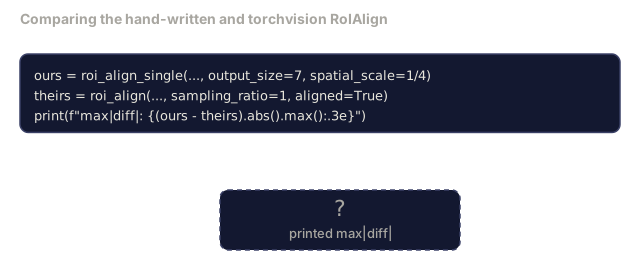
Before trusting a hand-written RoIAlign anywhere real, check it against torchvision's own implementation.
from torchvision.ops import roi_align

feature = torch.randn(1, 16, 50, 50)
boxes = torch.tensor([[0, 10, 20, 100, 90]], dtype=torch.float32)  # (batch_idx, x1, y1, x2, y2)

ours = roi_align_single(feature[0], boxes[0, 1:].tolist(), output_size=7, spatial_scale=1/4)
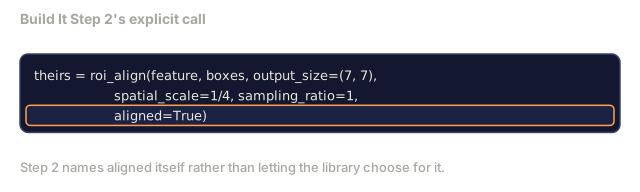
theirs = roi_align(feature, boxes, output_size=(7, 7), spatial_scale=1/4, sampling_ratio=1, aligned=True)[0]

print(f"shape ours:   {tuple(ours.shape)}")
print(f"shape theirs: {tuple(theirs.shape)}")
print(f"max|diff|:    {(ours - theirs).abs().max().item():.3e}")
With sampling_ratio=1 and aligned=True, the two match to within 1e-5.
Step 3: Load a pretrained Mask R-CNN
Skip training from zero. torchvision ships a Mask R-CNN already trained on COCO, so loading it gets you production-quality masks before you write a single training loop.
import torch
from torchvision.models.detection import maskrcnn_resnet50_fpn_v2, MaskRCNN_ResNet50_FPN_V2_Weights

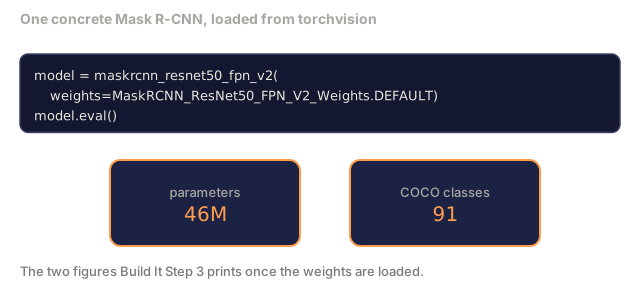
model = maskrcnn_resnet50_fpn_v2(weights=MaskRCNN_ResNet50_FPN_V2_Weights.DEFAULT)
model.eval()
print(f"params: {sum(p.numel() for p in model.parameters()):,}")
print(f"classes (including background): {len(model.roi_heads.box_predictor.cls_score.out_features * [0])}")
46M parameters, 91 classes (COCO). The first class (id 0) is background; everything the model actually detects starts at id 1.
Step 4: Run inference
Before wiring this into a pipeline, check exactly what shape the model hands back for each prediction key.
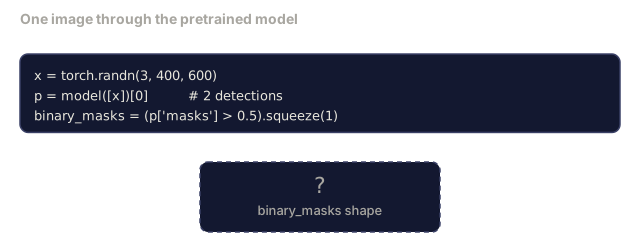
with torch.no_grad():
    x = torch.randn(3, 400, 600)
    predictions = model([x])
p = predictions[0]
print(f"boxes:  {tuple(p['boxes'].shape)}")
print(f"labels: {tuple(p['labels'].shape)}")
print(f"scores: {tuple(p['scores'].shape)}")
print(f"masks:  {tuple(p['masks'].shape)}")
The mask tensor is shape (N, 1, H, W). Threshold at 0.5 to get a binary mask per object:
binary_masks = (p['masks'] > 0.5).squeeze(1) # (N, H, W) booleanStep 5: Swap the heads for a custom class count
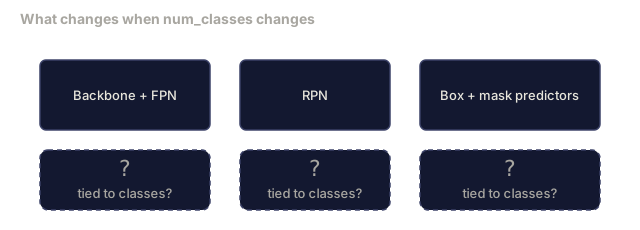
The common fine-tuning recipe: reuse the backbone, FPN, and RPN; replace the two classifier heads.
from torchvision.models.detection.faster_rcnn import FastRCNNPredictor
from torchvision.models.detection.mask_rcnn import MaskRCNNPredictor

def build_custom_maskrcnn(num_classes):
    model = maskrcnn_resnet50_fpn_v2(weights=MaskRCNN_ResNet50_FPN_V2_Weights.DEFAULT)
    in_features = model.roi_heads.box_predictor.cls_score.in_features
    model.roi_heads.box_predictor = FastRCNNPredictor(in_features, num_classes)
    in_features_mask = model.roi_heads.mask_predictor.conv5_mask.in_channels
    hidden_layer = 256
    model.roi_heads.mask_predictor = MaskRCNNPredictor(in_features_mask, hidden_layer, num_classes)
    return model

custom = build_custom_maskrcnn(num_classes=5)
print(f"custom cls_score.out_features: {custom.roi_heads.box_predictor.cls_score.out_features}")
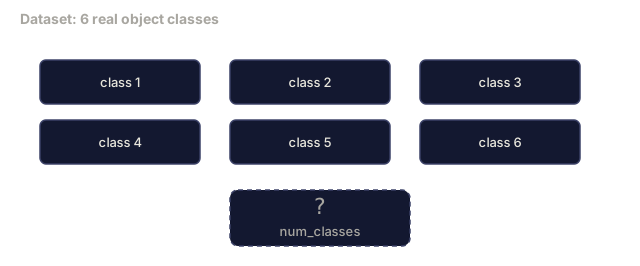
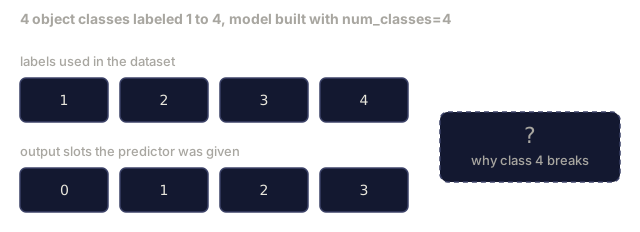
num_classes must include the background class, so a dataset with 4 object classes uses num_classes=5.
Step 6: Freeze what does not need training
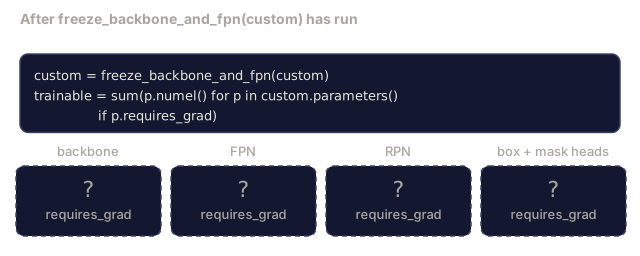
On small datasets, freeze the backbone and the FPN. Only the RPN objectness + regression and the two heads learn.
def freeze_backbone_and_fpn(model):
    # torchvision Mask R-CNN packs the FPN inside `model.backbone` (as
    # `model.backbone.fpn`), so iterating `model.backbone.parameters()` covers
    # both the ResNet feature layers and the FPN lateral/output convs.
    for p in model.backbone.parameters():
        p.requires_grad = False
    return model

custom = freeze_backbone_and_fpn(custom)
trainable = sum(p.numel() for p in custom.parameters() if p.requires_grad)
print(f"trainable after freeze: {trainable:,}")
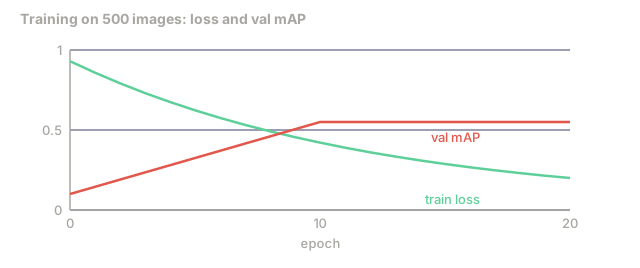
On 500-image datasets this is the difference between convergence and overfitting.
Use It
The full training loop for Mask R-CNN in torchvision is 40 lines, and it barely changes between tasks. Swap datasets and go.
def train_step(model, images, targets, optimizer):
    model.train()
    loss_dict = model(images, targets)
    losses = sum(loss for loss in loss_dict.values())
    optimizer.zero_grad()
    losses.backward()
    optimizer.step()
    return {k: v.item() for k, v in loss_dict.items()}
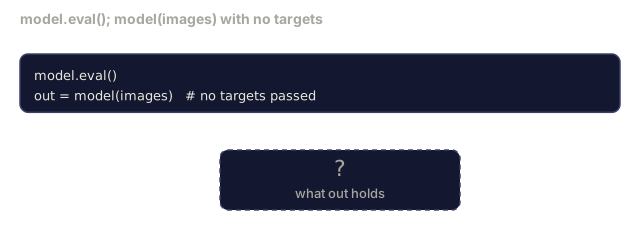
The targets list must have per-image dicts with boxes, labels, and masks (as (num_instances, H, W) binary tensors). The model returns a dict of five losses during training and a list of predictions during eval, keyed on model.training.
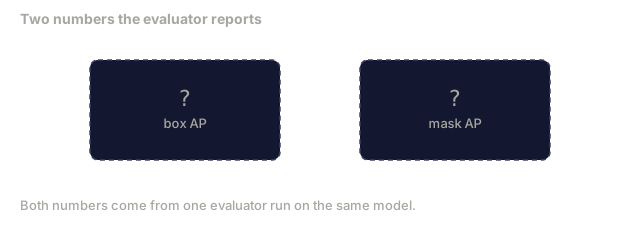
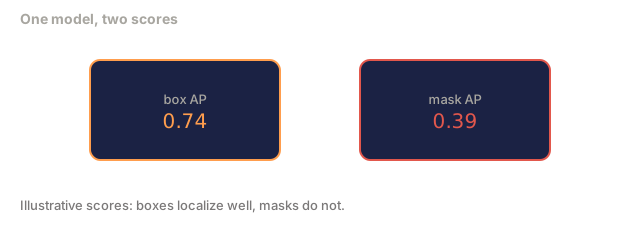
The pycocotools evaluator produces mAP@IoU=0.5:0.95 for both boxes and masks; you need both numbers to know whether the box head or the mask head is the bottleneck.
Ship It
This lesson produces:
outputs/prompt-instance-vs-semantic-router.md, a prompt that asks three questions and picks instance vs semantic vs panoptic plus the exact model to start with.outputs/skill-mask-rcnn-head-swapper.md, a skill that generates the 10 lines of code for swapping heads on any torchvision detection model, given the newnum_classes.
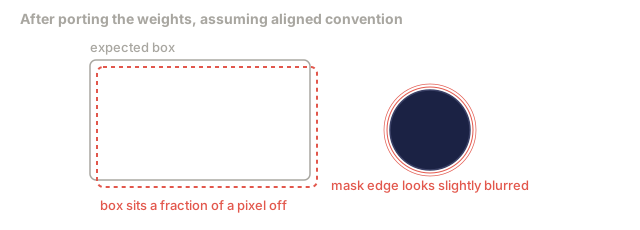
The place people actually get stuck on Mask R-CNN isn't the architecture, it's RoIAlign's aligned flag, and the trap runs backward from what you'd guess. torchvision's roi_align defaults to aligned=False, and maskrcnn_resnet50_fpn_v2's pooler never overrides that default, so the pretrained model you load out of the box runs the unaligned convention internally. Build It Step 2 passes aligned=True explicitly because that is the corrected behavior, not the shipped one. Assume the opposite, that the pretrained model already uses the aligned convention, and you get boxes that look almost right: off by a fraction of a pixel everywhere, mask boundaries blurred just enough that the cause is hard to trace back. If you ever port weights between frameworks or reimplement RoIAlign yourself, check that flag before touching anything else, and don't trust your memory of which way the default goes.
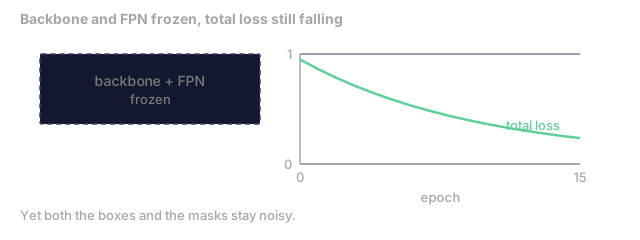
The other trap is freezing too little. Freezing the backbone and FPN on a small dataset (Build It, Step 6) is the right call, but it's easy to leave the RPN undertrained at the same time and not notice, because the total loss still drops. A weak RPN feeds noisy proposals to both heads no matter how well you tune them. Watch the RPN's own loss term, not just the sum.
Exercises
- (Easy) Verify your RoIAlign against
torchvision.ops.roi_alignon 100 random boxes. Report the max absolute difference. Also run RoIPool (pre-2017 behaviour) and show it diverges by ~1-2 feature-map pixels on boxes near the border. - (Medium) Fine-tune
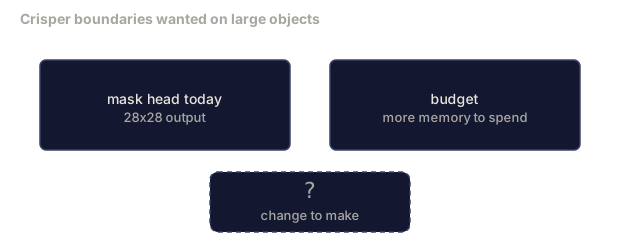
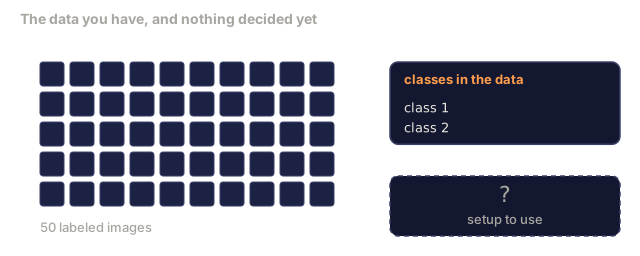
maskrcnn_resnet50_fpn_v2on a 50-image custom dataset (any two classes: balloons, fish, pothole, logos). Freeze the backbone, train for 20 epochs, report mask [email protected]. - (Hard) Replace Mask R-CNN's mask head with one that predicts at 56x56 instead of 28x28. Measure mAP@IoU=0.75 before and after. Explain why the gain (or lack of one) matches the expected boundary-precision / memory trade-off.
Key Terms
| Term | What people say | What it actually means |
|---|---|---|
| Mask R-CNN | "Detection plus masks" | Faster R-CNN + a small FCN head that predicts a 28x28 mask per proposal per class |
| FPN | "Feature pyramid" | Top-down + lateral connections that give every stride level C channels of semantic-rich features |
| RPN | "Region proposer" | A small conv head that produces ~1000 object/no-object proposals per image |
| RoIAlign | "No-rounding crop" | Bilinearly samples a fixed-size feature grid from any float-coordinate box |
| RoIPool | "Pre-2017 crop" | Same purpose as RoIAlign but rounds box coordinates; obsolete |
| Mask AP | "Instance mAP" | Average precision computed with mask IoU instead of box IoU; the COCO instance segmentation metric |
| Binary mask head | "Per-class mask" | Predicts one binary mask per class for each proposal; only the predicted class's channel is kept |
| Background class | "Class 0" | The catch-all "no object" class; indices for real classes start at 1 |
Further Reading
- Mask R-CNN (He et al., 2017) — the paper; section 3 on RoIAlign is the critical read
- FPN: Feature Pyramid Networks (Lin et al., 2017) — the FPN paper; every modern detector uses it
- torchvision Mask R-CNN tutorial — the reference for the fine-tuning loop
- Detectron2 model zoo — production implementations with trained weights for nearly every detection and segmentation variant
Code
- main.py (python, 104 lines)