Voice Cloning & Voice Conversion
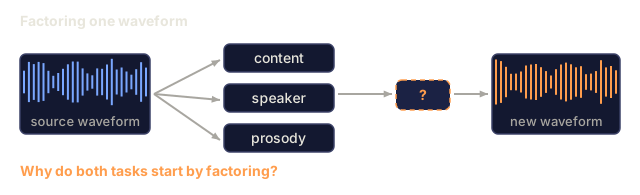
Voice cloning speaks your text in someone else's voice. Voice conversion swaps your voice for someone else's without changing what you said. Both rest on the same trick: split speaker identity from content, then recombine them from two different sources.
Learning Objectives
- Distinguish voice cloning from voice conversion, and explain how both factor a waveform into content, speaker identity, and prosody before recombining them from two different sources.
- Compare zero-shot, few-shot, recognition-synthesis, disentanglement, and neural-codec approaches to cloning and conversion, and name a representative model for each.
- Build a zero-shot cloning pipeline with F5-TTS and a nearest-neighbor voice-conversion pipeline with KNN-VC, using a target speaker's reference audio.
- Design a consent gate and audio watermark that satisfy the EU AI Act and California AB 2905 before a cloned voice ships.
The Problem
In 2026, a 5-second clip is all it takes to clone anyone's voice on a consumer GPU. Two closely related tasks fall under that umbrella:
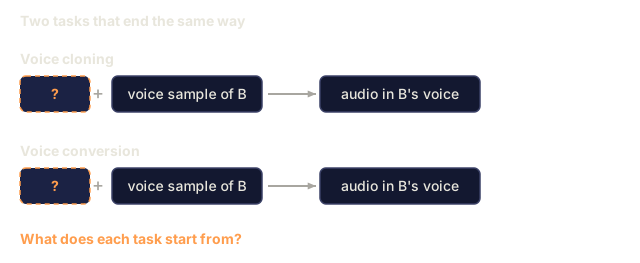
- Voice cloning (TTS-side): text plus a 5-second reference voice produces audio in that voice.
- Voice conversion (speech-side): source audio of person A saying X, plus a reference voice from person B, produces audio of B saying X.
Both factor a waveform into content, speaker, and prosody, then recombine content from one source with the speaker identity of another.
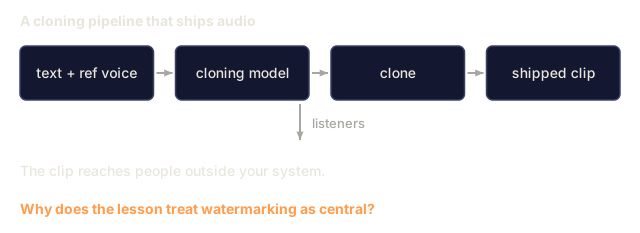
ElevenLabs, F5-TTS, OpenVoice v2, and VoiceBox all ship zero-shot or few-shot cloning out of the box, and that capability cuts both ways. It powers accessibility TTS, dubbing, and assistive voices. It also powers scam calls, political deepfakes, and IP theft.
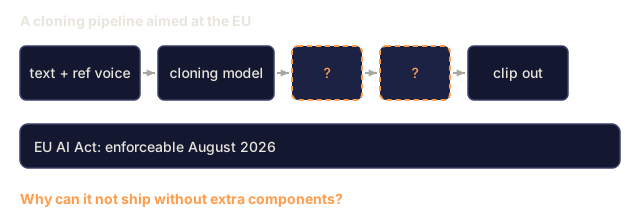
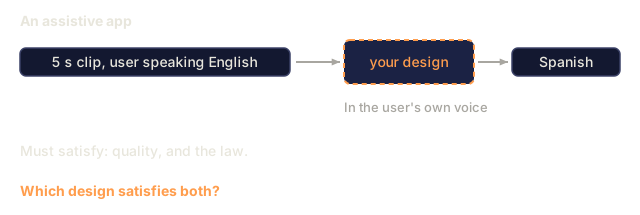
You now ship under a hard constraint: watermarking and consent gates are legally required in the EU (AI Act, enforceable August 2026) and in California (AB 2905, effective 2025). Your pipeline has to emit an inaudible watermark and refuse non-consensual clones, or it doesn't ship.
The Concept

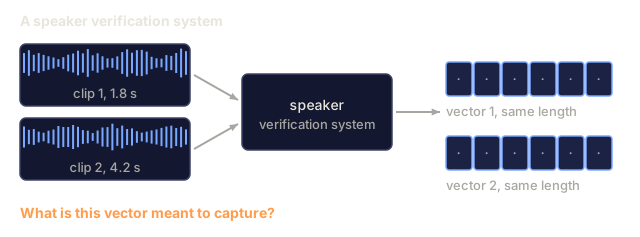
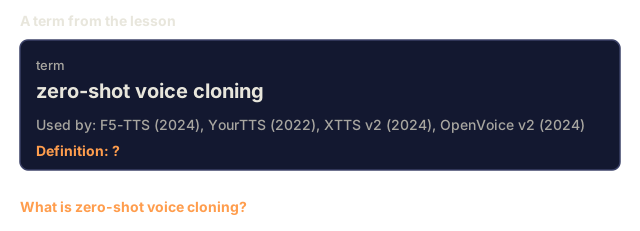
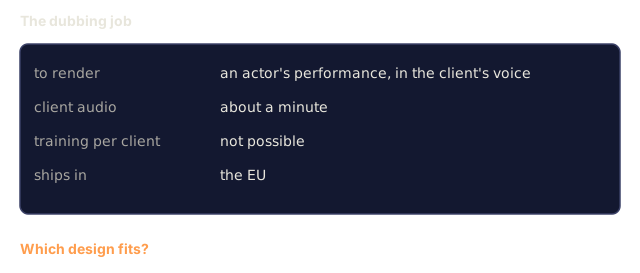
Zero-shot cloning. Pass a 5-second clip to a model trained on thousands of speakers. The speaker encoder maps the clip to a speaker embedding, and the TTS decoder conditions on that embedding plus the text.
Used by: F5-TTS (2024), YourTTS (2022), XTTS v2 (2024), OpenVoice v2 (2024).
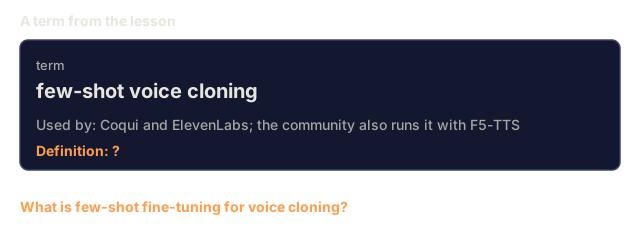
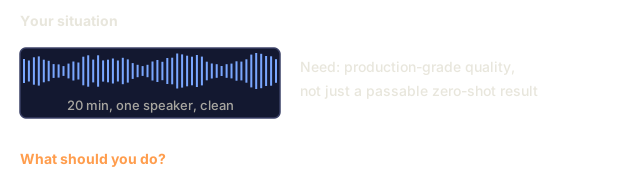
Few-shot fine-tuning. Record 5-30 minutes of the target voice, then LoRA-fine-tune (update a small adapter instead of the full model) a base model for about an hour. Quality leaps from "okay" to "indistinguishable." Coqui and ElevenLabs both support this pattern, and the community runs it with F5-TTS too.
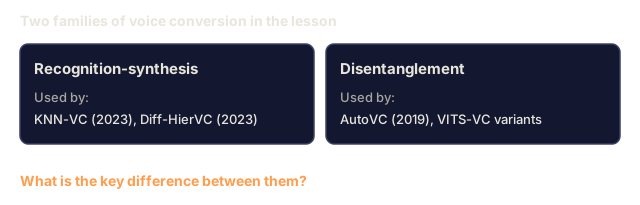
Voice conversion (VC). Two families:
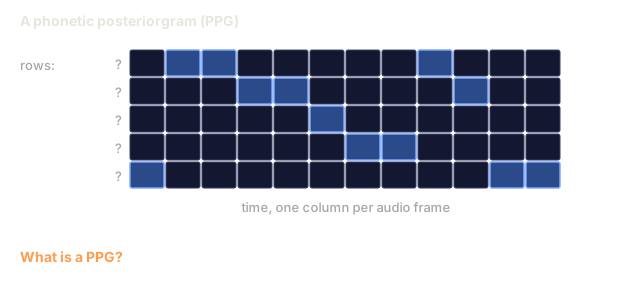
- Recognition-synthesis. Run an ASR-like model to extract a content representation (soft phoneme posteriors, PPGs), then resynthesize with the target speaker embedding. Robust to language and accent. Used by KNN-VC (2023), Diff-HierVC (2023).
- Disentanglement. Train an autoencoder that separates content, speaker, and prosody in latent space at the bottleneck, then swap the speaker embedding at inference. Lower quality but faster. Used by AutoVC (2019), VITS-VC variants.
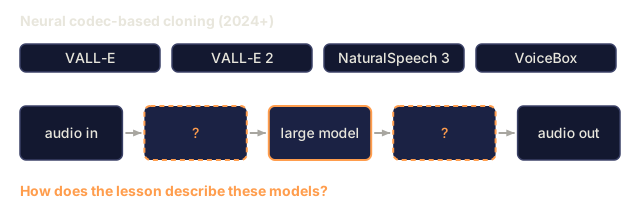
Neural codec-based cloning (2024+). VALL-E, VALL-E 2, NaturalSpeech 3, and VoiceBox all treat audio as discrete tokens from SoundStream or EnCodec, then train a large autoregressive or flow-matching (predict a direct path from noise to the target audio, rather than one token at a time) model over those codec tokens. Quality is comparable to ElevenLabs on short prompts.
The ethics bit, not a bolt-on
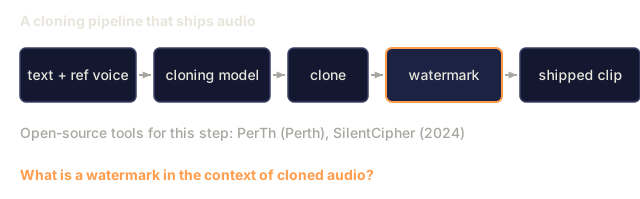
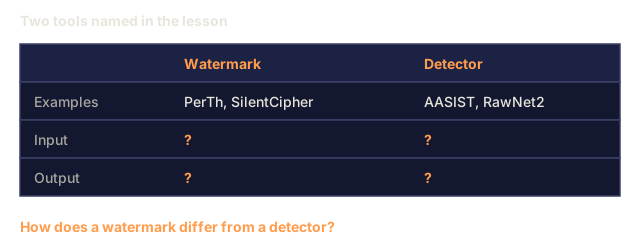
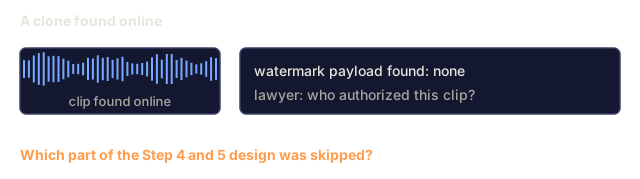
Watermarking. PerTh (Perth) and SilentCipher (2024) embed a ~16-32 bit ID imperceptibly in the audio. It survives re-encoding, streaming, and common edits, and both are production-ready open source.
Consent gates. Pair every cloned output with a verifiable consent record: "I, Rohit, on 2026-04-22, authorize this voice for X purpose." Store it in a tamper-evident log.
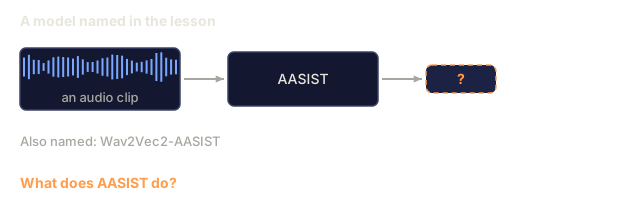
Detection. AASIST, RawNet2, and Wav2Vec2-AASIST ship as detectors. The ASVspoof 2025 challenge published EERs of 0.8–2.3% for state-of-the-art detectors against ElevenLabs, VALL-E 2, and Bark outputs.
Numbers (2026)
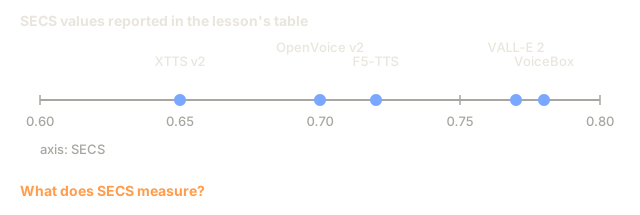
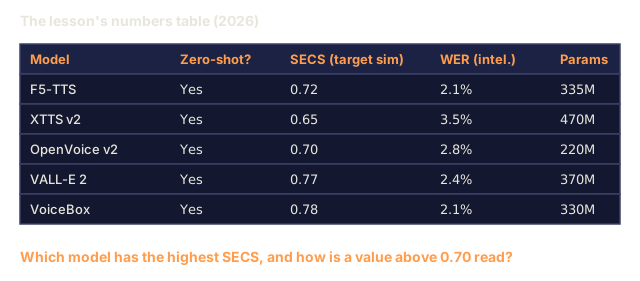
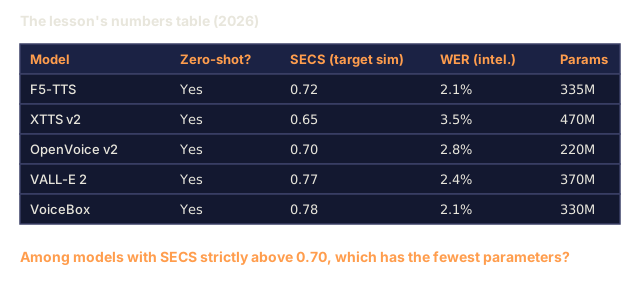
| Model | Zero-shot? | SECS (target sim) | WER (intel.) | Params |
|---|---|---|---|---|
| F5-TTS | Yes | 0.72 | 2.1% | 335M |
| XTTS v2 | Yes | 0.65 | 3.5% | 470M |
| OpenVoice v2 | Yes | 0.70 | 2.8% | 220M |
| VALL-E 2 | Yes | 0.77 | 2.4% | 370M |
| VoiceBox | Yes | 0.78 | 2.1% | 330M |
SECS above 0.70 is generally indistinguishable from the target for most listeners.
Build It
Step 1: decompose with recognition-synthesis (code-only demo in main.py)
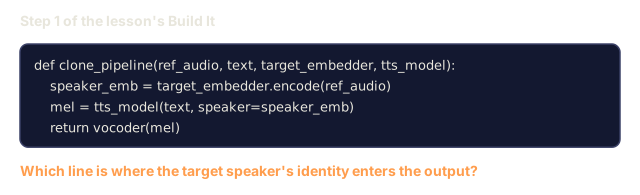
def clone_pipeline(ref_audio, text, target_embedder, tts_model):
    speaker_emb = target_embedder.encode(ref_audio)
    mel = tts_model(text, speaker=speaker_emb)
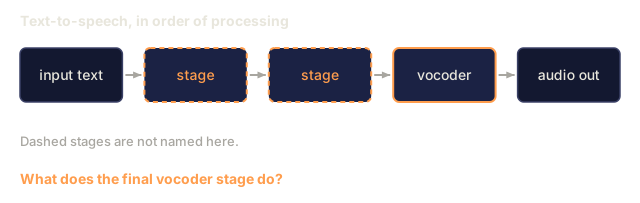
    return vocoder(mel)
Conceptually simple. Nearly all the real work happens inside tts_model and the speaker encoder.
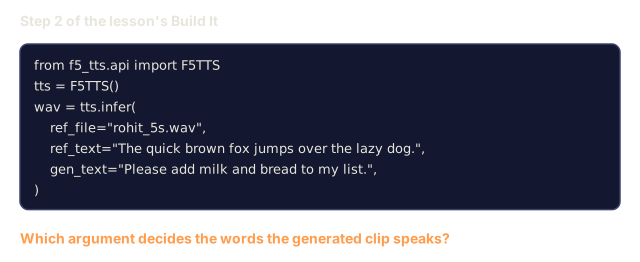
Step 2: zero-shot clone with F5-TTS
from f5_tts.api import F5TTS
tts = F5TTS()
wav = tts.infer(
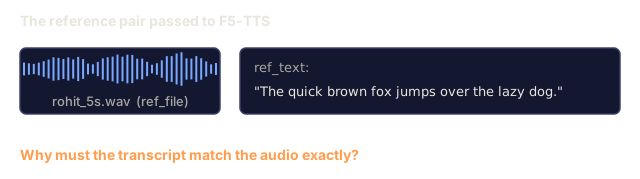
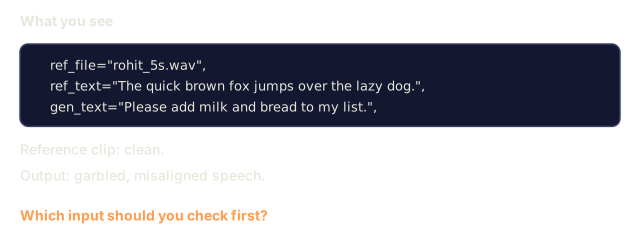
    ref_file="rohit_5s.wav",
    ref_text="The quick brown fox jumps over the lazy dog.",
    gen_text="Please add milk and bread to my list.",
)
The reference transcript has to match the audio exactly, or the alignment breaks.
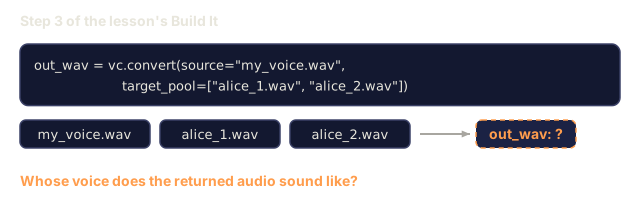
Step 3: voice conversion with KNN-VC
import torch
from knnvc import KNNVC  # 2023 model, https://github.com/bshall/knn-vc
vc = KNNVC.load("wavlm-base-plus")
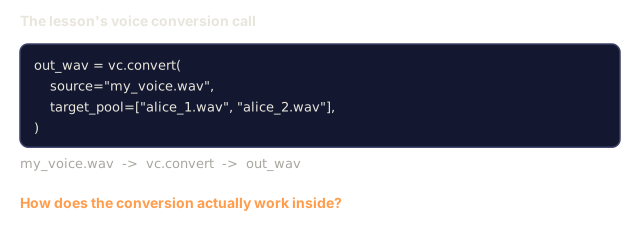
out_wav = vc.convert(source="my_voice.wav", target_pool=["alice_1.wav", "alice_2.wav"])
KNN-VC runs WavLM to extract per-frame embeddings for the source and the target pool, then replaces each source frame with its nearest neighbor in that pool. It's non-parametric and works with as little as a minute of target speech.
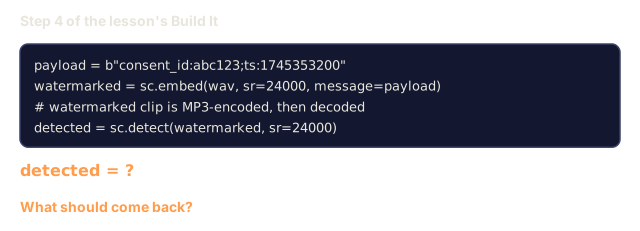
Step 4: embed a watermark
from silentcipher import SilentCipher
sc = SilentCipher(model="2024-06-01")
payload = b"consent_id:abc123;ts:1745353200"
watermarked = sc.embed(wav, sr=24000, message=payload)
detected = sc.detect(watermarked, sr=24000)   # returns payload bytes
About 32 bits of payload, and it's still detectable after an MP3 re-encode or light noise.
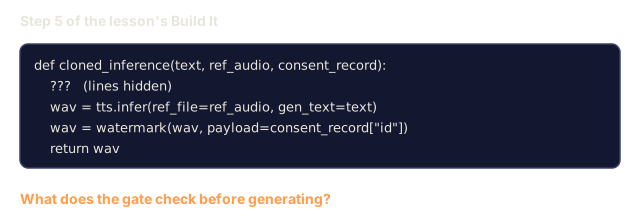
Step 5: consent gate
def cloned_inference(text, ref_audio, consent_record):
    assert verify_signature(consent_record), "Signed consent required"
    assert consent_record["speaker_id"] == hash_speaker(ref_audio)
    wav = tts.infer(ref_file=ref_audio, gen_text=text)
    wav = watermark(wav, payload=consent_record["id"])
    return wav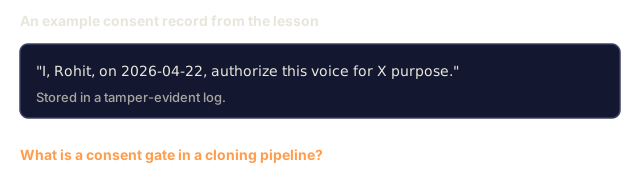
Use It
The 2026 stack:
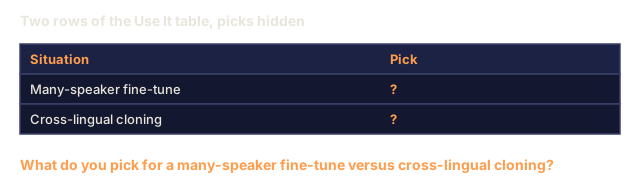
| Situation | Pick |
|---|---|
| 5-sec zero-shot clone, open-source | F5-TTS or OpenVoice v2 |
| Commercial production cloning | ElevenLabs Instant Voice Clone v2.5 |
| Voice conversion (rewriting) | KNN-VC or Diff-HierVC |
| Many-speaker fine-tune | StyleTTS 2 + speaker adapter |
| Cross-lingual cloning | XTTS v2 or VALL-E X |
| Deepfake detection | Wav2Vec2-AASIST |
Pitfalls
- Misaligned reference transcript. F5-TTS and similar require the reference text to match the reference audio exactly, punctuation included.
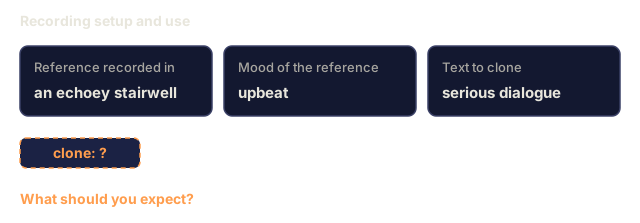
- Reverberant reference. Echo kills the clone. Record dry, close-mic.
- Emotional mismatch. A cheerful reference clip produces cheerful clones of everything, so match the reference emotion to the target use.
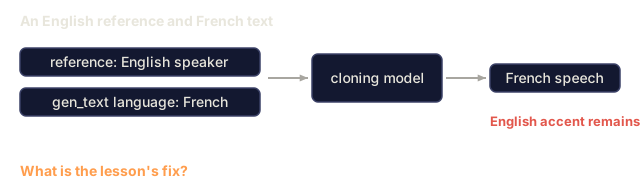
- Language leakage. Clone an English speaker, then ask the model to speak French, and the accent often carries over anyway. Use a cross-lingual model instead (XTTS, VALL-E X).
- No watermark. Legally unshippable in the EU from August 2026.
Ship It
Save as outputs/skill-voice-cloner.md. Design a cloning or conversion pipeline with consent gate + watermark + quality target.
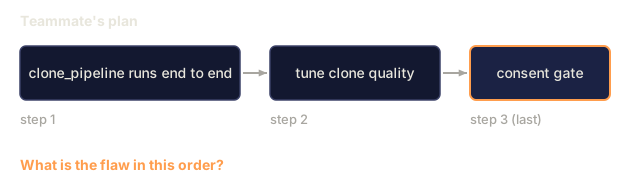
The consent gate is the part people build last, once the pipeline already works, and that ordering is backwards. Build it first, even in a prototype, even when the only voice you're cloning is your own. Once clone_pipeline runs end to end on whatever reference clip was closest to hand, retrofitting a permission check into it is a much easier step to skip than adding one before you had anything worth shipping. The watermark is non-negotiable for the same reason: it's cheap to bolt on now and effectively impossible to add after a clone is already out in the world.
Exercises
- Easy. Run
code/main.py. Demonstrates the speaker-embedding swap by computing the cosine between two "speakers" pre and post swap. - Medium. Use OpenVoice v2 to clone your own voice. Measure SECS between reference and clone. Measure CER via Whisper.
- Hard. Apply SilentCipher watermark to 20 clones, run them through 128 kbps MP3 encode+decode, detect the payload. Report bit-accuracy.
Key Terms
| Term | What people say | What it actually means |
|---|---|---|
| Zero-shot clone | 5 seconds is enough | Pretrained model + speaker embedding; no training. |
| PPG | Phonetic posteriorgram | Per-frame ASR posteriors used as language-agnostic content rep. |
| KNN-VC | Nearest-neighbor conversion | Replace each source frame with nearest target-pool frame. |
| Neural codec TTS | VALL-E style | AR model over EnCodec/SoundStream tokens. |
| Watermark | Inaudible signature | Bits embedded in audio, survive re-encode. |
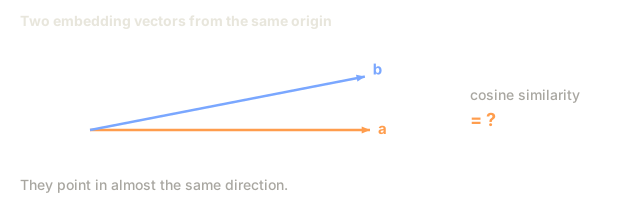
| SECS | Cloning fidelity | Cosine between target and clone speaker embeddings. |
| AASIST | Deepfake detector | Anti-spoof model; detects synthesized speech. |
Further Reading
- Chen et al. (2024). F5-TTS: open-source SOTA zero-shot cloning.
- Baevski et al. / Microsoft (2023). VALL-E and VALL-E 2 (2024): neural-codec TTS.
- Qian et al. (2019). AutoVC: disentanglement-based voice conversion.
- Baas, Waubert de Puiseau, Kamper (2023). KNN-VC: retrieval-based VC.
- SilentCipher (2024): Audio Watermarking: production-ready 32-bit audio watermark.
- ASVspoof 2025 results: detector vs synthesizer arms race, updated 2026.
Code
- main.py (python, 161 lines)