Audio Transformers — Whisper Architecture
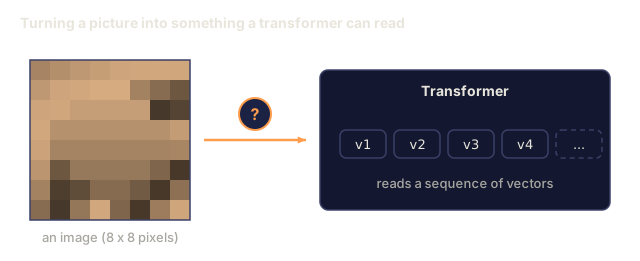
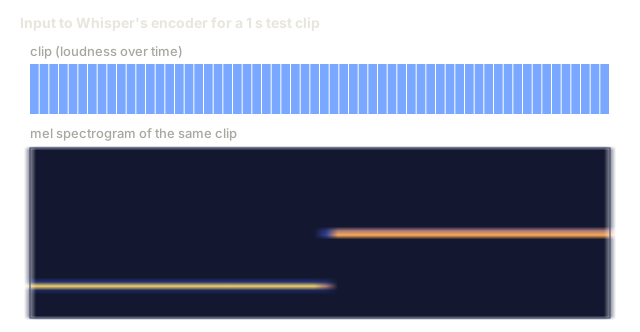
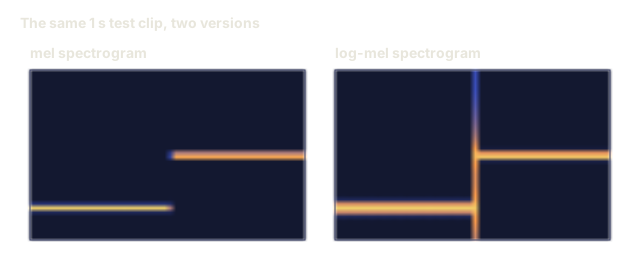
A log-mel spectrogram is audio drawn as an image of frequency over time. Whisper is a ViT that eats mel spectrograms and speaks back in text tokens.
Learning Objectives
- Trace Whisper's pipeline from 16 kHz audio through the log-mel spectrogram, convolutional stem, encoder, and decoder to text tokens.
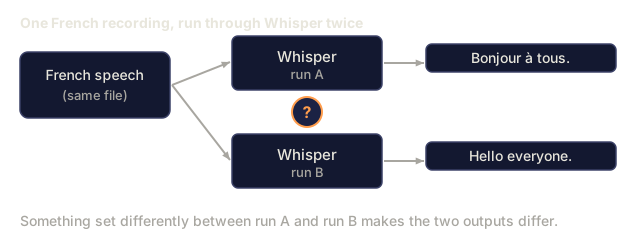
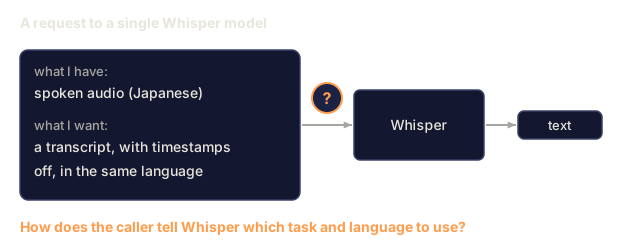
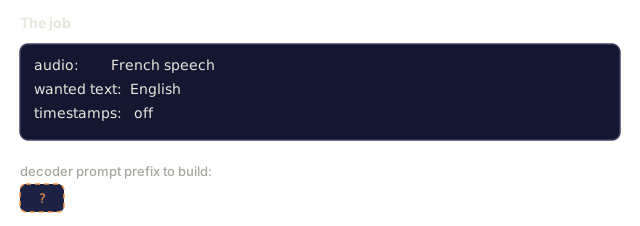
- Control Whisper's task, language, and timestamp behavior with the control-token prefix of the decoder prompt.
- Compute frame counts for a 25 ms window with a 10 ms hop and pad the result to Whisper's 3,000-frame window.
- Choose between Whisper sizes and alternatives (turbo, faster-whisper, Moonshine, pyannote) from their trade-offs and limits.
The Problem
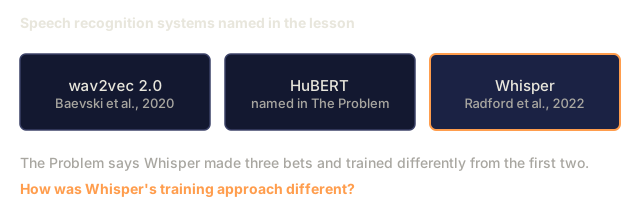
Automatic speech recognition (ASR) is the task of turning audio into text. Before Whisper (OpenAI, Radford et al. 2022), state-of-the-art ASR meant wav2vec 2.0 and HuBERT: self-supervised feature extractors plus a fine-tuned head. Quality was high, but the data pipelines were expensive and the models were domain-brittle. Multilingual recognition needed separate models per language family.
Whisper made three bets:
- Train on everything. 680,000 hours of weakly-labeled audio scraped from the internet across 97 languages. No clean academic corpus, no phoneme labels.
- Multi-task single model. One decoder trained jointly on transcription, translation, voice activity detection, language ID, and timestamping via task tokens.
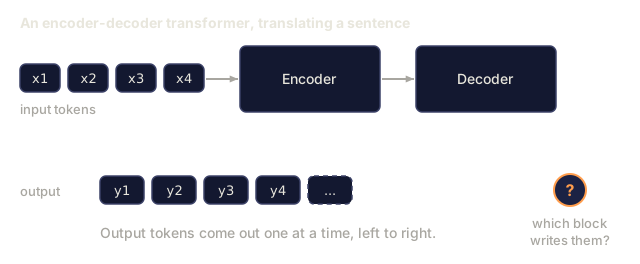
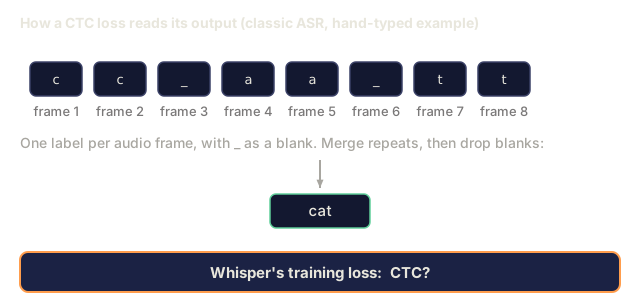
- Standard encoder-decoder transformer. The encoder consumes log-mel spectrograms and the decoder produces text tokens autoregressively. No vocoder, no CTC, no HMM.
The result is that Whisper large-v3 holds up across accents, noise, and languages with no clean labeled data. In 2026 it is the default speech front-end for open-source voice assistants and many commercial ones.
The Concept

Whisper is an encoder-decoder transformer that reads a 30-second log-mel spectrogram and writes out text tokens. The pipeline runs in six steps.
Step 1: resample + window
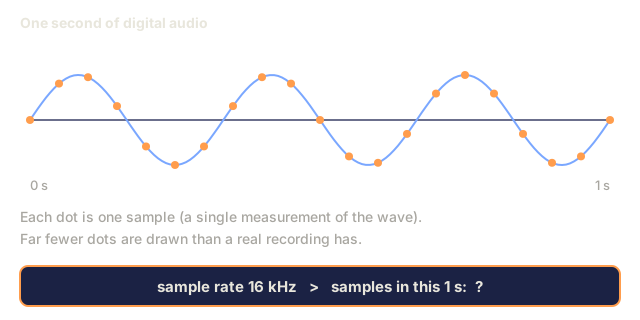
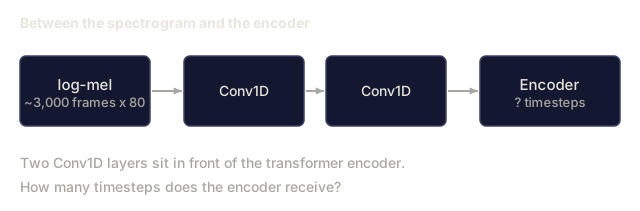
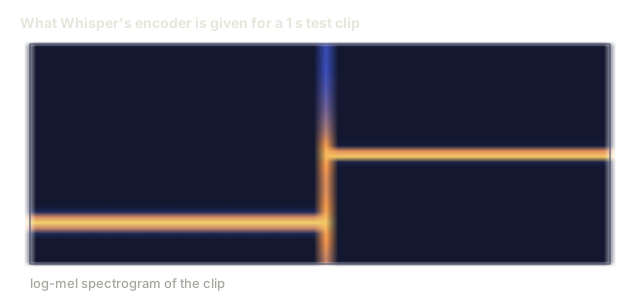
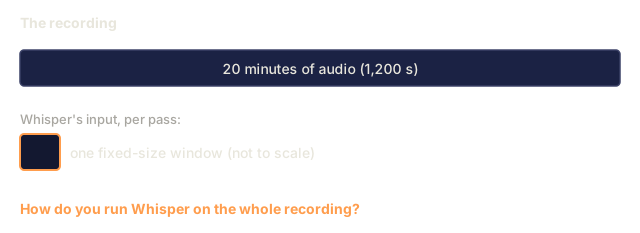
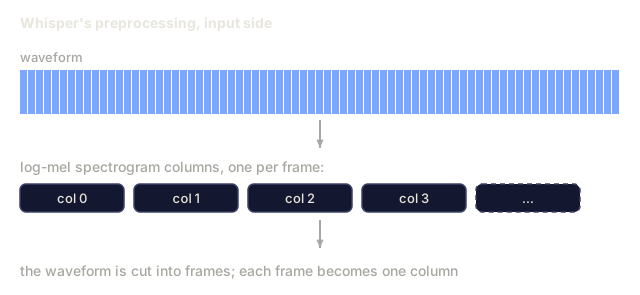
Audio is resampled to 16 kHz and clipped or padded to 30 seconds. The log-mel spectrogram has 80 mel bins at a 10 ms stride, which gives ~3,000 frames × 80 features. That is the "input image" Whisper sees.
Step 2: convolutional stem
Two Conv1D layers with kernel 3 and stride 2 reduce the 3,000 frames to 1,500. That halves the sequence length without adding many parameters.
Step 3: encoder
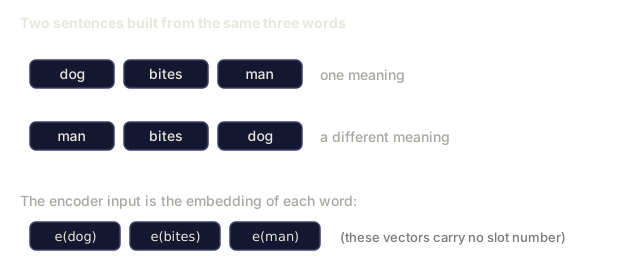
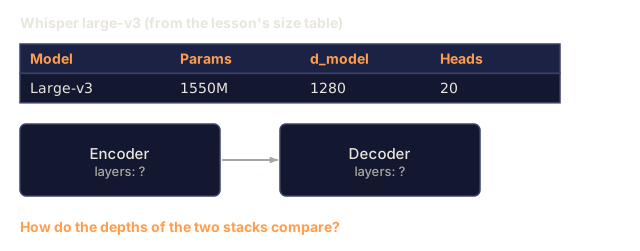
A 32-layer (for large) transformer encoder runs over the 1,500 timesteps, with sinusoidal positional encoding, self-attention, and a GELU FFN. It produces 1,500 × 1,280 hidden states.
Step 4: decoder
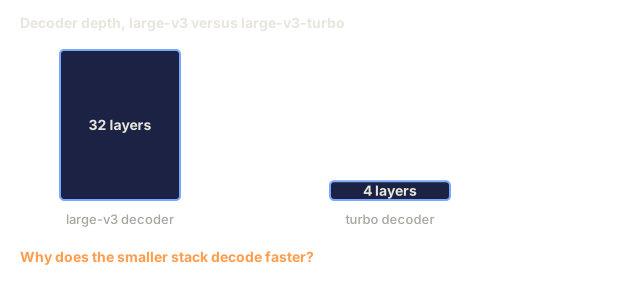
A 32-layer (for large) transformer decoder produces tokens autoregressively from a BPE vocabulary that is a superset of GPT-2's plus a few audio-specific special tokens.
Step 5: task tokens
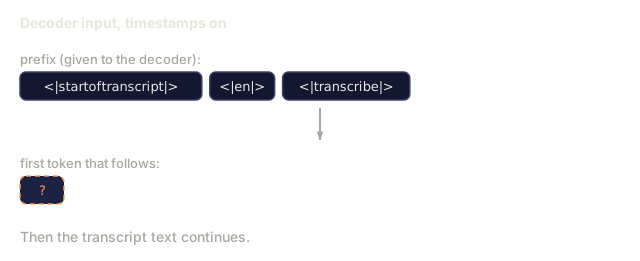
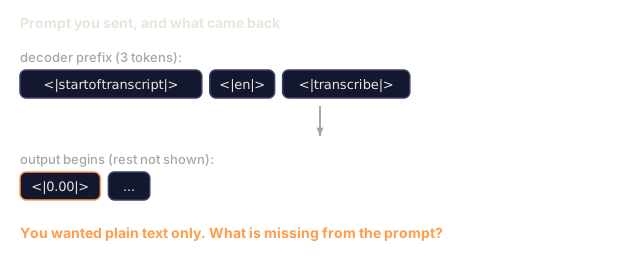
The decoder prompt starts with control tokens that tell the model what to do:
<|startoftranscript|> <|en|> <|transcribe|>
or
<|startoftranscript|> <|fr|> <|translate|>
The model was trained on this convention, so you pick the task with the prefix. With timestamps on, the model itself then emits <|0.00|> as its first output token; to turn timestamps off you append <|notimestamps|> to the prefix. It is the 2026 equivalent of instruction-tuning, applied to speech.
Step 6: output
Decoding uses beam search (width 5) with a log-prob threshold. When the <|notimestamps|> token is absent, timestamps are predicted every 0.02 seconds of audio.
Whisper sizes
| Model | Params | Layers | d_model | Heads | VRAM (fp16) |
|---|---|---|---|---|---|
| Tiny | 39M | 4 | 384 | 6 | ~1 GB |
| Base | 74M | 6 | 512 | 8 | ~1 GB |
| Small | 244M | 12 | 768 | 12 | ~2 GB |
| Medium | 769M | 24 | 1024 | 16 | ~5 GB |
| Large | 1550M | 32 | 1280 | 20 | ~10 GB |
| Large-v3 | 1550M | 32 | 1280 | 20 | ~10 GB |
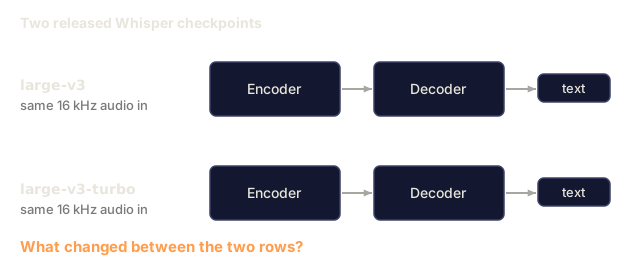
| Large-v3-turbo | 809M | 32 | 1280 | 20 | ~6 GB (4-layer decoder) |
Large-v3-turbo (2024) cut the decoder from 32 layers to 4, which gives 8× faster decoding with <1 WER point regression. That decode speed is why Whisper-turbo is the default for real-time voice agents in 2026.
What Whisper does not do
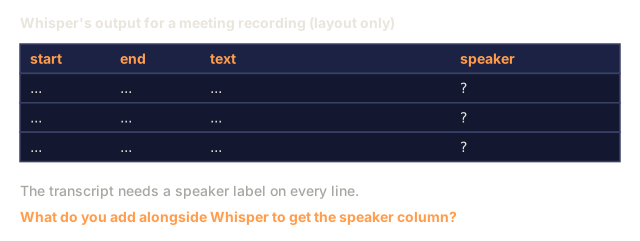
- No diarization (who is speaking). Pair it with pyannote for that.
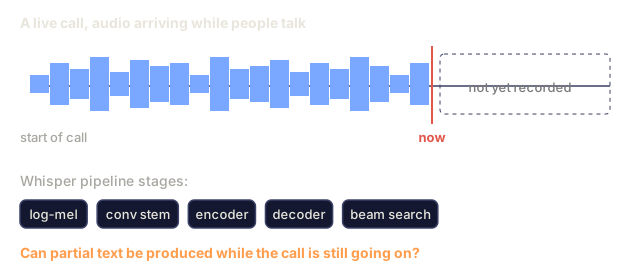
- No native real-time streaming, because the 30-second window is fixed. Wrappers such as
faster-whisperandWhisperXadd streaming through VAD and overlap. - No long-form context beyond 30 s without external chunking. That works well in practice because human speech rarely needs long-range context for transcription.
2026 landscape
| Task | Model | Notes |
|---|---|---|
| English ASR | Whisper-turbo, Moonshine | Moonshine is 4× faster on edge |
| Multilingual ASR | Whisper-large-v3 | 97 languages |
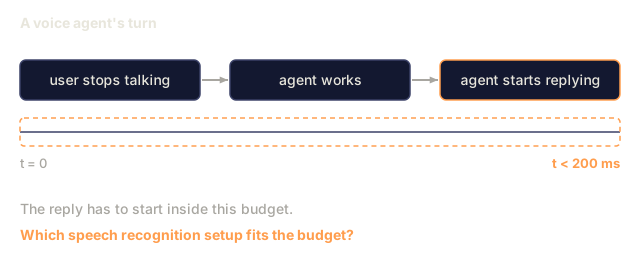
| Streaming ASR | faster-whisper + VAD | 150 ms latency targets achievable |
| TTS | Piper, XTTS-v2, Kokoro | Encoder-decoder pattern, but Whisper-shaped |
| Audio + language | AudioLM, SeamlessM4T | Text tokens + audio tokens in one transformer |
Build It
See code/main.py. It doesn't train or run Whisper. It builds a simplified version of the preprocessing (framing, a per-frame log-energy stand-in for the mel features, padding to 3,000 frames) plus the task-token prompt formatter, the parts you touch in production. It has no mel filterbank or FFT, does not build the 30-second waveform clip (it only pads or clips the list of frames), and implements no convolutional stem, encoder, decoder, beam search, or timestamp prediction.
Step 1: synthesize audio
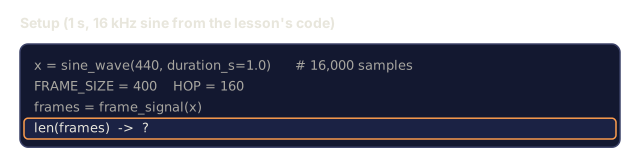
Generate a 1-second sine wave at 440 Hz sampled at 16 kHz, which is 16,000 samples.
Step 2: framing and log-energy (simplified mel stand-in)
A full log-mel spectrogram needs an FFT and a mel filterbank. This version does framing plus per-frame log sum-of-squares energy, which shows the pipeline's shape without requiring librosa:
def frame_signal(x, frame_size=400, hop=160):
    frames = []
    for start in range(0, len(x) - frame_size + 1, hop):
        frames.append(x[start:start + frame_size])
    return frames
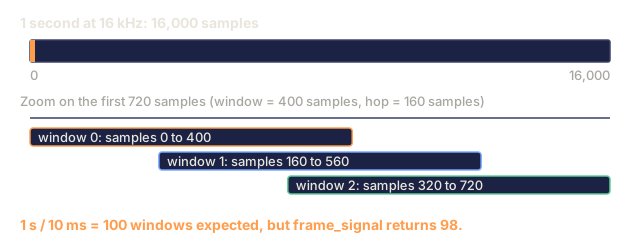
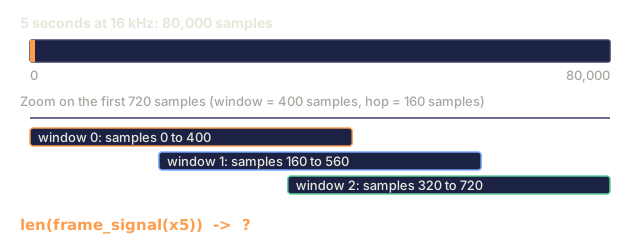
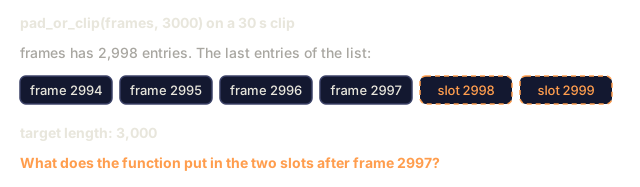
A frame is 25 ms and the hop is 10 ms, which matches Whisper's windowing. Per-frame log-energy stands in for mel bins: one number per frame instead of Whisper's 80. For the 1-second signal this gives 98 frames, not 100, because the last frame must fit entirely inside the signal: (16000 - 400) // 160 + 1 = 98.
Step 3: pad to 30 s
Whisper processes 30-second chunks, so pad_or_clip pads (or clips) the list of frames to 3,000 with all-zero frames. It works on frames, not on the waveform.
Step 4: build the prompt tokens
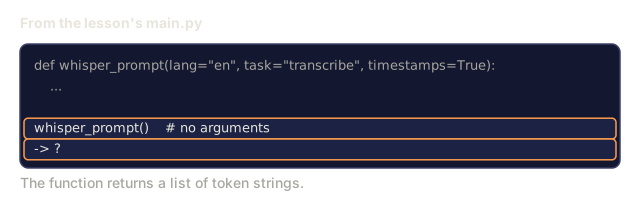
def whisper_prompt(lang="en", task="transcribe", timestamps=True):
    tokens = ["<|startoftranscript|>", f"<|{lang}|>", f"<|{task}|>"]
    if not timestamps:
        tokens.append("<|notimestamps|>")
    return tokens
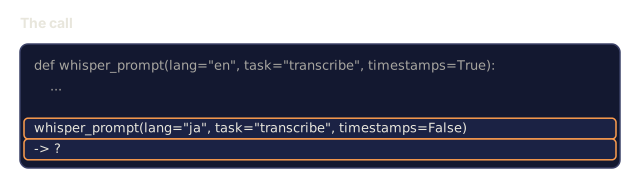
That function is the whole task-control surface. By default it returns a 3-token prefix (start token, language, task); with timestamps=False it appends <|notimestamps|> for a 4-token prefix.
Step 5: the size table
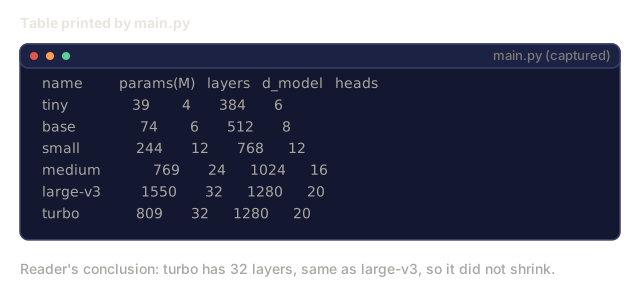
main.py also prints a size table in large-v3 geometry. It lists large-v3 and turbo but not the plain Large row from the table above. The turbo row shows 32 layers (the encoder depth); the 4-layer decoder is only mentioned in the line printed after the table.
Use It
import whisper
model = whisper.load_model("large-v3-turbo")
result = model.transcribe("meeting.wav", language="en", task="transcribe")
print(result["text"])
print(result["segments"][0]["start"], result["segments"][0]["end"])
Faster, OpenAI-compatible:
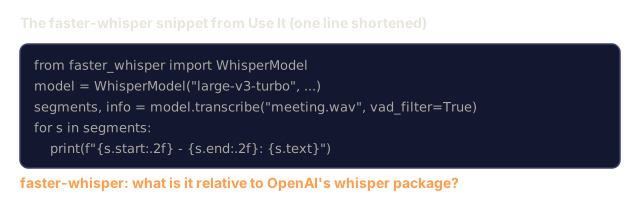
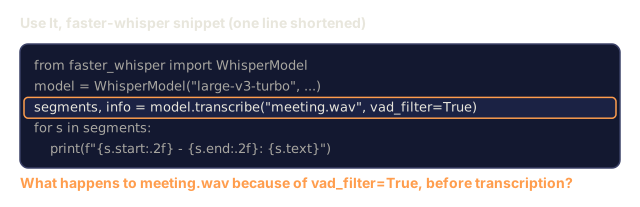
from faster_whisper import WhisperModel
model = WhisperModel("large-v3-turbo", compute_type="int8_float16")
segments, info = model.transcribe("meeting.wav", vad_filter=True)
for s in segments:
    print(f"{s.start:.2f} - {s.end:.2f}: {s.text}")
When to pick Whisper in 2026:
- Multilingual ASR with one model.
- Robust transcription of noisy, diverse audio.
- Research or prototype ASR, where it is the fastest starting point.
When to pick something else:
- Ultra-low latency streaming on edge: Moonshine beats Whisper at matched quality.
- Real-time conversational AI needing <200 ms: a dedicated streaming ASR.
- Speaker diarization: Whisper does not do this, so bolt on pyannote.
Ship It
The skill in outputs/skill-asr-configurator.md picks an ASR model, decoding parameters, and preprocessing pipeline for a new speech application.
I'd get the task prefix right before anything else. In main.py, whisper_prompt takes a language, a task, and a timestamps flag, and the demo prints three prefixes: English transcription, French translation without timestamps, and Japanese transcription. Those three lines are what separate the behaviors, and they are the part of Whisper you control from outside the model.
My bet is that the framing arithmetic is worth checking by hand. The script prints the frame counts for a 1-second and a 5-second signal, then pads the 5-second one out to the 3,000-frame target. If you change the frame size or the hop, predict the new counts before you run it.
I'd treat the per-frame energy as a placeholder. It gives one log-energy number per frame, where the code's own comment says Whisper uses 80 mel bins, so Exercise 2 is where the real spectrogram work happens. I'd read the size table the same careful way: the turbo row in main.py lists 32 layers, and the 4-layer decoder is mentioned in the line printed under the table.
Exercises
- Easy. Run
code/main.py. Confirm the frame count for a 1-second signal at 16 kHz with a 400-sample window and 160-sample (10 ms) hop. The formula(n - 400) // 160 + 1gives 98 frames, a little under the ~100 you'd get from 1 s / 10 ms. For 30 seconds the same formula gives 2,998, which is why padding to 3,000 matters. - Medium. Build the full log-mel spectrogram using
numpy.fft. Verify 80 mel bins matchlibrosa.feature.melspectrogram(n_mels=80)within numerical error. - Hard. Implement streaming inference: chunk audio into 10 s windows with 2 s overlap, run Whisper on each chunk, merge transcripts. Measure word-error rate vs single-pass on a 5-minute podcast sample.
Key Terms
| Term | What people say | What it actually means |
|---|---|---|
| Mel spectrogram | "Audio image" | 2D representation: frequency bins on one axis, time frames on the other; log-scaled energy per cell. |
| Log-mel | "What Whisper sees" | Mel spectrogram passed through log; approximates human perception of loudness. |
| Frame | "One time slice" | A 25 ms window of samples; overlapping at 10 ms stride. |
| Task token | "Prompt prefix for speech" | Special tokens like <|transcribe|> / <|translate|> in the decoder prompt. |
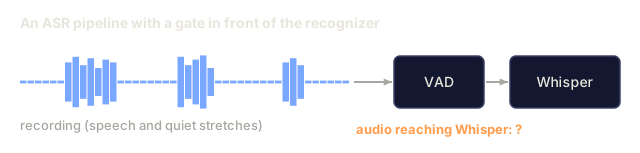
| Voice activity detection (VAD) | "Find the speech" | Gate that removes silence before ASR; cuts cost a lot. |
| CTC | "Connectionist Temporal Classification" | Classic ASR loss for alignment-free training; Whisper does not use it. |
| Whisper-turbo | "Small decoder, full encoder" | large-v3 encoder + 4-layer decoder; 8× faster decoding. |
| Faster-whisper | "The production wrapper" | CTranslate2 reimplementation; int8 quantization; 4× faster than OpenAI's reference. |
Further Reading
- Radford et al. (2022). Robust Speech Recognition via Large-Scale Weak Supervision: Whisper paper.
- OpenAI Whisper repo: reference code + model weights. Read
whisper/model.pyto see the Conv1D stem + encoder + decoder top-to-bottom in ~400 lines. - OpenAI Whisper:
whisper/decoding.py: the beam-search + task-token logic described in Steps 5–6 is here; 500 lines, fully readable. - Baevski et al. (2020). wav2vec 2.0: A Framework for Self-Supervised Learning of Speech Representations: precursor; still SOTA features in some settings.
- SYSTRAN/faster-whisper: production wrapper, 4× faster than reference.
- Jia et al. (2024). Moonshine: Speech Recognition for Live Transcription and Voice Commands: 2024 edge-friendly ASR, Whisper-shaped but smaller.
- HuggingFace blog: "Fine-Tune Whisper For Multilingual ASR with 🤗 Transformers": canonical fine-tuning recipe including mel spectrogram preprocessor and token-timestamp handling.
- HuggingFace
modeling_whisper.py: full implementation (encoder, decoder, cross-attention, generation) that mirrors the architecture diagram in The Concept.
Code
- main.py (python, 108 lines)