Speculative Decoding — Draft, Verify, Repeat
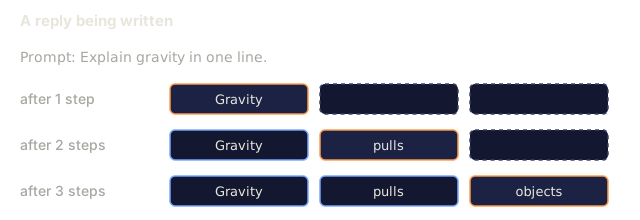
Speculative decoding lets a cheap draft model propose N tokens that the expensive verifier checks in one forward pass. Autoregressive decoding is serial, with each token waiting on the one before it, so when the draft is right you pay for one big forward and get N generations.
Learning Objectives
- Explain how a cheap draft model and an expensive verifier combine to produce several tokens per big-model forward pass.
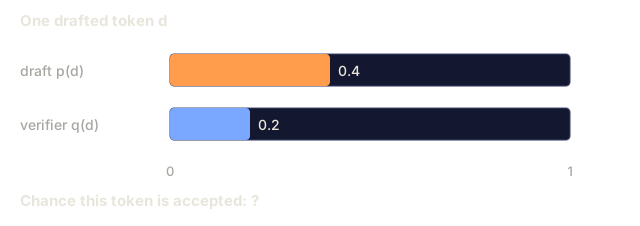
- Apply the accept rule min(1, q/p) and the residual distribution (q - p)_+ to show why the output matches the verifier's own distribution.
- Estimate expected tokens per verifier call from the acceptance rate and draft length, and name what drives the acceptance rate.
- Choose between vanilla, Medusa, EAGLE and lookahead for a workload, and describe the KV-cache rollback needed after a rejection.
The Problem
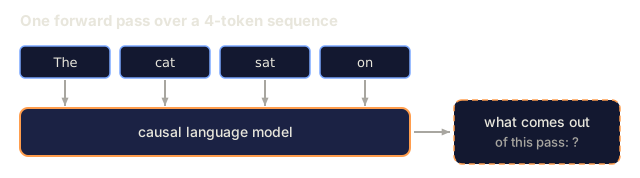
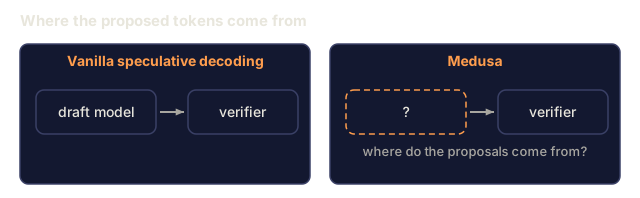
Speculative decoding is a way to generate tokens from a large model faster: a small draft model proposes several tokens ahead, and the large model, called the verifier, checks all of them in a single forward pass.
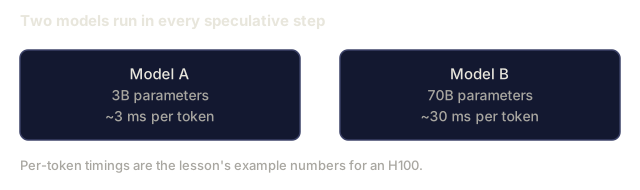
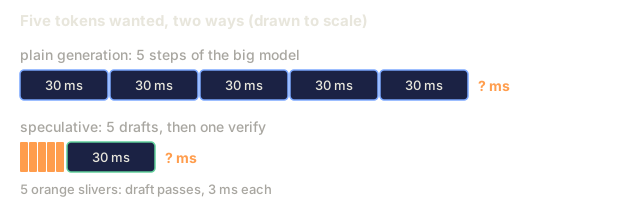
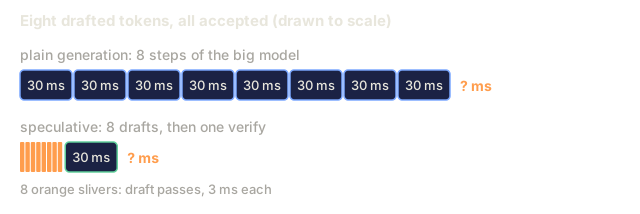
The arithmetic: a 70B LLM sampling one token takes ~30 ms on an H100, and a 3B draft model takes ~3 ms. If the 3B drafts 5 tokens ahead and the 70B runs once to verify all 5, the total is 5×3 + 30 = 45 ms for up to 5 accepted tokens, versus 5×30 = 150 ms for straight-line generation. That is the whole pitch: spend a little extra GPU memory on the draft model and get 2–4× lower decode latency.
The trick has to preserve the distribution. Speculative sampling, introduced by Leviathan et al. (2023) and by Chen et al. concurrently, guarantees that the output sequence is identically distributed to what the big model would have produced on its own. No quality tradeoff. Just faster.
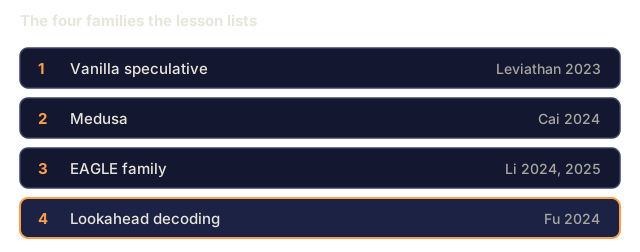
Four families of draft-verifier pairs dominate 2026 inference:
- Vanilla speculative (Leviathan 2023). A separate draft model (e.g., Llama 3 1B) plus a verifier (e.g., Llama 3 70B).
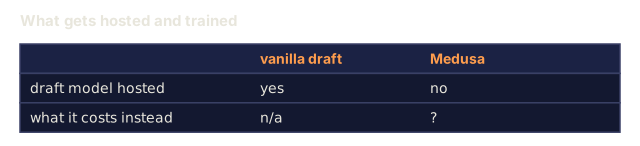
- Medusa (Cai 2024). Multiple decoding heads on the verifier predict positions
t+1..t+kin parallel. No separate draft model. - EAGLE family (Li 2024, 2025). A lightweight draft that reuses the verifier's hidden states. Its acceptance rate is higher than vanilla's, and a 3–4× speedup is typical.
- Lookahead decoding (Fu 2024). Jacobi iteration with no draft model at all. This is self-speculation: niche, but dependency-free.
Production inference stacks ship speculative decoding by default in 2026. vLLM, TensorRT-LLM, SGLang, and llama.cpp all support at least vanilla and EAGLE-2.
The Concept
The core algorithm
Given a verifier M_q and a cheaper draft M_p:
- Let
x_1..x_kbe the prefix already decoded. - Draft: use
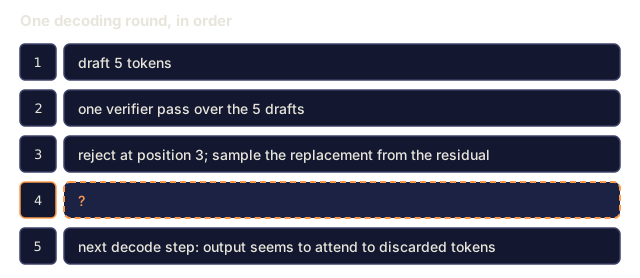
M_pto autoregressively proposed_{k+1}, d_{k+2}, ..., d_{k+N}with draft probabilitiesp_1..p_N. - Verify in parallel: run
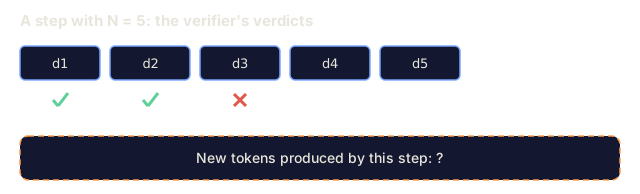
M_qonce onx_1..x_k, d_{k+1}, ..., d_{k+N}, getting verifier probabilitiesq_1..q_{N+1}for positionsk+1..k+N+1. - Accept or reject each draft token left to right: for each
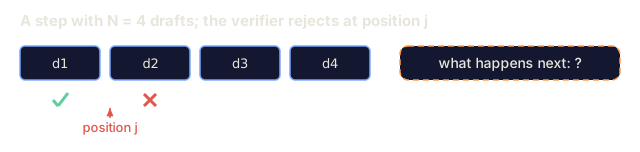
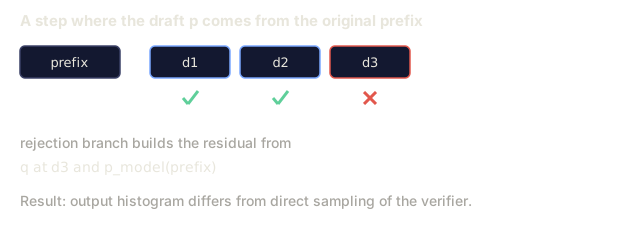
i, accept with probabilitymin(1, q_i(d_i) / p_i(d_i)). - On the first rejection at position
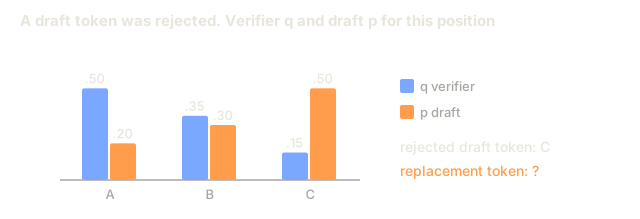
j: samplet_jfrom the "residual" distribution(q_j - p_j)_+, normalized. All drafts afterjare discarded. - If all
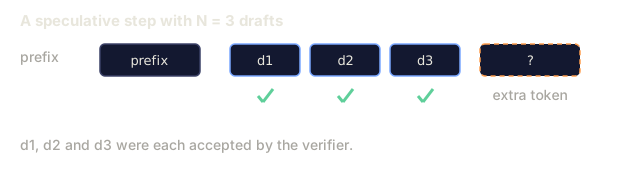
Nare accepted: sample one extra tokent_{N+1}fromq_{N+1}(the free bonus token).
The residual distribution is the mathematical insight that keeps the output distributed exactly as if M_q had sampled from scratch.
What determines speedup
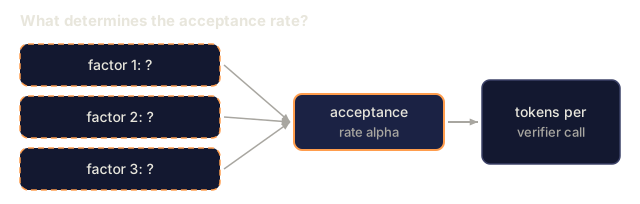
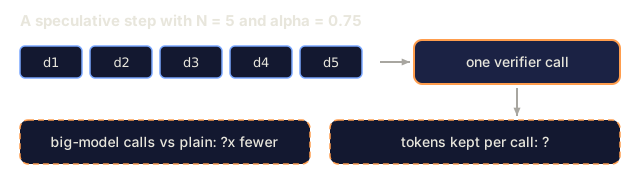
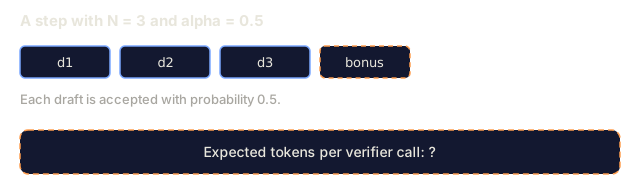
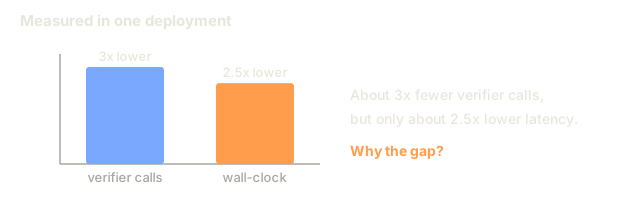
Let α be the expected acceptance rate per draft token and c the draft-to-verifier cost ratio. Per step, naive generation makes 1 big-model call per token. Speculative decoding makes 1 big-model call per (1 - α^{N+1}) / (1 - α) ≈ 1/(1-α) tokens when α is high.
A rule of thumb at α = 0.75 and N = 5: 3× fewer big-model calls. The draft costs 5× less per call, and total wall-clock drops ~2.5×.
α depends on:
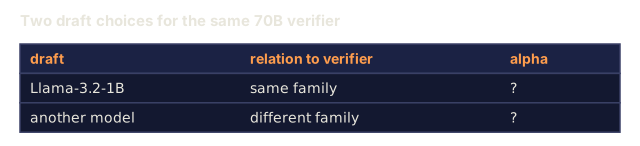
- How well the draft approximates the verifier. Same family or same training data raises α significantly.
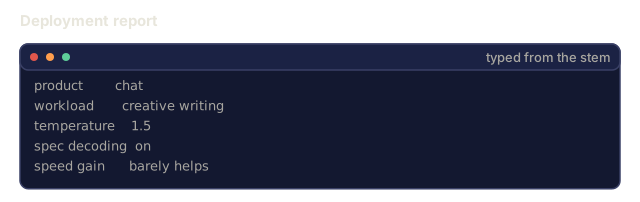
- Decoding strategy. A greedy draft against a greedy verifier gives high α. Temperature sampling is harder to match, and acceptance drops.
- Task type. Code and structured output accept more because they are predictable. Free-form creative writing accepts less.
Medusa: drafts without a draft model
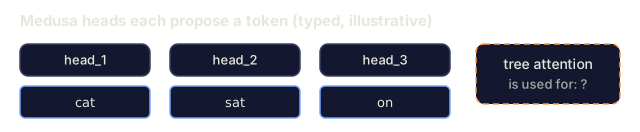
Medusa replaces the draft model with extra output heads on the verifier. At position t:
shared trunk → hidden h_t
    ├── head_0: predict token at t+1  (standard LM head)
    ├── head_1: predict token at t+2
    ├── head_2: predict token at t+3
    ├── head_3: predict token at t+4
Each head outputs its own logits. At inference you sample from each head to get a candidate sequence, then verify with one forward pass using a tree-attention scheme that considers all candidate continuations at once.
The upside is that there is no second model to host. The cost is extra trainable parameters and a supervised fine-tuning stage (~1B tokens), and the acceptance rate runs a bit lower than vanilla speculative decoding with a good draft.
EAGLE: a better draft from reused hidden states
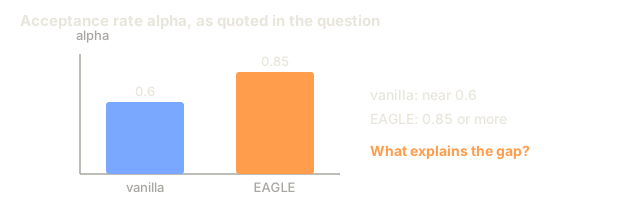
EAGLE-1/2/3 (Li et al., 2024–2025) makes the draft model a tiny transformer (typically 1 layer) that ingests the verifier's last-layer hidden states. Because the draft sees the verifier's feature representation, its predictions correlate strongly with the verifier's output distribution. Acceptance rates climb from ~0.6 (vanilla) to 0.85+.
EAGLE-3 (2025) added tree search over candidate continuations. vLLM and SGLang ship EAGLE-2/3 as the default spec pathway for Llama 3/4 and Qwen 3.
The KV cache dance
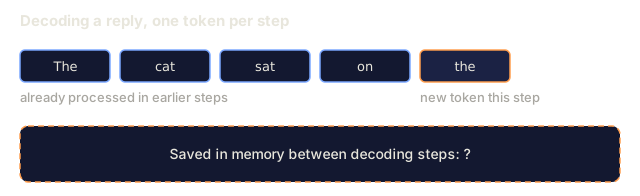
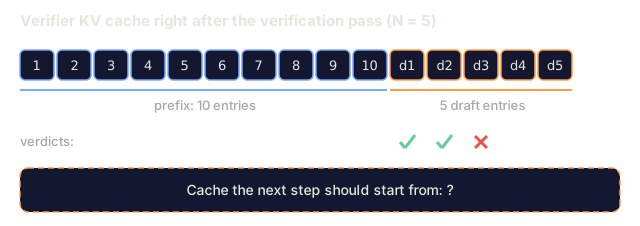
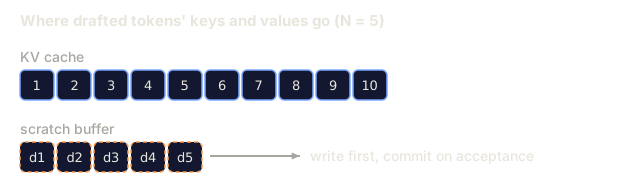
Verification feeds N draft tokens into the verifier in one forward pass, which extends the verifier's KV cache by N entries. If some drafts are rejected, you must roll the cache back to the accepted prefix length.
Production implementations (vLLM's --speculative-model, TensorRT-LLM's LookaheadDecoder) handle this with scratch KV buffers: write first, commit on acceptance. The idea is not conceptually hard, but the bookkeeping is fiddly.
Build It
See code/main.py. It implements the core speculative-sampling algorithm (rejection step plus residual distribution) with:
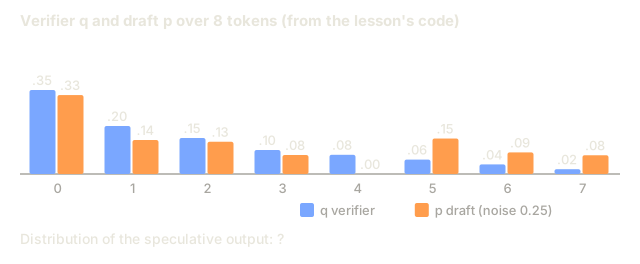
- A "big model" that is a deterministic softmax over a hand-coded distribution, so the acceptance math can be checked analytically.
- A "draft model" that is a perturbation of the big model.
- An acceptance and rejection loop that produces the same marginal distribution as direct sampling.
The snippets below are illustrative. In main.py the accept test is inline, and the functions are residual(q, p), spec_step_one_token(q, p, rng) and spec_step_n(q, p, N, rng). They take fixed q and p probability vectors per call, so there is no prefix, no model callables, and no KV cache.
Step 1: the rejection step
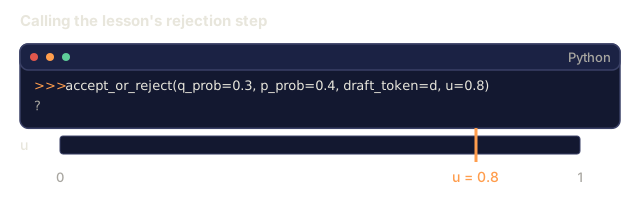
def accept_or_reject(q_prob, p_prob, draft_token, u):
    ratio = q_prob / p_prob if p_prob > 0 else float("inf")
    return u < min(1.0, ratio)
u is a uniform random number. q_prob is the verifier's probability for the drafted token and p_prob is the draft model's. The Leviathan theorem says this Bernoulli decision, followed by sampling from the residual on rejection, preserves the verifier's distribution exactly.
Step 2: residual distribution
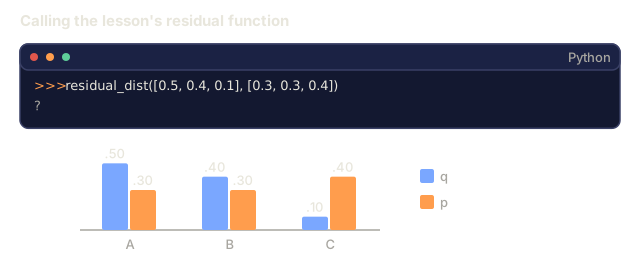
def residual_dist(q, p):
    raw = [max(0.0, qi - pi) for qi, pi in zip(q, p)]
    s = sum(raw)
    return [r / s for r in raw]
Subtract p from q element-wise, clamp negative values to zero, and renormalize. On a rejection, sample from this. main.py's residual(q, p) returns list(q) when the clamped sum is 0 (which only happens when q == p), where the snippet above would divide by zero.
Step 3: one speculative step
def spec_step(prefix, q_model, p_model, N, rng):
    drafts = []
    p_probs = []
    ctx = list(prefix)
    for _ in range(N):
        p_dist = p_model(ctx)
        d = sample(p_dist, rng)
        drafts.append(d)
        p_probs.append(p_dist[d])
        ctx.append(d)

    q_dists = [q_model(prefix + drafts[:i]) for i in range(N + 1)]

    for i, d in enumerate(drafts):
        u = rng.random()
        q_prob = q_dists[i][d]
        p_prob = p_probs[i]
        if u < min(1.0, q_prob / p_prob if p_prob > 0 else float("inf")):
            prefix = prefix + [d]
        else:
            res = residual_dist(q_dists[i], p_model(prefix))
            prefix = prefix + [sample(res, rng)]
            return prefix
    prefix = prefix + [sample(q_dists[N], rng)]
    return prefix
Five accepted → one bonus → six tokens produced in one verifier pass.
This snippet is a sketch of the full algorithm with model callables, not code from main.py; the file's spec_step_n(q, p, N, rng) runs the same accept loop on fixed vectors. One detail worth getting right: on rejection at position i, the p in the residual must be the draft distribution that produced the rejected draft, which is the draft's distribution at context prefix + drafts[:i]. Here that works because prefix has already been extended by each accepted draft by the time the rejection branch runs, but storing the draft distributions from the drafting loop and reusing p_dists[i] is clearer and harder to break.
Step 4: measure acceptance rate
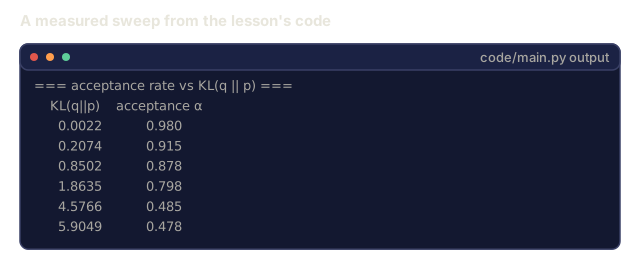
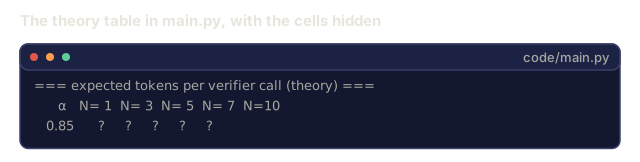
main.py runs 5,000 one-token speculative steps at each of six draft-noise levels and prints a table of acceptance rate next to the KL divergence between verifier and draft distributions. It prints a table rather than a plot, so plot it yourself if you want the curve. The relationship comes out monotone: more KL, lower acceptance. It then prints expected tokens per verifier call for N of 1, 3, 5, 7 and 10 at five values of α, and its takeaway line (α = 0.85, N = 5 gives about 4.1 tokens per call) is a count of verifier calls. It measures no wall-clock time, so the rule of thumb in The Concept (α = 0.75, N = 5, about 3× fewer calls and ~2.5× wall-clock) is a figure to check on your own workload.
Step 5: verify distribution equivalence
The histogram of tokens produced by the speculative loop should match the histogram from sampling directly from the verifier. This is the Leviathan theorem in practice. main.py draws 50,000 tokens each way using spec_step_one_token (not the N-token path), computes a chi-square statistic, and prints PASS when it is under 30 on 7 degrees of freedom. It does not compute a p-value.
Use It
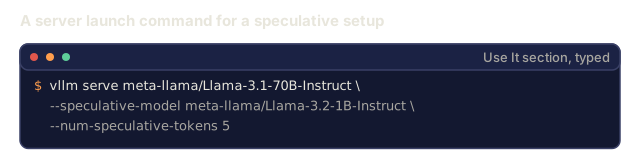
In production you launch a server with the speculative settings:
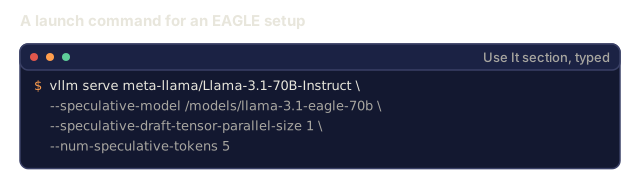
# vLLM with EAGLE
vllm serve meta-llama/Llama-3.1-70B-Instruct \
    --speculative-model /models/llama-3.1-eagle-70b \
    --speculative-draft-tensor-parallel-size 1 \
    --num-speculative-tokens 5

# vLLM with vanilla draft model
vllm serve meta-llama/Llama-3.1-70B-Instruct \
    --speculative-model meta-llama/Llama-3.2-1B-Instruct \
    --num-speculative-tokens 5
TensorRT-LLM has the fastest Medusa path as of mid-2026. faster-whisper wraps speculative decoding for Whisper-large with a small draft.
Picking a draft:
| Strategy | When to pick | Speedup |
|---|---|---|
| Vanilla draft (1B/3B Llama family) | Fast prototype, no training | 1.8–2.3× |
| Medusa heads | You can fine-tune the verifier | 2–3× |
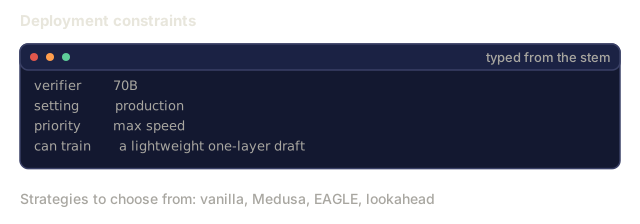
| EAGLE-2 / 3 | Production, max speed | 3–4× |
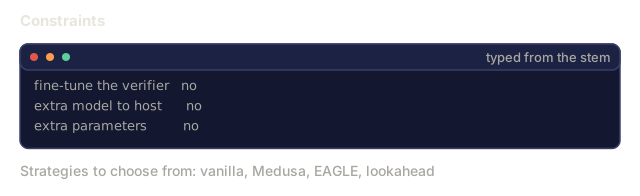
| Lookahead | No draft, no training, no extra params | 1.3–1.6× |
When NOT to spec-decode:
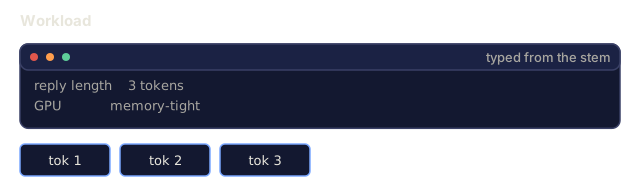
- Single-sequence generation of 1–5 tokens. Overhead dominates.
- Wildly creative or high-temperature sampling (α drops).
- Memory-constrained deployments (the draft model adds VRAM).
Ship It
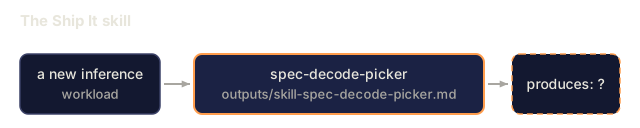
The skill in outputs/skill-spec-decode-picker.md picks a speculative decoding strategy (vanilla / Medusa / EAGLE / lookahead) and tuning parameters (N, draft temperature) for a new inference workload.
Before I trust a speedup number, I want the distribution check in main.py to pass. It samples 50,000 tokens both ways and prints PASS when chi^2 is under 30 on 7 degrees of freedom. It doesn't compute a p-value, so for Exercise 1 I work out the p > 0.05 test myself instead of leaning on that threshold.
The number I'd carry away is how α moves with draft quality. main.py sweeps six noise levels and prints acceptance rate next to KL(q || p), then prints expected tokens per verifier call for N of 1, 3, 5, 7, and 10 at five values of α. That table counts verifier calls, not milliseconds, and its own takeaway line says "minus draft-model overhead." The speedup figures in the Use It table are claims to measure on your own workload.
The script also leaves something out. Its q and p are fixed distributions per call, so it has no prefix and no KV cache, and the rollback problem doesn't come up. Exercise 4 is where it does, and I'd do it before putting any of this near a serving stack.
Exercises
- Easy. Run
code/main.py. Confirm the speculative token distribution matches the verifier's direct-sample distribution on 50,000 tokens.main.pyprints the chi-square statistic and PASS under 30; to test p > 0.05 yourself, compare the statistic against the 7-degree-of-freedom critical value of 14.07. - Medium. Plot speedup (tokens per big-model forward) as a function of
Nforα = 0.5, 0.7, 0.85. Identify the optimalNfor each α. (Hint: expected tokens per verify call =(1 - α^{N+1}) / (1 - α).) - Hard. Implement a tiny Medusa: take the capstone GPT from Lesson 14, add 3 extra LM heads that predict positions t+2, t+3, t+4. Train on tinyshakespeare with a joint multi-head loss. Compare acceptance rates vs a vanilla draft made by truncating the same model.
- Hard. Implement rollback: start with a 10-token prefix KV cache, feed 5 draft tokens, simulate a rejection at position 3. Verify your cache reads correctly match "prefix + first 2 accepted drafts" at the next iteration.
Key Terms
| Term | What people say | What it actually means |
|---|---|---|
| Draft model | "The cheap one" | A smaller model that proposes candidate tokens; usually 10–50× cheaper than the verifier. |
| Verifier | "The big one" | The target model whose distribution we preserve; runs once per speculative step. |
| Acceptance rate (α) | "How often the draft is right" | Per-token probability that the verifier accepts the draft. 0.7–0.9 typical. |
| Residual distribution | "The rejection fallback" | (q - p)_+ normalized; sampling from this on rejection preserves the verifier's distribution. |
| Bonus token | "The free one" | When all N drafts accepted, sample one more from the verifier's next-step distribution. |
| Medusa | "Draft-less speculative" | Multiple LM heads on the verifier predict positions t+1..t+k in parallel. |
| EAGLE | "Hidden-state draft" | Tiny transformer draft conditioned on the verifier's last-layer hidden states. |
| Lookahead decoding | "Jacobi iteration" | Self-speculation using a fixed-point iteration; no draft model. |
| Tree attention | "Verify many candidates at once" | Branching verification that considers several draft continuations simultaneously. |
| KV rollback | "Undo rejected drafts" | Scratch KV buffer; commit on acceptance, discard on reject. |
Further Reading
- Leviathan, Kalman, Matias (2023). Fast Inference from Transformers via Speculative Decoding: the core algorithm and the equivalence theorem.
- Chen et al. (2023). Accelerating Large Language Model Decoding with Speculative Sampling: concurrent introduction; clean Bernoulli-rejection proof.
- Cai et al. (2024). Medusa: Simple LLM Inference Acceleration Framework with Multiple Decoding Heads: Medusa paper; tree-attention verification.
- Li et al. (2024). EAGLE: Speculative Sampling Requires Rethinking Feature Uncertainty: EAGLE-1; hidden-state-conditioned draft.
- Li et al. (2024). EAGLE-2: Faster Inference of Language Models with Dynamic Draft Trees: EAGLE-2; dynamic tree depth.
- Li et al. (2025). EAGLE-3: Scaling up Inference Acceleration of Large Language Models via Training-Time Test: EAGLE-3.
- Fu et al. (2024). Break the Sequential Dependency of LLM Inference Using Lookahead Decoding: lookahead, no-draft approach.
- vLLM docs: Speculative Decoding: canonical production reference with all four strategies wired up.
- SafeAILab / EAGLE reference implementation: the reference code for EAGLE-1/2/3.
Code
- main.py (python, 160 lines)