Instruction Tuning (SFT)
A base model predicts the next token and nothing else. It doesn't follow instructions, answer questions, or refuse harmful requests. SFT bridges the gap between a token predictor and a useful assistant, and chat models like Claude, GPT, and Llama Chat all went through this step.
Learning Objectives
- Implement supervised fine-tuning (SFT) that converts a base language model into an instruction-following assistant
- Format training data using chat templates with system, user, and assistant roles, and mask loss on non-assistant tokens
- Explain why SFT is necessary: base models continue text rather than answer questions
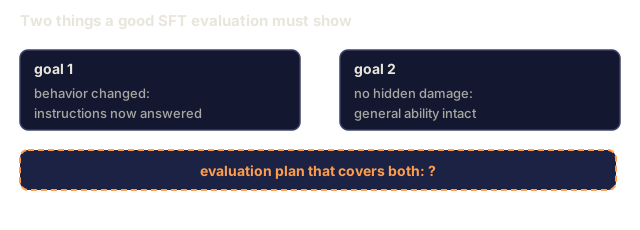
- Evaluate SFT quality by comparing base model vs fine-tuned model responses on a held-out instruction set
The Problem
You trained a model in Lesson 04. Give it a sequence and it predicts the next token. Feed it "The transformer architecture" and it might continue with "has revolutionized natural language processing." Good for a next-token predictor.
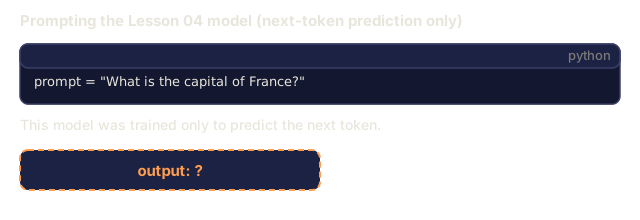
Now feed it "What is the capital of France?" A base model doesn't answer "Paris." It continues the pattern, and the pattern might be a list of questions: "What is the capital of Germany? What is the capital of Spain?" Or it might produce "is a question that many people ask," because that is a plausible continuation too. The model has no concept of answering. It only knows continuing.
That's the gap between GPT-3 (base model, released June 2020) and ChatGPT (instruction-tuned, released November 2022). Same architecture, same pre-training. The difference is 20,000 to 100,000 carefully crafted (instruction, response) pairs that taught the model the conversation pattern.
Stanford Alpaca showed you don't need millions of examples. In March 2023 they fine-tuned Llama 7B on 52,000 instruction-response pairs generated by GPT-3.5, for a total cost of $600. The result followed instructions, answered questions, and held conversations. It wasn't as good as ChatGPT, but it was close for $600 and a few hours of training.
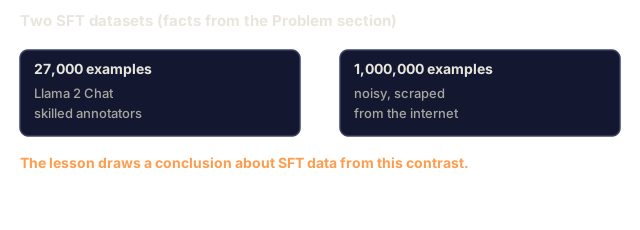
Meta's Llama 2 Chat used about 27,000 high-quality examples for its initial SFT stage. Quality matters more than quantity: 27,000 examples from skilled annotators beat 1 million noisy examples scraped from the internet.
The Concept
What SFT Actually Does
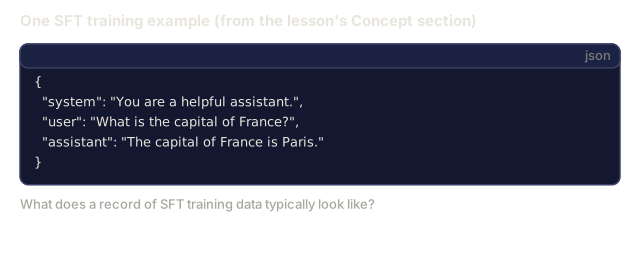
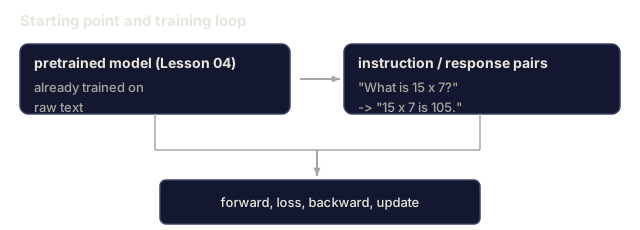
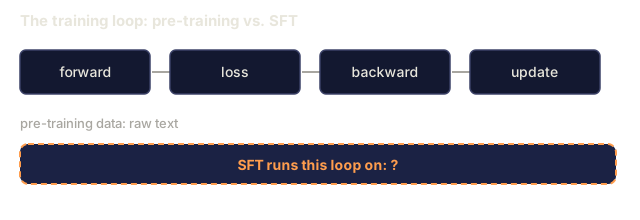
Supervised Fine-Tuning continues the same training loop from pre-training (forward pass, compute loss, backward pass, update weights) but on a different kind of data. Instead of raw text, you train on structured conversations:
{
  "system": "You are a helpful assistant.",
  "user": "What is the capital of France?",
  "assistant": "The capital of France is Paris."
}
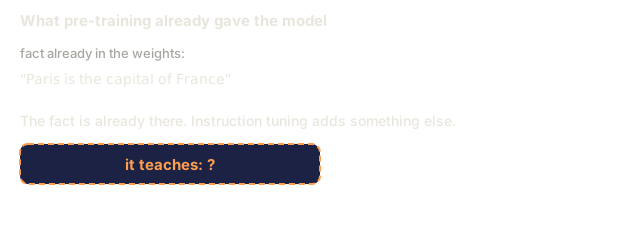
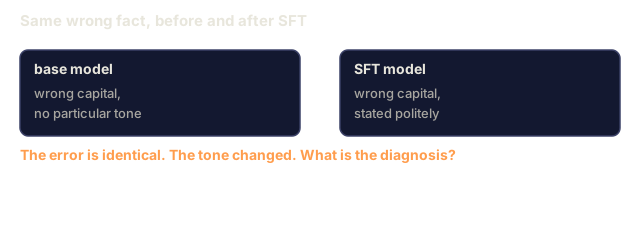
The model already knows that Paris is the capital of France. It learned this during pre-training on Wikipedia, textbooks, and web pages. SFT doesn't teach the model new facts. It teaches the model a new behavior: when you see a question, produce an answer. When you see an instruction, produce a completion. When you see a harmful request, produce a refusal.
Think of it this way. Pre-training gives the model knowledge. SFT gives the model manners.
Data Formats
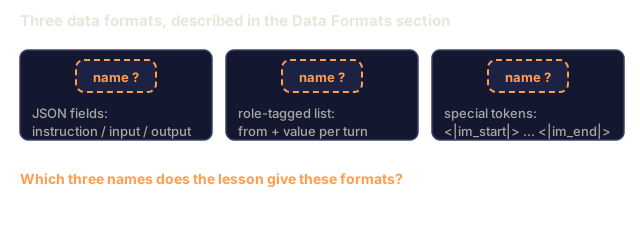
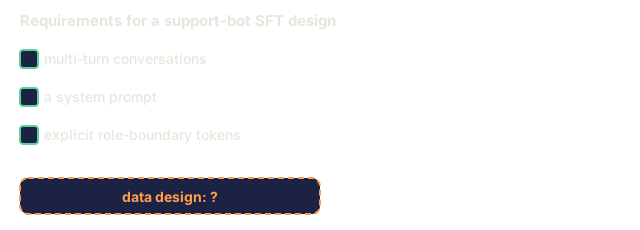
Three formats dominate the industry. Each encodes the same information, who said what, with different delimiters.
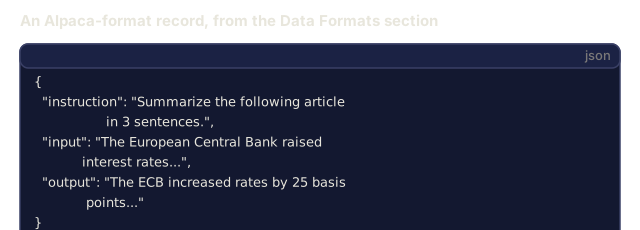
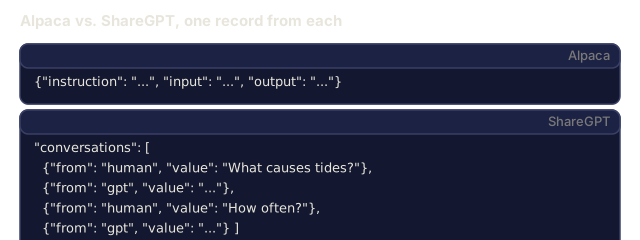
Alpaca Format (Stanford, March 2023):
{
  "instruction": "Summarize the following article in 3 sentences.",
  "input": "The European Central Bank raised interest rates...",
  "output": "The ECB increased rates by 25 basis points..."
}
Simple and widely used. The input field is optional, since many instructions don't need additional context. Stanford released 52,000 examples in this format, generated by GPT-3.5 for $600. This kicked off the open-source instruction tuning movement.
ShareGPT Format (community, 2023):
{
  "conversations": [
    {"from": "system", "value": "You are a helpful assistant."},
    {"from": "human", "value": "What causes tides?"},
    {"from": "gpt", "value": "Tides are caused by the gravitational pull of the Moon..."},
    {"from": "human", "value": "How often do they occur?"},
    {"from": "gpt", "value": "Most coastal areas experience two high tides and two low tides per day..."}
  ]
}
Supports multi-turn conversations. The "from" field uses "human" and "gpt" by convention, regardless of the actual model. Vicuna was trained on 70,000 ShareGPT conversations scraped from user-shared ChatGPT transcripts.
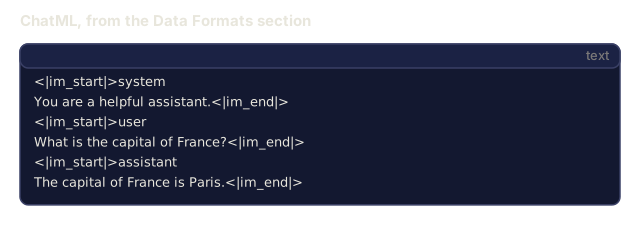
ChatML Format (OpenAI, used by many open-source models):
<|im_start|>system
You are a helpful assistant.<|im_end|>
<|im_start|>user
What is the capital of France?<|im_end|>
<|im_start|>assistant
The capital of France is Paris.<|im_end|>
Uses special tokens (<|im_start|>, <|im_end|>) to delimit roles. These tokens are added to the tokenizer's vocabulary during fine-tuning. Qwen, Yi, and many other models use ChatML.
All three formats accomplish the same thing: they tell the model "this is the instruction, this is the response, learn this pattern."
Why It Works
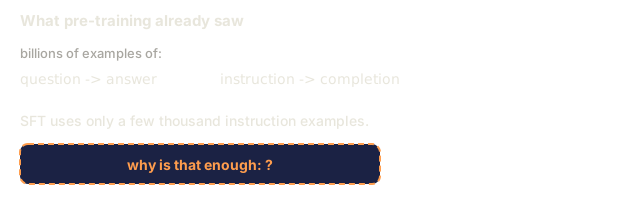
The model already knows language from pre-training. It has seen billions of examples of questions followed by answers, instructions followed by completions, and conversations between people. The patterns are already encoded in the weights.
SFT concentrates this latent ability. Instead of the model needing to figure out from context whether it should answer a question or continue a document, SFT explicitly trains on the conversation pattern. After a few thousand examples, the model learns: when you see the assistant role marker, produce a helpful response.
This is why 27,000 examples is enough. You're not teaching the model English. You're not teaching it facts about the world. You're teaching it one simple behavior: respond to instructions. The knowledge was already there.
The Masked Loss
This is the most important technical detail in SFT, and many tutorials skip it.
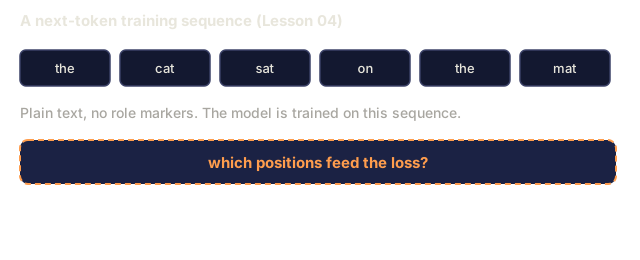
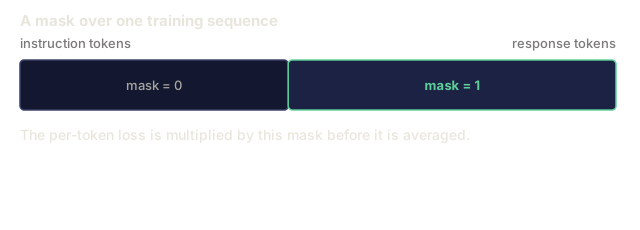
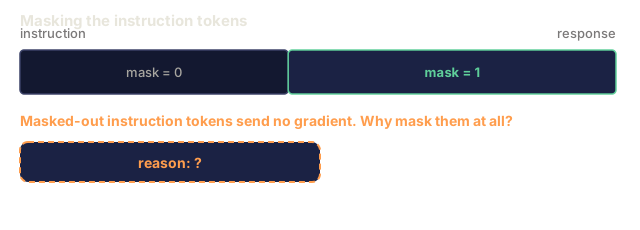
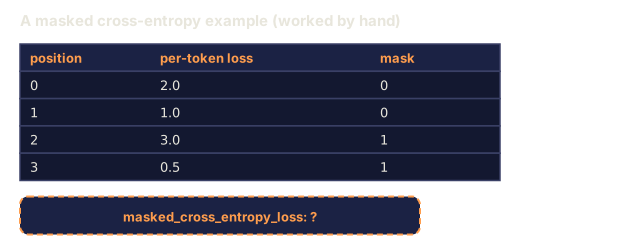
During pre-training, you compute loss on every token. The model learns to predict every next token in the sequence. During SFT, you only compute loss on the response tokens. The instruction tokens are there for context, but the model is not penalized for "predicting" them incorrectly.
Why? Because you don't want the model to learn to generate instructions. You want it to learn to respond to instructions. If you compute loss on the instruction tokens, you're training the model to predict "What is the capital of France?" as if it's the one asking the question. That wastes gradient signal and can confuse the model about its role.
In practice, you create a loss mask: 1 for response tokens, 0 for instruction tokens. Multiply the per-token loss by this mask before averaging.
Tokens:    [SYS] You are helpful [USER] What is the capital? [ASST] Paris is the capital [EOS]
Loss mask:   0    0    0     0      0     0   0  0     0       1     1    1   1     1      1
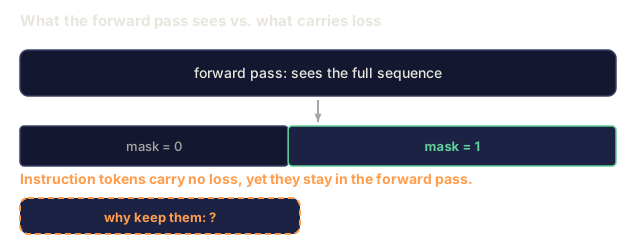
Only the tokens after [ASST] contribute to the loss. The model sees the full conversation during the forward pass (it needs the instruction to produce the right response) but only updates its weights based on how well it predicted the response.
Training Hyperparameters
SFT uses very different hyperparameters than pre-training. You're not training from scratch. You're adjusting a model that already works.
| Parameter | Pre-Training (Llama 2 7B) | SFT (Llama 2 Chat) |
|---|---|---|
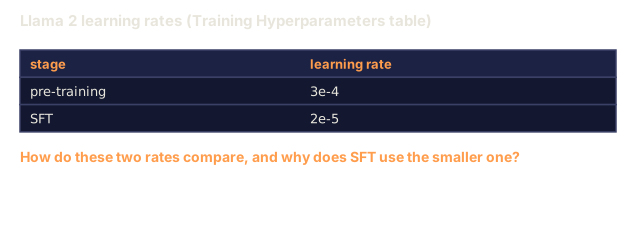
| Learning rate | 3e-4 (peak) | 2e-5 |
| Epochs | 1 (single pass over data) | 2 |
| Batch size | 4M tokens | 64 examples |
| Warmup steps | 2,000 | 0-100 |
| Weight decay | 0.1 | 0.0-0.1 |
| Data size | 2T tokens | 27,000 examples |
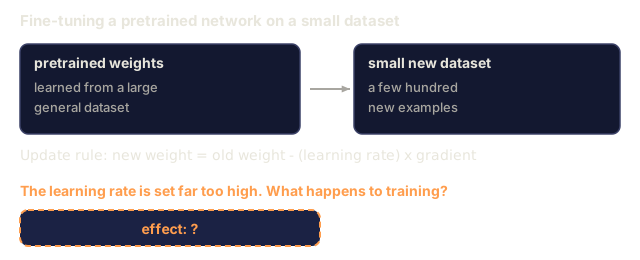
The learning rate is 15x lower for SFT. This is critical. A high learning rate during fine-tuning destroys the pre-trained knowledge. The model "forgets" what it learned and overfits to the small fine-tuning dataset. This is catastrophic forgetting.
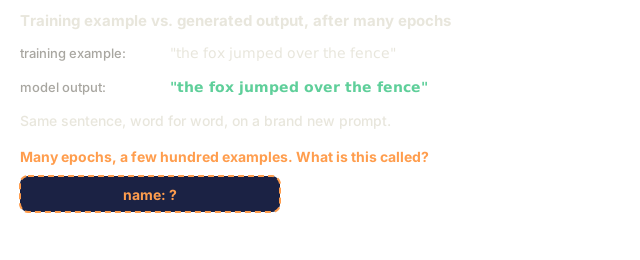
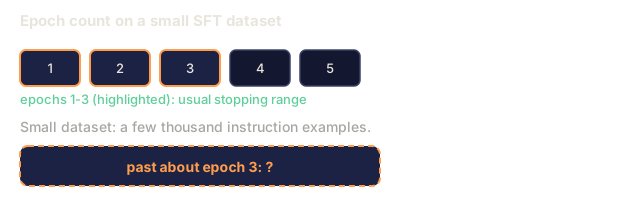
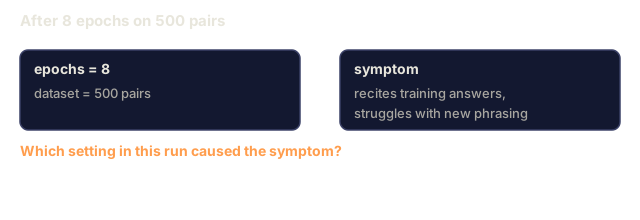
Two epochs means the model sees each training example twice. More than 3 epochs on a small dataset leads to memorization: the model starts reproducing training examples verbatim instead of generalizing.
Catastrophic Forgetting
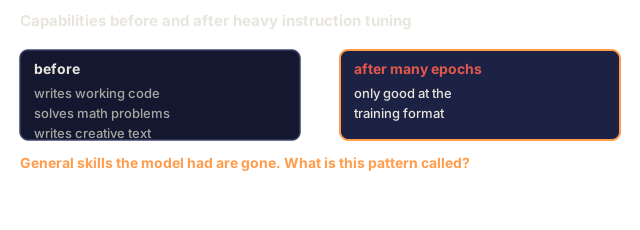
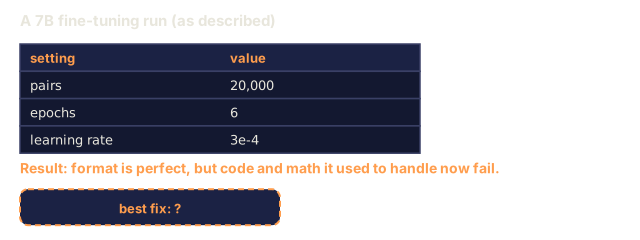
Fine-tuning can destroy general capabilities. Train too long on instruction-following data and the model loses its ability to write code, do math, or produce creative text. It becomes very good at the specific format of its training data and terrible at everything else.
Three mitigations:
-
Low learning rate. 1e-5 to 5e-5. Smaller updates mean less destruction of pre-trained features.
-
Short training. 1-3 epochs. Stop before the model overfits.
-
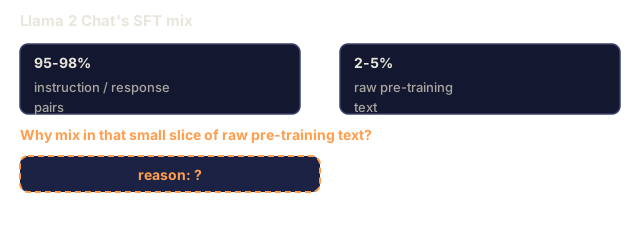
Mix in pre-training data. Llama 2 Chat mixed a small percentage (2-5%) of raw pre-training data into the SFT dataset. This "reminds" the model of its general capabilities while learning the new instruction-following behavior.
Real Numbers
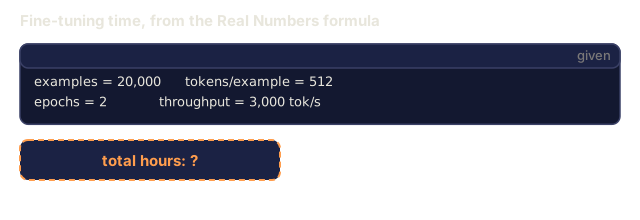
Fine-tuning a 7B model on 10,000 high-quality instruction pairs takes approximately 1 hour on a single NVIDIA A100 80GB GPU. Here's the math:
- 10,000 examples x 512 tokens average = 5.12M tokens
- 2 epochs = 10.24M tokens total
- A100 throughput for 7B model fine-tuning: ~3,000 tokens/second
- 10.24M / 3,000 = ~3,400 seconds = ~57 minutes
For our mini GPT (4 layers, 128 dims), training is nearly instant. The point is understanding the mechanics, not the scale.

Build It
Step 1: Instruction Dataset
Create a synthetic instruction dataset. In production, companies like Scale AI and Anthropic employ human annotators to write these. We'll create them programmatically to demonstrate the format.
import numpy as np

INSTRUCTION_DATA = [
    {
        "instruction": "What is the capital of France?",
        "response": "The capital of France is Paris."
    },
    {
        "instruction": "Explain gravity in one sentence.",
        "response": "Gravity is the force that attracts objects with mass toward each other."
    },
    {
        "instruction": "Write a haiku about the ocean.",
        "response": "Waves crash on the shore, salt and foam beneath the sun, endless blue expanse."
    },
    {
        "instruction": "What is 15 multiplied by 7?",
        "response": "15 multiplied by 7 is 105."
    },
    {
        "instruction": "Name three programming languages.",
        "response": "Three programming languages are Python, Rust, and TypeScript."
    },
    {
        "instruction": "Summarize photosynthesis.",
        "response": "Photosynthesis converts sunlight, water, and carbon dioxide into glucose and oxygen."
    },
    {
        "instruction": "What year did World War II end?",
        "response": "World War II ended in 1945."
    },
    {
        "instruction": "Define machine learning.",
        "response": "Machine learning is a field where algorithms learn patterns from data to make predictions."
    },
]
Eight examples is tiny. Stanford Alpaca used 52,000. But the mechanics are identical whether you have 8 or 52,000: tokenize, mask, compute loss on responses only.
Step 2: Tokenize with Chat Template
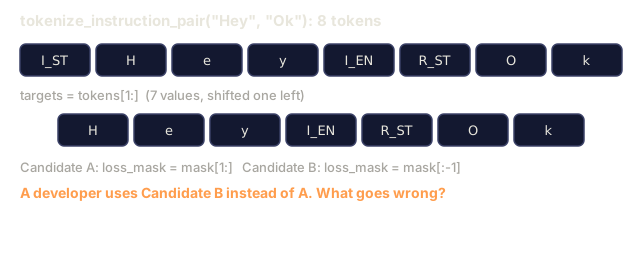
Convert instruction-response pairs into token sequences with special role markers. The markers tell the model where the instruction ends and where the response begins.
SPECIAL_TOKENS = {
    "INST_START": 253,
    "INST_END": 254,
    "RESP_START": 255,
}


def tokenize_instruction_pair(instruction, response, vocab_size=256):
    inst_tokens = list(instruction.encode("utf-8"))
    resp_tokens = list(response.encode("utf-8"))

    inst_tokens = [min(t, vocab_size - 4) for t in inst_tokens]
    resp_tokens = [min(t, vocab_size - 4) for t in resp_tokens]

    tokens = (
        [SPECIAL_TOKENS["INST_START"]]
        + inst_tokens
        + [SPECIAL_TOKENS["INST_END"]]
        + [SPECIAL_TOKENS["RESP_START"]]
        + resp_tokens
    )

    return tokens


def create_loss_mask(tokens):
    mask = np.zeros(len(tokens), dtype=np.float32)
    in_response = False

    for i, token in enumerate(tokens):
        if token == SPECIAL_TOKENS["RESP_START"]:
            in_response = True
            continue
        if in_response:
            mask[i] = 1.0

    return mask
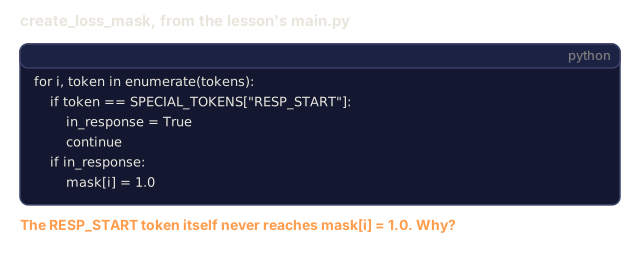
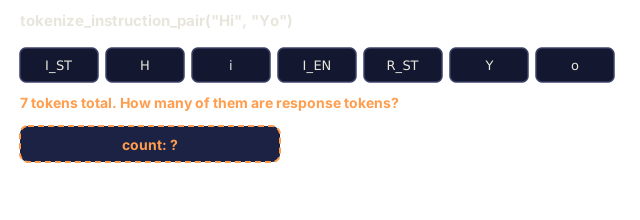
The loss mask is all zeros for instruction tokens and all ones for response tokens. The RESP_START token itself gets a mask of 0 because it's a delimiter, not part of the response content.
Step 3: Masked Cross-Entropy Loss
Standard cross-entropy, but multiplied by the loss mask. Only response tokens contribute to the gradient.
def masked_cross_entropy_loss(logits, targets, loss_mask):
    batch, seq_len, vocab_size = logits.shape
    logits_flat = logits.reshape(-1, vocab_size)
    targets_flat = targets.reshape(-1)
    mask_flat = loss_mask.reshape(-1)

    max_logits = logits_flat.max(axis=-1, keepdims=True)
    log_softmax = logits_flat - max_logits - np.log(
        np.exp(logits_flat - max_logits).sum(axis=-1, keepdims=True)
    )

    per_token_loss = -log_softmax[np.arange(len(targets_flat)), targets_flat]

    masked_loss = per_token_loss * mask_flat
    num_response_tokens = mask_flat.sum()
    if num_response_tokens == 0:
        return 0.0
    loss = masked_loss.sum() / num_response_tokens

    return loss
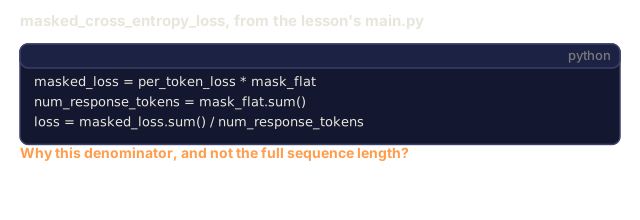
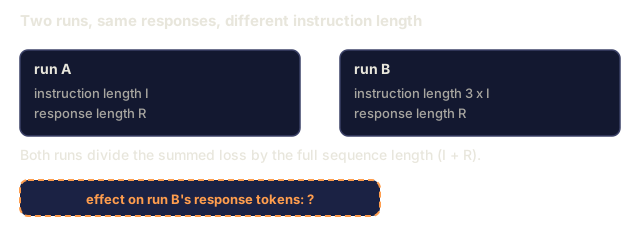
The denominator is num_response_tokens, not seq_len. If you divide by the total sequence length, longer instructions dilute the gradient signal. Dividing by response token count ensures equal weight per response token regardless of instruction length.
Step 4: SFT Training Loop
Reuse the MiniGPT from Lesson 04. The training loop looks almost identical to pre-training, but with instruction formatting and masked loss.
import sys
import os
sys.path.insert(0, os.path.join(os.path.dirname(__file__), "..", "..", "04-pre-training-mini-gpt", "code"))
from main import MiniGPT, LayerNorm, FeedForward, MultiHeadAttention, TransformerBlock, Embedding


def sft_train(model, dataset, num_epochs=2, lr=2e-5, seq_len=64):
    formatted_data = []
    for example in dataset:
        tokens = tokenize_instruction_pair(example["instruction"], example["response"])
        mask = create_loss_mask(tokens)
        formatted_data.append((tokens, mask))

    print(f"SFT Training: {len(formatted_data)} examples, {num_epochs} epochs, lr={lr}")
    print(f"Total tokens: {sum(len(t) for t, _ in formatted_data):,}")
    print()

    losses = []

    for epoch in range(num_epochs):
        epoch_loss = 0.0
        num_batches = 0

        indices = np.random.permutation(len(formatted_data))

        for idx in indices:
            tokens, mask = formatted_data[idx]

            if len(tokens) < 3:
                continue
            if len(tokens) > seq_len:
                tokens = tokens[:seq_len]
                mask = mask[:seq_len]

            input_ids = np.array(tokens[:-1]).reshape(1, -1)
            target_ids = np.array(tokens[1:]).reshape(1, -1)
            loss_mask = np.array(mask[1:]).reshape(1, -1)

            logits = model.forward(input_ids)
            loss = masked_cross_entropy_loss(logits, target_ids, loss_mask)

            batch_size, s_len, v_size = logits.shape
            probs = np.exp(logits - logits.max(axis=-1, keepdims=True))
            probs = probs / probs.sum(axis=-1, keepdims=True)
            dlogits = probs.copy()
            dlogits[np.arange(batch_size)[:, None], np.arange(s_len), target_ids] -= 1.0

            mask_expanded = loss_mask[:, :, np.newaxis]
            num_resp = loss_mask.sum()
            if num_resp > 0:
                dlogits = dlogits * mask_expanded / num_resp

            for block in model.blocks:
                block.ffn.W1 -= lr * np.random.randn(*block.ffn.W1.shape) * 0.01
                block.ffn.W2 -= lr * np.random.randn(*block.ffn.W2.shape) * 0.01
                block.ffn.b1 -= lr * np.random.randn(*block.ffn.b1.shape) * 0.01
                block.ffn.b2 -= lr * np.random.randn(*block.ffn.b2.shape) * 0.01

            epoch_loss += loss
            num_batches += 1
            losses.append(loss)

        avg_loss = epoch_loss / max(num_batches, 1)
        print(f"Epoch {epoch + 1}/{num_epochs} | Avg Loss: {avg_loss:.4f}")

    return model, losses
The learning rate is 2e-5, matching Llama 2 Chat. Pre-training used 3e-4, so this is 15x smaller. The dlogits are masked, so instruction positions contribute zero and only response positions carry signal.
Step 5: Compare Base vs SFT Model
The whole point of SFT is behavioral change. Let's measure it by checking how the model responds to instruction-formatted inputs versus raw text continuations.
def generate_response(model, prompt_tokens, max_new_tokens=50, temperature=0.8):
    tokens = list(prompt_tokens)
    seq_len = model.embedding.pos_embed.shape[0]

    for _ in range(max_new_tokens):
        context = np.array(tokens[-seq_len:]).reshape(1, -1)
        logits = model.forward(context)
        next_logits = logits[0, -1, :]

        next_logits = next_logits / max(temperature, 1e-8)
        probs = np.exp(next_logits - next_logits.max())
        probs = probs / probs.sum()
        probs = np.clip(probs, 1e-10, 1.0)
        probs = probs / probs.sum()

        next_token = np.random.choice(len(probs), p=probs)
        tokens.append(int(next_token))

    return tokens


def evaluate_instruction_following(model, instructions):
    print("Evaluating instruction following:")
    print("-" * 50)

    for instruction in instructions:
        tokens = (
            [SPECIAL_TOKENS["INST_START"]]
            + [min(t, 252) for t in list(instruction.encode("utf-8"))]
            + [SPECIAL_TOKENS["INST_END"]]
            + [SPECIAL_TOKENS["RESP_START"]]
        )

        output = generate_response(model, tokens, max_new_tokens=30, temperature=0.6)
        response_start = len(tokens)
        response_tokens = output[response_start:]
        response_bytes = bytes([t for t in response_tokens if t < 128])
        response_text = response_bytes.decode("utf-8", errors="replace")

        print(f"  Q: {instruction}")
        print(f"  A: {response_text[:80]}")
        print()
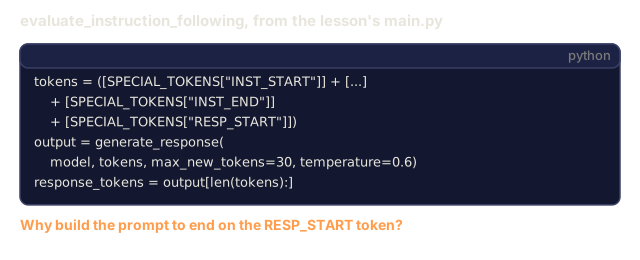
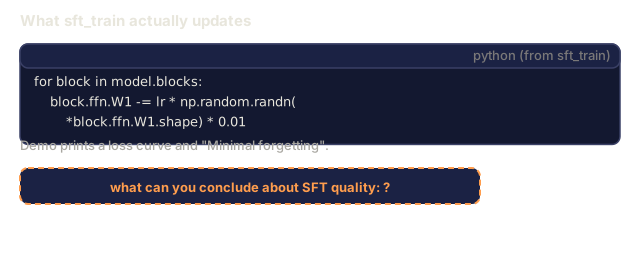
On a tiny model with 8 examples, the responses won't be meaningful. The weight update here is random noise rather than a gradient step (see the Author's Note), so the output is noise whatever the data. What you're checking is the structure: the prompt ends at the response marker, so everything generated counts as response text. With a real backward pass, this is where a model learns to answer instead of generating more instructions.
Step 6: Measure Catastrophic Forgetting
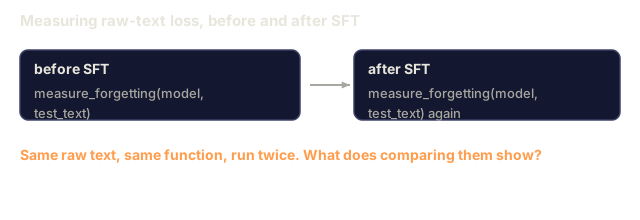
Compare the model's next-token prediction ability before and after SFT. If SFT damages general capabilities, the loss on raw text will increase.
def measure_forgetting(model, test_text, seq_len=64):
    tokens = np.array(list(test_text.encode("utf-8")[:512]))

    total_loss = 0.0
    num_windows = 0

    for start in range(0, len(tokens) - seq_len - 1, seq_len):
        input_ids = tokens[start:start + seq_len].reshape(1, -1)
        target_ids = tokens[start + 1:start + seq_len + 1].reshape(1, -1)

        logits = model.forward(input_ids)

        batch, s_len, vocab_size = logits.shape
        logits_flat = logits.reshape(-1, vocab_size)
        targets_flat = target_ids.reshape(-1)

        max_logits = logits_flat.max(axis=-1, keepdims=True)
        log_softmax = logits_flat - max_logits - np.log(
            np.exp(logits_flat - max_logits).sum(axis=-1, keepdims=True)
        )

        loss = -log_softmax[np.arange(len(targets_flat)), targets_flat].mean()
        total_loss += loss
        num_windows += 1

    return total_loss / max(num_windows, 1)
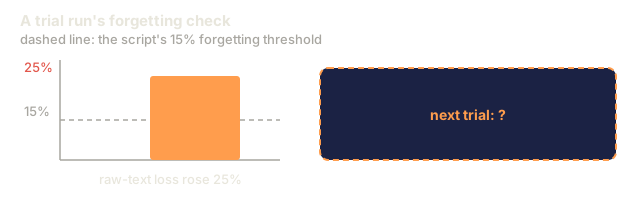
In real fine-tuning, you would track this metric throughout training. If the raw text loss increases by more than 10-15%, your SFT is too aggressive. Lower the learning rate or reduce the number of epochs.
Use It
Full SFT Pipeline Demo
if __name__ == "__main__":
    np.random.seed(42)

    test_text = """The transformer architecture processes sequences through self-attention.
Each layer applies multi-head attention followed by a feedforward network.
Residual connections and layer normalization stabilize deep networks.
The model learns to predict the next token given all previous tokens."""

    print("=" * 70)
    print("INSTRUCTION TUNING (SFT) DEMO")
    print("=" * 70)
    print()

    model = MiniGPT(
        vocab_size=256, embed_dim=128, num_heads=4,
        num_layers=4, max_seq_len=128, ff_dim=512
    )
    print(f"Model: {model.count_parameters():,} parameters")
    print(f"Config: 4 layers, 4 heads, 128 dims (mini GPT from Lesson 04)")
    print()

    print("PRE-SFT: Measuring base model loss on raw text")
    base_loss = measure_forgetting(model, test_text)
    print(f"  Base model loss: {base_loss:.4f}")
    print()

    print("=" * 70)
    print("SFT TRAINING")
    print("=" * 70)

    model, losses = sft_train(
        model, INSTRUCTION_DATA, num_epochs=3, lr=2e-5, seq_len=128
    )

    print()
    print("POST-SFT: Measuring fine-tuned model loss on raw text")
    sft_loss = measure_forgetting(model, test_text)
    print(f"  SFT model loss: {sft_loss:.4f}")
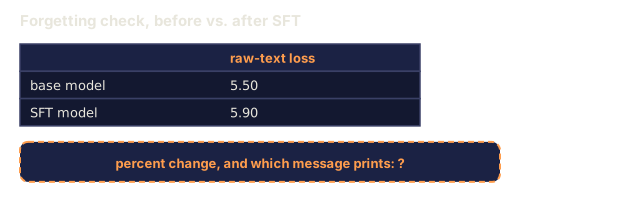
    print(f"  Change: {((sft_loss - base_loss) / base_loss * 100):+.1f}%")
    if abs(sft_loss - base_loss) / base_loss < 0.15:
        print("  Minimal forgetting (< 15% change)")
    else:
        print("  Significant forgetting detected")
    print()

    print("=" * 70)
    print("INSTRUCTION FOLLOWING EVALUATION")
    print("=" * 70)
    print()

    test_instructions = [
        "What is the capital of France?",
        "Name a programming language.",
        "Define gravity.",
    ]
    evaluate_instruction_following(model, test_instructions)

    print("=" * 70)
    print("DATA FORMAT EXAMPLES")
    print("=" * 70)
    print()

    for i, example in enumerate(INSTRUCTION_DATA[:3]):
        tokens = tokenize_instruction_pair(example["instruction"], example["response"])
        mask = create_loss_mask(tokens)
        resp_count = int(mask.sum())
        total_count = len(tokens)
        print(f"  Example {i + 1}: {total_count} tokens, {resp_count} response tokens ({resp_count/total_count:.0%} of sequence)")
        print(f"    Instruction: {example['instruction']}")
        print(f"    Response: {example['response']}")
        print()

    print("=" * 70)
    print("TRAINING LOSS CURVE")
    print("=" * 70)
    print()

    if losses:
        window = max(1, len(losses) // 5)
        for i in range(0, len(losses), window):
            chunk = losses[i:i + window]
            avg = sum(chunk) / len(chunk)
            print(f"  Steps {i:3d}-{i + len(chunk) - 1:3d}: avg loss = {avg:.4f}")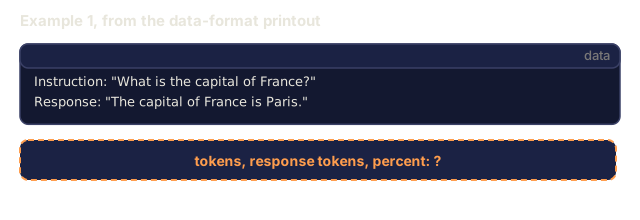
Ship It
This lesson produces outputs/prompt-sft-data-curator.md, a prompt that helps you design and curate instruction datasets for SFT. Given a target capability (code generation, math, conversation), it produces a data collection plan with format specifications, quality criteria, and diversity requirements.
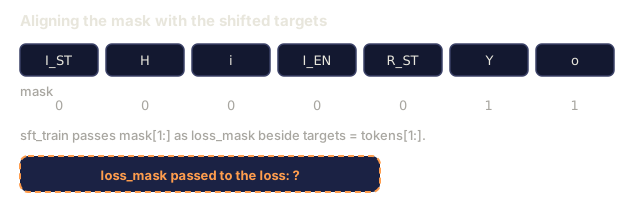
I'd run main.py and read the data format printout first. For three examples it shows how many of the tokens are response tokens, which is the loss mask made concrete. Then reread create_loss_mask and the mask[1:] slice in sft_train together. The mask has to line up with the shifted targets, and that alignment is easy to get off by one.
One thing to know before you trust any number it prints: the weight update in sft_train is not a gradient step. The script builds dlogits with the mask applied and then doesn't backpropagate it. What changes the weights is small random noise on the feed-forward matrices, scaled by lr. So the loss curve and the before/after forgetting check exercise the plumbing (formatting, masking, the denominator) and say nothing about whether SFT worked. I'd wire a real backward pass through the Lesson 04 model before running the learning rate comparison in exercise 5, since that comparison only means something after that.
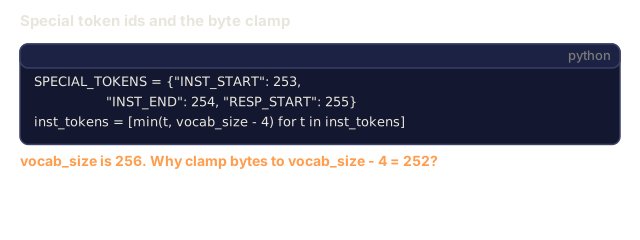
The tokenizer is a toy too. Bytes above 252 are clamped to 252 so the three special ids stay free, and the evaluation decodes only tokens below 128. That's fine for ASCII prompts. For anything else I'd swap in a real tokenizer with ChatML-style special tokens.
Exercises
-
Add system prompt support. Modify
tokenize_instruction_pairto accept a system message and prepend it before the instruction. Create 5 examples with different system prompts ("You are a poet", "You are a math tutor") and verify the model sees different system prompts during training. -
Implement data mixing. Create a function that takes an SFT dataset and a raw text corpus, then produces training batches where 5% of examples are raw text (no masking) and 95% are instruction pairs (masked). Run 3 epochs and compare forgetting metrics against pure SFT training.
-
Build a data quality scorer. For each instruction-response pair, compute: (a) response length in tokens, (b) instruction-to-response ratio, (c) vocabulary diversity (unique tokens / total tokens). Filter out examples with response length < 10 tokens or diversity < 0.3. Show how filtering affects the final loss.
-
Implement multi-turn conversation training. Extend the tokenization to handle 3-turn conversations (user-assistant-user-assistant-user-assistant). The loss mask should cover all three assistant turns. Verify the mask is correct by printing the token-mask alignment for one example.
-
Compare learning rates. Train the same model three times with lr=1e-4, lr=2e-5, and lr=1e-6. Plot the loss curves. The 1e-4 run should show rapid initial descent but higher final loss (overfitting). The 1e-6 run should barely move. The 2e-5 run should be the sweet spot.
Key Terms
| Term | What people say | What it actually means |
|---|---|---|
| SFT | "Fine-tuning on conversations" | Supervised Fine-Tuning: continuing training on (instruction, response) pairs with loss computed only on response tokens |
| Instruction tuning | "Teaching the model to follow instructions" | Training on explicit instruction-response pairs so the base model learns the conversation pattern, not new knowledge |
| Loss masking | "Ignoring the prompt" | Setting loss to zero for instruction tokens so gradients only flow from response token predictions |
| ChatML | "Chat Markup Language" | A token format using <|im_start|> and <|im_end|> delimiters to mark speaker roles in conversation data |
| Alpaca format | "Stanford's format" | A JSON format with instruction/input/output fields, used for 52K GPT-3.5-generated examples that cost $600 |
| Catastrophic forgetting | "The model gets dumber" | Fine-tuning destroys pre-trained capabilities because gradient updates overwrite general knowledge with task-specific patterns |
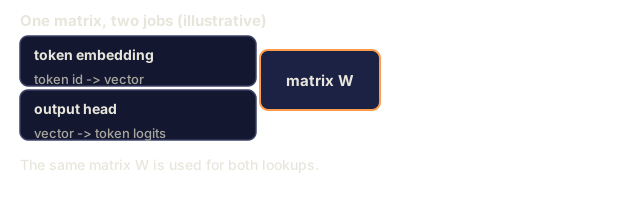
| Weight tying | "Shared embeddings" | Using the same matrix for input token embeddings and output prediction head, saving parameters and improving coherence |
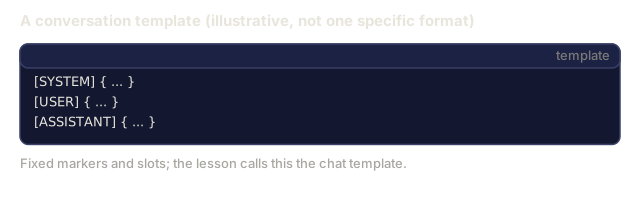
| Chat template | "How you format the prompt" | The specific token sequence (role markers, delimiters) that structures a conversation for the model |
Further Reading
- Ouyang et al., 2022: "Training language models to follow instructions with human feedback" (InstructGPT): the paper that introduced instruction tuning + RLHF at OpenAI
- Taori et al., 2023: "Stanford Alpaca: An Instruction-following LLaMA Model": 52K instruction examples for $600, proving SFT works on small datasets
- Touvron et al., 2023: "Llama 2: Open Foundation and Fine-Tuned Chat Models": Meta's SFT + RLHF pipeline with 27K high-quality examples
- Chiang et al., 2023: "Vicuna: An Open-Source Chatbot Impressing GPT-4": training on 70K ShareGPT conversations
- Zhou et al., 2023: "LIMA: Less Is More for Alignment": proving that 1,000 carefully curated examples can match SFT on much larger datasets
Code
- main.py (python, 336 lines)