Evaluation: Benchmarks, Evals, LM Harness
Goodhart's Law: when a measure becomes a target, it ceases to be a good measure. Every frontier lab tunes for benchmarks. MMLU scores go up while models still miscount the R's in "strawberry." The eval you can trust most is your own, on your task, with your data.
Learning Objectives
- Build a custom evaluation harness that runs multiple-choice and open-ended benchmarks against a language model
- Explain why standard benchmarks (MMLU, HumanEval) saturate and fail to differentiate frontier models
- Implement task-specific evals with proper metrics: exact match, F1, BLEU, and LLM-as-judge scoring
- Design a custom evaluation suite targeting your specific use case rather than relying solely on public leaderboards
The Problem
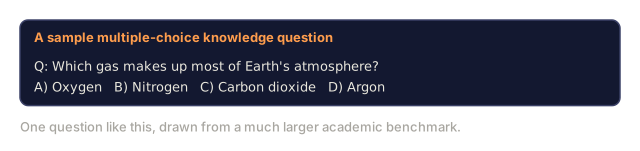
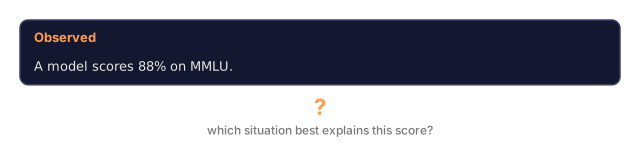
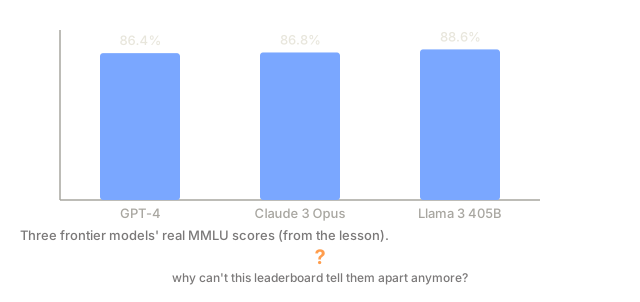
MMLU was published in 2020 with 15,908 questions across 57 subjects. Within three years, frontier models saturated it. GPT-4 scored 86.4%. Claude 3 Opus scored 86.8%. Llama 3 405B scored 88.6%. The leaderboard compressed into a 3-point range where differences are statistical noise, not real capability gaps.
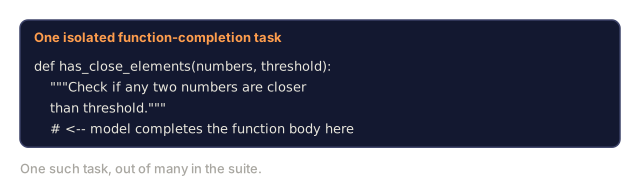
Meanwhile, those same models fail at tasks that a 10-year-old handles without thinking. Claude 3.5 Sonnet, scoring 88.7% on MMLU, initially could not count the letters in "strawberry". The task needs no world knowledge and no reasoning, just character-level iteration. HumanEval tests code generation with 164 problems. Models score 90%+ on it while still producing code that crashes on edge cases a junior developer would catch.
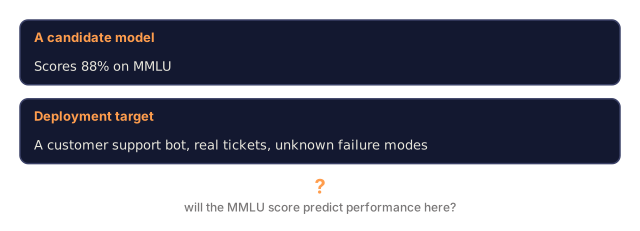
The gap between benchmark performance and real-world reliability is the central problem of LLM evaluation. Benchmarks tell you how a model performs on the benchmark. They say very little about how that model will perform on your specific task, with your specific data, under your specific failure modes. If you are building a customer support bot, MMLU is irrelevant. If you are building a code assistant, HumanEval only covers function-level generation. It says nothing about debugging, refactoring, or explaining code across files.
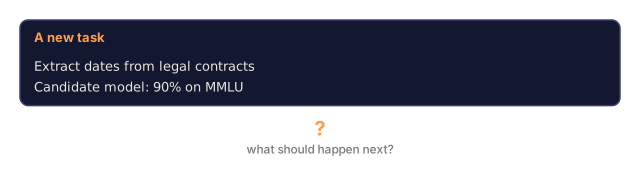
You need custom evals. Benchmarks are still useful for rough model selection, but the final evaluation has to match your deployment conditions.
The Concept
The Eval Landscape
There are three categories of evaluation, each with different cost and signal quality.
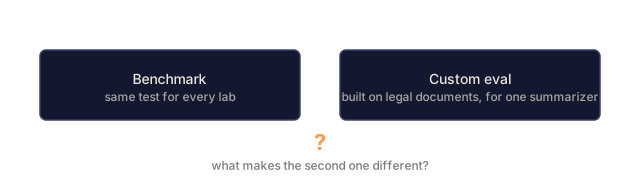
Benchmarks are standardized test suites. MMLU, HumanEval, SWE-bench, MATH, ARC, HellaSwag. You run a model against the benchmark and get a score. The advantage: everyone uses the same test, so you can compare models. The disadvantage: models and training data increasingly contaminate these benchmarks. Labs train on data that includes benchmark questions. Scores go up. Capability may not.
Custom evals are test suites you build for your specific use case. You define the inputs, the expected outputs, and the scoring function. A legal document summarizer gets evaluated on legal documents. A SQL generator gets evaluated on your database schema. These are expensive to create but they are the only evaluation that predicts production performance.
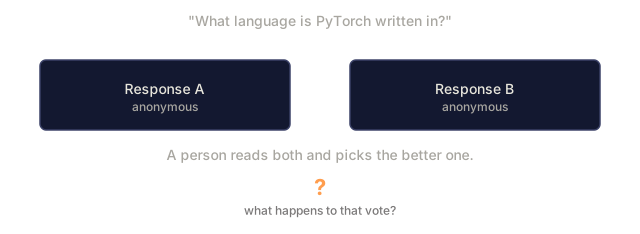
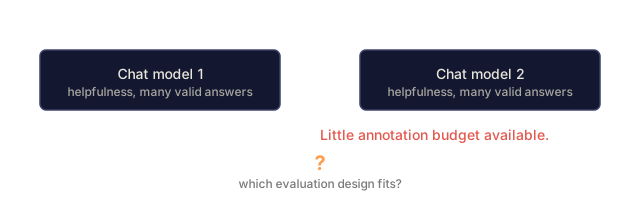
Human evals use paid annotators to judge model outputs on criteria like helpfulness, correctness, fluency, and safety. The gold standard for open-ended tasks where automated scoring fails. Chatbot Arena has collected over 2 million human preference votes across 100+ models. The downside: cost ($0.10-$2.00 per judgment) and speed (hours to days).

Why Benchmarks Break
Three mechanisms cause benchmark scores to stop reflecting real capability.
Data contamination. Training corpora scrape the internet. Benchmark questions live on the internet. Models see the answers during training. Labs do not include benchmark data on purpose, but web-scale scraping makes it nearly impossible to keep out.
Teaching to the test. Labs optimize training mixtures for benchmark performance. If 5% of the training mix is MMLU-style multiple choice, the model learns the format and the answer distribution. MMLU is 4-way multiple choice. Models learn that the answer distribution is approximately uniform across A/B/C/D, which helps even when the model does not know the answer.
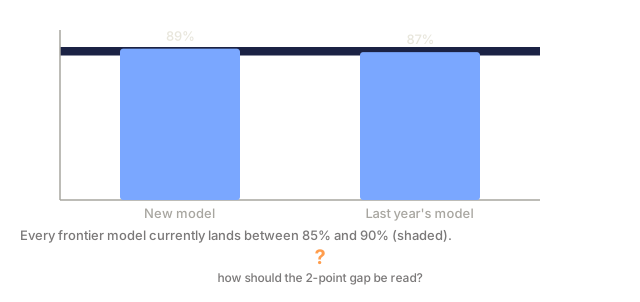
Saturation. When every frontier model scores 85-90% on a benchmark, the benchmark stops discriminating. The remaining 10-15% of questions may be ambiguous, mislabeled, or require obscure domain knowledge. Improving from 87% to 89% on MMLU may mean the model memorized two more obscure questions, not that it got smarter.
Perplexity: A Quick Health Check
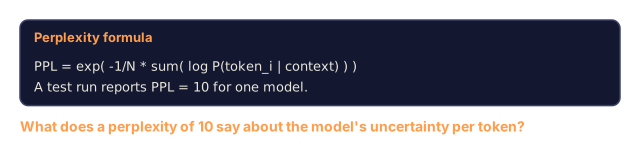
Perplexity measures how surprised a model is by a sequence of tokens. Formally, it is the exponentiated average negative log-likelihood:
PPL = exp(-1/N * sum(log P(token_i | context)))
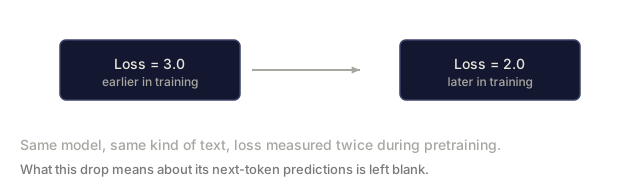
A perplexity of 10 means the model is, on average, as uncertain as choosing uniformly among 10 options at each token position. Lower is better. GPT-2 gets a perplexity of ~30 on WikiText-103. GPT-3 gets ~20. Llama 3 8B gets ~7.
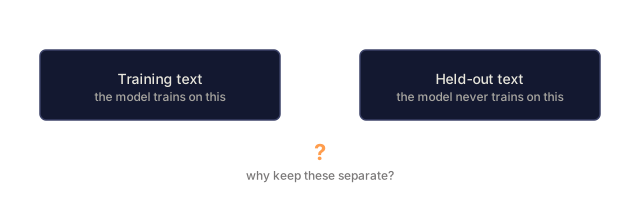
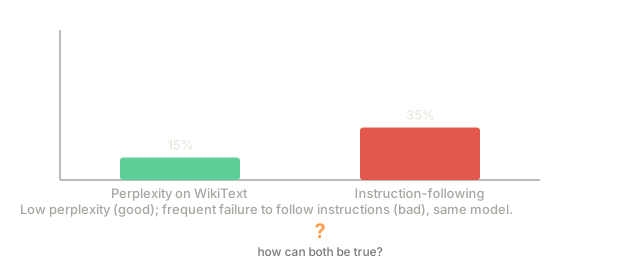
Perplexity is useful for comparing models on the same test set, but it has blind spots. A model can have low perplexity by being good at predicting common patterns while being terrible at rare but important patterns. It also says nothing about instruction following, reasoning, or factual accuracy. Use it as a sanity check, not a final verdict.
LLM-as-Judge
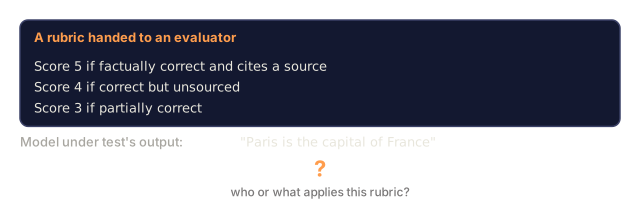
Use a strong model to evaluate a weaker model's output. The idea is simple: ask GPT-4o or Claude Sonnet to rate a response on a 1-5 scale for correctness, helpfulness, and safety. This costs about $0.01 per judgment with GPT-4o-mini and correlates surprisingly well with human judgments, at around 80% agreement on most tasks.
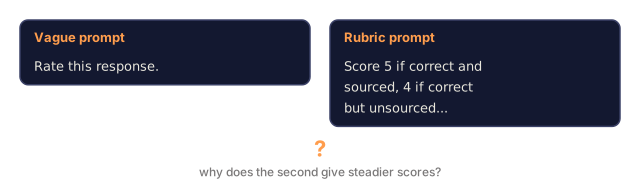
The scoring prompt matters more than the model. A vague prompt ("Rate this response") produces noisy scores. A structured prompt with a rubric ("Score 5 if the answer is factually correct and cites a source, 4 if correct but unsourced, 3 if partially correct...") produces consistent, reproducible scores.
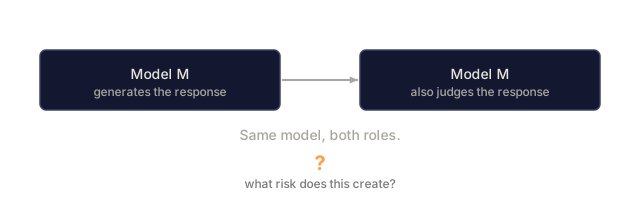
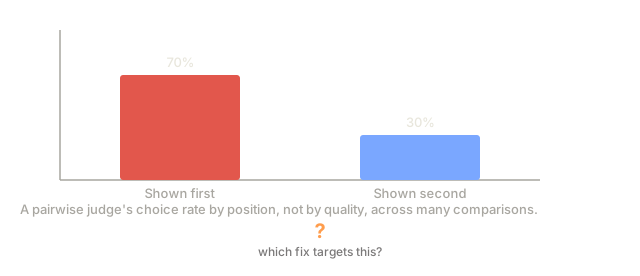
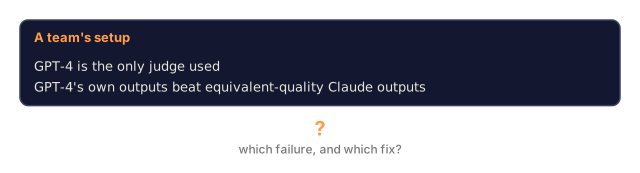
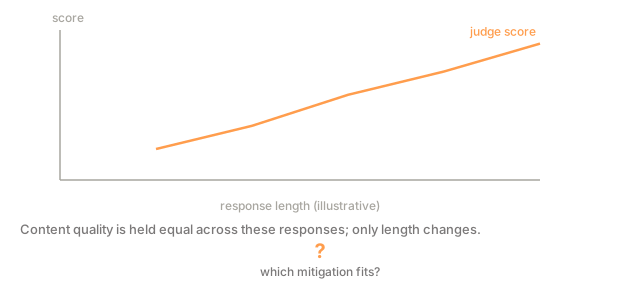
Failure modes: judge models exhibit position bias (prefer the first response in pairwise comparisons), verbosity bias (prefer longer responses), and self-preference (GPT-4 rates GPT-4 outputs higher than equivalent Claude outputs). Mitigations: randomize order, normalize for length, use a different judge than the model being evaluated.
ELO Ratings from Pairwise Comparisons
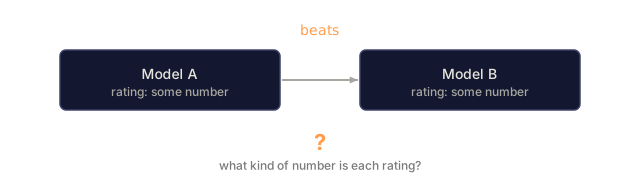
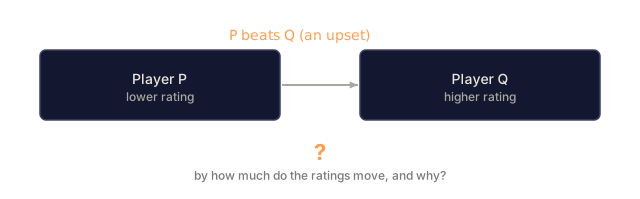
Chatbot Arena's approach. Show two responses to the same prompt from different models. A human (or LLM judge) picks the better one. From thousands of these comparisons, compute an ELO rating for each model, the same system used in chess.
ELO advantages: relative ranking is more reliable than absolute scoring, handles ties gracefully, and converges with fewer comparisons than scoring every output independently. As of early 2026, Chatbot Arena ranks show GPT-4o, Claude 3.5 Sonnet, and Gemini 1.5 Pro within 20 ELO points of each other at the top.

Eval Frameworks
lm-evaluation-harness (EleutherAI): the standard open-source eval framework. Supports 200+ benchmarks. Run any Hugging Face model against MMLU, HellaSwag, ARC, etc. with one command. Used by the Open LLM Leaderboard.
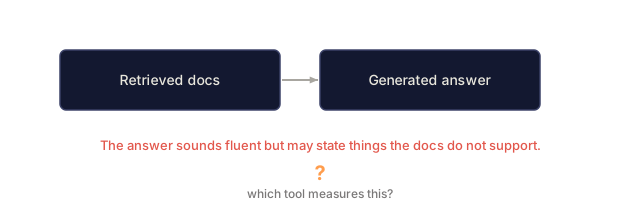
RAGAS: evaluation framework specifically for RAG pipelines. Measures faithfulness (does the answer match the retrieved context?), relevance (is the retrieved context relevant to the question?), and answer correctness.
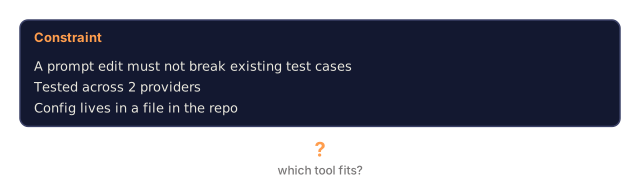
promptfoo: config-driven eval for prompt engineering. Define test cases in YAML, run against multiple models, get a pass/fail report. Useful for regression testing prompts, so a prompt change does not break existing test cases.
Building Custom Evals
This is the eval that predicts production behavior. The process:
-
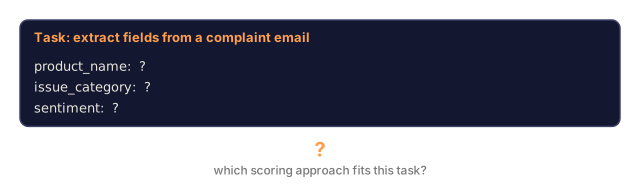
Define the task. What exactly should the model do? Be precise. "Answer questions" is too vague. "Given a customer complaint email, extract the product name, issue category, and sentiment" is a task you can evaluate.
-
Create test cases. Minimum 50 for a prototype eval, 200+ for production. Each test case is an (input, expected_output) pair. Include edge cases: empty inputs, adversarial inputs, ambiguous inputs, inputs in other languages.
-
Define scoring. Exact match for structured outputs. BLEU/ROUGE for text similarity. LLM-as-judge for open-ended quality. F1 for extraction tasks. Combine multiple metrics with weights.
-
Automate. Every eval runs with one command. No manual steps. Store results in a format that enables comparison over time.
-
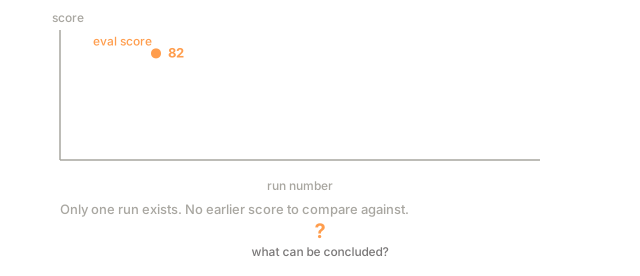
Track over time. An eval score is meaningless in isolation. You need the trendline. Did the score improve after the last prompt change? Did it regress after switching models? Version your eval alongside your prompts.
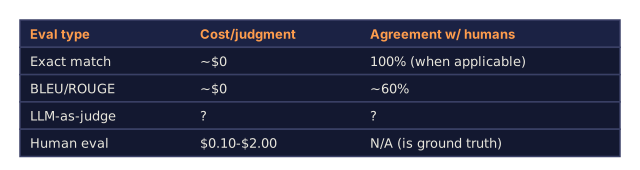
| Eval Type | Cost per judgment | Agreement with humans | Best for |
|---|---|---|---|
| Exact match | ~$0 | 100% (when applicable) | Structured output, classification |
| BLEU/ROUGE | ~$0 | ~60% | Translation, summarization |
| LLM-as-judge | ~$0.01 | ~80% | Open-ended generation |
| Human eval | $0.10-$2.00 | N/A (is the ground truth) | Ambiguous, high-stakes tasks |


Build It
Step 1: A Minimal Eval Framework
Define the core abstractions. An eval case has an input, an expected output, and an optional metadata dict. A scorer takes a prediction and a reference and returns a score between 0 and 1.
import json
from collections import Counter

class EvalCase:
    def __init__(self, input_text, expected, metadata=None):
        self.input_text = input_text
        self.expected = expected
        self.metadata = metadata or {}

class EvalSuite:
    def __init__(self, name, cases, scorers):
        self.name = name
        self.cases = cases
        self.scorers = scorers

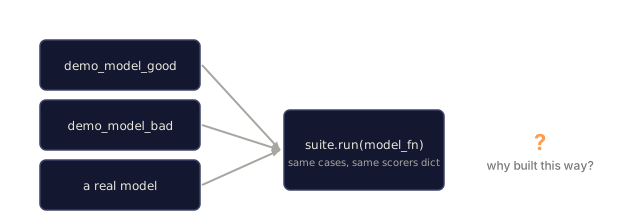
    def run(self, model_fn):
        results = []
        for case in self.cases:
            prediction = model_fn(case.input_text)
            scores = {}
            for scorer_name, scorer_fn in self.scorers.items():
                scores[scorer_name] = scorer_fn(prediction, case.expected)
            results.append({
                "input": case.input_text,
                "expected": case.expected,
                "prediction": prediction,
                "scores": scores,
            })
        return results
Step 2: Scoring Functions
Build exact match, token F1, and a simulated LLM-as-judge scorer.
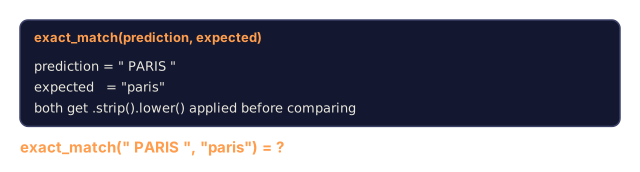
def exact_match(prediction, expected):
    return 1.0 if prediction.strip().lower() == expected.strip().lower() else 0.0

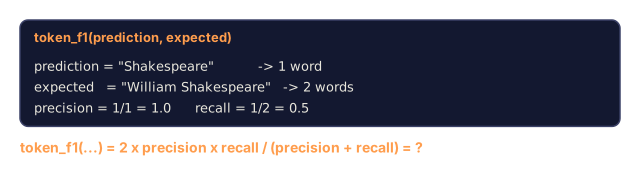
def token_f1(prediction, expected):
    pred_tokens = set(prediction.lower().split())
    exp_tokens = set(expected.lower().split())
    if not pred_tokens or not exp_tokens:
        return 0.0
    common = pred_tokens & exp_tokens
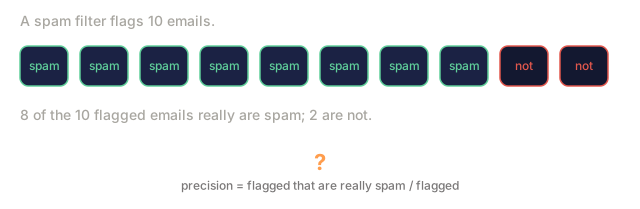
    precision = len(common) / len(pred_tokens)
    recall = len(common) / len(exp_tokens)
    if precision + recall == 0:
        return 0.0
    return 2 * (precision * recall) / (precision + recall)

def llm_judge_simulated(prediction, expected):
    pred_words = set(prediction.lower().split())
    exp_words = set(expected.lower().split())
    if not exp_words:
        return 0.0
    overlap = len(pred_words & exp_words) / len(exp_words)
    length_penalty = min(1.0, len(prediction) / max(len(expected), 1))
    return round(overlap * 0.7 + length_penalty * 0.3, 3)
Step 3: ELO Rating System
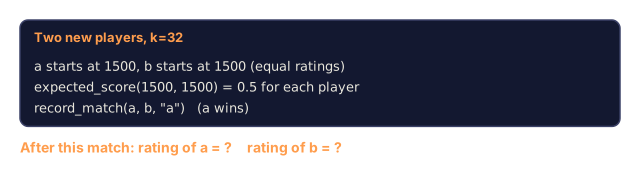
Implement pairwise comparisons with ELO updates. This is exactly the system Chatbot Arena uses to rank models.
class ELOTracker:
    def __init__(self, k=32, initial_rating=1500):
        self.ratings = {}
        self.k = k
        self.initial_rating = initial_rating
        self.history = []

    def _ensure_player(self, name):
        if name not in self.ratings:
            self.ratings[name] = self.initial_rating

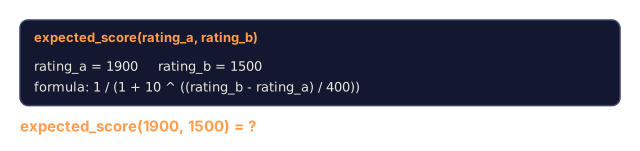
    def expected_score(self, rating_a, rating_b):
        return 1 / (1 + 10 ** ((rating_b - rating_a) / 400))

    def record_match(self, player_a, player_b, outcome):
        self._ensure_player(player_a)
        self._ensure_player(player_b)

        ea = self.expected_score(self.ratings[player_a], self.ratings[player_b])
        eb = 1 - ea

        if outcome == "a":
            sa, sb = 1.0, 0.0
        elif outcome == "b":
            sa, sb = 0.0, 1.0
        else:
            sa, sb = 0.5, 0.5

        self.ratings[player_a] += self.k * (sa - ea)
        self.ratings[player_b] += self.k * (sb - eb)

        self.history.append({
            "a": player_a, "b": player_b,
            "outcome": outcome,
            "rating_a": round(self.ratings[player_a], 1),
            "rating_b": round(self.ratings[player_b], 1),
        })

    def leaderboard(self):
        return sorted(self.ratings.items(), key=lambda x: -x[1])
Step 4: Perplexity Calculation
Compute perplexity using token probabilities. In practice you would get these from the model's logits. Here we simulate with a probability distribution.
import numpy as np

def perplexity(log_probs):
    if not log_probs:
        return float("inf")
    avg_neg_log_prob = -np.mean(log_probs)
    return float(np.exp(avg_neg_log_prob))

def token_log_probs_simulated(text, model_quality=0.8):
    np.random.seed(hash(text) % 2**31)
    tokens = text.split()
    log_probs = []
    for i, token in enumerate(tokens):
        base_prob = model_quality
        if len(token) > 8:
            base_prob *= 0.6
        if i == 0:
            base_prob *= 0.7
        prob = np.clip(base_prob + np.random.normal(0, 0.1), 0.01, 0.99)
        log_probs.append(float(np.log(prob)))
    return log_probs
Step 5: Aggregate Results
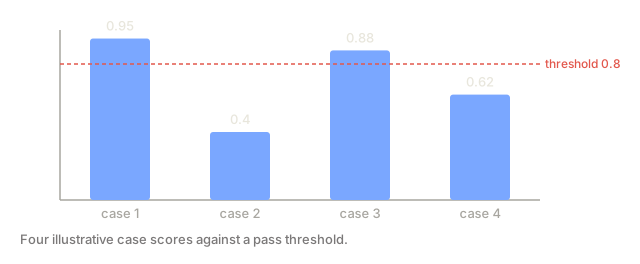
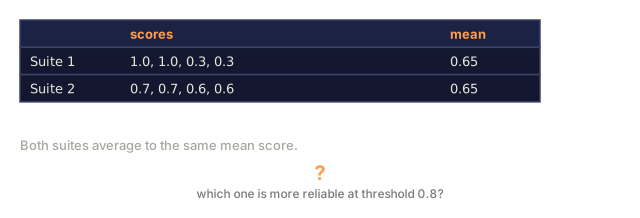
Compute summary statistics across an eval run: mean, median, pass rate at a threshold, and per-metric breakdowns.
def summarize_results(results, threshold=0.8):
    all_scores = {}
    for r in results:
        for metric, score in r["scores"].items():
            all_scores.setdefault(metric, []).append(score)

    summary = {}
    for metric, scores in all_scores.items():
        arr = np.array(scores)
        summary[metric] = {
            "mean": round(float(np.mean(arr)), 3),
            "median": round(float(np.median(arr)), 3),
            "std": round(float(np.std(arr)), 3),
            "min": round(float(np.min(arr)), 3),
            "max": round(float(np.max(arr)), 3),
            "pass_rate": round(float(np.mean(arr >= threshold)), 3),
            "n": len(scores),
        }
    return summary

def print_summary(summary, suite_name="Eval"):
    print(f"\n{'=' * 60}")
    print(f"  {suite_name} Summary")
    print(f"{'=' * 60}")
    for metric, stats in summary.items():
        print(f"\n  {metric}:")
        print(f"    Mean:      {stats['mean']:.3f}")
        print(f"    Median:    {stats['median']:.3f}")
        print(f"    Std:       {stats['std']:.3f}")
        print(f"    Range:     [{stats['min']:.3f}, {stats['max']:.3f}]")
        print(f"    Pass rate: {stats['pass_rate']:.1%} (threshold >= 0.8)")
        print(f"    N:         {stats['n']}")
Step 6: Run the Full Pipeline
Wire everything together. Define a task, create test cases, simulate two models, run evals, compute ELO from pairwise comparisons, and print the leaderboard.
def demo_model_good(prompt):
    responses = {
        "What is the capital of France?": "Paris",
        "What is 2 + 2?": "4",
        "Who wrote Hamlet?": "William Shakespeare",
        "What language is PyTorch written in?": "Python and C++",
        "What is the boiling point of water?": "100 degrees Celsius",
    }
    return responses.get(prompt, "I don't know")

def demo_model_bad(prompt):
    responses = {
        "What is the capital of France?": "Paris is the capital city of France",
        "What is 2 + 2?": "The answer is four",
        "Who wrote Hamlet?": "Shakespeare",
        "What language is PyTorch written in?": "Python",
        "What is the boiling point of water?": "212 Fahrenheit",
    }
    return responses.get(prompt, "Unknown")

cases = [
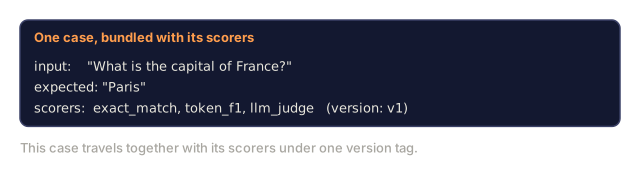
    EvalCase("What is the capital of France?", "Paris"),
    EvalCase("What is 2 + 2?", "4"),
    EvalCase("Who wrote Hamlet?", "William Shakespeare"),
    EvalCase("What language is PyTorch written in?", "Python and C++"),
    EvalCase("What is the boiling point of water?", "100 degrees Celsius"),
]

suite = EvalSuite(
    name="General Knowledge",
    cases=cases,
    scorers={
        "exact_match": exact_match,
        "token_f1": token_f1,
        "llm_judge": llm_judge_simulated,
    },
)

results_good = suite.run(demo_model_good)
results_bad = suite.run(demo_model_bad)

print_summary(summarize_results(results_good), "Model A (concise)")
print_summary(summarize_results(results_bad), "Model B (verbose)")
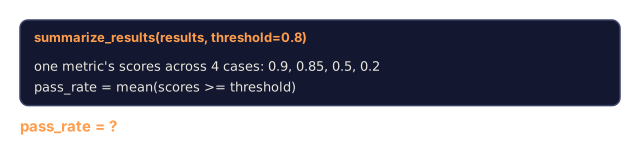
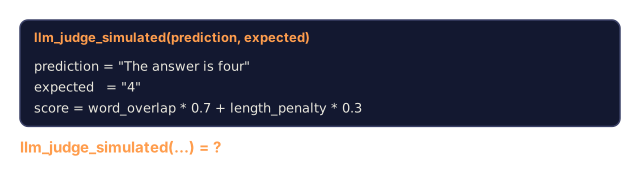
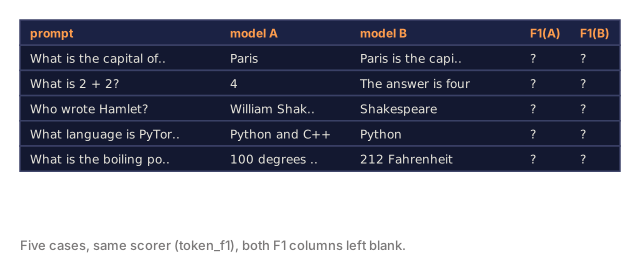
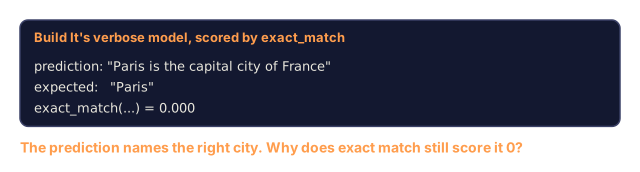
The "good" model gives exact answers. The "bad" model gives verbose paraphrases. Exact match punishes the verbose model severely. Token F1 and LLM-as-judge are more forgiving. This illustrates why metric choice matters: the same model looks great or terrible depending on how you score it. In this five-case run, Model B scores 0.000 on exact match, 0.283 mean token F1 and 0.481 mean judge score, with a judge pass rate of 20%. main.py extends this to eight cases and adds a random third model.
Step 7: ELO Tournament
Run pairwise comparisons between models across multiple rounds.
elo = ELOTracker(k=32)

for case in cases:
    pred_a = demo_model_good(case.input_text)
    pred_b = demo_model_bad(case.input_text)

    score_a = token_f1(pred_a, case.expected)
    score_b = token_f1(pred_b, case.expected)

    if score_a > score_b:
        outcome = "a"
    elif score_b > score_a:
        outcome = "b"
    else:
        outcome = "tie"

    elo.record_match("model_a_concise", "model_b_verbose", outcome)

print("\nELO Leaderboard:")
for name, rating in elo.leaderboard():
    print(f"  {name}: {rating:.0f}")
Step 8: Perplexity Comparison
Compare perplexity across "models" of different quality levels.
test_text = "The quick brown fox jumps over the lazy dog in the garden"

for quality, label in [(0.9, "Strong model"), (0.7, "Medium model"), (0.4, "Weak model")]:
    log_probs = token_log_probs_simulated(test_text, model_quality=quality)
    ppl = perplexity(log_probs)
    print(f"  {label} (quality={quality}): perplexity = {ppl:.2f}")
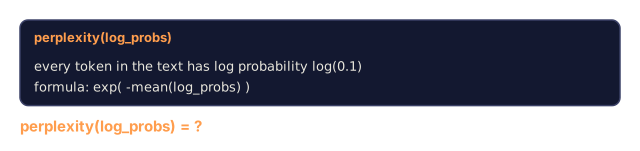
The values are simulated, so they land far below the real-model numbers in the concept section (roughly 1.2, 1.6 and 2.9 here). What matters is the ordering: lower quality gives higher perplexity. The seed comes from hash(text), so set PYTHONHASHSEED if you want repeatable numbers.
Use It
lm-evaluation-harness (EleutherAI)
The standard tool for running benchmarks on any model.
# pip install lm-eval
# Command line:
# lm_eval --model hf --model_args pretrained=meta-llama/Llama-3.1-8B --tasks mmlu --batch_size 8

# Python API:
# import lm_eval
# results = lm_eval.simple_evaluate(
#     model="hf",
#     model_args="pretrained=meta-llama/Llama-3.1-8B",
#     tasks=["mmlu", "hellaswag", "arc_easy"],
#     batch_size=8,
# )
# print(results["results"])
promptfoo
Config-driven eval for prompt engineering. Define tests in YAML and run against multiple providers.
# promptfoo.yaml
providers:
  - openai:gpt-4o-mini
  - anthropic:claude-3-haiku

prompts:
  - "Answer in one word: {{question}}"

tests:
  - vars:
      question: "What is the capital of France?"
    assert:
      - type: contains
        value: "Paris"
  - vars:
      question: "What is 2 + 2?"
    assert:
      - type: equals
        value: "4"
RAGAS for RAG evaluation
# pip install ragas
# from ragas import evaluate
# from ragas.metrics import faithfulness, answer_relevancy, context_precision
#
# result = evaluate(
#     dataset,
#     metrics=[faithfulness, answer_relevancy, context_precision],
# )
# print(result)
RAGAS measures what generic evals miss: whether the model's answer is grounded in the retrieved context, not just whether the answer is "correct" in the abstract.
Ship It
This lesson produces outputs/prompt-eval-designer.md, a reusable prompt that designs custom eval suites for any task. Give it a task description and it generates test cases, scoring functions, and a pass/fail threshold recommendation.
It also produces outputs/skill-llm-evaluation.md, a decision framework for choosing the right evaluation strategy based on your task type, budget, and latency requirements.
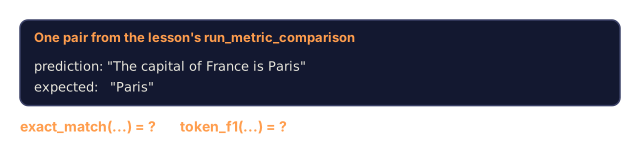
I'd run main.py and read the last block of output first. It scores six prediction and reference pairs with exact match, token F1, and the simulated judge side by side, so you can watch "The capital of France is Paris" get 0 from exact match and a nonzero score from the other two. That disagreement is the argument for picking metrics per task.
Nothing in the file calls a model. The judge is word overlap plus a length term, and the perplexity log-probs come from a seeded random generator, so those numbers show how the functions behave and say nothing about a real model. The seed comes from hash(text), and Python salts string hashes per process, so the perplexity values and the random model in the ELO demo can change between runs unless you set PYTHONHASHSEED.
Exercise 5, the model diff, is the one I'd build next. summarize_results collapses each metric into summary statistics, but the records EvalSuite.run returns already hold the input, prediction, and scores for each case, which is all you need to see what moved.
Exercises
-
Add a "consistency" scorer that runs the same input through the model 5 times and measures how often the outputs match. Inconsistent answers on deterministic inputs reveal fragile prompts or high temperature settings.
-
Extend the ELO tracker to support multiple judge functions (exact match, F1, LLM-as-judge) and weight them. Compare how the leaderboard changes when you weight exact match heavily versus F1 heavily.
-
Build an eval suite for a specific task: email classification into 5 categories. Create 100 test cases with diverse examples including edge cases (emails that could belong to multiple categories, empty emails, emails in other languages). Measure how different "models" (rule-based, keyword matching, simulated LLM) perform.
-
Implement contamination detection: given a set of eval questions and a training corpus, check what percentage of eval questions (or close paraphrases) appear in the training data. This is how researchers audit benchmark validity.
-
Build a "model diff" tool. Given eval results from two model versions, highlight which specific test cases improved, which regressed, and which stayed the same. This is the eval equivalent of a code diff, and you need it to understand whether a change helped or hurt.
Key Terms
| Term | What people say | What it actually means |
|---|---|---|
| MMLU | "The benchmark" | Massive Multitask Language Understanding -- 15,908 multiple choice questions across 57 subjects, saturated above 88% by 2025 |
| HumanEval | "Code eval" | 164 Python function-completion problems from OpenAI, tests only isolated function generation |
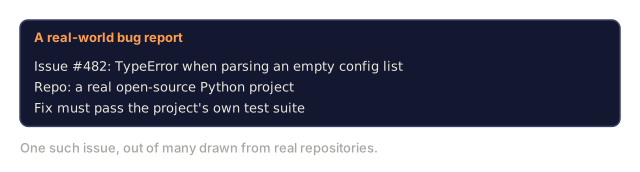
| SWE-bench | "Real coding eval" | 2,294 GitHub issues from 12 Python repos, measures end-to-end bug fixing including test generation |
| Perplexity | "How confused the model is" | exp(-avg(log P(token_i given context))) -- lower means the model assigns higher probability to the actual tokens |
| ELO rating | "Chess ranking for models" | A relative skill rating computed from pairwise win/loss records, used by Chatbot Arena to rank 100+ models |
| LLM-as-judge | "Using AI to grade AI" | A strong model scores a weaker model's outputs against a rubric, ~80% agreement with human judges at ~$0.01/judgment |
| Data contamination | "The model saw the test" | Training data includes benchmark questions, inflating scores without improving real capability |
| Eval suite | "A bunch of tests" | A versioned collection of (input, expected_output, scorer) triples that measure a specific capability |
| Pass rate | "What percentage it gets right" | Fraction of eval cases scoring above a threshold -- more actionable than mean score because it measures reliability |
| Chatbot Arena | "Model ranking website" | LMSYS platform with 2M+ human preference votes, producing the most trusted LLM leaderboard via ELO ratings |
Further Reading
- Hendrycks et al., 2021 -- "Measuring Massive Multitask Language Understanding": the MMLU paper, still the most cited LLM benchmark despite its saturation
- Chen et al., 2021 -- "Evaluating Large Language Models Trained on Code": the HumanEval paper from OpenAI, established code generation evaluation methodology
- Zheng et al., 2023 -- "Judging LLM-as-a-Judge": systematic analysis of using LLMs to evaluate LLMs, including position bias and verbosity bias findings
- LMSYS Chatbot Arena: crowdsourced model comparison platform with 2M+ votes, the most trusted real-world LLM ranking
Code
- main.py (python, 335 lines)