Structured Output — JSON Schema, Pydantic, Zod, Constrained Decoding
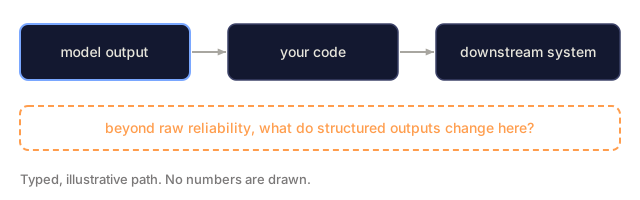
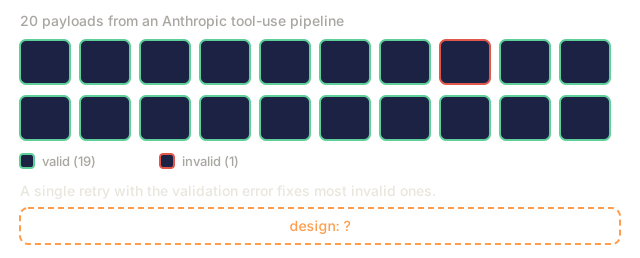
"Ask the model nicely to return JSON" fails 5 to 15 percent of the time, even on frontier models. Structured outputs close that gap with constrained decoding: the decoder masks any token that would violate the schema. OpenAI's strict mode, Anthropic's schema-typed tool use, Gemini's `responseSchema`, Pydantic AI's `output_type`, and Zod's `.parse` are five surface forms of the same idea. This lesson builds a schema validator and the three-outcome contract you will reuse in every production extraction pipeline.
Learning Objectives
- Write a JSON Schema 2020-12 for an extraction target using the right constraints (enum, min/max, required, pattern).
- Explain why strict mode and constrained decoding give different guarantees from "validate after generation".
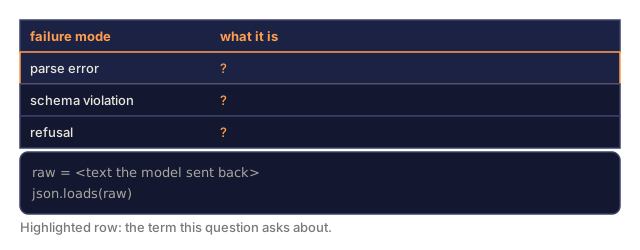
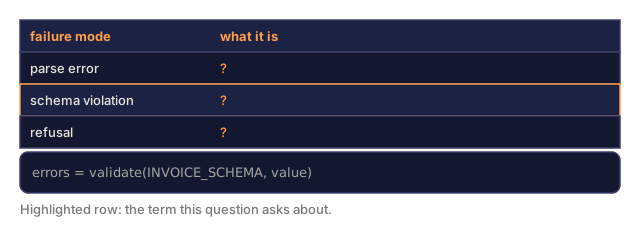
- Distinguish the three failure modes: parse error, schema violation, model refusal.
- Ship an extraction pipeline with typed repair and typed refusal handling.
The Problem
An agent reading a purchase-order email needs to turn free text into {customer, line_items, total_usd}. There are three ways to do it.
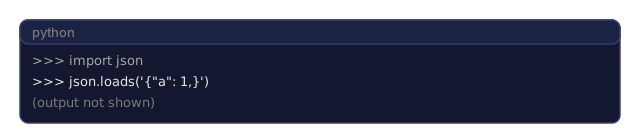
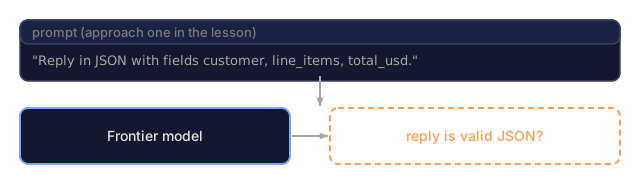
Approach one: prompt for JSON. "Reply in JSON with fields customer, line_items, total_usd." This works 85 to 95 percent of the time on frontier models. The rest fail in six ways: a missing brace, a trailing comma, wrong types, hallucinated fields, truncation at the token limit, and leaked prose like "Here is your JSON:".
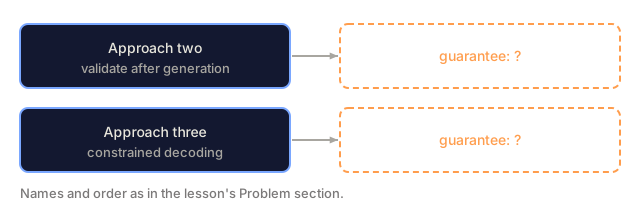
Approach two: validate after generation. Generate freely, parse, validate against the schema, retry on failure. It is reliable but you pay for every retry, and each truncation bug costs one extra turn.
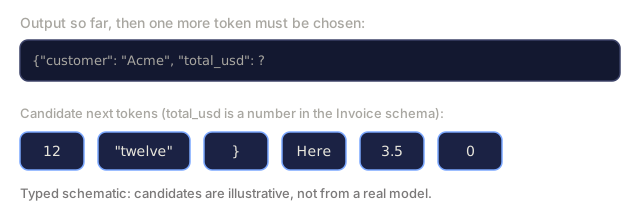
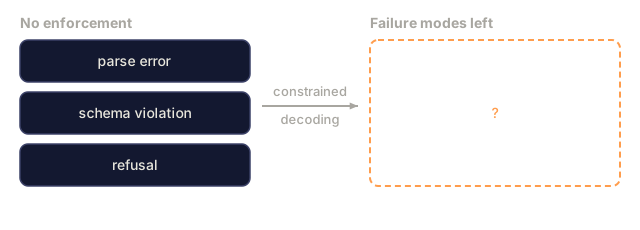
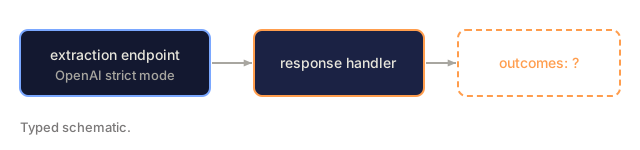
Approach three: constrained decoding. The provider enforces the schema at decode time. Invalid tokens are masked out of the sampling distribution, so the output parses and validates. Failure collapses to one mode, refusal, where the model decides the input does not fit the schema.
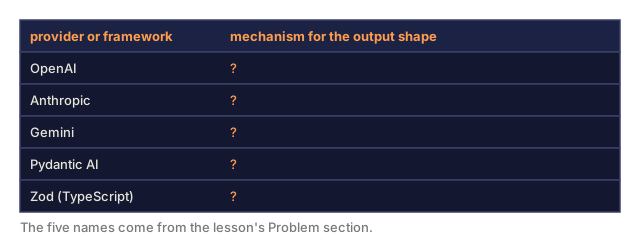
Every 2026 frontier provider ships some form of approach three.
- OpenAI.
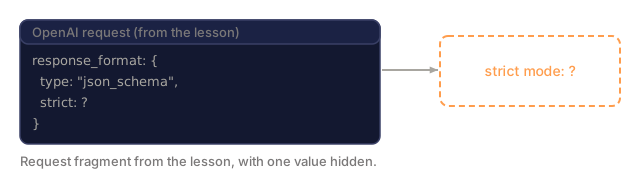
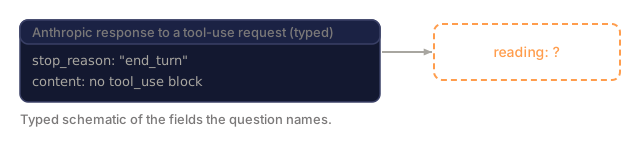
response_format: {type: "json_schema", strict: true}, plus arefusalin the response if the model declines. - Anthropic. Schema enforcement on
tool_useinputs. There is nostop_reason: "refusal"; the signal isend_turnwith no tool call. - Gemini.
responseSchemaat request level. In 2026 Gemini ships token-level grammar constraints for selected types. - Pydantic AI.
output_type=InvoiceModelreturns aRunResulttyped toInvoiceModel. - Zod (TypeScript). A runtime parser that validates provider output against a Zod schema. It pairs with OpenAI's
beta.chat.completions.parse.
Declare the schema once and enforce it end to end.
The Concept
JSON Schema 2020-12, the lingua franca
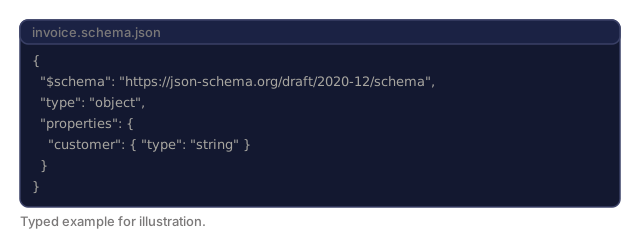
Every provider accepts JSON Schema 2020-12. These are the constructs you will reach for most:
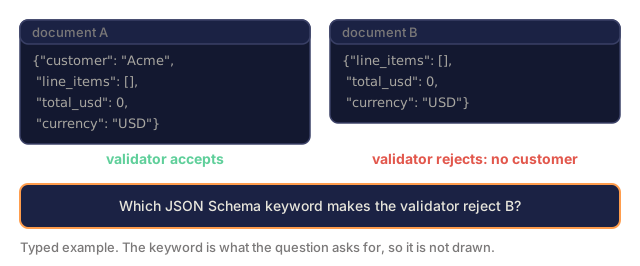
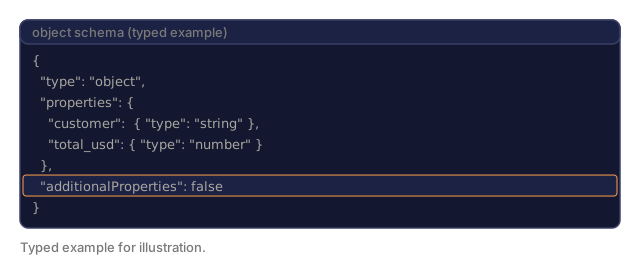
type: one ofobject,array,string,number,integer,boolean,null.properties: map of field name to subschema.required: list of field names that must appear.enum: closed set of allowed values.minimum/maximum(numbers),minLength/maxLength/pattern(strings).items: subschema applied to every array element.additionalProperties:falseforbids extra fields (default varies by mode).
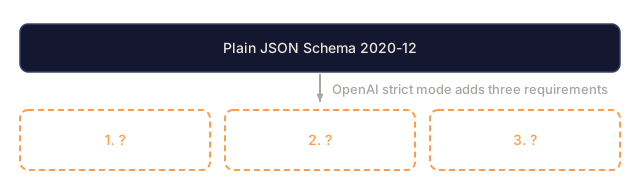
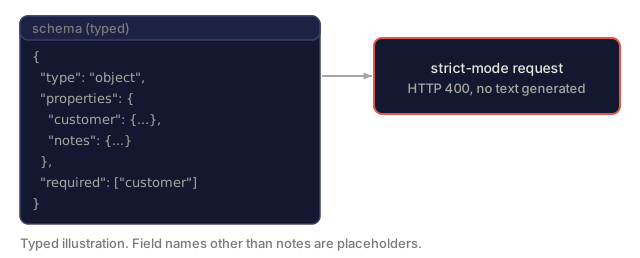
OpenAI strict mode adds three requirements: every property must be listed in required, additionalProperties: false must be set at every object level, and no $ref can be left unresolved. Break one and the API returns a 400 at request time.
Pydantic, the Python binding
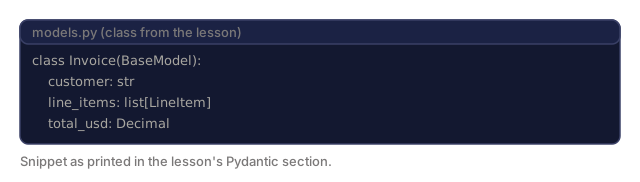
Pydantic v2 generates JSON Schema from dataclass-shaped models via model_json_schema(). Pydantic AI wraps this so you write:
class Invoice(BaseModel):
    customer: str
    line_items: list[LineItem]
    total_usd: Decimal
and the agent framework translates the schema into OpenAI strict mode, Anthropic input_schema, or Gemini responseSchema at the edge. The output comes back as a typed Invoice instance, and validation errors raise ValidationError with typed error paths.
Zod, the TypeScript binding
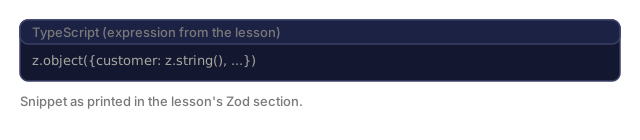
Zod (z.object({customer: z.string(), ...})) is the TS equivalent. OpenAI's Node SDK exposes zodResponseFormat(Invoice), which translates to the API's JSON Schema payload.
Refusals
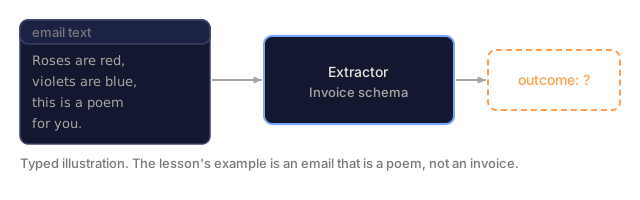
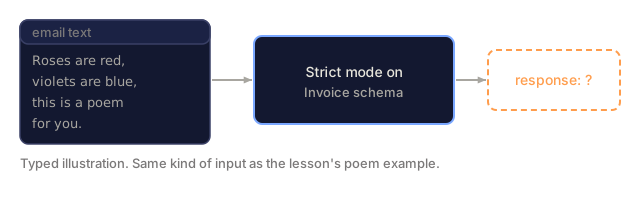
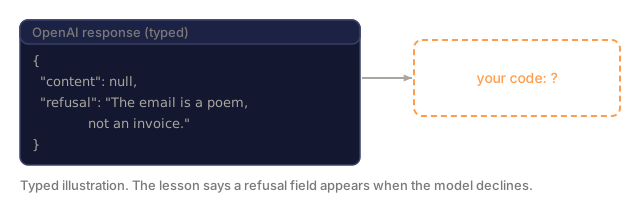
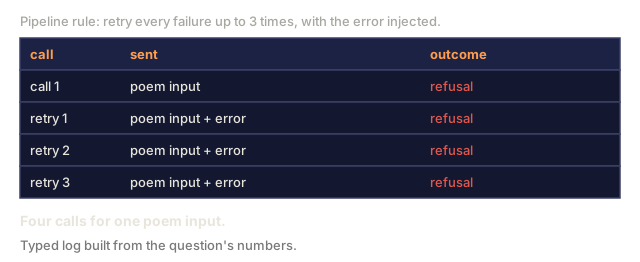
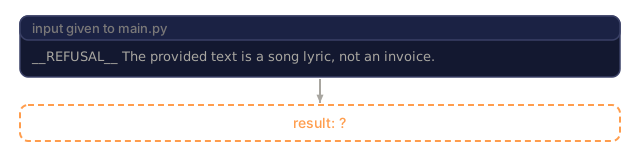
Strict mode cannot force the model to answer. If the input cannot fit the schema ("the email was a poem, not an invoice"), the model emits a refusal field with the reason. Handle it as a first-class outcome, not a failure. It doubles as a safety signal: a model asked to extract a credit card number from a protected-content email returns a refusal with the safety reason attached.
Constrained decoding in the open
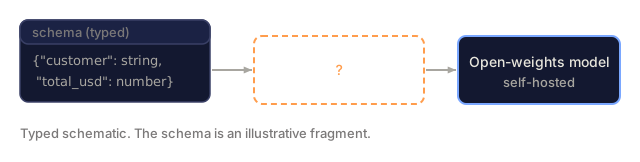
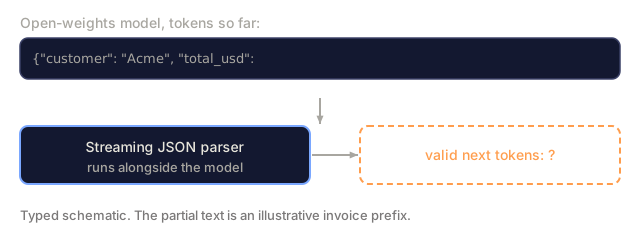
Open-weights implementations use three techniques.
- Grammar-based decoding (
outlines,guidance,lm-format-enforcer): build a deterministic finite automaton from the schema; at every step, mask the logits of tokens that would violate the FSM. - Logit masking with a JSON parser: run a streaming JSON parser in lockstep with the model; at every step, compute the valid-next-token set.
- Speculative decoding with a verifier: cheap draft model proposes tokens, verifier enforces the schema.
Commercial providers pick one of these behind the scenes. The 2026 state of the art is faster than plain generation for short structured outputs and roughly the same speed for long ones.
The three failure modes
- Parse error. The output is not valid JSON. Strict mode rules this out, but non-strict providers can still produce it.
- Schema violation. The output parses but breaks the schema. Strict mode rules this out too. Outside it, this one is common.
- Refusal. The model declines. Handle it as a typed outcome.
Retry strategy
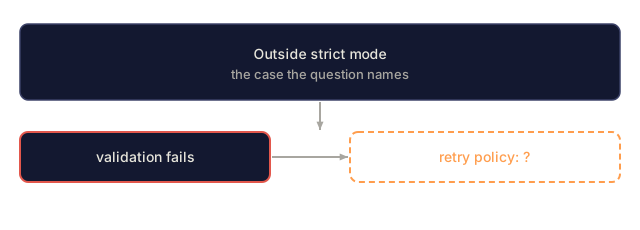
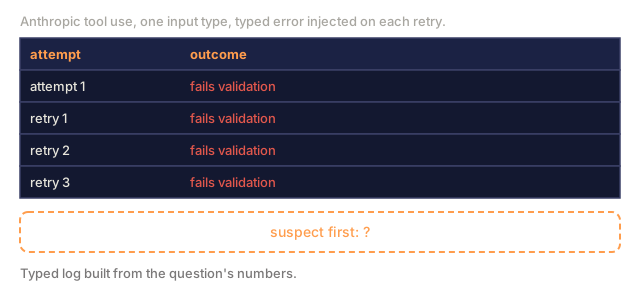
When you are outside strict mode (Anthropic tool use, non-strict OpenAI, older Gemini), the recovery pattern is:
generate -> parse -> validate -> if fail, inject error and retry, max 3x
One retry usually fixes it. Three catch the flakes from weaker models. If you need more than three, suspect the schema: the model cannot satisfy it for some inputs, and the prompt or the schema needs fixing.
Small-model support
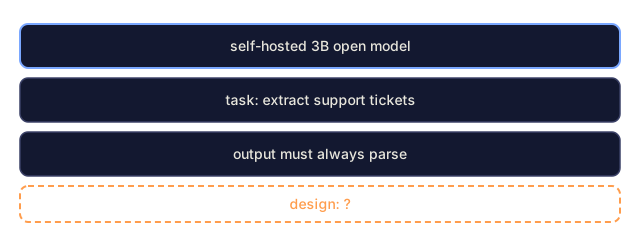
Constrained decoding works on small models. A 3B-parameter open model with grammar enforcement outperforms a 70B-parameter model with raw prompting on structured tasks. That is the main reason structured outputs matter in production: reliability stops depending on model size.
Use It
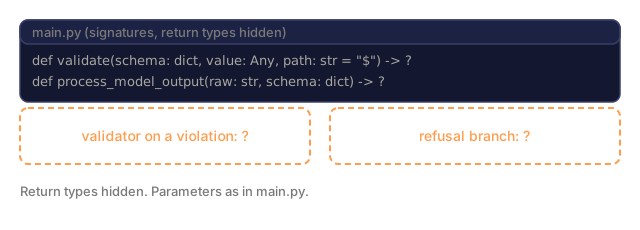
main.py ships a minimal JSON Schema 2020-12 validator in stdlib (types, required, enum, min/max, pattern, items, additionalProperties). It wraps an Invoice schema and runs a fake LLM output through the validator, which exercises the parse error, schema violation, and refusal paths. In production, swap the fake output for any provider's real response.
What to look at:
- The validator returns a typed
[ValidationError]list with a path and a message. That is the shape you want to feed into the retry prompt. - The refusal branch does not retry. It logs and returns a typed refusal. Phase 14 · 09 uses refusals as a safety signal.
- The
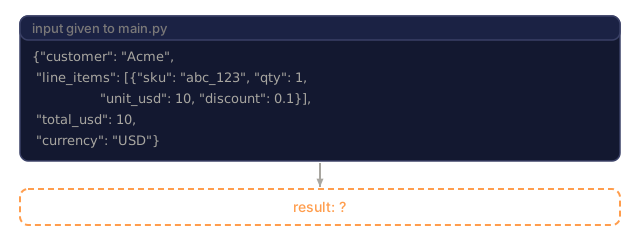
additionalProperties: falsecheck fires on the adversarial test input, which shows why strict mode shuts the door on hallucinated fields.
Ship It
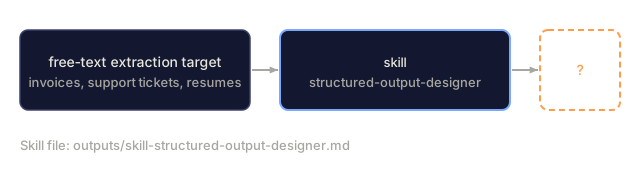
This lesson produces outputs/skill-structured-output-designer.md. Give it a free-text extraction target (invoices, support tickets, resumes) and it returns a strict-mode-compatible JSON Schema 2020-12 and a matching Pydantic model, with typed refusal and retry handling stubbed in.
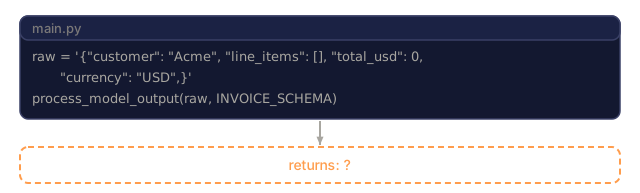
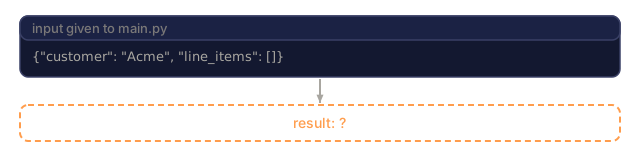
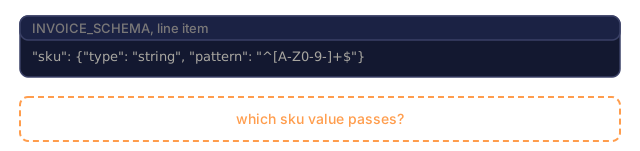
I'd run main.py first and read the five test cases against the schema. It needs nothing beyond the standard library, and each case lands in a different branch of process_model_output: ok, parse_error, violation (twice, once for extra fields and a bad sku, once for a missing field), and refusal. Seeing which error paths come back for each is faster than reading the validator top to bottom.
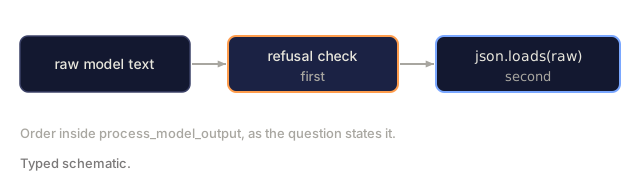
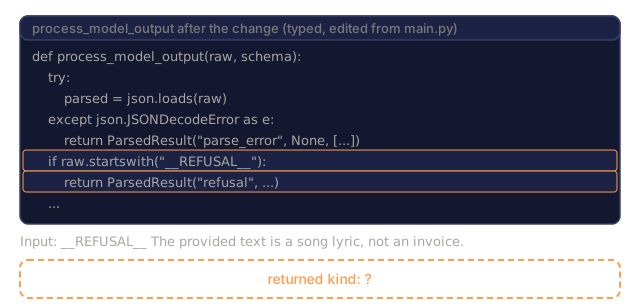
The part I'd look at hardest is the refusal check, which runs before json.loads. In the toy it is a __REFUSAL__ string prefix standing in for a provider's refusal field, so a refusal never gets mistaken for a parse error. Real providers hand you that signal differently, and the Anthropic case is the awkward one, since you infer it from end_turn with no tool call.
I'd also keep the validator in proportion. It covers a subset of the spec and has no oneOf and no $ref, so it will not stand in for a real library on a production schema. It is there to show the error shape you want to feed back into a retry prompt. The retry loop itself is not in the file, so the pattern in The Concept is yours to build, and exercise 2 covers the missing oneOf.
Exercises
-
Run
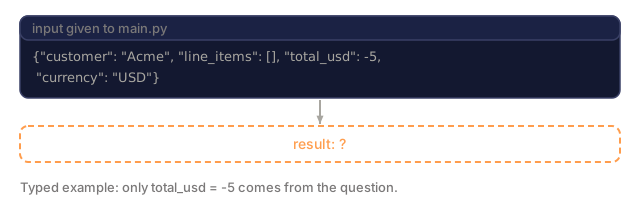
main.py. Add a sixth test case whosetotal_usdis a negative number. Confirm the validator rejects it with theminimumconstraint path. -
Extend the validator to support
oneOfwith a discriminator. The common case:line_itemis either a product or a service, tagged bykind. Strict mode has subtle rules here; check OpenAI's structured outputs guide. -
Write the same Invoice schema as a Pydantic BaseModel and compare
model_json_schema()output to your hand-rolled schema. Identify the one field Pydantic sets by default that the hand-rolled version omits. -
Measure refusal rates. Construct ten inputs that should not be extractable (a song lyric, a math proof, a blank email) and run them through a real provider with strict mode. Count refusals vs hallucinated outputs. This is your ground truth for refusal-aware retries.
-
Read OpenAI's structured outputs guide top to bottom. Identify the one construct it explicitly forbids in strict mode that plain JSON Schema allows. Then design a schema that uses the forbidden construct non-essentially and refactor it to be strict-compatible.
Key Terms
| Term | What people say | What it actually means |
|---|---|---|
| JSON Schema 2020-12 | "The schema spec" | IETF-draft schema dialect every modern provider speaks |
| Strict mode | "Guaranteed schema" | OpenAI flag that enforces schema via constrained decoding |
| Constrained decoding | "Logit masking" | Decode-time enforcement that masks invalid next-tokens |
| Refusal | "Model declines" | Typed outcome when input cannot fit the schema |
| Parse error | "Invalid JSON" | Output did not parse as JSON; impossible under strict |
| Schema violation | "Wrong shape" | Parsed but violated types / required / enum / range |
additionalProperties: false | "No extras allowed" | Forbids unknown fields; required in OpenAI strict |
| Pydantic BaseModel | "Typed output" | Python class that emits and validates JSON Schema |
| Zod schema | "TypeScript output type" | TS runtime schema for provider output validation |
| Grammar enforcement | "Open-weights constrained decode" | FSM-based logit masking, as in outlines / guidance |
Further Reading
- OpenAI: Structured outputs: strict mode, refusals, and schema requirements
- OpenAI: Introducing structured outputs: August 2024 launch post explaining the decoding guarantee
- Pydantic AI: Output: typed output_type bindings that serialize to each provider
- JSON Schema: 2020-12 release notes: the canonical spec
- Microsoft: Structured outputs in Azure OpenAI: enterprise deployment notes and strict-mode caveats
Code
- main.py (python, 206 lines)