Self-Supervised Vision — SimCLR, DINO, MAE
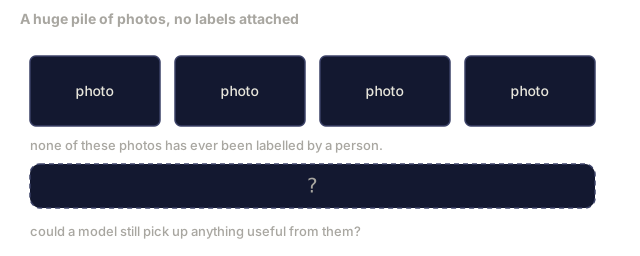
Labels are the bottleneck in supervised vision. Self-supervised pretraining routes around it: learn visual features from 100M unlabelled images, then fine-tune on 10k labelled ones.
Learning Objectives
- Trace the three major self-supervised families — contrastive (SimCLR), teacher-student (DINO), masked reconstruction (MAE) — and state what each one optimises
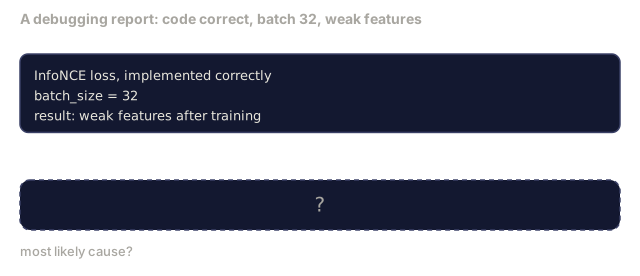
- Implement an InfoNCE loss from scratch and explain why a batch of 512 works but a batch of 32 fails
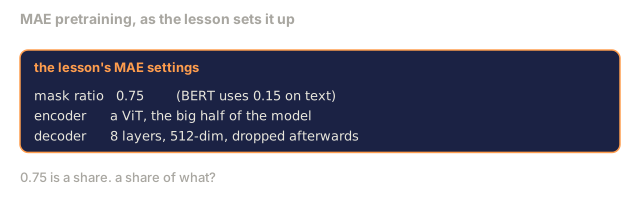
- Explain why MAE's 75% masking ratio is not arbitrary and how it differs from BERT's 15% for text
- Use DINOv2 or MAE ImageNet checkpoints for linear probing and zero-shot retrieval
The Problem
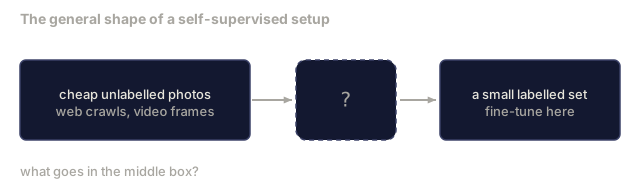
Supervised ImageNet has 1.3M labelled images, which cost an estimated $10M to annotate. Medical and industrial datasets are smaller and even more expensive to label. Every vision team ends up asking the same question: can we pretrain on cheap unlabelled data (YouTube frames, web crawls, webcam footage, satellite sweeps) and then fine-tune on a small labelled set?
Self-supervised learning solves this: train the model on a task built entirely out of the unlabelled data itself, no human annotation involved, then transfer the features it learns to the small labelled set you actually care about. A modern self-supervised ViT trained on LAION or JFT reaches or beats supervised ImageNet accuracy once fine-tuned, and it transfers better to downstream tasks (detection, segmentation, depth) than supervised pretraining does. DINOv2 (Meta, 2023) and MAE (Meta, 2022) are the current production defaults for transferable vision features.
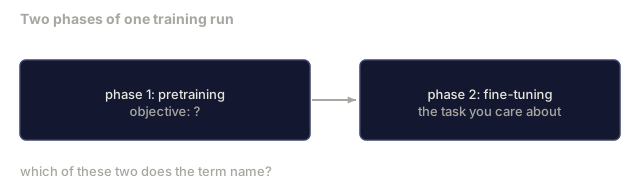
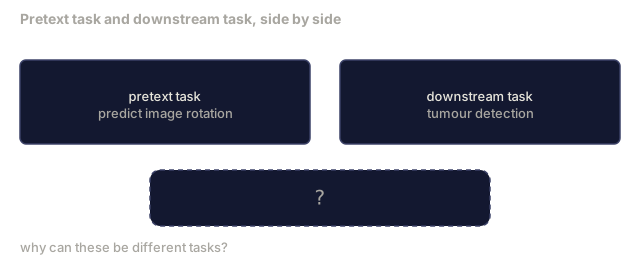
The conceptual shift is that the pretext task, the objective the model actually trains on, doesn't have to match the downstream task. What matters is that it forces the model to learn useful features. Predicting the colour of grayscale images, rotating images and classifying the rotation, masking patches and reconstructing them: all of these have worked. The three approaches that scale to production are contrastive learning, teacher-student distillation, and masked reconstruction.
The Concept
Three families

Contrastive learning (SimCLR)
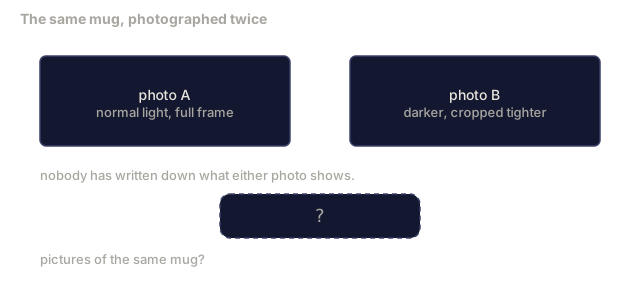
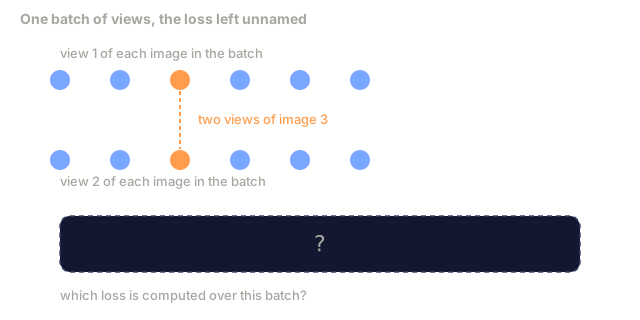
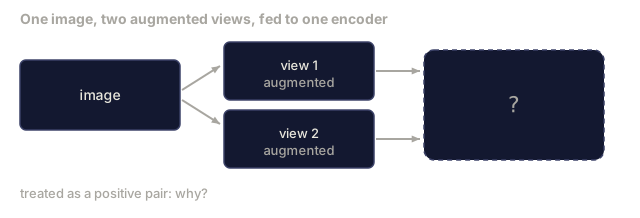
Take one image, apply two random augmentations, and get two views. Feed both through the same encoder plus a projection head (a small MLP that maps the encoder's features into the space where the contrastive loss is computed). Minimise a loss that says "these two embeddings should be close" and "this embedding should be far from every other image's embeddings in the batch."
Loss for positive pair (z_i, z_j) among 2N views per batch:

   L_ij = -log( exp(sim(z_i, z_j) / tau) / sum_k in batch \ {i} exp(sim(z_i, z_k) / tau) )

sim = cosine similarity
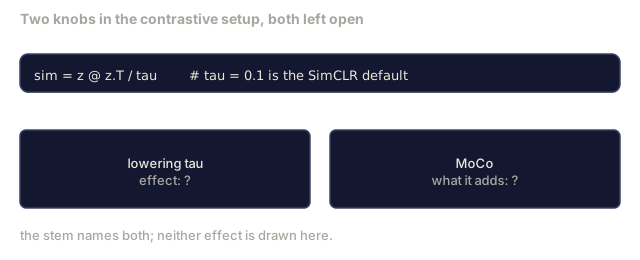
tau = temperature (0.1 standard)
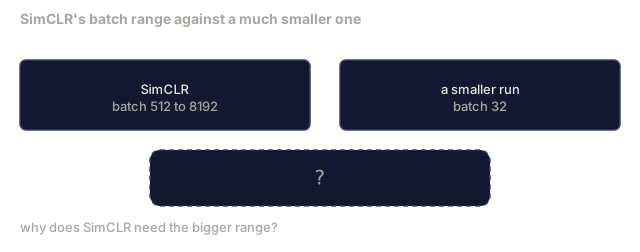
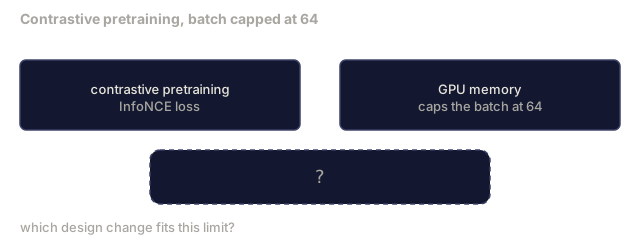
This is the InfoNCE loss. It needs many negatives per positive, so batch size matters: SimCLR runs on batches of 512 to 8192. MoCo introduced a momentum queue of past batches to decouple negative count from batch size.
Teacher-student (DINO)
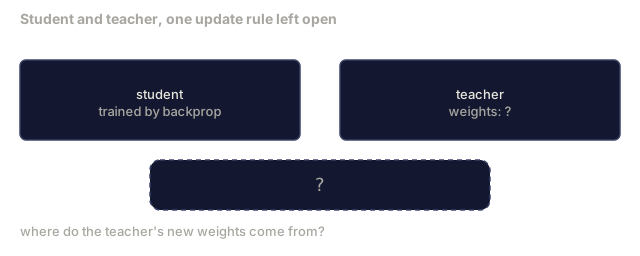
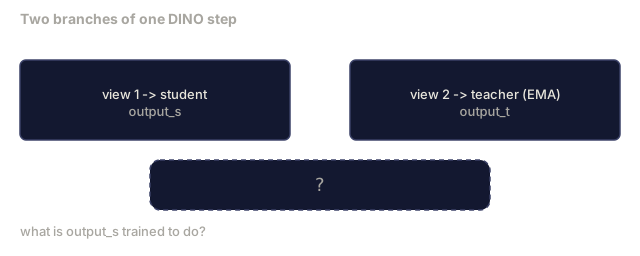
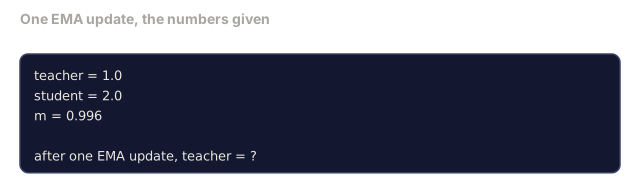
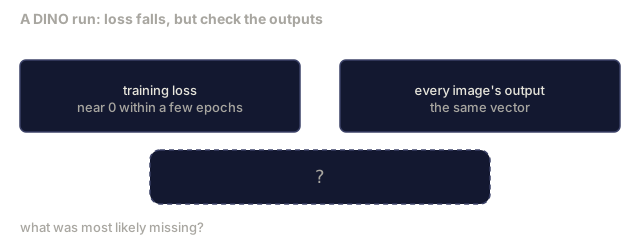
Two networks share the same architecture: student and teacher. The teacher is an exponential moving average (EMA) of the student's weights. Both see augmented views of the image, and the student's output is trained to match the teacher's, with no explicit negatives.
loss = CE( student_output(view_1),  teacher_output(view_2) )
     + CE( student_output(view_2),  teacher_output(view_1) )

teacher_weights = m * teacher_weights + (1 - m) * student_weights   (m ≈ 0.996)
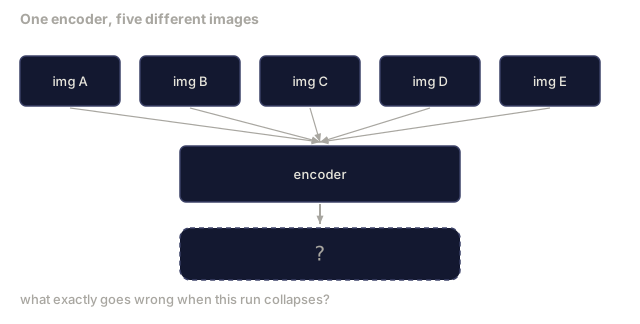
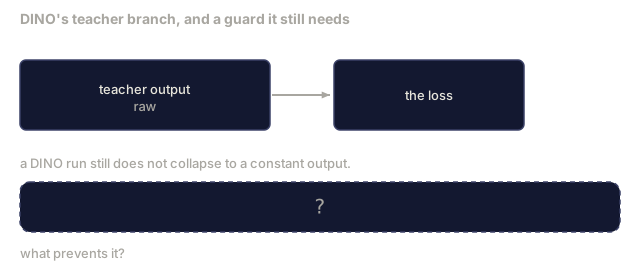
Why it doesn't collapse to "predict a constant": the teacher's output is centred (subtract the per-dimension mean) and sharpened (divide by a small temperature). Centring stops one dimension from dominating; sharpening stops the output from collapsing to uniform.
DINO is what DINOv2 scales up, on 142M curated images. The resulting features are the current SOTA for zero-shot visual retrieval and dense prediction.
Masked reconstruction (MAE)
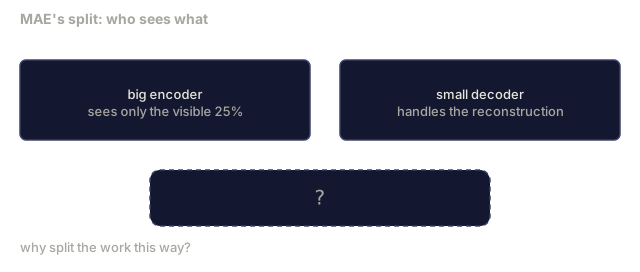
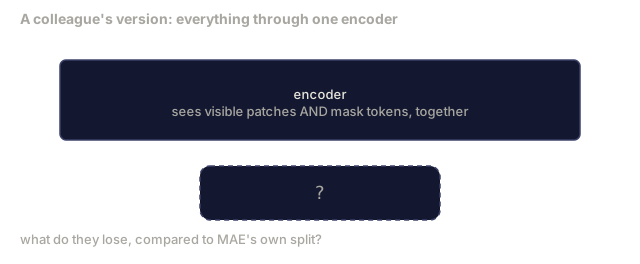
Mask 75% of the patches in a ViT input. Pass only the visible 25% through the encoder. A small decoder receives the encoder's output plus mask tokens at the masked positions, and it's trained to reconstruct the pixels of the masked patches.
Encoder:  visible 25% of patches -> features
Decoder:  features + mask tokens at masked positions -> reconstructed pixels
Loss:     MSE between reconstructed and original pixels on masked patches only
Three design choices make MAE work:
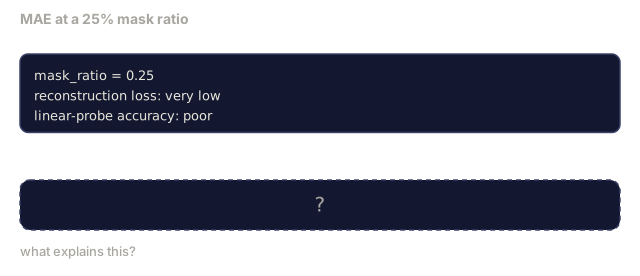
- 75% mask ratio: high, and deliberately so. It forces the encoder to learn semantic features; at a 25% mask ratio, reconstruction would be near-trivial, since neighbouring pixels are correlated enough that a plain CNN could nail it.
- Asymmetric encoder/decoder: the big ViT encoder only ever sees visible patches, while a small decoder (8-layer, 512-dim) handles reconstruction. That's roughly 3x faster pretraining than naive BEiT (which runs every token, including the masked ones, through the full encoder).
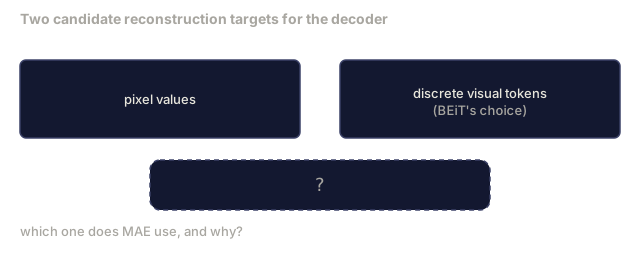
- Pixel-space reconstruction target: simpler than BEiT's target of predicting discrete visual tokens, and it works better on ViT.
After pretraining, discard the decoder. The encoder is the feature extractor.
Why 75% and not 15%
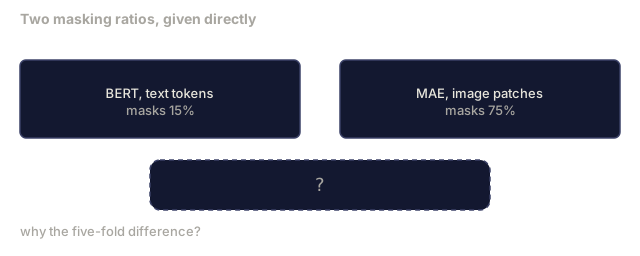
BERT masks 15% of tokens. MAE masks 75%. The difference comes down to information density.
- Natural language has high entropy per token. Predicting 15% of tokens is still hard, because each masked position has many plausible completions.
- Image patches have low entropy: an unmasked neighbourhood often determines the masked patch's pixels almost exactly. Making the prediction require real semantic understanding means masking aggressively.
75% is high enough that simple spatial extrapolation can't solve the task; the encoder has to actually represent the image content.
Linear-probe evaluation
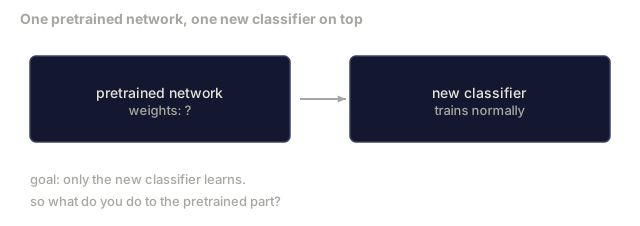
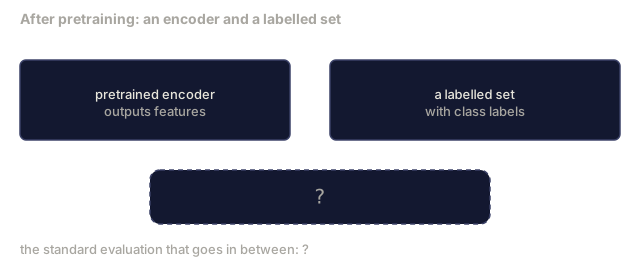
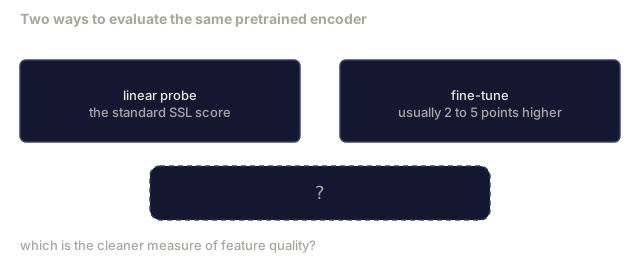
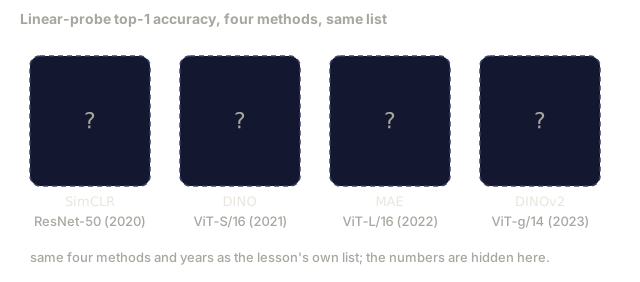
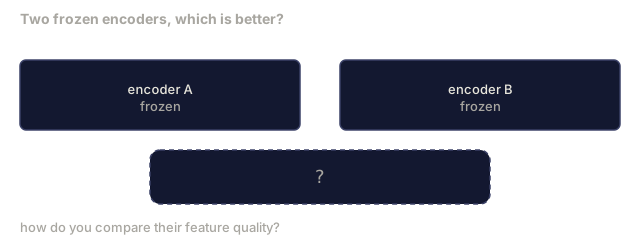
After self-supervised pretraining, the standard evaluation is a linear probe: freeze the encoder, then train a single linear classifier on top of it using ImageNet labels, and report top-1 accuracy.
- SimCLR ResNet-50: ~71% (2020)
- DINO ViT-S/16: ~77% (2021)
- MAE ViT-L/16: ~76% (2022)
- DINOv2 ViT-g/14: ~86% (2023)
A linear probe is a pure measure of feature quality. Fine-tuning typically adds another 2-5 points, but it also mixes in the effect of retraining the head.
Build It
Step 1: Two-view augmentation pipeline
import torch
import torchvision.transforms as T

two_view_train = lambda: T.Compose([
    T.RandomResizedCrop(96, scale=(0.2, 1.0)),
    T.RandomHorizontalFlip(),
    T.ColorJitter(0.4, 0.4, 0.4, 0.1),
    T.RandomGrayscale(p=0.2),
    T.ToTensor(),
])


class TwoViewDataset(torch.utils.data.Dataset):
    def __init__(self, base):
        self.base = base
        self.aug = two_view_train()

    def __len__(self):
        return len(self.base)

    def __getitem__(self, i):
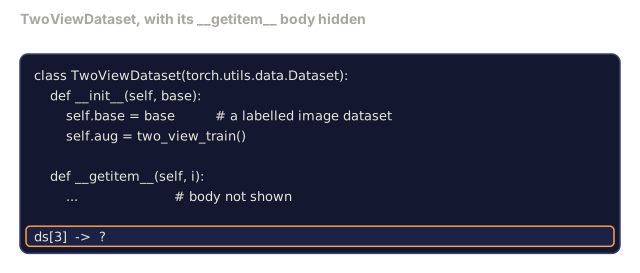
        img, _ = self.base[i]
        v1 = self.aug(img)
        v2 = self.aug(img)
        return v1, v2
Each getitem call returns two augmented views of the same image; no labels needed.
Step 2: InfoNCE loss
import torch.nn.functional as F

def info_nce(z1, z2, tau=0.1):
    """
    z1, z2: (N, D) L2-normalised embeddings of paired views
    """
    N, D = z1.shape
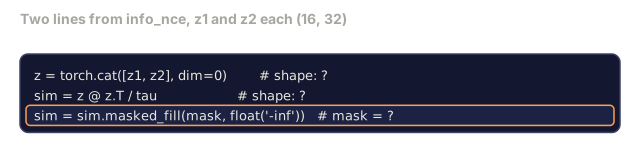
    z = torch.cat([z1, z2], dim=0)  # (2N, D)
    sim = z @ z.T / tau              # (2N, 2N)

    mask = torch.eye(2 * N, dtype=torch.bool, device=z.device)
    sim = sim.masked_fill(mask, float("-inf"))

    targets = torch.cat([torch.arange(N, 2 * N), torch.arange(0, N)]).to(z.device)
    return F.cross_entropy(sim, targets)
L2-normalise the embeddings before calling this. tau=0.1 is the SimCLR default: a lower value sharpens the loss and demands more negatives.
Step 3: Sanity check InfoNCE
z1 = F.normalize(torch.randn(16, 32), dim=-1)
z2 = z1.clone()
loss_same = info_nce(z1, z2, tau=0.1).item()
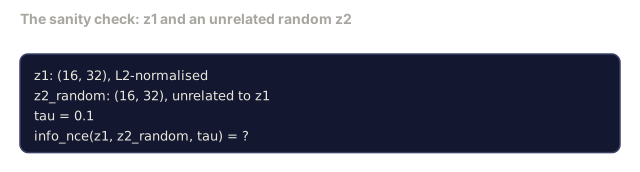
z2_random = F.normalize(torch.randn(16, 32), dim=-1)
loss_random = info_nce(z1, z2_random, tau=0.1).item()
print(f"InfoNCE with identical pairs:  {loss_same:.3f}")
print(f"InfoNCE with random pairs:     {loss_random:.3f}")
Identical pairs should produce a low loss (close to 0, for a large batch and a cold temperature). Random pairs should land near log(2N-1) = ~log(31) = ~3.4 for a 16-pair batch.
Step 4: MAE-style masking
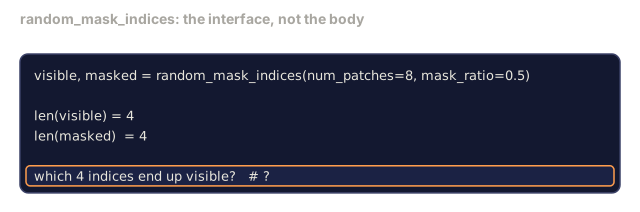
def random_mask_indices(num_patches, mask_ratio=0.75, seed=0):
    g = torch.Generator().manual_seed(seed)
    n_keep = int(num_patches * (1 - mask_ratio))
    perm = torch.randperm(num_patches, generator=g)
    visible = perm[:n_keep]
    masked = perm[n_keep:]
    return visible.sort().values, masked.sort().values


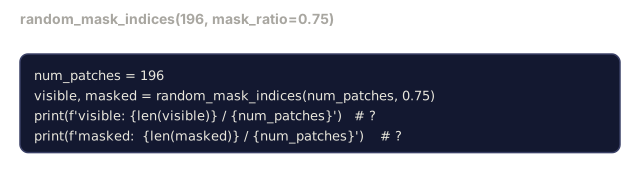
num_patches = 196
visible, masked = random_mask_indices(num_patches, mask_ratio=0.75)
print(f"visible: {len(visible)} / {num_patches}")
print(f"masked:  {len(masked)} / {num_patches}")
This version is simple, fast, and deterministic for a given seed. Real MAE implementations batch it and keep a separate mask per sample.
Use It
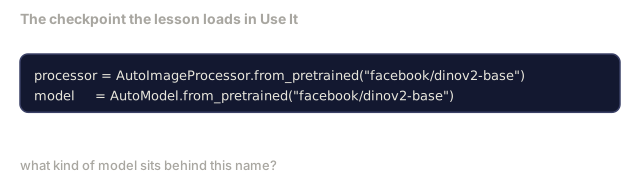
DINOv2 is the production standard in 2026:
import torch
from transformers import AutoImageProcessor, AutoModel

processor = AutoImageProcessor.from_pretrained("facebook/dinov2-base")
model = AutoModel.from_pretrained("facebook/dinov2-base")
model.eval()

# Per-image embeddings for zero-shot retrieval
with torch.no_grad():
    inputs = processor(images=[pil_image], return_tensors="pt")
    outputs = model(**inputs)
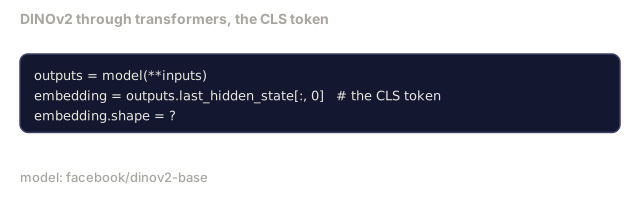
    embedding = outputs.last_hidden_state[:, 0]  # CLS token
The resulting 768-dim embedding is the backbone of modern image retrieval, dense correspondence, and zero-shot transfer pipelines. Fine-tuning on a downstream task rarely needs more than a linear head.
For image-text embeddings, SigLIP and OpenCLIP fill the same role; for MAE-style fine-tuning, the timm repo ships every MAE checkpoint.
Ship It
This lesson produces:
outputs/prompt-ssl-pretraining-picker.md: a prompt that picks SimCLR, MAE, or DINOv2 given dataset size, compute, and downstream task.outputs/skill-linear-probe-runner.md: a skill that writes the linear-probe evaluation for any frozen encoder plus labelled dataset.
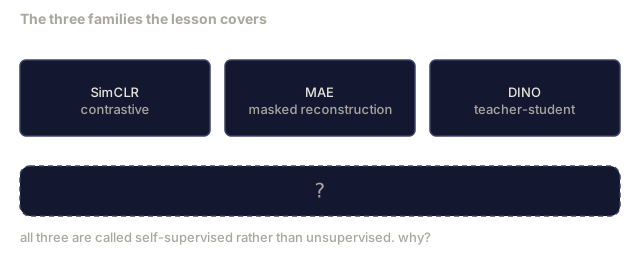
The distinction that trips people up first is "self-supervised" versus "unsupervised." Self-supervised training still uses labels, just labels the data manufactures for itself: the other augmented view in SimCLR, the unmasked patches in MAE, the teacher's own output in DINO. Nothing about the objective is unsupervised — the supervision signal is just synthetic. Once that clicks, SimCLR, DINO, and MAE stop looking like three unrelated tricks and start looking like three answers to the same question: what free label can I manufacture from this image alone?
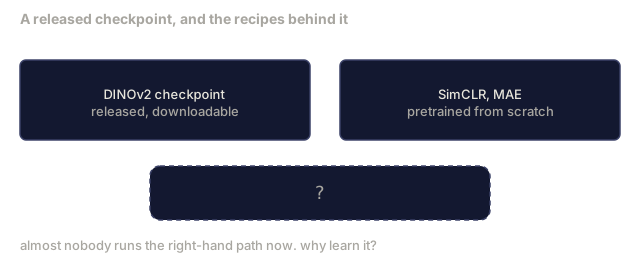
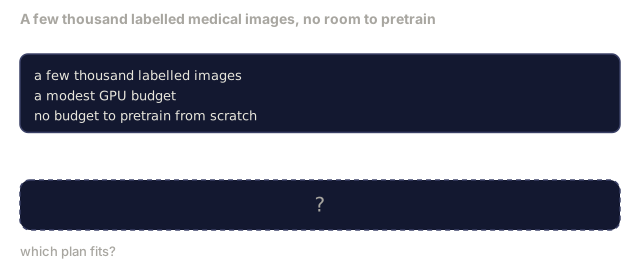
In practice, almost nobody pretrains their own SimCLR or MAE from scratch anymore. DINOv2 checkpoints are strong enough, and cheap enough to fine-tune, that training an encoder from raw pixels is usually a poor use of a GPU budget. Learn the mechanics here because they explain why DINOv2's features are as good as they are, not because you'll run this exact pipeline in production.
Exercises
- (Easy) Verify that InfoNCE loss drops when you decrease temperature for well-aligned embeddings and rises when you decrease temperature for random embeddings. Produce a plot
tau in [0.05, 0.1, 0.2, 0.5]vs loss. - (Medium) Implement a DINO-style centre buffer. Show that without the centring, the student collapses to a constant vector within a few epochs.
- (Hard) Train MAE on CIFAR-100 using the TinyUNet from Lesson 10 as the backbone. Report linear-probe accuracy at 10, 50, and 200 epochs. Show that a MAE-pretrained linear probe beats a from-scratch supervised linear probe on the same 1,000-image subset.
Key Terms
| Term | What people say | What it actually means |
|---|---|---|
| Self-supervised | "Label-free" | A pretext task that produces useful representations from unlabelled data |
| Pretext task | "The fake task" | The objective used during SSL (reconstruct patches, match views); discarded after pretraining |
| Linear probe | "Frozen encoder + linear head" | Standard SSL evaluation: train only a linear classifier on top of frozen features |
| InfoNCE | "Contrastive loss" | softmax over cosine similarities; positive pair is the target class, all others are negatives |
| EMA teacher | "Moving-average teacher" | Teacher whose weights are an exponential moving average of the student's; used by BYOL, MoCo, DINO |
| Mask ratio | "% of patches hidden" | Fraction of patches masked during MAE; 75% for vision, 15% for text |
| Representation collapse | "Constant output" | SSL failure where the encoder outputs a constant vector for all inputs; prevented by centring, sharpening, or negatives |
| DINOv2 | "Production SSL backbone" | Meta's 2023 self-supervised ViT; strongest general-purpose image features in 2026 |
Further Reading
- SimCLR (Chen et al., 2020): the contrastive learning reference
- DINO (Caron et al., 2021): teacher-student with momentum, centring, and sharpening
- MAE (He et al., 2022): masked autoencoder pretraining for ViT
- DINOv2 (Oquab et al., 2023): scaling self-supervised ViT to production features
Code
- main.py (python, 77 lines)