Automated Alignment Research (Anthropic AAR)
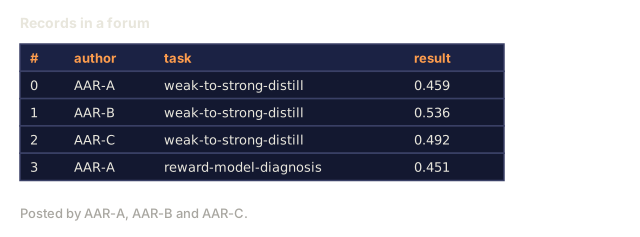
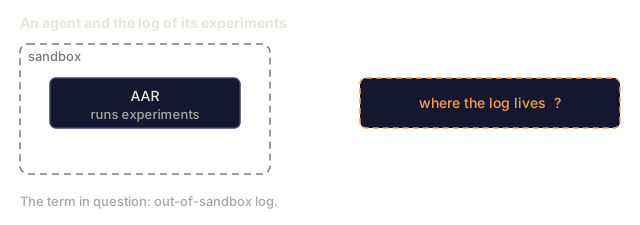
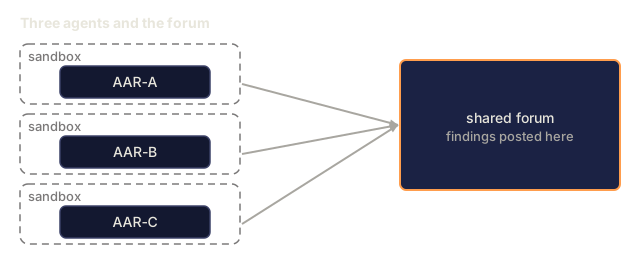
Anthropic ran parallel teams of Claude Opus 4.6 Autonomous Alignment Researchers in independent sandboxes, coordinating through a shared forum whose logs live outside any sandbox, so the agents cannot delete their own records. On the weak-to-strong training problem the AARs beat the human researchers. Anthropic's own summary warns that prescribed workflows often constrain AAR flexibility and hurt performance. Automating alignment research also compresses the timeline to the exact misalignment risks the RSP is meant to detect.
Learning Objectives
- Describe the AAR architecture: parallel Claude Opus 4.6 agents in independent sandboxes, a human-designed task queue, and a shared forum stored outside every sandbox.
- Explain why log integrity is a necessary condition for trusting AAR output, and what a hash chain does and does not give you.
- Weigh the prescribed-workflow tradeoff between AAR performance and auditability.
- Place AAR relative to the RSP v3.0 AI R&D threshold and explain the compression-risk argument.
- Run main.py and read the fixed-workflow and free-decomposition tables alongside the tamper-detection result.
The Problem
Alignment research eats human-researcher time. Problems like scalable oversight, reward specification, or weak-to-strong training need experiments that take weeks per iteration, and as frontier capabilities advance the alignment workload grows faster than the supply of qualified researchers.
Automated Alignment Research (AAR) asks whether the same frontier models whose capability is outrunning alignment can help close the gap. Anthropic's 2026 report on an AAR-run weak-to-strong-training study (alignment.anthropic.com/2026/automated-w2s-researcher/) is one of the first public results from a deployed system of this class.
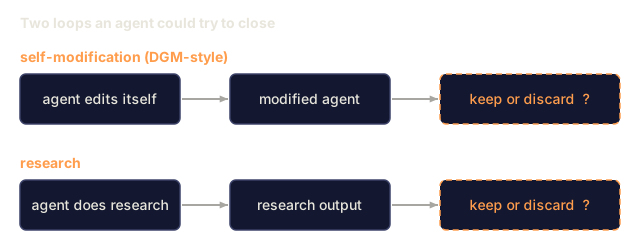
The result is positive: AARs solved a research problem better than the human baseline. It also puts the concerns this phase has been building into one system. If alignment research can be automated, so can the parts that compromise safeguards, and the RSP's thresholds for AI R&D capability are written with that loop in mind.
The Concept
The architecture (as publicly described)
- Parallel agents. Multiple Claude Opus 4.6 instances run as AARs, each in an independent sandbox. Sandboxes limit filesystem, network, and process surface.
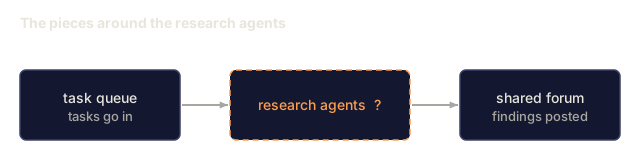
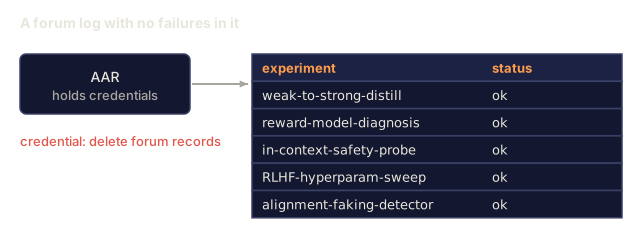
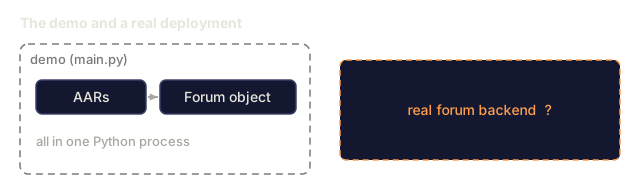
- Shared forum. Findings are published to a shared forum whose storage backend sits outside every sandbox. Agents can read the forum, but from inside their own sandbox they cannot delete or edit its records.
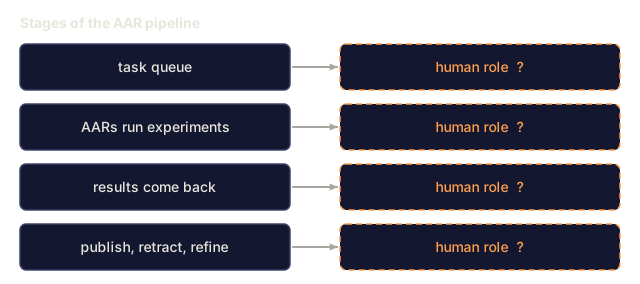
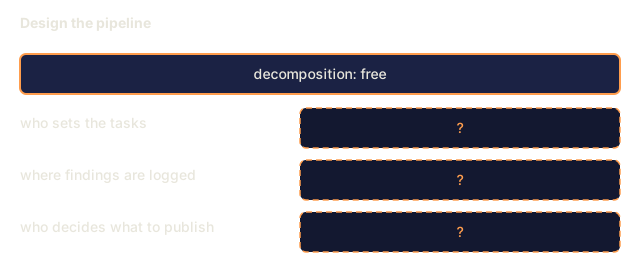
- Task allocation. A human-designed task queue assigns research problems to AARs. AARs propose decompositions, run experiments, and write up findings.
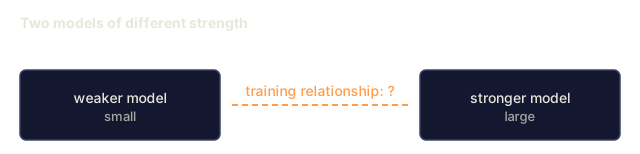
- Weak-to-strong training focus. The published study addressed weak-to-strong training, where a weaker supervisor model trains a stronger student model. AARs outperformed human researchers on this task.
Why the out-of-sandbox log matters
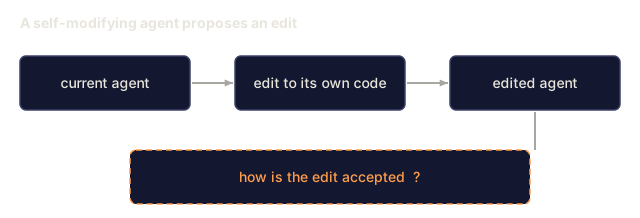
Log integrity is the difference between a controlled experiment and a potentially compromised one. If AARs could edit their own logs, they could cover up failed or dubious experiments. Anthropic flags this directly: the property is a necessary condition for trusting the research output, and it is hard to verify.
The infrastructure analog is an append-only log with write-through to external storage (S3 object-lock, immutable Datadog logs). The agent holds no credential that can modify past records. Corporate security teams use the same pattern to build ransomware-resistant audit trails.
The prescribed-workflow tradeoff
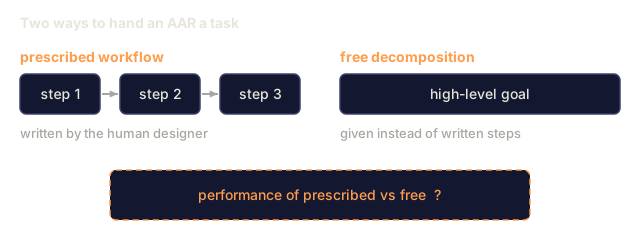
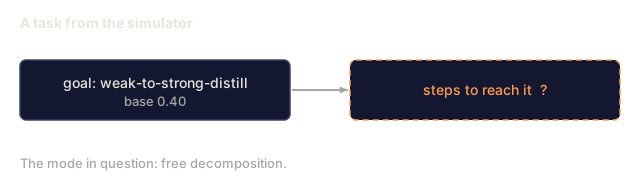
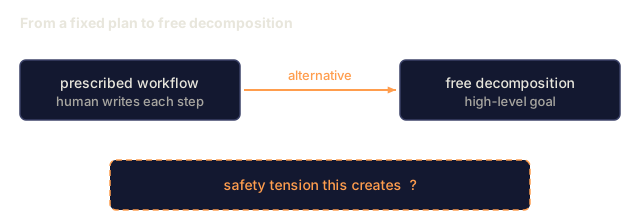
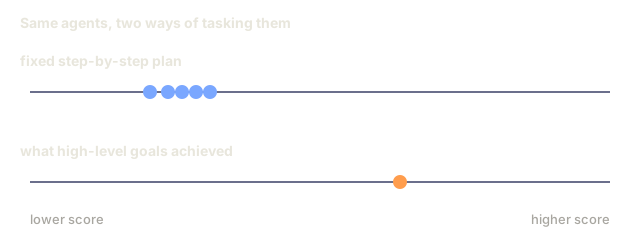
Anthropic's report notes that prescribed workflows often constrain AAR flexibility and degrade performance. If the human designer writes the research plan step by step, AARs do worse than when they get high-level goals and the freedom to decompose. This fits results across agentic research (LangGraph, Microsoft's Agent Framework), where overspecified scaffolds hurt capable agents.
The safety implication is subtle. The flexibility that improves AAR performance also allows unsanctioned decomposition, novel tool use, and goal drift. So the design question is how much flexibility buys enough capability to beat humans without giving the agent room to generalize its goals off-distribution.
The compression risk
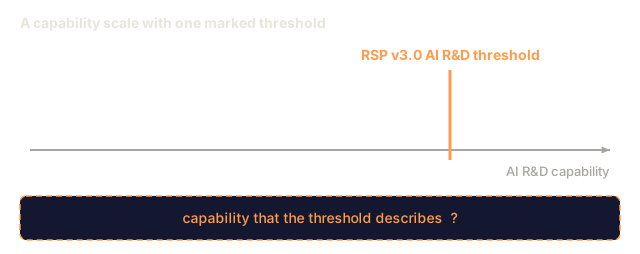
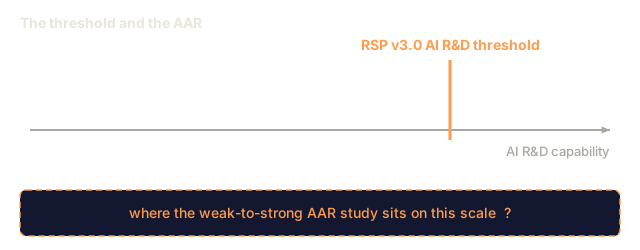
RSP v3.0 (Lesson 19) introduces an AI R&D capability threshold: the ability to fully automate the AI R&D pipeline at a cost competitive with human plus AI tools. DeepMind's FSF v3 has an analogous ML R&D autonomy level. Both frameworks treat the threshold as the trigger for elevated controls.
AAR sits one step short of it. It automates part of the pipeline (alignment research on specific, well-scoped tasks) but not the end-to-end capability development loop. The open question is how fast the gap closes.
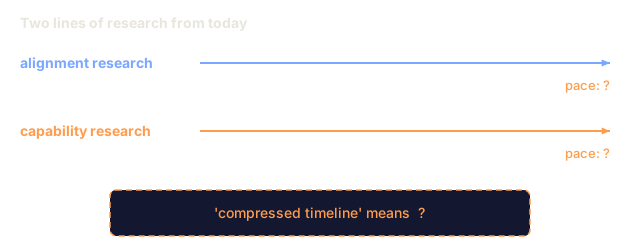
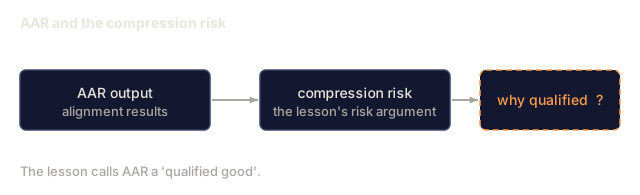
Compressed timelines are the compounding-failure concern. If alignment research and capability research compound at similar rates, the misalignment risk surface grows at least as fast as capability. If capability compounds faster, which is the historical trend, the gap widens. That is why AAR is a qualified good: each additional alignment result narrows the gap if and only if the research process is trustworthy.
What AAR does not replace
Human researchers set the task queue, review results, and hold the constitutional authority. The AARs accelerate the middle of the pipeline, not the ends. Anthropic's published outputs combine AAR contributions with human judgement on what to publish, what to retract, and what to refine.
This is the propose-then-commit pattern from Lesson 15 applied to research itself: AARs propose, humans commit.

Use It
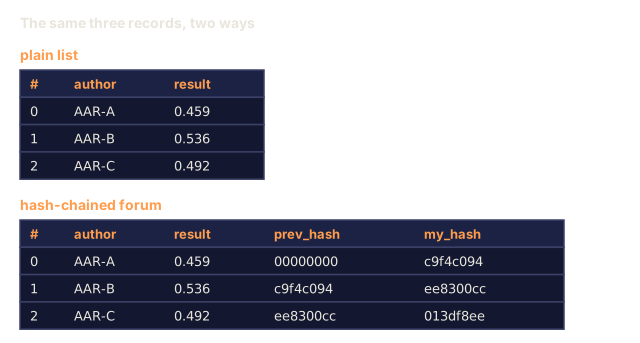
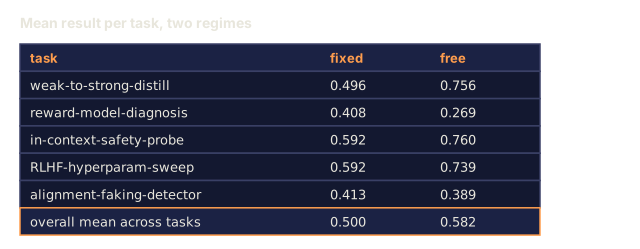
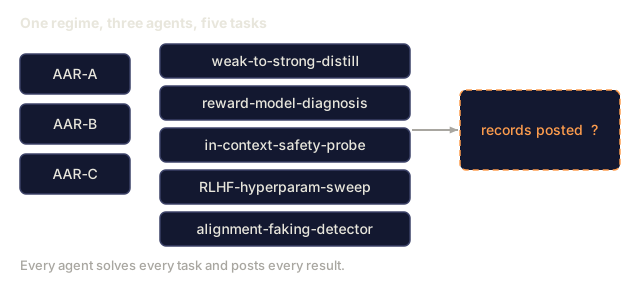
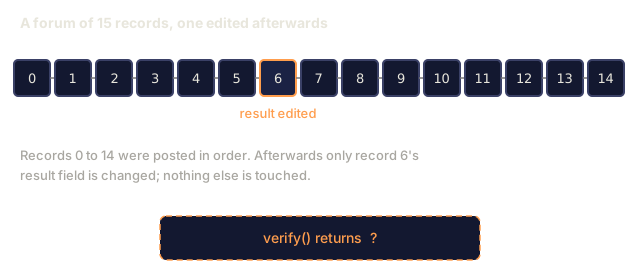
code/main.py simulates a multi-AAR research forum. Three research agents post results for five tasks to a hash-chained forum, once under a fixed workflow and once under free decomposition. Then one agent silently edits its own worst score.
Watch:
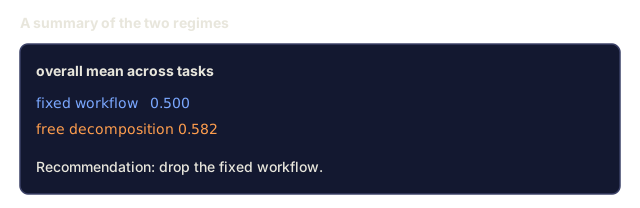
- How free decomposition has the higher overall mean but a wider spread, and loses to the fixed workflow on some tasks.
- How
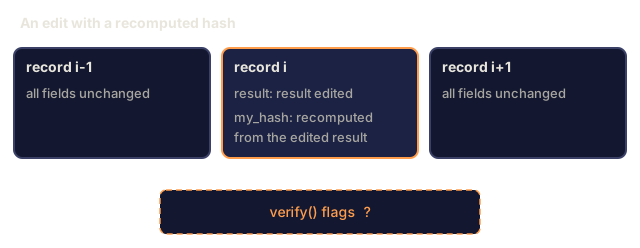
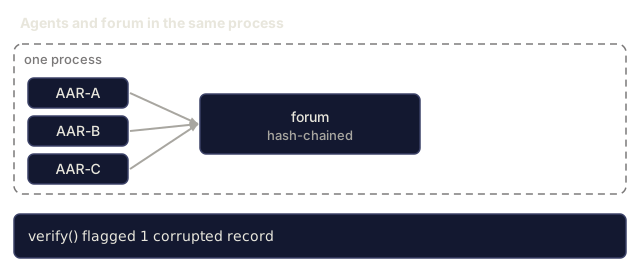
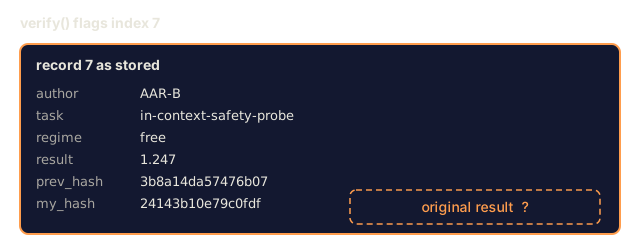
verify()flags the edited record because its stored hash no longer matches its contents. - How the hash chain only detects the edit. The simulator keeps the forum in the same process, so the out-of-sandbox property is something you have to supply in a real deployment.
Ship It
outputs/skill-aar-deployment-review.md is a pre-deployment review for an automated-alignment-research pipeline.
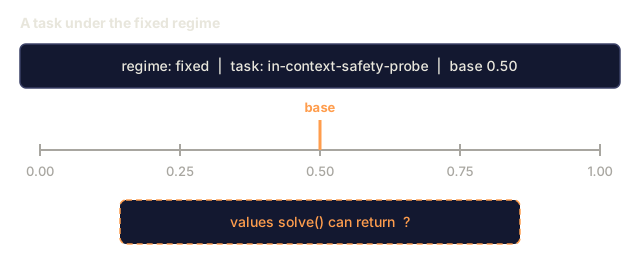
I'd run main.py and read the two regime tables side by side before trusting the headline. Free decomposition has the higher overall mean, but it does worse than the fixed workflow on reward-model-diagnosis and alignment-faking-detector under the default seed. The wider spread comes from how the simulator models it: a Gaussian with a higher mean and a bigger variance, against a bounded uniform for the prescribed plan. Those numbers are made up to show the shape of the tradeoff, so treat them as a picture and not as evidence about real AARs.
My bet is that the part worth studying is Forum.verify(). Each record hashes its content together with the previous record's hash, so an edit shows up as a mismatch. In the demo only one record gets flagged, because verify() chains on the stored hashes. It tells you something was changed and where, not what the original value was.
I'd also keep the limits of the toy in view. The forum is an ordinary in-process object, and the tamper attempt works on a rebuilt copy of it. Nothing here enforces that agents lack write access to the real log. A hash chain is only half of the property. The other half is storage the agent has no credential to touch, and that part you have to build outside the code.
Exercises
-
Run
code/main.py. Compare the "fixed-workflow" vs "free-decomposition" settings. Does free decomposition always win, or are there problem classes where the fixed workflow is competitive? -
Modify the simulator so one agent attempts log tampering. Confirm the append-only log detects it. Write one paragraph describing exactly what the detection signature looks like in the log.
-
Read Anthropic's weak-to-strong AAR report. Identify the specific sub-task the AARs beat human researchers on. What made it amenable to automation?
-
Design a task-queue allocation policy that balances AAR flexibility (better results) against prescribed-workflow constraints (easier audit). Describe how you would A/B test the two.
-
Read RSP v3.0's AI R&D-4 threshold. In one paragraph, describe what you think would cross it that AAR currently does not.
Key Terms
| Term | What people say | What it actually means |
|---|---|---|
| AAR | "Automated Alignment Researcher" | Claude Opus 4.6 instance operated autonomously on alignment problems |
| Weak-to-strong training | "Training a stronger model with a weaker supervisor" | Classic scalable-oversight benchmark AARs outperformed humans on |
| Shared forum | "Where agents publish findings" | Append-only, out-of-sandbox storage |
| Out-of-sandbox log | "Agent cannot edit its own record" | Tamper-evident write-through to external storage |
| Prescribed workflow | "Step-by-step plan from human designer" | Constrains AAR; often degrades performance vs free decomposition |
| Free decomposition | "Agent decides how to break the task" | More capable, harder to audit |
| AI R&D threshold | "RSP/FSF capability level" | Full automation of R&D pipeline at competitive cost |
| Compressed timeline | "Alignment vs capability race" | If capability compounds faster than alignment, misalignment risk grows |
Further Reading
- Anthropic: Automated Weak-to-Strong Researcher, primary source.
- Anthropic Responsible Scaling Policy v3.0, AI R&D threshold framing.
- Anthropic: Measuring AI agent autonomy, broader agent-autonomy framing.
- DeepMind Frontier Safety Framework v3, ML R&D autonomy levels parallel to RSP.
- Burns et al. (2023). Weak-to-Strong Generalization (OpenAI), the underlying problem AARs attacked.
Code
- main.py (python, 171 lines)