ML Pipelines
A model is not the product. A pipeline is: everything from raw data to a deployed prediction, every step reproducible.
Learning Objectives
- Build an ML pipeline from scratch that chains imputation, scaling, encoding, and model training into a single reproducible object
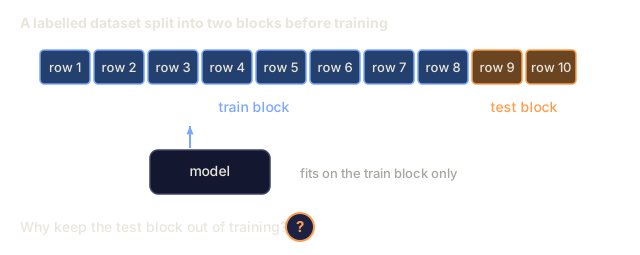
- Identify data leakage scenarios and explain how pipelines prevent them by fitting transformers only on training data
- Construct a ColumnTransformer that applies different preprocessing to numeric and categorical features
- Implement pipeline serialization and demonstrate that the same fitted pipeline produces identical results in training and production
The Problem
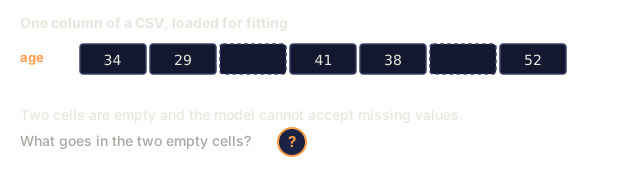
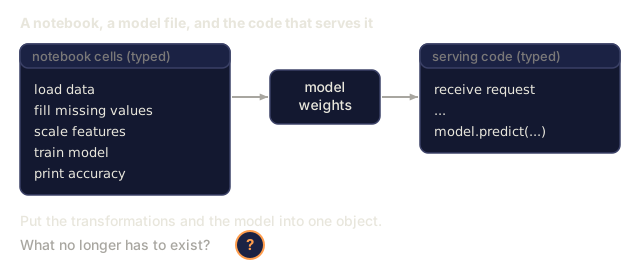
You have a notebook that loads data, fills missing values with the median, scales features, trains a model, and prints an accuracy number. It works, so you ship it.
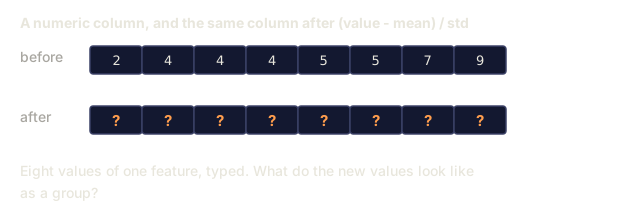
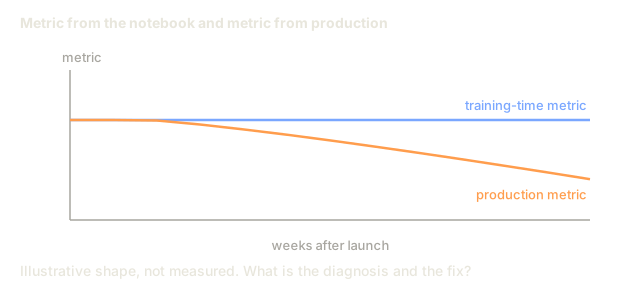
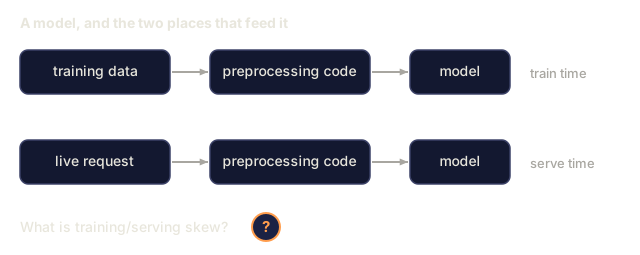
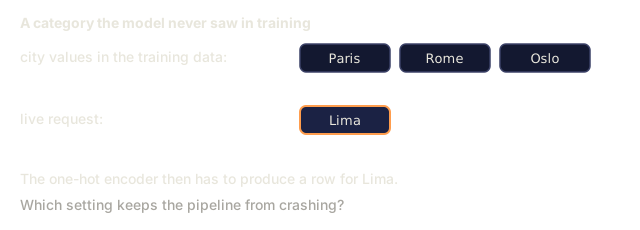
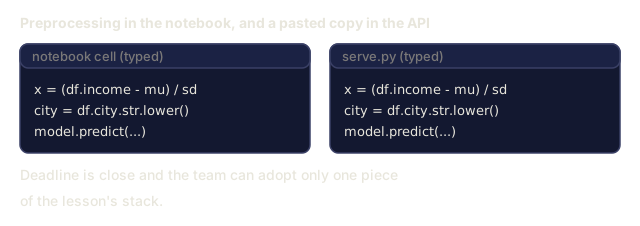
A month later someone retrains the model and gets different numbers. The median was computed on the full dataset, test rows included: that's leakage. The scaling parameters were never saved, so inference runs on different statistics than training did. The feature engineering got copy-pasted between the training script and the serving code, and the two copies drifted apart. Then a categorical column shows up in production with a value the encoder has never seen, and the whole thing falls over.
None of this is exotic; it's the ordinary way ML systems break in production. Every one of these failures traces back to the same root cause: the transformations weren't packaged with the model. A pipeline fixes that by fusing every transformation step and the model into one ordered, reproducible object, fit once and applied identically everywhere.
The Concept
What a Pipeline Is
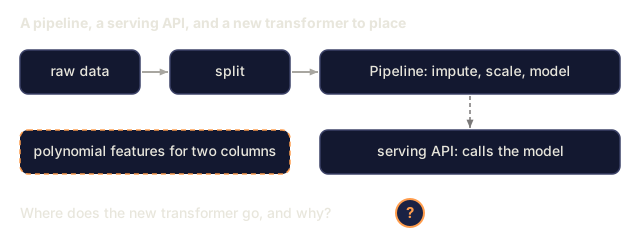
A pipeline is an ordered sequence of data transformations that ends in a model, each step feeding its output straight into the next. Fit the whole thing once on training data, and at inference time that same fitted pipeline transforms new data and produces predictions — no separate code path, no re-deriving statistics.

The pipeline guarantees:
- Transformations are fitted only on training data (no leakage)
- The same transformations are applied at inference time
- The entire object can be serialized and deployed as one artifact
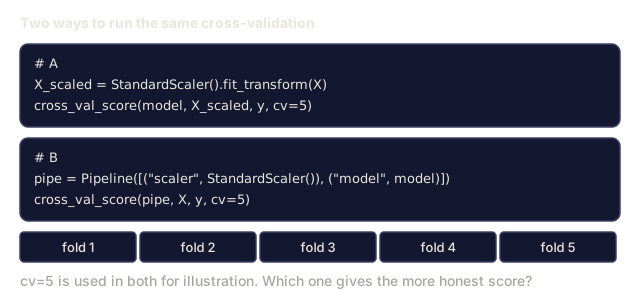
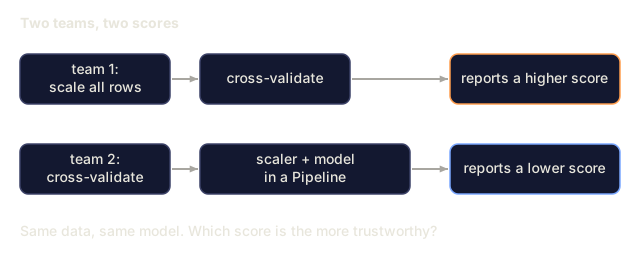
- Cross-validation applies the pipeline per fold, preventing subtle leakage
Data Leakage: The Silent Killer
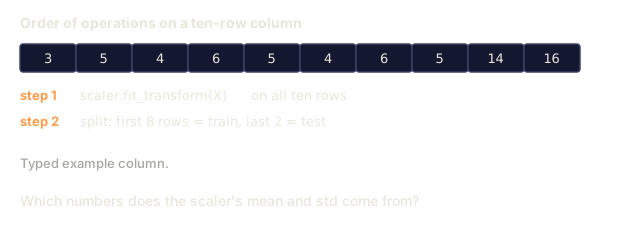
Data leakage is any information from the test set, or from the future, sneaking into training. It inflates whatever accuracy number you report, and pipelines block the most common forms of it by construction.
Leaky (wrong):
X = df.drop("target", axis=1)
y = df["target"]

scaler = StandardScaler()
X_scaled = scaler.fit_transform(X)

X_train, X_test = X_scaled[:800], X_scaled[800:]
y_train, y_test = y[:800], y[800:]
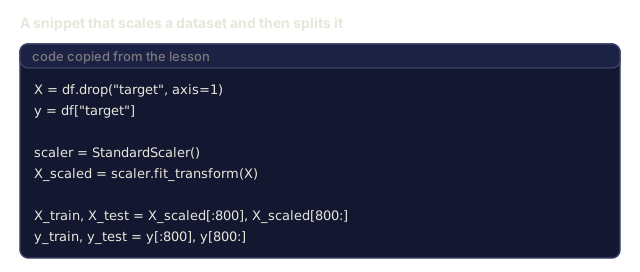
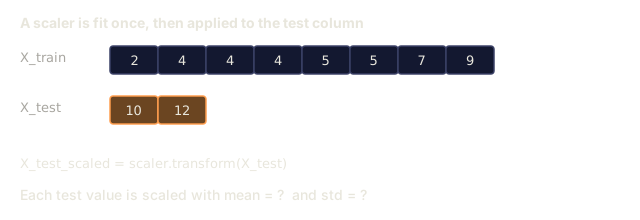
The scaler saw test data before the model ever did. Its mean and standard deviation already include test samples, so the accuracy you measure afterward is inflated.
Correct:
X_train, X_test = X[:800], X[800:]

scaler = StandardScaler()
X_train_scaled = scaler.fit_transform(X_train)
X_test_scaled = scaler.transform(X_test)
With a pipeline, this stops being something you have to remember to get right. It's handled by construction, every time.
sklearn Pipeline
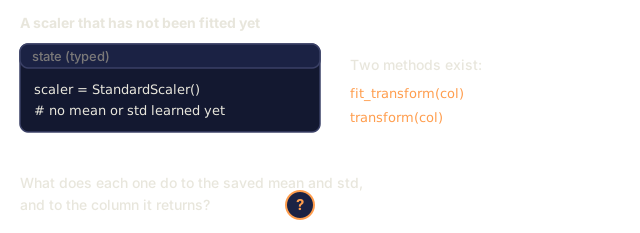
sklearn's Pipeline chains transformers and a final estimator into one object, exposing .fit(), .predict(), and .score() that run every step in order.
from sklearn.pipeline import Pipeline
from sklearn.preprocessing import StandardScaler
from sklearn.linear_model import LogisticRegression

pipe = Pipeline([
    ("scaler", StandardScaler()),
    ("model", LogisticRegression()),
])

pipe.fit(X_train, y_train)
predictions = pipe.predict(X_test)
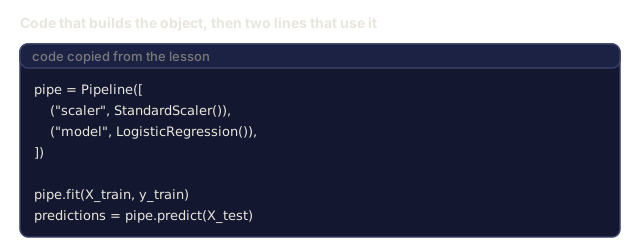
When you call pipe.fit(X_train, y_train):
- Scaler calls
fit_transformon X_train - Model calls
fiton the scaled X_train
When you call pipe.predict(X_test):
- Scaler calls
transform(not fit_transform) on X_test - Model calls
predicton the scaled X_test
The scaler never sees test data during fitting; that's the entire point of wrapping it in a Pipeline.
ColumnTransformer: Different Pipelines for Different Columns
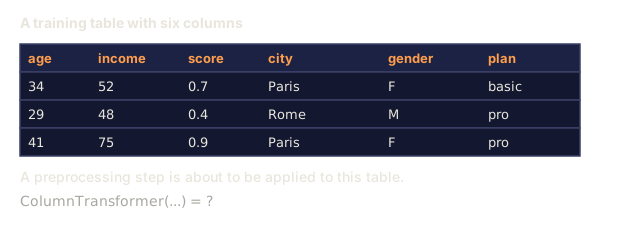
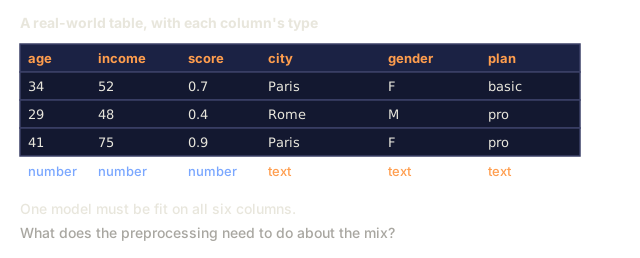
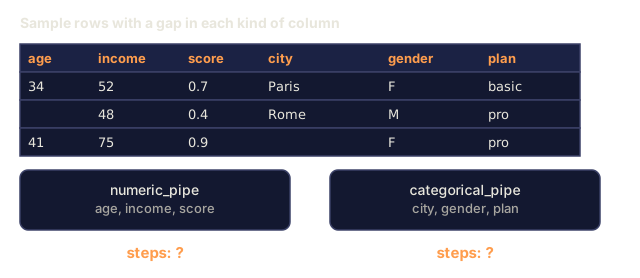
ColumnTransformer routes different subsets of columns to different preprocessing pipelines, then combines the results into one feature matrix. Real datasets need this: numeric columns want imputation and scaling, categorical columns want a different imputation strategy and encoding, and hand-rolling that split every time is how column-order bugs get in.
from sklearn.compose import ColumnTransformer
from sklearn.preprocessing import StandardScaler, OneHotEncoder
from sklearn.impute import SimpleImputer

numeric_pipe = Pipeline([
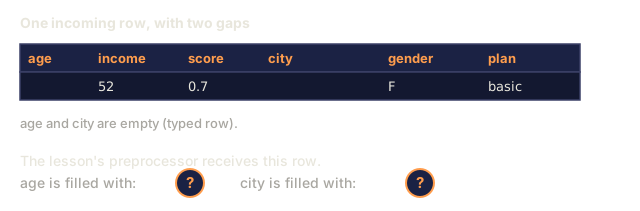
    ("impute", SimpleImputer(strategy="median")),
    ("scale", StandardScaler()),
])

categorical_pipe = Pipeline([
    ("impute", SimpleImputer(strategy="most_frequent")),
    ("encode", OneHotEncoder(handle_unknown="ignore")),
])

preprocessor = ColumnTransformer([
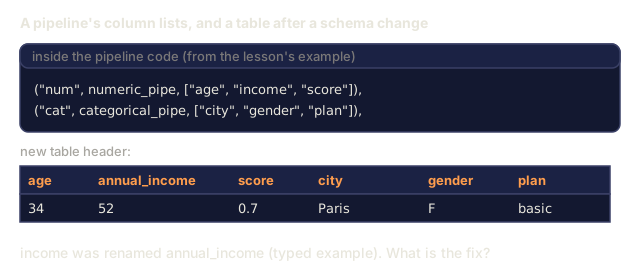
    ("num", numeric_pipe, ["age", "income", "score"]),
    ("cat", categorical_pipe, ["city", "gender", "plan"]),
])

full_pipeline = Pipeline([
    ("preprocess", preprocessor),
    ("model", GradientBoostingClassifier()),
])
handle_unknown="ignore" on OneHotEncoder is the one setting that actually matters for production. When a new category shows up (a city the model never saw during training), it returns a zero vector instead of raising and taking the request down with it.
Experiment Tracking
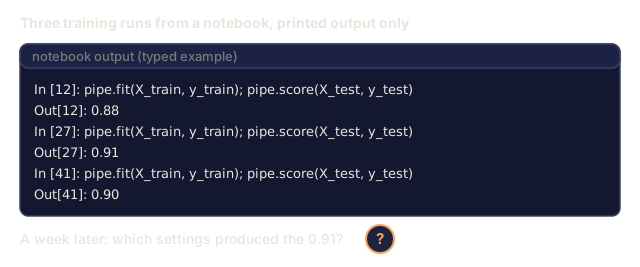
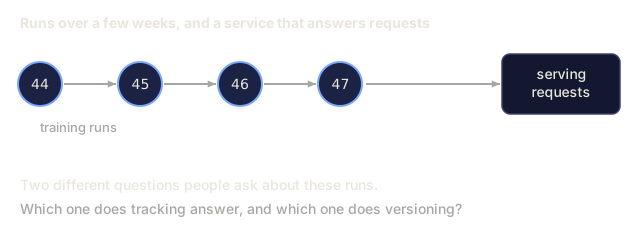
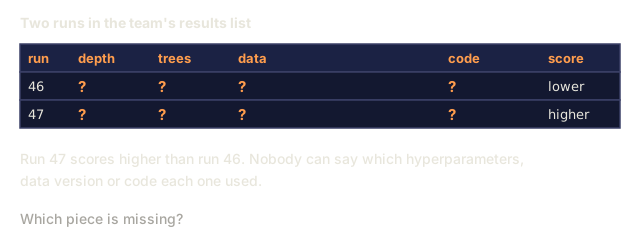
Experiment tracking is the record of what happened across every training run: which hyperparameters, which dataset version, what the metrics came out to, which code was actually running. A pipeline makes any single run reproducible, but it doesn't by itself tell you what you tried last week or why run 47 beat run 46.
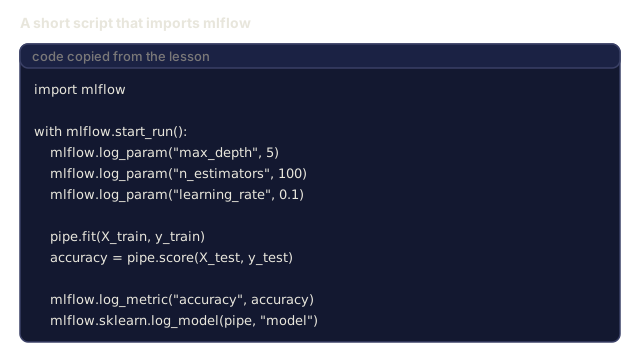
MLflow is the most common open-source solution:
import mlflow

with mlflow.start_run():
    mlflow.log_param("max_depth", 5)
    mlflow.log_param("n_estimators", 100)
    mlflow.log_param("learning_rate", 0.1)

    pipe.fit(X_train, y_train)
    accuracy = pipe.score(X_test, y_test)

    mlflow.log_metric("accuracy", accuracy)
    mlflow.sklearn.log_model(pipe, "model")
Every run gets recorded with its parameters, metrics, artifacts, and the full model, so you can compare runs, reproduce any of them, and deploy whichever version actually won.
Weights & Biases (wandb) provides the same functionality with a hosted dashboard:
import wandb

wandb.init(project="my-pipeline")
wandb.config.update({"max_depth": 5, "n_estimators": 100})

pipe.fit(X_train, y_train)
accuracy = pipe.score(X_test, y_test)

wandb.log({"accuracy": accuracy})
Model Versioning
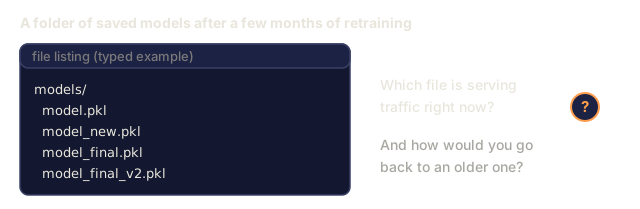
Model versioning is knowing, at any moment, exactly which model is in production, which is staging, and which one you retired last week. Experiment tracking tells you what you tried; versioning tells you what's actually live.
MLflow's Model Registry provides:
- Version tracking: Every saved model gets a version number
- Stage transitions: "Staging", "Production", "Archived"
- Approval workflow: Models must be explicitly promoted to production
- Rollback: Switch back to a previous version instantly
Data Versioning with DVC
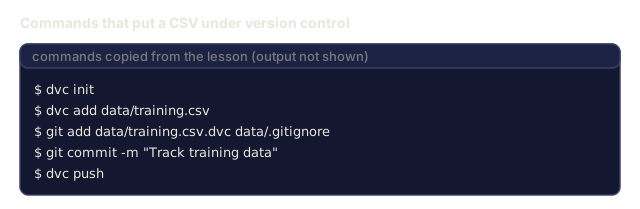
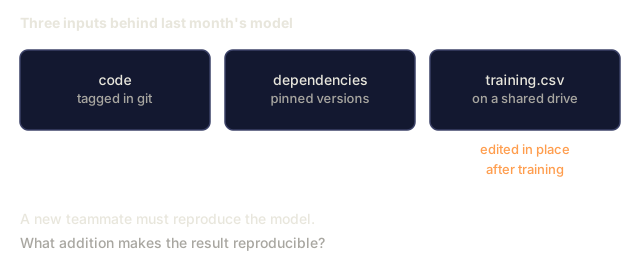
DVC (Data Version Control) versions large data files the way git versions code: a content hash lives in git, the actual bytes live in remote storage. Git alone can't do this, since it chokes on large binary files and was never built to track them.
dvc init
dvc add data/training.csv
git add data/training.csv.dvc data/.gitignore
git commit -m "Track training data"
dvc push
In practice that remote storage is S3, GCS, or Azure, and the .dvc file left behind in git is tiny: just the hash. Switch git commits and run dvc checkout, and it restores the exact data that commit was trained on.
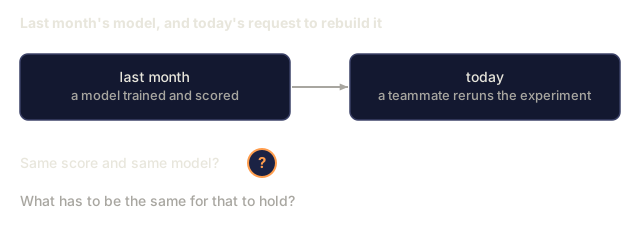
That's the real payoff: every git commit now pins both code and data, so reproducing last month's experiment stops being an archaeology project.
Reproducible Experiments
A reproducible experiment requires four things:
- Fixed random seeds: Set seeds for numpy, random, and the framework (torch, sklearn)
- Pinned dependencies: requirements.txt or poetry.lock with exact versions
- Versioned data: DVC or similar
- Config files: All hyperparameters in a config, not hardcoded
import numpy as np
import random

def set_seed(seed=42):
    random.seed(seed)
    np.random.seed(seed)
    try:
        import torch
        torch.manual_seed(seed)
        torch.cuda.manual_seed_all(seed)
        torch.backends.cudnn.deterministic = True
    except ImportError:
        pass
From Notebook to Production Pipeline

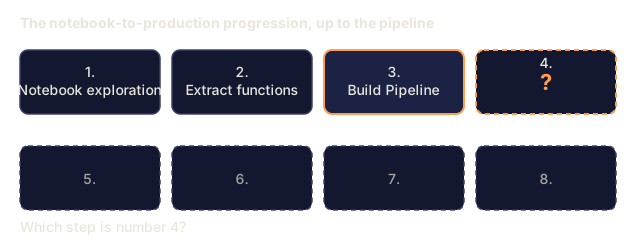
The typical progression:
- Notebook exploration: Quick experiments, visualizations, feature ideas
- Extract functions: Move preprocessing, feature engineering, evaluation into modules
- Build Pipeline: Chain transformations into a sklearn Pipeline or custom class
- Config management: Move all hyperparameters into a YAML/JSON config
- Experiment tracking: Add MLflow or wandb logging
- Data validation: Check schema, distributions, and missing value patterns before training
- Tests: Unit tests for transformers, integration tests for the full pipeline
- Deployment: Serialize the pipeline, wrap in an API (FastAPI, Flask), containerize
Common Pipeline Mistakes
| Mistake | Why it is bad | Fix |
|---|---|---|
| Fitting on full data before splitting | Data leakage | Use Pipeline with cross_val_score |
| Feature engineering outside pipeline | Different transforms at train vs serve | Put all transforms in the Pipeline |
| Not handling unknown categories | Production crash on new values | OneHotEncoder(handle_unknown="ignore") |
| Hardcoded column names | Breaks when schema changes | Use column name lists from config |
| No data validation | Silently wrong predictions on bad data | Add schema checks before prediction |
| Training/serving skew | Model sees different features in prod | One Pipeline object for both |
Build It
The code in code/pipeline.py builds a complete ML pipeline from scratch, in four steps:
Step 1: Custom Transformer
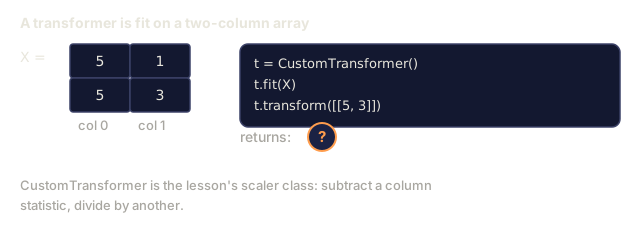
class CustomTransformer:
    def __init__(self):
        self.means = None
        self.stds = None

    def fit(self, X):
        self.means = np.mean(X, axis=0)
        self.stds = np.std(X, axis=0)
        self.stds[self.stds == 0] = 1.0
        return self

    def transform(self, X):
        return (X - self.means) / self.stds

    def fit_transform(self, X):
        return self.fit(X).transform(X)
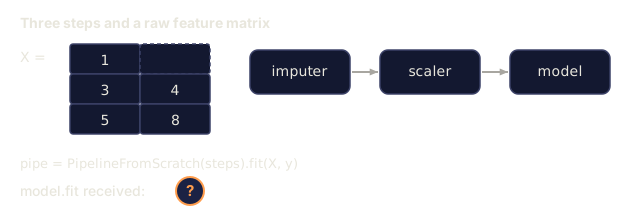
Step 2: Pipeline from Scratch
class PipelineFromScratch:
    def __init__(self, steps):
        self.steps = steps

    def fit(self, X, y=None):
        X_current = X.copy()
        for name, step in self.steps[:-1]:
            X_current = step.fit_transform(X_current)
        name, model = self.steps[-1]
        model.fit(X_current, y)
        return self

    def predict(self, X):
        X_current = X.copy()
        for name, step in self.steps[:-1]:
            X_current = step.transform(X_current)
        name, model = self.steps[-1]
        return model.predict(X_current)
Step 3: Cross-Validation with Pipeline
The code demonstrates how cross-validation with a pipeline prevents data leakage: the scaler gets fit separately on each fold's training data, never on the fold it's about to score.
Step 4: Full Production Pipeline with sklearn
A full production pipeline: ColumnTransformer routing to multiple preprocessing paths, a model at the end, trained with proper cross-validation and experiment logging.
Step 5: Serialize and Verify
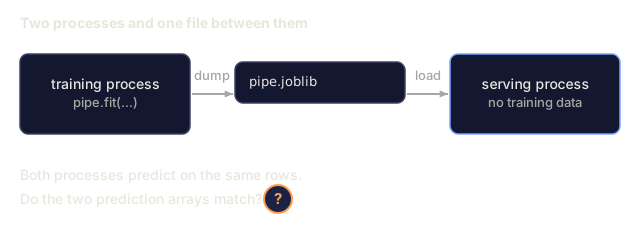
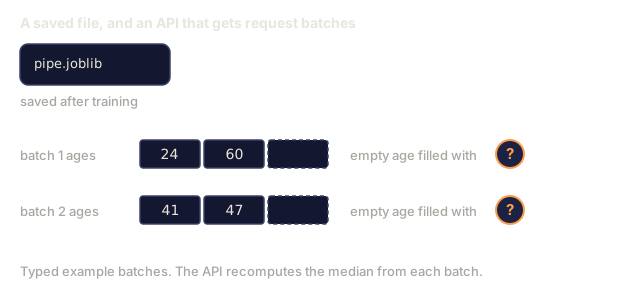
A fitted pipeline is a Python object like any other, so joblib can freeze it to disk and hand it to a process that never saw the training data:
import joblib

joblib.dump(pipe, "pipe.joblib")

loaded = joblib.load("pipe.joblib")
predictions_original = pipe.predict(X_test)
predictions_loaded = loaded.predict(X_test)

assert (predictions_original == predictions_loaded).all()
That assertion is the entire point. The loaded object carries the same fitted imputer, the same fitted encoder, the same trained model as the pipeline you trained. Nothing refits, nothing recomputes a statistic from a different sample, so training and production see exactly the same transformations. This is what "reproducible" cashes out to in practice: not a promise, a passing assert.
Ship It
This lesson produces:
outputs/prompt-ml-pipeline.md-- a skill for building and debugging ML pipelinescode/pipeline.py-- a complete pipeline from scratch through sklearn
The leak everyone teaches is the scaler fit on the full dataset before the split. I've seen that maybe twice in five years. The leak that actually gets people is quieter: feature engineering that starts life in a notebook cell, gets copy-pasted into the serving code a few weeks later, and drifts the day someone tweaks it in only one of the two places. Nobody notices until the metrics in production stop matching the metrics from training, and by then it's a multi-day investigation instead of a five-minute diff.
Wrapping everything in a Pipeline object doesn't just prevent leakage. It removes the second copy entirely, so there's nothing left to drift. If you're under deadline pressure and can only adopt one piece of this lesson's stack right now, skip the experiment tracker and the model registry and make it this one. Everything else here is about managing complexity you've chosen to take on. The pipeline is about not creating a second, silently diverging copy of your model in the first place.
Exercises
-
Build a pipeline that handles a dataset with 3 numeric columns and 2 categorical columns. Use
ColumnTransformerto apply median imputation + scaling to numerics and most-frequent imputation + one-hot encoding to categoricals. Train with 5-fold cross-validation. -
Deliberately introduce data leakage: fit the scaler on the full dataset before splitting. Compare the cross-validation score (leaky) to the pipeline cross-validation score (clean). How large is the difference?
-
Serialize your pipeline with
joblib.dump. Load it in a separate script and run predictions. Verify the predictions are identical. -
Add a custom transformer to the pipeline that creates polynomial features (degree 2) for the two most important numeric columns. Where should it go in the pipeline?
-
Set up MLflow tracking for the pipeline. Run 5 experiments with different hyperparameters. Use the MLflow UI (
mlflow ui) to compare runs and pick the best model.
Key Terms
| Term | What people say | What it actually means |
|---|---|---|
| Pipeline | "Chain of transforms + model" | An ordered sequence of fitted transformers and a model, applied as one unit to prevent leakage |
| Data leakage | "Test info leaked into training" | Using information from outside the training set to build the model, inflating performance estimates |
| ColumnTransformer | "Different preprocessing per column" | Applies different pipelines to different subsets of columns, combining results |
| Experiment tracking | "Logging your runs" | Recording parameters, metrics, artifacts, and code versions for every training run |
| MLflow | "Track and deploy models" | Open-source platform for experiment tracking, model registry, and deployment |
| DVC | "Git for data" | Version control system for large data files, storing hashes in git and data in remote storage |
| Model registry | "Model version catalog" | A system that tracks model versions with stage labels (staging, production, archived) |
| Training/serving skew | "It worked in the notebook" | Differences between how data is processed during training versus inference, causing silent errors |
| Reproducibility | "Same code, same result" | The ability to get identical results from the same code, data, and configuration |
Further Reading
- scikit-learn Pipeline docs -- the official pipeline reference
- MLflow documentation -- experiment tracking and model registry
- DVC documentation -- data versioning
- Sculley et al., Hidden Technical Debt in Machine Learning Systems (2015) -- the seminal paper on ML systems complexity
- Google ML Best Practices: Rules of ML -- practical production ML advice
Code
- pipeline.py (python, 655 lines)