Audio Classification — From k-NN on MFCCs to AST and BEATs
"Dog barking vs siren" and "which language is this" are the same task: audio classification. The features are mels. The architecture moves each decade. The evaluation stays AUC, F1, and per-class recall.
Learning Objectives
- Identify what counts as an audio classification task (urban sound, speech command, language ID, speaker emotion) and what doesn't, like voice cloning or generation.
- Trace the architecture ladder from k-NN on MFCCs through 2D CNNs, AST, and BEATs to a frozen Whisper-encoder backbone, and explain why 2026 practice defaults to a frozen backbone first.
- Implement a k-NN audio classifier from scratch: MFCC featurization, a fixed-length mean/variance summary, and cosine-similarity voting.
- Apply class-imbalance techniques (balanced sampling, Mixup, SpecAugment) and pick the right evaluation metric, accuracy, mAP, AUC, or per-class recall and macro F1, for a task's label distribution.
- Fine-tune a pretrained AST or BEATs checkpoint with Hugging Face transformers instead of training a CNN from scratch.
The Problem
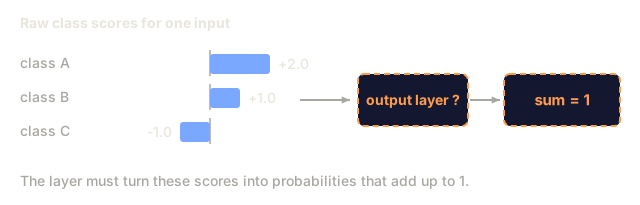
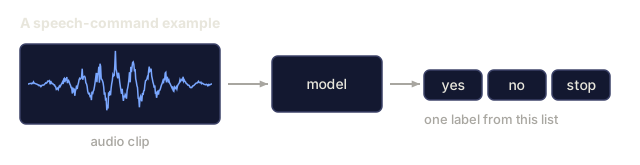
Audio classification is the task of mapping a clip to a label, and by 2026 the baseline architecture for doing it is mature: log-mel → CNN or Transformer → softmax. Hand a model a 10-second clip and ask "what is it?" and you're doing this task, whatever the domain: urban sound (siren, drill, dog), speech command (yes/no/stop), language ID (en/es/ar), speaker emotion (angry/neutral), environmental sound (indoor/outdoor, babble).
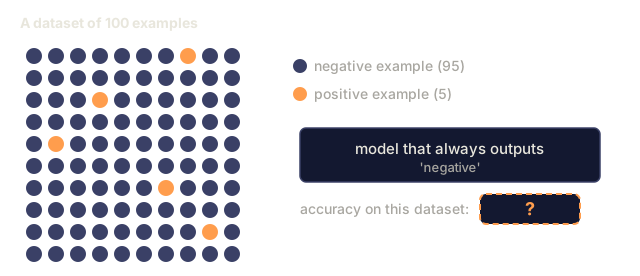
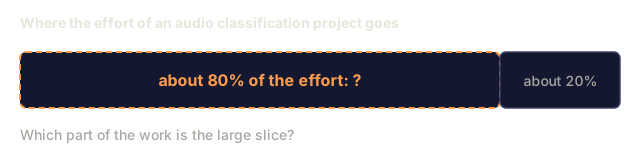
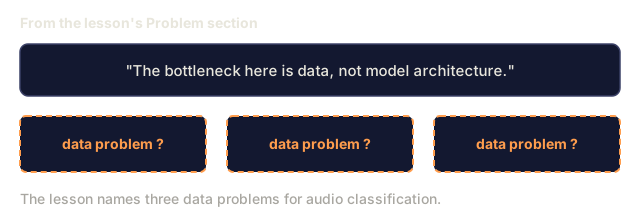
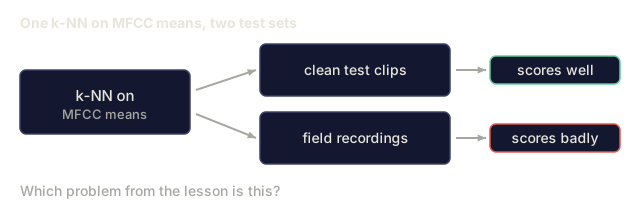
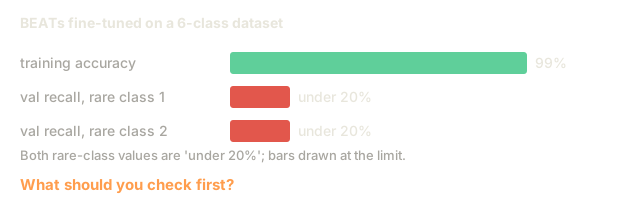
The bottleneck here is data, not model architecture. Audio datasets carry brutal class imbalance, strong domain shift (clean vs noisy), and label noise nobody agrees on (is that "urban babble" or "restaurant noise"?). Curation, augmentation, and evaluation make up 80% of the actual work; swapping a CNN for a Transformer barely touches it.
The Concept

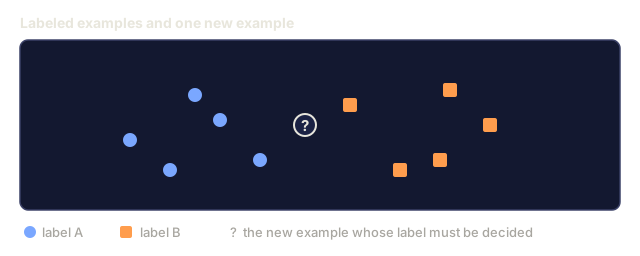
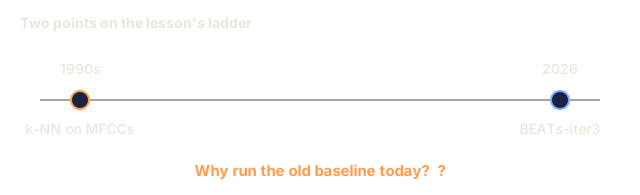
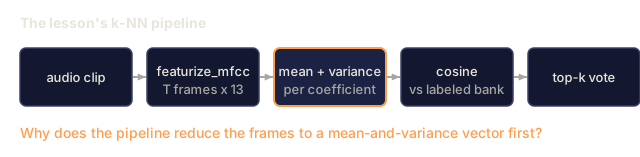
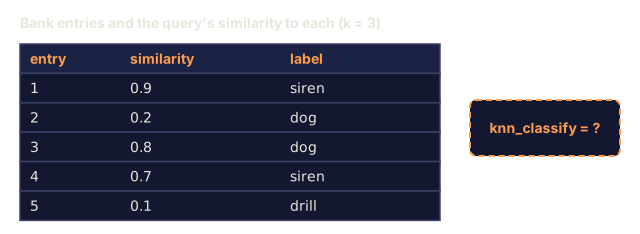
k-NN on MFCCs (the 1990s baseline). Flatten the MFCCs for a clip, compute cosine similarity against a labeled bank, and return the majority vote of the top K. It's surprisingly strong on clean, small datasets like Speech Commands and ESC-50, and it runs with no GPU at all.
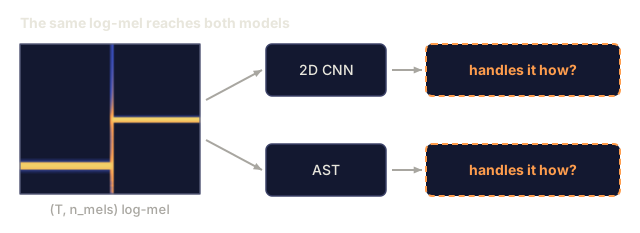
2D CNN on log-mels (2015-2019). Treat the (T, n_mels) log-mel as an image, run it through a ResNet-18 or VGG-style stack, global-mean-pool the time axis, and softmax over classes. Still the baseline you'll see in most 2026 Kaggle competitions.
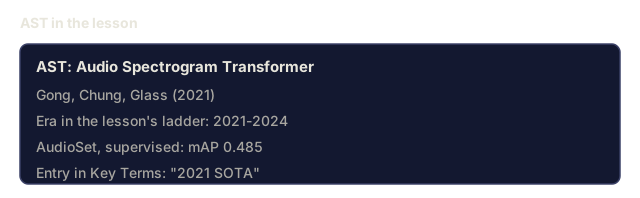
Audio Spectrogram Transformer, AST (2021-2024). Patchify the log-mel (16×16 patches are typical), add position embeddings, and feed the result to a ViT. State of the art on AudioSet for supervised learning, at mAP 0.485.
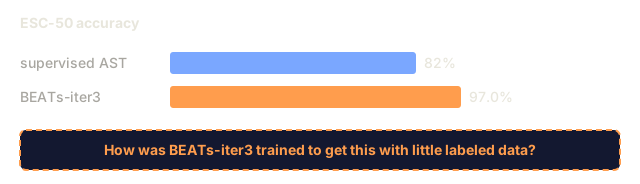
BEATs and WavLM-base (2024-2026). Self-supervised pretraining on millions of hours of audio, then fine-tune on your task with 1-10% of the supervised data you'd otherwise need. This is the default starting point for non-speech audio in 2026: BEATs-iter3 beats AST by 1-2 mAP on AudioSet while using 1/4 the compute.
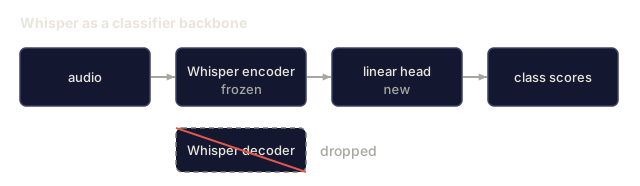
Whisper-encoder as a frozen backbone (2024). Take Whisper's encoder, drop the decoder, attach a linear classifier. That's it. It lands near-SOTA on language ID and simple event classification with zero audio augmentation, which is why it's the "free lunch" baseline.
Class imbalance is the real challenge
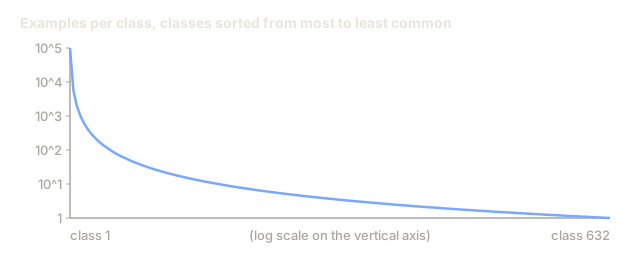
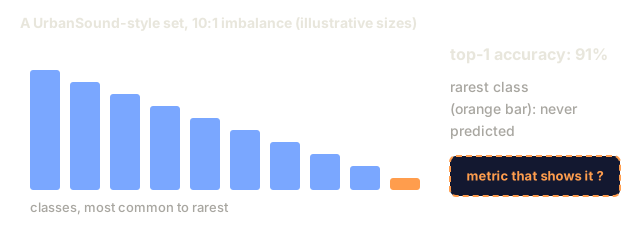
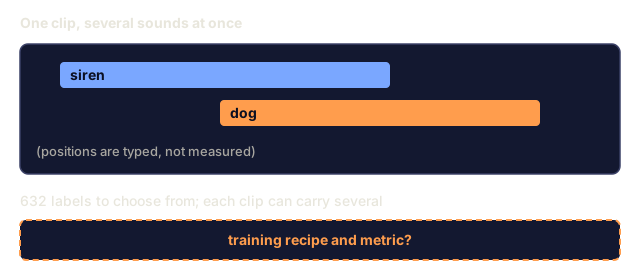
ESC-50 keeps things easy: 50 classes, 40 clips each, balanced. UrbanSound8K is already lopsided, 10 classes imbalanced 10:1. AudioSet is the extreme case: 632 classes with a 100,000:1 long tail. A few techniques actually move the needle:
- Balanced sampling during training (not evaluation).
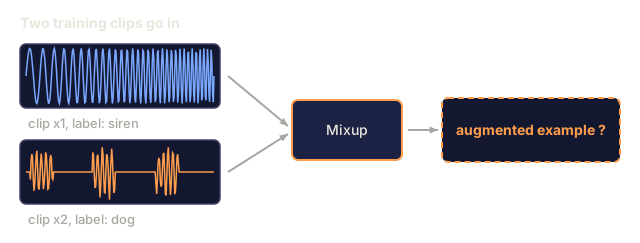
- Mixup: linearly interpolate two clips, and their labels, as augmentation.
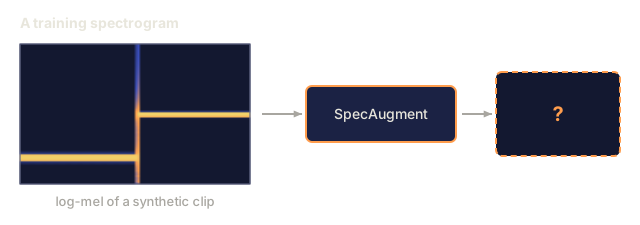
- SpecAugment: mask random time and frequency bands. Simple, and critical.
Evaluation
- Multiclass exclusive (Speech Commands): top-1 accuracy, top-5 accuracy.
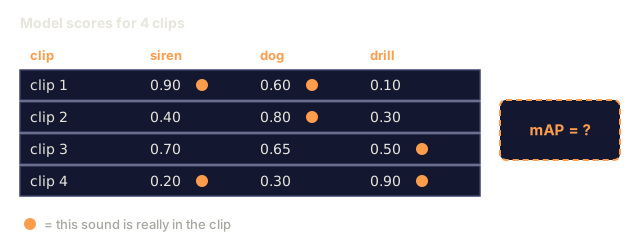
- Multiclass multi-label (AudioSet, UrbanSound-style): mean average precision (mAP), plus AUC (area under the ROC curve) as the companion metric AudioSet leaderboards report alongside it.
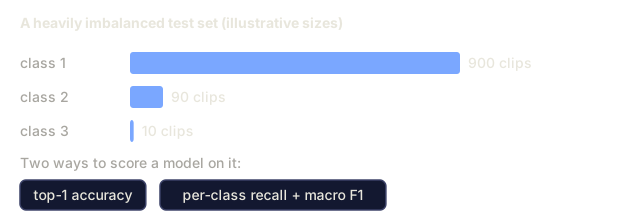
- Heavily imbalanced: per-class recall plus macro F1.
The 2026 numbers worth memorizing:
| Benchmark | Baseline | SOTA 2026 | Source |
|---|---|---|---|
| ESC-50 | 82% (AST) | 97.0% (BEATs-iter3) | BEATs paper (2024) |
| AudioSet mAP | 0.485 (AST) | 0.548 (BEATs-iter3) | HEAR leaderboard 2026 |
| Speech Commands v2 | 98% (CNN) | 99.0% (Audio-MAE) | HEAR v2 results |


Build It
Step 1: featurize
def featurize_mfcc(signal, sr, n_mfcc=13, n_mels=40, frame_len=400, hop=160):
    mag = stft_magnitude(signal, frame_len, hop)
    fb = mel_filterbank(n_mels, frame_len, sr)
    mels = apply_filterbank(mag, fb)
    log = log_transform(mels)
    return [dct_ii(frame, n_mfcc) for frame in log]
Step 2: fixed-length summary
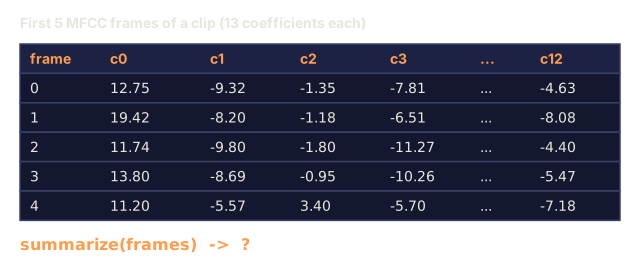
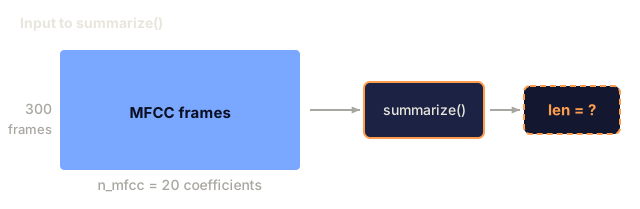
def summarize(mfcc_frames):
    n = len(mfcc_frames[0])
    mean = [sum(f[i] for f in mfcc_frames) / len(mfcc_frames) for i in range(n)]
    var = [
        sum((f[i] - mean[i]) ** 2 for f in mfcc_frames) / len(mfcc_frames) for i in range(n)
    ]
    return mean + var
Simple but strong: mean + variance across time turns a 13-coef MFCC into a fixed 26-dim embedding. It runs instantly, and this exact trick beat state-of-the-art NN baselines on ESC-50 as recently as 2017.
Step 3: k-NN
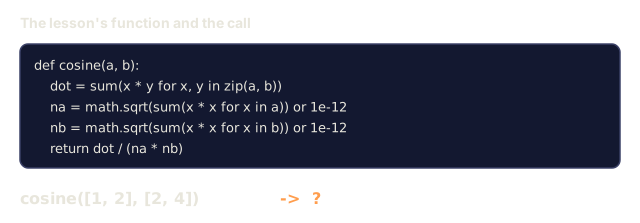
def cosine(a, b):
    dot = sum(x * y for x, y in zip(a, b))
    na = math.sqrt(sum(x * x for x in a)) or 1e-12
    nb = math.sqrt(sum(x * x for x in b)) or 1e-12
    return dot / (na * nb)

def knn_classify(q, bank, labels, k=5):
    sims = sorted(range(len(bank)), key=lambda i: -cosine(q, bank[i]))[:k]
    votes = Counter(labels[i] for i in sims)
    return votes.most_common(1)[0][0]
Step 4: upgrade to CNN on log-mels
In PyTorch:
import torch.nn as nn

class AudioCNN(nn.Module):
    def __init__(self, n_mels=80, n_classes=50):
        super().__init__()
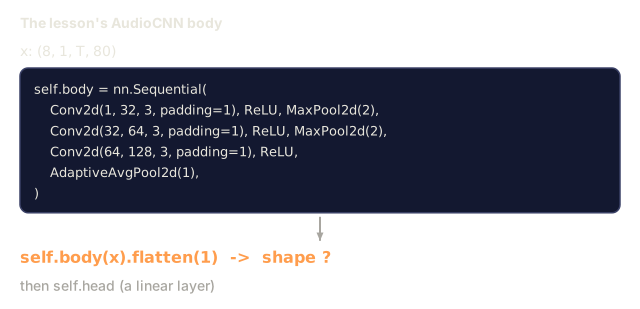
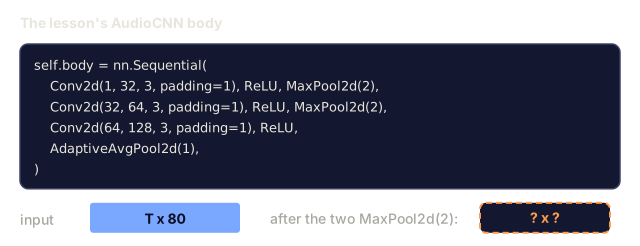
        self.body = nn.Sequential(
            nn.Conv2d(1, 32, 3, padding=1), nn.ReLU(), nn.MaxPool2d(2),
            nn.Conv2d(32, 64, 3, padding=1), nn.ReLU(), nn.MaxPool2d(2),
            nn.Conv2d(64, 128, 3, padding=1), nn.ReLU(),
            nn.AdaptiveAvgPool2d(1),
        )
        self.head = nn.Linear(128, n_classes)

    def forward(self, x):  # x: (B, 1, T, n_mels)
        return self.head(self.body(x).flatten(1))
3M parameters, trains in ~10 min on ESC-50 with a single RTX 4090, and clears 80%+ accuracy.
Step 5: fine-tune BEATs (the 2026 default)
from transformers import ASTFeatureExtractor, ASTForAudioClassification

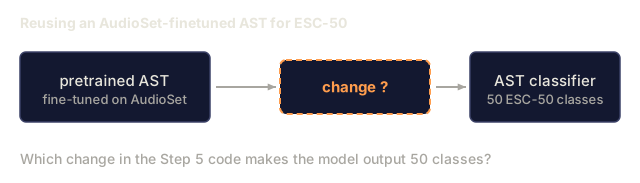
ext = ASTFeatureExtractor.from_pretrained("MIT/ast-finetuned-audioset-10-10-0.4593")
model = ASTForAudioClassification.from_pretrained(
    "MIT/ast-finetuned-audioset-10-10-0.4593",
    num_labels=50,
    ignore_mismatched_sizes=True,
)

inputs = ext(audio, sampling_rate=16000, return_tensors="pt")
logits = model(**inputs).logits
For BEATs, swap in microsoft/BEATs-base via the beats library. The transformers API keeps the same shape.
Use It
The 2026 stack:
| Situation | Start with |
|---|---|
| Tiny dataset (<1000 clips) | k-NN on MFCC means (your baseline) + audio augmentation |
| Medium dataset (1K–100K) | BEATs or AST fine-tune |
| Large dataset (>100K) | Train from scratch or fine-tune Whisper-encoder |
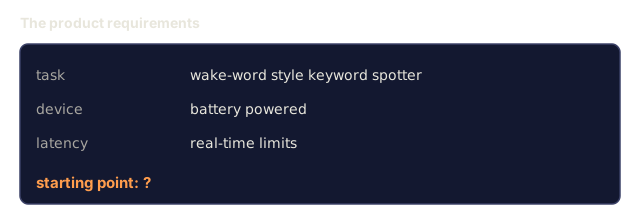
| Real-time, edge | 40-MFCC CNN, quantized to int8 (KWS-style) |
| Multi-label (AudioSet) | BEATs-iter3 with BCE loss + mixup + SpecAugment |
| Language ID | MMS-LID, SpeechBrain VoxLingua107 baseline |
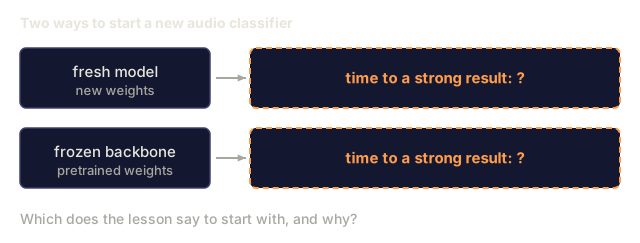
Decision rule: start with a frozen backbone, not a fresh model. Fine-tuning a BEATs head gets you 95% of SOTA in hours, not weeks.
Ship It
This lesson ships outputs/skill-classifier-designer.md, a skill for picking architecture, augmentations, class-balance strategy, and eval metric for a given audio classification task.
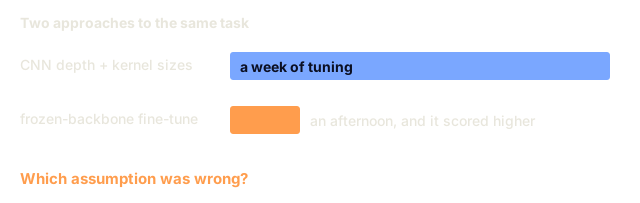
The line here I'd tattoo on a wall somewhere is the decision rule in Use It: start with a frozen backbone, not a fresh model. I've watched people spend a week arguing over CNN depth and kernel sizes on a dataset that a BEATs fine-tune would have beaten before lunch. Architecture search is fun, and for most audio classification tasks in 2026 it's also a distraction from what's actually deciding whether your classifier works, which is your data. Fix the class imbalance first. Audit a sample of your labels by hand before you trust the rest. Only reach for a custom architecture once a frozen backbone has genuinely run out of room to improve.
Exercises
- Easy. Run
code/main.py. It trains the k-NN MFCC baseline on a 4-class synthetic dataset (pure tones at different pitches). Report confusion matrix. - Medium. Replace
summarizewith [mean, var, skew, kurtosis]. Does 4-moment pooling beat mean+var on the same synthetic dataset? - Hard. Using
torchaudio, train a 2D CNN on ESC-50 fold 1. Report 5-fold cross-validation accuracy. Add SpecAugment (time mask = 20, freq mask = 10) and report the delta.
Key Terms
| Term | What people say | What it actually means |
|---|---|---|
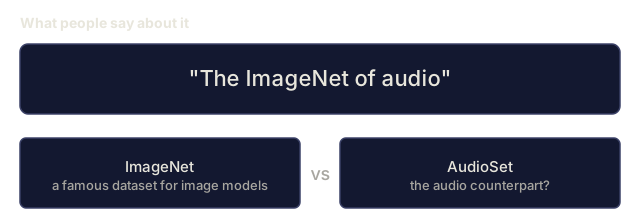
| AudioSet | The ImageNet of audio | Google's 2M-clip, 632-class weakly-labeled YouTube dataset. |
| ESC-50 | Small classification benchmark | 50 classes × 40 clips of environmental sounds. |
| AST | Audio Spectrogram Transformer | ViT on log-mel patches; 2021 SOTA. |
| BEATs | Self-supervised audio | Microsoft model, iter3 leads AudioSet as of 2026. |
| Mixup | Pair augmentation | x = λ·x1 + (1-λ)·x2; y = λ·y1 + (1-λ)·y2. |
| SpecAugment | Mask-based augmentation | Zero-out random time and frequency bands of the spectrogram. |
| mAP | Main multi-label metric | Mean average precision across classes and thresholds. |
Further Reading
- Gong, Chung, Glass (2021). AST: Audio Spectrogram Transformer: the architecture of record from 2021–2024.
- Chen et al. (2022, rev. 2024). BEATs: Audio Pre-Training with Acoustic Tokenizers: the 2024+ default.
- Park et al. (2019). SpecAugment: the dominant audio augmentation.
- Piczak (2015). ESC-50 dataset: 50-class benchmark that lives on.
- Gemmeke et al. (2017). AudioSet: 632-class YouTube taxonomy; still the gold standard.
Code
- main.py (python, 179 lines)